

TL;DR:
- Gang sheet printing significantly reduces per-piece costs by consolidating multiple designs onto one transfer sheet, boosting profit margins and resource efficiency. It streamlines workflows, shortens production cycles, and enables small shops to fulfill mixed, small, or custom orders without volume penalties. When properly implemented with standardized layouts and automation, gang sheets enhance print consistency and quality, making them ideal for varied and fast-paced apparel decorating businesses.
Apparel printing has always been a balancing act. You need to control costs, manage varied design requests, and keep production moving without burning through materials or time. For small shops and growing decorators, every inefficient setup fee and wasted sheet of film chips away at your margin. The advantages of gang sheet printing address these exact pressure points by consolidating multiple designs onto a single transfer sheet, cutting per-piece costs dramatically while tightening your production workflow. If you’ve been printing designs one at a time, this approach will fundamentally change what’s possible for your business.
Table of Contents
- Key takeaways
- 1. The core advantages of gang sheet printing: cost savings that matter
- 2. Workflow improvements that speed up your entire operation
- 3. Design flexibility without the volume penalties
- 4. Print quality and color consistency across every sheet
- 5. How gang sheets compare to other printing methods
- My honest take on gang sheet printing after years in this industry
- Put these advantages to work with Transferkingz
- FAQ
Key takeaways
| Point | Details |
|---|---|
| Significant cost reduction | Gang sheet printing cuts per-piece transfer costs by 30% to 60% by eliminating redundant setup fees. |
| Higher material utilization | Optimized layouts push film utilization rates above 85%, reducing costly waste per batch. |
| Faster production cycles | Consolidated sheets reduce press setup changes, shortening heat press cycle times and improving throughput. |
| Small batch friendly | Multiple designs share one sheet, removing minimum order pressures and enabling profitable one-off printing. |
| Consistent print quality | Standardized layouts, color calibration strips, and automated pre-flight checks reduce errors and reprints. |
1. The core advantages of gang sheet printing: cost savings that matter
The most compelling reason to adopt gang sheet printing comes down to numbers. Per-piece costs drop 30% to 60% when you eliminate per-setup fees and maximize how much usable area each sheet provides. That range is not a rounding estimate. It reflects the difference between printing one design per sheet versus packing eight, ten, or twelve designs efficiently into the same footprint.
Setup fees are one of the most underestimated costs in apparel printing. Every time a new file goes to press as a standalone job, you pay for file preparation, sheet loading, and equipment adjustment. Gang sheets absorb that overhead across multiple designs simultaneously, spreading the cost thin enough that even low-volume orders become financially viable.
Material efficiency compounds these savings. Experienced decorators achieve utilization rates above 85% with well-organized layouts, which means the film you buy actually becomes product, not scrap. At current DTF film prices, a 15% to 20% improvement in utilization can translate to hundreds of dollars saved each month.
Pro Tip: Group designs of similar dimensions together before building your sheet. Designs with comparable heights and widths nest together more efficiently, which pushes your utilization rate closer to 95% without extra effort.
The profit margin math is straightforward. If you’re currently clearing $3 per piece after materials and setup, cutting material waste by 20% and setup time by a third can push that to $4.50 or more. Across hundreds of pieces weekly, that gap funds new equipment, better inks, or simply a healthier business.
2. Workflow improvements that speed up your entire operation
Gang sheet printing does not just save money on materials. It restructures how work flows through your shop. Integrating gang sheet builders reduces pre-press setup time by 25% to 40% and cuts transfer sheet waste by 15% to 25% per batch. Those numbers translate directly into more orders processed per day and fewer hours spent on file prep.
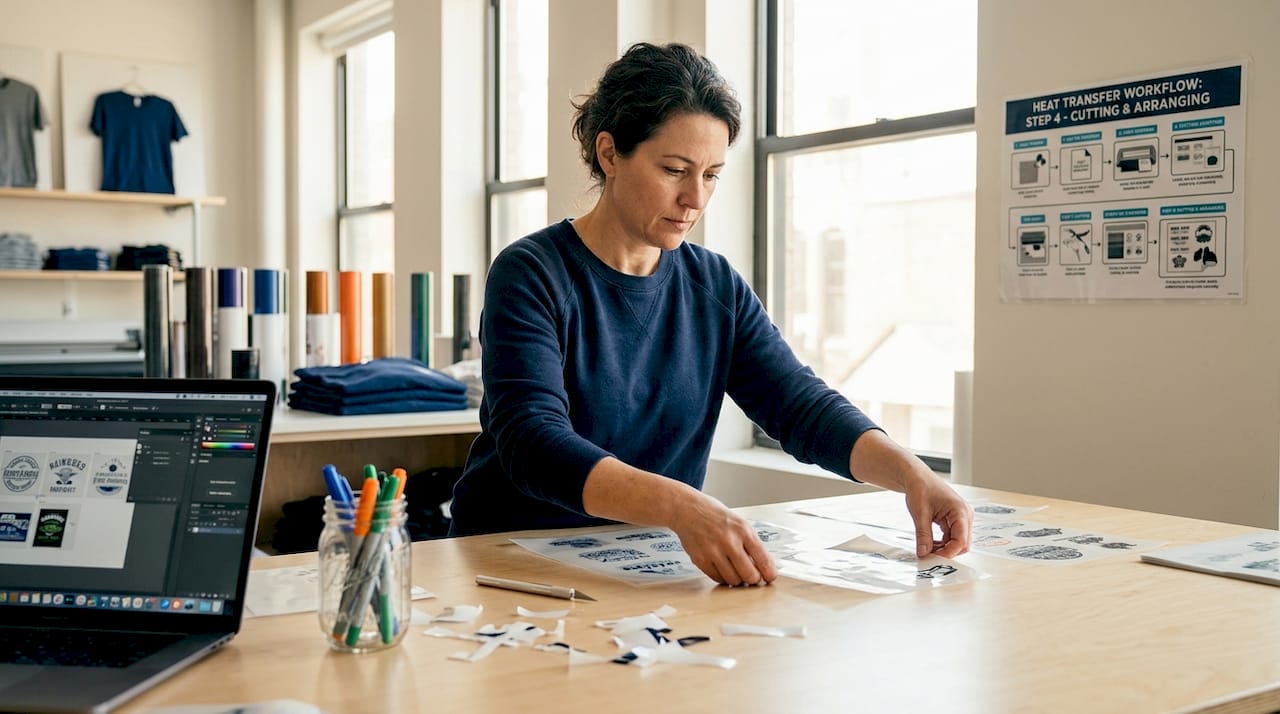
The production line benefits are equally tangible. Optimized gang sheet layouts shorten heat press cycles by reducing platen changes and reorganization between runs. Instead of pressing one transfer, repositioning, and pressing again, your operator works through a sheet with multiple pieces in a logical sequence. Fewer interruptions per batch means faster output overall.
Here is what this looks like in practice across a typical production day:
- Reduced file handling: One sheet covers multiple client orders, so your operator touches fewer individual files per hour
- Fewer press adjustments: Consistent sheet sizing means temperature, pressure, and timing settings stay stable across a run
- Simplified quality checks: Reviewing one organized sheet is faster than auditing a dozen separate transfers
- Lower error exposure: Consolidated layouts reduce the chance that a wrong transfer reaches the wrong garment
Efficient gangsheet workflows turn manual steps into repeatable processes that minimize operator mistakes and scale without requiring additional staffing. A one-person shop running disciplined gang sheets can often match the throughput of a two-person shop running individual transfers.
Pro Tip: Build a weekly template library organized by common design sizes. When repeat orders come in, you pull a pre-planned layout rather than rebuilding from scratch, which cuts prep time to nearly zero for returning clients.
3. Design flexibility without the volume penalties
One of the most misunderstood benefits of gang sheet printing is what it does for order flexibility. Traditional print methods typically punish small or mixed orders with minimum quantities, setup charges, or longer lead times. Gang sheets remove that friction entirely.
Gang sheets allow small shops and online decorators to fulfill mixed orders efficiently and test new artwork without volume penalties. You can combine a 10-piece run of one design with a 5-piece run of another and a single prototype graphic all on the same sheet. The printer does not know or care. You get everything in one pass.
This has strategic implications for how you run your business:
- Test new designs cheaply: A new graphic takes up a small corner of a gang sheet at no extra cost, giving you real samples before committing to a larger run
- Serve retail boutiques and event clients: These buyers often need 6 to 12 pieces of a dozen different designs, which is exactly what gang sheets handle without friction
- Faster inventory cycles: You can print small restocks on demand rather than holding large finished-goods inventory
- React to trends quickly: New artwork goes from file to wearable within your normal gang sheet turnaround, not weeks out as a standalone job
Gang sheets decouple design variety from order volume, which means profitable one-off and small batch printing becomes a real business model rather than a loss leader. For custom decorators building a reputation on unique work, this flexibility is the competitive edge that larger screen printers simply cannot match. You can also explore how to optimize apparel production using gang sheets as a central strategy for 2026 and beyond.
4. Print quality and color consistency across every sheet
Saving money only matters if the product coming off the press is good enough to sell. Gang sheet printing, done correctly, actually improves consistency rather than compromising it. The key is in how layouts are structured.
Standardized margins, bleed, and orientation lead to consistent print quality by reducing the variables that cause color shifts or misregistration between runs. When every design on your sheet follows the same grid logic, your printer calibrates once and delivers predictably across the entire output.
Here is a quality-focused checklist built around best practices:
- Set uniform margins of at least 0.125 inches around each design to prevent bleed overlap
- Orient all designs with the same baseline alignment to simplify heat press placement
- Include a color calibration strip along one edge of every sheet
- Use your gang sheet builder’s automated pre-flight check before every print submission
- Document your layout grids in a master template file tied to your order management system
Gang sheet software automates pre-flight checks that catch low-resolution artwork, missing bleeds, and color mode errors before they become expensive misprints. Catching one bad file before printing saves more than the software costs in a single month.
Integrating color management protocols into your gangsheet workflow ensures that a design printed in January looks identical to the same design reprinted in August. For brands with strict logo color standards, this repeatability is not optional. A well-built gang sheet template with embedded color profiles is your best tool for delivering that consistency at scale.
| Quality factor | Individual transfers | Gang sheet printing |
|---|---|---|
| Color consistency run to run | Variable | High, with calibration strips |
| Operator error rate | Higher (more file touches) | Lower (standardized layouts) |
| Reprint frequency | Higher | Reduced by automated pre-flight |
| Alignment accuracy | Dependent on individual setup | Improved by grid templates |
5. How gang sheets compare to other printing methods
Understanding when gang sheet printing is the right call requires honest comparison with the alternatives. The table below covers the most common scenarios.
| Factor | Gang sheet DTF | Individual DTF transfers | Screen printing |
|---|---|---|---|
| Setup cost per run | Low (shared across designs) | High (per design) | Very high (per color per design) |
| Minimum order | None | None | Typically 24+ pieces |
| Design variety per run | High | Low | Very low |
| Waste per batch | Low (optimized layout) | Moderate to high | Low at volume, high at small runs |
| Best fit | Mixed, small to mid orders | Simple single-design runs | High-volume single designs |
| Turnaround speed | Fast | Moderate | Slow for setup |
Screen printing still wins on per-piece cost at very high volumes with a single design, but the break-even point sits far higher than most small and mid-size shops ever reach on a single SKU. Gang sheet DTF printing is more effective for the reality most decorators face: varied orders, shifting demand, and clients who want 15 pieces in 10 different graphics.
A disciplined gang sheet process reduces misprints, reworks, and improves on-time delivery rates, which makes it a reliable production backbone regardless of order size. The workflow is also far more accessible for shops without dedicated prepress staff, since automated gangsheet software democratizes layout creation and removes the technical barrier that once required specialized knowledge.
If you are already running DTF and want a deeper look at building an efficient print workflow, this beginner’s guide to printing workflows covers the foundational structure that makes gang sheets even more effective.
My honest take on gang sheet printing after years in this industry
I’ve watched a lot of shops hesitate on gang sheets because the initial layout work feels like overhead. They’re not wrong that it takes discipline to build good templates and maintain them. But every shop I’ve seen commit to a structured gang sheet workflow has never gone back.
The thing most articles skip over is that gang sheets reward consistency. The first month is slower as you build your template library and learn how your designs nest together. By month three, you’re building sheets in minutes because the groundwork is done. The step-by-step creation process is learnable for anyone, but the shops that excel are the ones who treat it as a system, not just a technique.
I also want to push back on the idea that gang sheets are only for small shops trying to save pennies. Some of the highest-volume decorators I’ve seen use them precisely because they’ve discovered that grouping designs by color or motif before printing reduces ink consumption meaningfully beyond just layout efficiency. That is a discovery you only make if you take gang sheet printing seriously enough to study your own data.
The shops that struggle are the ones who treat every order as a one-off rather than building repeatable systems around their most common design categories. If you’re in that camp, the fix is not a new printer. It’s a better layout strategy.
— Anthony
Put these advantages to work with Transferkingz
Transferkingz built its entire DTF printing operation around the gang sheet model because it’s the most cost-effective and reliable way to deliver consistent results at any order size. Whether you’re running a weekend custom apparel side project or managing production for a growing decoration business, Transferkingz gives you access to professional-grade DTF gang sheet printing with no minimum order requirements. Upload your artwork, use the built-in gang sheet builder to arrange your designs, and get vibrant, press-ready transfers back fast. The turnaround times are built for real production schedules, not ideal-world estimates. Explore what Transferkingz can handle for your shop and see why decorators across the country trust their gang sheet runs to a printer that understands the business side of apparel production, not just the technical side.
FAQ
How much can gang sheet printing reduce my costs?
Gang sheet printing reduces per-piece costs by 30% to 60% by eliminating individual setup fees and maximizing usable film area per sheet.
Is gang sheet printing effective for small or mixed orders?
Yes. Gang sheets are specifically suited for mixed and small batch orders because multiple designs share one sheet with no minimum volume requirement per design.
What utilization rate should I aim for with gang sheets?
Experienced decorators push utilization rates above 85% through optimized nesting and grouping designs by similar dimensions before building the sheet.
How does gang sheet printing improve print quality?
Standardized layouts and automated pre-flight checks reduce operator errors and catch file issues before printing, resulting in fewer reprints and more consistent color across runs.
Do I need special software to build gang sheets?
Most gang sheet builders are web-based and require no design background. Tools like the one built into Transferkingz’s platform automate layout creation and remove the prepress barrier for shops without dedicated staff.
Recommended
- Optimize your apparel production with gang sheets in 2026 – Transfer Kingz
- What is a gang sheet? Save costs & boost apparel printing – Transfer Kingz
- Step-by-step guide to gang sheet creation for custom apparel – Transfer Kingz
- What is a Gang Sheet in DTF? Meaning, Benefits & How to Create One – Transfer Kingz
0 comments