

TL;DR:
- Choosing the right apparel printing method depends on fabric type, artwork complexity, order size, and budget.
- DTF transfers offer versatile, cost-effective options suitable for small to medium batches on various fabrics, especially for beginners.
The apparel printing process is the set of techniques used to apply designs onto garments, and choosing the wrong method costs you money, time, and customer trust. Methods like screen printing, direct-to-garment (DTG), direct-to-film (DTF), heat transfers, and embroidery each serve different needs. Aligning your garment type, artwork complexity, and decoration method before you place a single order is what separates profitable custom apparel businesses from ones that constantly redo work. This guide breaks down every major method, how to choose between them, and what the production workflow actually looks like.
What are the main apparel printing methods and how do they work?
The five core methods in the fabric printing process are screen printing, DTG, DTF, heat transfer, and embroidery. Each has a distinct workflow, cost structure, and ideal use case. Understanding all five before committing to one is the single best decision you can make early in your business.
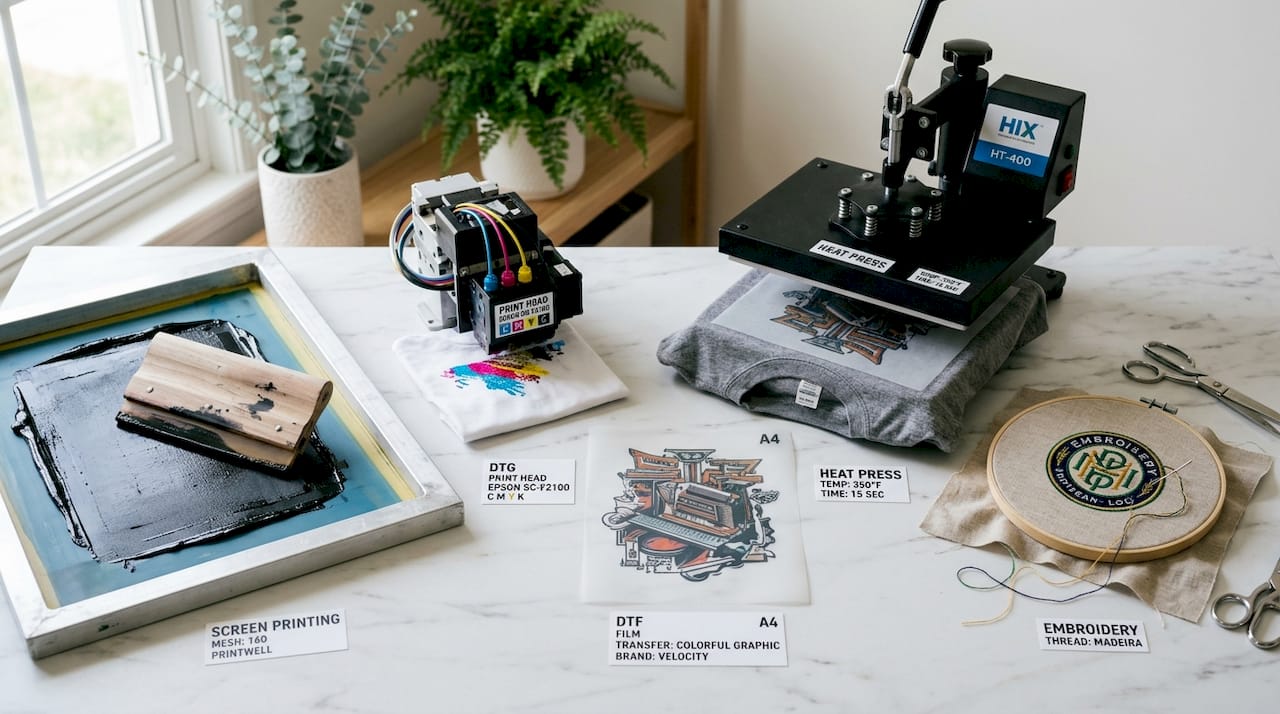
Screen printing pushes ink through a mesh screen onto the garment. Each color in your design requires its own physical screen, which means color separations drive setup cost and timeline directly. The result is bold, durable color that holds up through hundreds of washes. Screen printing is the standard for company uniforms, event shirts, and any order where you need consistent color across dozens or hundreds of pieces.
Direct-to-garment (DTG) works like an inkjet printer for fabric. Specialized inks bond directly to fabric fibers, making it ideal for photographic detail, gradients, and small runs where screen setup costs would be prohibitive. A 12-piece run of a full-color portrait design is exactly where DTG wins.
Direct-to-film (DTF) prints your design onto a special film, applies a hot-melt adhesive powder, and then transfers it to the garment with a heat press. DTF transfers are versatile and cost-effective across fabrics including cotton, polyester, nylon, and blends. Unlike DTG, DTF does not require garment pretreatment, which cuts production time significantly. You can learn more about how DTF printing works to see why it has become the go-to for small and mid-size apparel businesses.
Heat transfer printing covers a broad category where a pre-printed design is transferred to a garment using heat and pressure. It suits personalization runs, one-offs, and situations where you need fast turnaround on individual pieces.
Embroidery stitches thread directly into the garment. Embroidery delivers a dimensional, premium look that can outlast the garment itself. Polos, hats, and workwear are the natural home for embroidery because the texture signals quality in a way no ink-based method can replicate.
Here is a quick reference for each method’s strengths:
- Screen printing: Bold colors, high durability, best for bulk orders with simple designs
- DTG: Full-color detail, no minimums, best for small runs on 100% cotton
- DTF: Works on any fabric, no pretreatment, fast production, low startup cost
- Heat transfer: Quick turnaround, great for personalization and one-off pieces
- Embroidery: Premium texture, long-lasting, ideal for hats, polos, and workwear
Pro Tip: If you are just starting out, DTF transfers give you the most flexibility with the lowest barrier to entry. You can print on almost any fabric without investing in expensive equipment upfront.
How to choose the right printing method for your project
Choosing the right printing method depends on four variables: garment type, artwork complexity, order quantity, and budget. Skipping any one of these in your planning creates expensive surprises at production time.
Garment fabric is the first filter. DTG works best on 100% cotton because the ink bonds to natural fibers. DTF works on virtually any fabric, making it the default choice when you are printing on polyester blends, nylon, or mixed-material items. Embroidery works on most woven and knit fabrics but struggles with very thin or stretchy materials.
Artwork complexity is the second filter. A simple two-color logo is a natural fit for screen printing or embroidery. A full-color photograph or a design with gradients belongs in DTG or DTF territory. Complex designs requiring gradients or fine detail can disrupt print workflows regardless of the equipment you use, so getting your artwork files production-ready before ordering is non-negotiable.
Order quantity determines cost-effectiveness. Screen printing’s setup costs spread over units, making it economical only above a certain threshold, typically a dozen or more pieces. DTF and DTG have no meaningful setup costs, so they stay cost-effective at any quantity.
| Method | Best for | Min. quantity | Durability | Cost per unit (small run) |
|---|---|---|---|---|
| Screen printing | Bold, simple designs, bulk | 12+ pieces | Very high | Low at scale |
| DTG | Full-color, photo-quality | 1+ pieces | Medium-high | Medium |
| DTF | Any fabric, mixed orders | 1+ pieces | High | Low to medium |
| Heat transfer | Personalization, one-offs | 1+ pieces | Medium | Low |
| Embroidery | Premium workwear, hats | 6+ pieces | Very high | High |
Pro Tip: For mixed orders where you need both small and large quantities across different garment types, DTF transfers let you batch everything onto a single gang sheet and cut costs per design significantly.
Step-by-step apparel printing process workflow
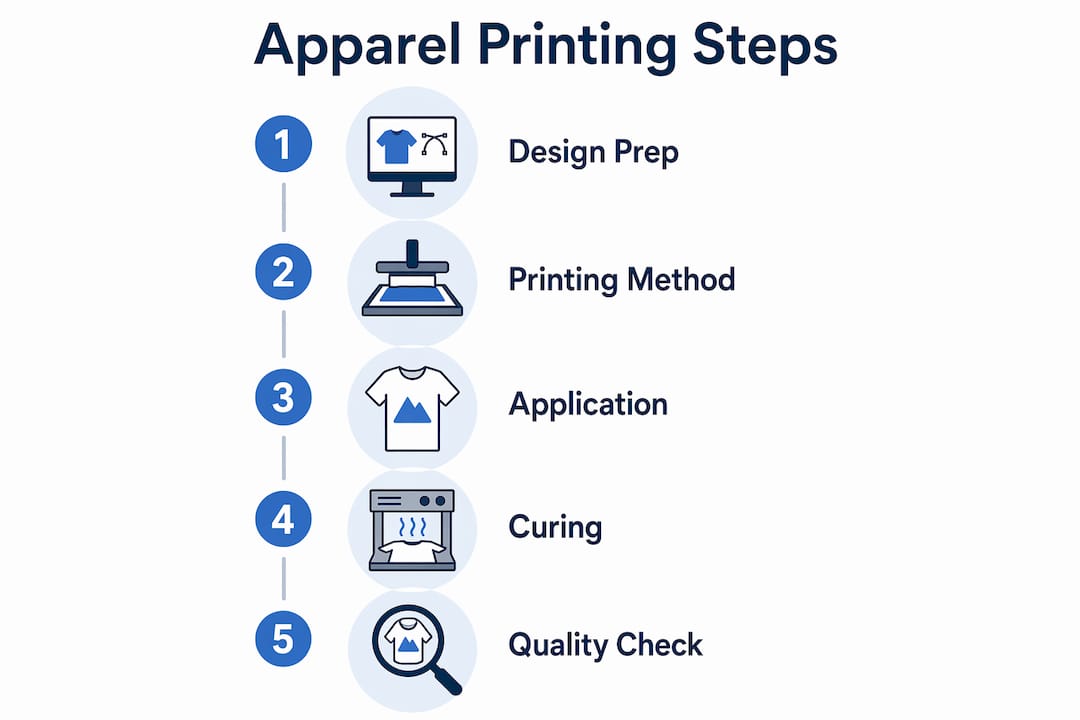
Every successful print job follows the same core sequence regardless of the method. Skipping steps is where most production problems originate.
- Design creation and file prep. Your artwork needs to be in the correct format for your chosen method. Vector files (AI, EPS, SVG) work best for screen printing and embroidery. High-resolution raster files (PNG at 300 DPI minimum) work for DTG and DTF. Artwork readiness creates bottlenecks more often than printing hardware does, so audit your files before anything else.
- Garment preparation. For DTG, this means pretreating the fabric with a chemical solution that helps ink bond. For screen printing, it means staging garments on pallets. DTF requires no pretreatment, which is one of its biggest production advantages.
- Print setup. Screen printing requires burning screens for each color. DTG and DTF require loading the design into RIP (raster image processing) software and calibrating color profiles. This step is where color management tools like Fiery software make a measurable difference in output consistency.
- Printing. The actual print run. For screen printing, this is manual or semi-automated ink application through each screen. For DTG and DTF, the printer handles it automatically once the job is queued.
- Curing and finishing. Ink must cure to bond permanently to the fabric. Screen printing uses a conveyor dryer at high heat. DTG uses a heat press or tunnel dryer. DTF transfers are pressed onto the garment with a heat press at a specific temperature and dwell time.
- Quality check. Inspect for color accuracy, registration (alignment of multiple colors), ink coverage, and adhesion. Catching defects here is far cheaper than handling customer returns.
Here is a quick tools and supplies checklist for a DTF setup:
| Item | Purpose |
|---|---|
| DTF printer | Prints design onto PET film |
| Hot-melt adhesive powder | Bonds design to fabric during pressing |
| Heat press | Transfers design from film to garment |
| RIP software | Manages color profiles and print queues |
| PET film rolls | Substrate for printing |
| Weeding tools | Removes excess film after pressing |
Pro Tip: Always do a test press on a scrap piece of the same fabric before running your full order. Fabric thickness and texture affect heat transfer adhesion more than most beginners expect.
What trends are shaping apparel printing in 2026?
The digital textile printing market is projected to reach $8.8 billion by 2027, driven by on-demand production, personalization demand, and sustainability pressure. That growth is not just good news for large manufacturers. It creates real opportunities for small apparel businesses that move fast.
The most significant workflow shift is the rise of all-in-one print-and-fix systems. Technologies from EFI, Epson, and Fiery are collapsing multi-step processes into single-pass production, reducing labor and error rates simultaneously. For a small shop, this means you can produce more units per hour without adding headcount.
Sustainability is moving from marketing language to production reality. Eco-friendly water-based inks, reduced water consumption in digital processes, and waste reduction through on-demand printing are now standard selling points for apparel decoration businesses targeting conscious consumers.
The businesses winning in this market are not necessarily the ones with the highest print resolution. Leading digital print businesses differentiate with workflow efficiency and personalization capabilities. If you can offer a customer a single custom piece at the same turnaround time as a bulk order, you have a competitive advantage most traditional print shops cannot match.
The shift to on-demand production means your minimum order quantity is no longer a limitation. It is a selling point.
For a deeper look at where the industry is heading, the DTF trends shaping 2026 are worth reviewing before you finalize your production setup.
Key takeaways
The most effective apparel printing process starts with aligning garment type, artwork complexity, and order quantity before selecting a method, because that alignment determines both cost and quality outcomes.
| Point | Details |
|---|---|
| Method selection drives cost | Garment type, artwork detail, and quantity together determine which method is cost-effective. |
| DTF offers the most flexibility | DTF works on virtually any fabric with no pretreatment and low startup costs. |
| Artwork prep is the hidden bottleneck | File format and resolution issues cause more production delays than equipment failures. |
| Screen printing scales, not starts | Screen printing becomes economical above roughly a dozen pieces due to setup cost amortization. |
| Workflow efficiency beats resolution | Businesses that win in digital textile printing compete on speed and personalization, not just print quality. |
Why I think most beginners overcomplicate method selection
After years working in and around the apparel decoration industry, the mistake I see most often is not choosing the wrong printing method. It is spending weeks researching every method in parallel instead of starting with the two questions that actually matter: What fabric am I printing on, and how many pieces do I need?
Those two answers eliminate at least three of the five methods immediately. If you are printing on a polyester blend in quantities under 50, you are almost certainly looking at DTF. If you are printing a two-color logo on 200 cotton shirts, screen printing wins on cost every time. The comparison table in this article is not just a reference. It is a decision tree.
The second thing I would tell any entrepreneur entering this space is to treat artwork preparation as a production step, not a pre-production formality. I have seen orders delayed by days because a customer submitted a low-resolution JPEG for a DTG job or a raster file for a screen print that needed vector separations. Build an artwork checklist and make it part of your intake process from day one.
The third insight that took me longer to learn than it should have: do not commit to a single method for your entire business. The shops that scale well use screen printing for bulk runs, DTF for mixed or small orders, and embroidery for premium branded items. Flexibility is not indecision. It is a production strategy.
If you are evaluating DTF specifically, the comparison between DTF and screen printing is the clearest way to understand where each method wins and where it does not.
— Anthony
Print smarter with Transferkingz DTF transfers
Transferkingz specializes in high-quality DTF transfers built for entrepreneurs and small production shops that need speed, quality, and zero minimums. Whether you are decorating five shirts or five hundred, Transferkingz delivers vibrant, durable transfers ready to press onto virtually any fabric.
Customers across Texas use Transferkingz for fast turnaround on custom orders without the overhead of running their own print equipment. If you are in the Dallas area, the DTF transfers Dallas service page covers turnaround times, pricing, and how to place your first order. For customers across the state, DTF printing in Texas is available with the same quality and speed. Upload your artwork, build your gang sheet, and get production-ready transfers delivered to your door.
FAQ
What is the apparel printing process?
The apparel printing process is the set of techniques used to apply designs onto garments, including screen printing, DTG, DTF, heat transfer, and embroidery. Each method differs in workflow, cost, fabric compatibility, and ideal order size.
Which printing method works best for small orders?
DTF and DTG are the best printing methods for small orders because neither requires screen setup costs. DTF works on any fabric, while DTG is best suited for 100% cotton garments.
How does DTF printing differ from screen printing?
DTF prints a design onto film and transfers it via heat press, while screen printing pushes ink through mesh screens directly onto the garment. DTF has no color separation setup costs and works on any fabric, making it more flexible for mixed or small-batch orders.
What file format do I need for custom apparel printing?
Vector files like AI, EPS, or SVG work best for screen printing and embroidery. For DTG and DTF, use high-resolution PNG files at 300 DPI or higher to avoid print quality issues.
How durable are DTF transfers on clothing?
DTF transfers are highly durable and maintain color vibrancy through repeated washing when applied correctly with the right heat press temperature and dwell time. Proper curing is the single biggest factor in transfer longevity.
0 comments