

For most small retailers and entrepreneurs, no-minimum ordering is a clear net advantage. You preserve cash, test new products without committing to a pallet, and avoid the dead inventory that quietly kills margins. Three things make it work: lower working-capital requirements, the freedom to experiment with SKUs before scaling, and the ability to respond to trends in days rather than months.
Here’s what that means in practice:
- Cash flow stays intact. You pay for what you actually need, not what a supplier’s MOQ forces you to buy.
- Testing costs almost nothing. One unit, one case, or one transfer sheet tells you whether a product sells before you order fifty.
- Inventory risk drops. Smaller orders mean less storage, less spoilage, and fewer markdowns.
No-minimum ordering isn’t magic. Per-unit costs run higher, and shipping small orders eats into margin. But for most small businesses, the flexibility is worth the premium, especially early in a product’s life cycle.
Key Takeaways
No-minimum ordering is most valuable as a testing tool: use it to validate demand before committing to volume, then shift to MOQ-based purchasing once a product proves itself.
| Point | Details |
|---|---|
| Cash flow advantage | No-min orders eliminate large upfront commitments, keeping working capital available for other needs. |
| Higher per-unit cost | Small orders cost more per unit; landed cost including shipping is the figure that actually matters. |
| Gang sheets reduce the premium | Nesting multiple designs on one sheet spreads fixed costs and narrows the gap with volume pricing. |
| Test before you scale | Order the minimum, track sell-through and margin, then graduate to volume on proven SKUs. |
| Transferkingz for DTF | No-minimum DTF transfers with same-day pickup or nationwide shipping let small brands test and iterate fast. |
Table of Contents
- What does “no minimum order” actually mean vs. MOQ?
- What are the real benefits of no minimum order for small businesses?
- Pros and cons of no-minimum supplier policies
- How unit cost, shipping, and lead time actually affect your landed cost
- How to use no-minimum ordering strategically
- Real use cases where no-minimum ordering pays off
- How to place your first no-minimum test order
- When should you choose no-minimum, and when do MOQs make more sense?
- What most guides get wrong about no-minimum ordering
- Transferkingz makes no-minimum DTF transfers practical for small brands
- Sources
What does “no minimum order” actually mean vs. MOQ?
A minimum order quantity (MOQ) is the smallest number of units a supplier will sell in a single transaction. A supplier with a 144-unit MOQ on custom mugs won’t ship you 12, no matter how much you’re willing to pay. A no-minimum order policy removes that floor entirely. You order one unit, one sheet, or one case, and the supplier fulfills it.
The economics behind MOQs are straightforward: traditional manufacturing runs carry fixed setup costs (plate-making, machine changeovers, batch mixing) that only make financial sense when spread across a large quantity. Digital printing and print-on-demand sidestep those setup costs entirely, making single-unit production economically viable where offset or plate-based methods would require high minimums. That’s why DTF transfer printing, web-to-print services, and POD apparel platforms can offer no-minimum programs without losing money on every order.
| Factor | MOQ model | No-minimum model |
|---|---|---|
| Capital required | High upfront commitment | Pay only for units ordered |
| Inventory risk | High (overstock possible) | Low (order to demand) |
| Per-unit cost | Lower at volume | Higher at small quantities |
| Best fit | Proven, high-velocity SKUs | Testing, new products, events |
The table above captures the core trade-off. MOQs reward certainty and volume. No-minimum policies reward flexibility and speed, which is exactly what most small businesses need when they’re still figuring out what sells.
What are the real benefits of no minimum order for small businesses?
The advantages of no minimum purchase go well beyond convenience. They change how you manage cash, risk, and product strategy.
Cash-flow preservation is the most immediate win. When a supplier requires a large number of units at a set price each, you’re committing a large amount of capital before a single customer sees the product. A no-minimum order on the same item will have a higher per-unit price but requires less total upfront investment. The per-unit math looks worse, but the working-capital math looks much better.
Removing minimum order requirements keeps capital flexible, reduces overstock risk, and enables risk-free testing with small initial buys for independent retailers, a dynamic that’s especially visible in specialty food wholesale but applies across every product category.
SKU testing without financial exposure is the second major advantage. You can introduce a new colorway, a seasonal flavor, or a limited-edition design and gauge real demand before committing to a full run. If it sells, you scale. If it doesn’t, you’ve lost $70, not $2,000.
No MOQs let small businesses experiment, manage inventory more tightly, and scale gradually without risking large upfront investments, which is the difference between sustainable growth and a cash crunch.
Additional benefits worth noting:
- Smaller storage footprint. Less inventory means lower warehousing costs and less capital tied up on shelves.
- Seasonal flexibility. Order holiday-specific items in small quantities without worrying about clearance pricing in January.
- Mix-and-match variety. Carry a wider assortment without deep stock in any single SKU.
- Faster iteration. When a design or product underperforms, you’re not stuck with 400 units.
Pro Tip: When testing a new product, order the smallest quantity available and sell it at full price before reordering. A quick sell-through at margin tells you more than any market research.
Pros and cons of no-minimum supplier policies
The flexibility is real, but so are the trade-offs. Here’s an honest breakdown.
Pros:
- Operational flexibility. You can respond to a trend, a customer request, or a last-minute event without waiting for a bulk production run.
- Lower financial risk. Small orders limit downside exposure on unproven products.
- Faster product-market fit. For small retailers, the ability to respond to trends quickly often outweighs the higher per-unit cost of small runs.
- No dead stock. You’re not stuck liquidating 300 units of something that didn’t connect with customers.
- Accessible for startups. Businesses with limited capital can participate in markets that MOQ-only suppliers effectively close off.
Cons:
- Higher per-unit cost. Suppliers price small orders to cover handling, setup, and the opportunity cost of not batching. You’ll pay more per unit than a buyer ordering 500.
- Shipping inefficiencies. A small order ships in a small box. The shipping cost as a percentage of order value is often much higher than on a bulk shipment.
- Possible longer lead times on some items. Some suppliers batch small orders together before production, which can add days to fulfillment.
- Limited SKU availability. Not every product in a supplier’s catalog is available at no minimum. Special finishes, custom materials, or complex configurations often still carry MOQs.
- Supplier reliability concerns. A supplier who loses money on small orders may deprioritize them during busy periods.
When MOQs still make sense: If you’ve validated a product and you’re reordering a proven SKU at high volume, committing to an MOQ almost always drops your unit cost enough to justify the inventory commitment. MOQs are a tool for certainty, not a punishment.
How unit cost, shipping, and lead time actually affect your landed cost
The per-unit price on a no-minimum order is never the whole story. Landed cost, what you actually pay to get one unit into your hands and ready to sell, includes production, shipping, packaging, and any handling fees.
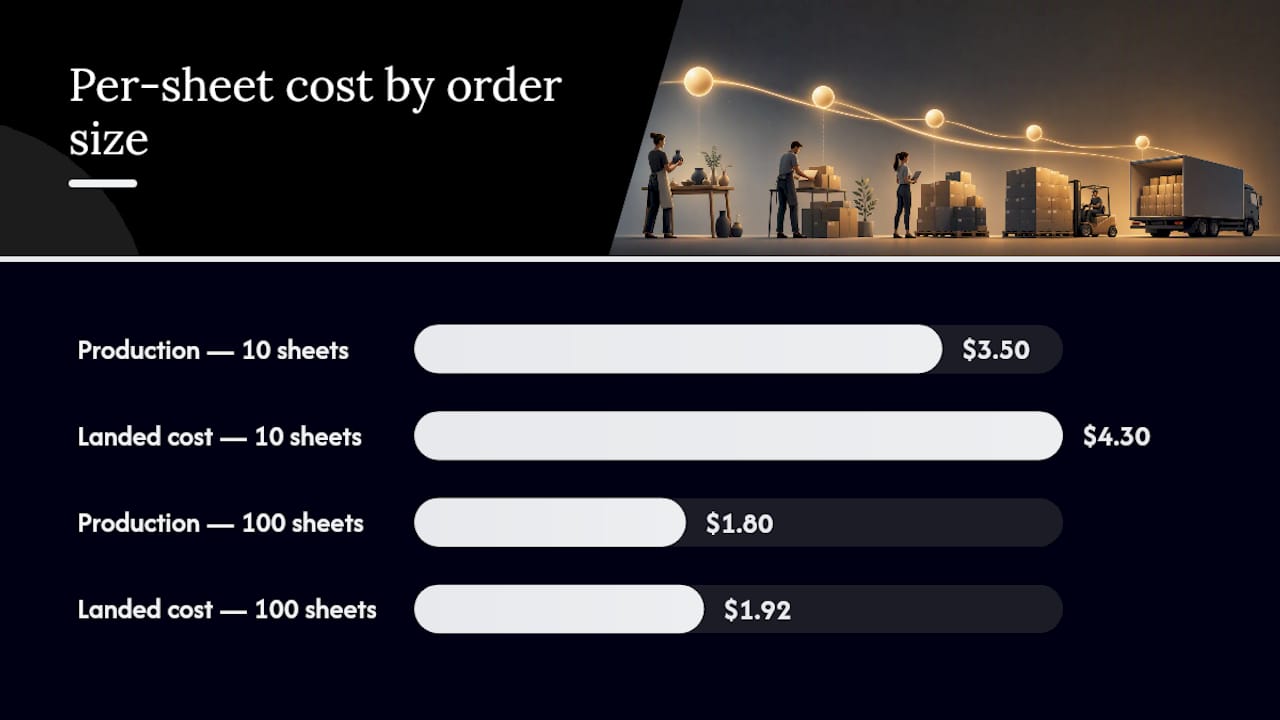
Here’s a simple example. Suppose a custom DTF transfer sheet costs $3.50 per sheet at no minimum and $1.80 per sheet at 100 sheets. If you order 10 sheets:
- Production: 10 × $3.50 = $35.00
- Flat-rate shipping: $8.00
- Total landed cost: $43.00, or $4.30 per sheet
At 100 sheets with a volume price:
- Production: 100 × $1.80 = $180.00
- Shipping: $12.00
- Total landed cost: $192.00, or $1.92 per sheet
The per-unit gap is real. But if you only need 10 sheets to test a design, ordering 100 to save $2.38 per sheet means spending $149 more upfront on inventory you may not use. The break-even question isn’t “which price is lower?” It’s “how many units do I need to sell to justify the larger commitment?”
No-minimum models shift risk from buyer to supplier; suppliers recoup higher per-unit costs through slightly elevated pricing, efficient batching, and repeat business from converted customers. That’s a sustainable model for both sides when the buyer is still in the testing phase.
Pro Tip: Combine multiple designs onto a single gang sheet to spread the base cost across more artwork. A 22×24-inch gang sheet with four designs costs far less per design than four individual small orders.
Shipping cost is the other lever. Flat-rate shipping options (USPS Priority Mail, UPS Ground) mean a small order can ship for $8–$12 regardless of weight up to a point. Consolidating orders, even across different SKUs, reduces the shipping cost per unit significantly. Fast turnaround transfer printing also reduces the lead-time penalty of small orders when the supplier’s production cycle is measured in hours, not weeks.
How to use no-minimum ordering strategically
No-minimum ordering works best when it’s deliberate, not reflexive. Here’s how to build it into your procurement process.
When to place a no-min order vs. consolidate for volume:
- Place a no-min order when: testing a new SKU, fulfilling a one-time event, proofing artwork before a full run, or responding to an unexpected customer request.
- Consolidate for volume when: reordering a proven product, preparing for a predictable seasonal spike, or when the per-unit savings clearly exceed the inventory carrying cost.
Questions to ask any supplier before committing:
- What is your turnaround time on single-unit or small-quantity orders?
- Do you batch small orders, and if so, how does that affect lead time?
- What are your shipping options and flat-rate thresholds?
- Is proofing or a sample run available before a full order?
- What’s your return or reprint policy for quality issues?
- Are there any SKUs or finishes that still carry a minimum?
Tactics that reduce the per-unit premium on small orders:
- Gang sheets. Nest multiple designs on one sheet to maximize material use and spread fixed costs.
- Pre-orders. Collect customer orders before production to guarantee sell-through and justify a slightly larger run.
- POD/dropship. Use print-on-demand fulfillment to eliminate inventory entirely for certain SKUs.
- Mixed-SKU shipments. Combine different products in one shipment to hit free-shipping thresholds.
Tactics like gang sheets, pre-orders, and mixed-SKU shipments can deliver much of the flexibility of no-minimum ordering while reducing the per-unit premium. The goal is to use no-min policies as a testing tool, then graduate to volume orders once demand is confirmed.
Real use cases where no-minimum ordering pays off
Trade-show and event promo items. You need 50 branded pens and 30 tote bags for a regional trade show. A standard MOQ of 250 per item would cost you $600 in inventory you’ll never use. Promotional-product suppliers list low- or no-minimum items specifically to serve small events, limited promotions, and customer gifts without forcing bulk purchases, so you can order exactly what you need for the booth.
Specialty food sampling. An independent grocery buyer wants to test a new hot sauce from a regional producer. Ordering one case instead of a pallet minimum lets the store gauge customer response before committing shelf space. Removing minimum order requirements is critical for specialty food independents precisely because one-case testing is how new products earn permanent placement.
Apparel capsule runs and seasonal drops. A small streetwear brand wants to release a 20-piece holiday capsule. Ordering blank shirts with no minimum quantities at wholesale rates, then applying custom DTF transfers, keeps the total production cost proportional to the run size. If the capsule sells out in a week, you reorder. If it doesn’t, you’re not sitting on 180 extra shirts.
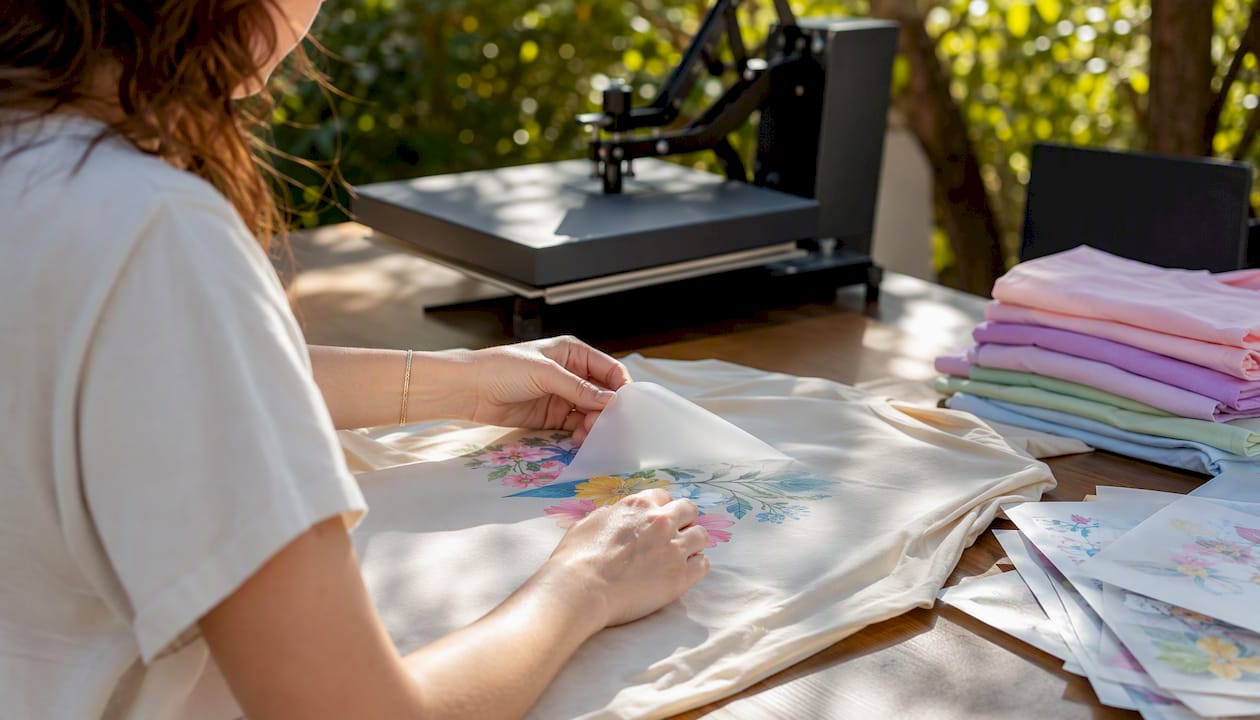
DTF transfers for apparel decorators. This is where Transferkingz fits directly. A small apparel decorator needs to test a new graphic on three shirt styles before committing to a full production run. With no-minimum DTF transfer orders, they can print one sheet per design, apply the transfers, photograph the samples, and list the product online, all before spending money on inventory. Same-day local pickup or nationwide shipping means the test cycle runs in days, not weeks. For a practical walkthrough of the ordering process, how to order custom transfers fast covers the steps from file upload to finished transfer.
Free sample strategies. For businesses sourcing physical materials like trims or finishing components, some partner suppliers offer free sample ordering so you can evaluate quality before placing any paid order. That’s the no-minimum logic applied to the sampling stage itself.
How to place your first no-minimum test order
Getting started is simpler than most small business owners expect. The friction is usually in supplier evaluation, not the ordering process itself.
- Identify one product to test. Pick a SKU you’re uncertain about, not your best seller. The goal is to validate demand with minimal exposure.
- Find a supplier with a transparent no-min policy. Look for published pricing, clear turnaround times, and a stated return or reprint policy. Vague policies on quality issues are a red flag.
- Request a proof or sample if available. For custom printed items, a digital proof or physical sample before the full order catches errors before they become expensive.
- Place the smallest order the supplier allows. Don’t over-order “just in case.” The point is to test, not to stock.
- Track three metrics after the order arrives: sell-through rate (how fast it sold), margin after landed cost, and any customer feedback on quality or fit.
- Decide: scale, iterate, or drop. Strong sell-through and positive feedback justify a larger follow-up order. Weak results mean you’ve lost $40–$70, not $400–$700.
For supplier evaluation, the no minimum order guide for small businesses on the Transferkingz blog covers what to look for when vetting a supplier’s no-min policy, including questions around turnaround, quality control, and shipping options.
When should you choose no-minimum, and when do MOQs make more sense?
No-minimum ordering is the right default when you’re testing, responding to a one-time need, or managing tight cash flow. It’s the wrong default when you’ve already validated demand and the volume savings are large enough to justify the inventory commitment.
A simple decision rule: use no-min orders for any product you haven’t sold before, any event-specific item, or any run under 50 units where the per-unit premium is smaller than the cost of holding unsold inventory.
The businesses that get into trouble are the ones who treat no-minimum ordering as a permanent strategy rather than a testing tool. Once a product proves itself, committing to volume is almost always the smarter financial move.
What most guides get wrong about no-minimum ordering
Most articles on this topic frame no-minimum ordering as a feature, something a supplier either offers or doesn’t. That framing misses the point.
No-minimum ordering is a risk management tool. Its value isn’t in the convenience of ordering one unit. It’s in what that one unit tells you before you commit to a hundred. The businesses that use it well treat every small order as a paid experiment with a defined hypothesis: does this product sell at this price to this customer?
The mistake is using no-minimum policies as a substitute for procurement strategy. Ordering small quantities indefinitely because it feels safer is just paying a permanent per-unit premium. The goal is to graduate. Test at no minimum, validate, then move to volume once the data supports it. That’s the cycle that actually builds margin over time.
For apparel decorators specifically, gang sheets are the most underused tool in this process. Instead of ordering one design at a time, nesting four or five designs on a single sheet cuts the effective cost per design dramatically while still keeping the total order small. It’s the closest thing to having both flexibility and volume pricing at the same time.
Transferkingz makes no-minimum DTF transfers practical for small brands
Custom DTF transfers with no order minimums, same-day local pickup in Dallas, and nationwide shipping mean you can run a test print on a Tuesday and have product in hand by Wednesday. Transferkingz offers DTF transfers in Dallas and across Texas with no minimum quantity requirements, a gang sheet builder for multi-design orders, and support for cotton, polyester, and hard surfaces.
Upload your artwork, configure your sheet, and check out in minutes. Quality is backed by premium inks and films, and the application process is straightforward enough for a first-time decorator. Whether you’re proofing a single design or running a 20-piece capsule drop, the order size is entirely yours to decide. Visit the Transferkingz Print Point to place your first no-minimum transfer order today.
Sources
- Why “No Minimum Order” is Critical in Specialty Food Wholesale — Gourmet Food Marketplace
- No Minimum Orders — WebToPrintGuide
- How no MOQs help small business owners scale without the risk — Brightpack
- Cheap blank t-shirts bulk — Joe’s USA
- Pens
0 comments