

TL;DR:
- Print-on-demand reduces inventory risk and startup costs for small apparel brands.
- Choosing between Printful and Printify depends on quality control or cost savings priorities.
- Proper design file preparation and ongoing adaptation are key to long-term POD success.
Standing out in the custom apparel space has never been more competitive. Small business owners and independent creators face a real challenge: how do you test new designs, keep costs manageable, and still deliver quality products your customers will love? Print-on-demand (POD) is a model where products are printed, packaged, and shipped only after a customer places an order, eliminating inventory risk entirely. This guide breaks down the strategies that actually move the needle, from choosing the right provider to designing products that sell and scaling without burning cash.
Table of Contents
- Understand the print-on-demand model and its essentials
- Choose the right print provider for your business
- Design smart: Tips for print-ready, in-demand products
- Optimize fulfillment, durability, and costs for lasting success
- What most POD guides miss: Adapting and thriving in a changing market
- Make your next move with expert-supported print-on-demand
- Frequently asked questions
Key Takeaways
| Point | Details |
|---|---|
| Eliminate inventory risk | Print-on-demand lets you sell custom apparel without holding stock, reducing upfront costs. |
| Choose your provider wisely | Compare features, quality, and prices of Printful, Printify, and hybrids to fit your business goals. |
| Perfect your designs | Prepare high-quality, market-focused designs and test them to minimize errors and returns. |
| Optimize for profit | Streamline fulfillment, select durable materials, and reinvest cost savings for sustainable growth. |
| Stay adaptable | Continuously adjust your POD strategies and embrace new trends to stay ahead of the competition. |
Understand the print-on-demand model and its essentials
Print-on-demand flips the traditional retail model on its head. Instead of ordering 200 shirts and hoping they sell, you list a product, take orders, and only print when a customer pays. That means zero unsold inventory sitting in a warehouse and zero upfront production costs eating into your budget.
For small apparel brands, this model is a genuine game-changer. You can experiment with business branding with POD without the financial pressure of bulk minimums. If a design flops, you have not lost anything except a little time. If it hits, you scale it.
Here are the core advantages POD delivers for small businesses and creators:
- No inventory risk: You only produce what sells, which protects your cash flow.
- Low startup costs: No need to invest thousands upfront in stock.
- Design flexibility: Swap out products and designs quickly as trends shift.
- Global reach: Most platforms handle international shipping automatically.
- Passive scaling: Your production grows with demand, not ahead of it.
The two platforms most creators start with are Printful and Printify. Both integrate with Shopify, Etsy, and WooCommerce. Printful handles fulfillment in-house, which means tighter quality control. Printify operates through a network of print partners, giving you more product options and lower base prices.
As a foundational truth, POD eliminates inventory risk and makes design experimentation practically free in terms of financial exposure. That is the single biggest reason small brands should understand this model deeply before choosing any other path.
Pro Tip: Start with 5 to 10 designs max. Track which ones get clicks and conversions before expanding your catalog. You will learn more from real customer behavior than from guessing what sells.
Choose the right print provider for your business
With the basics covered, the next big step is selecting the ideal print provider for your goals. This decision affects your margins, product quality, fulfillment speed, and how well your brand is represented every time a package arrives at someone’s door.
Here is an honest comparison of the two dominant players:
| Feature | Printful | Printify |
|—|—|—|
| Fulfillment model | In-house | Network of providers |
| Product range | ~388 products | 1,000+ products |
| Base T-shirt price | ~$9+ | ~$8 |
| Hoodie base price | ~$28.95 | ~$22.50 |
| Order accuracy | 99.5% accuracy | Varies by provider |
| Quality consistency | High and predictable | Variable |
| Best for | Brand consistency | Cost savings and variety |
If you are in an early stage and building a brand reputation, Printful’s predictability is worth the slightly higher price. When a customer receives a product that looks exactly like the mockup, they come back. If you are cost-focused and willing to vet individual print partners carefully, Printify’s 20 to 25% savings on base costs can significantly improve your margins.
Here are key situational factors to consider when choosing:
- Fulfillment speed: Do you promise fast delivery? Check each provider’s average turnaround per region.
- Product niche: Printify wins on specialty items like phone cases or eco-friendly blanks.
- Branding control: Printful offers branded packing slips and custom labels more reliably.
- Scalability: If you expect sudden order spikes, Printful’s in-house model scales more predictably.
Knowing which best printing method for apparel works for your specific product line also matters. DTF (Direct-to-Film) transfers, for example, outperform standard inkjet on certain fabric types, especially when you need fine detail and vibrant color on dark or textured garments.
Design smart: Tips for print-ready, in-demand products
Once you have picked your provider, it is time to ensure your products look as good as they print. Poorly prepared design files are the number one cause of misprints, color shifts, and customer complaints. Getting this right saves you money and protects your brand.
Follow these steps to prepare print-ready files every time:
- Use PNG files with transparent backgrounds. This prevents white boxes from appearing around your artwork on dark fabrics.
- Set your resolution to at least 300 DPI. Low-res files print blurry, and no amount of upscaling fixes a pixelated source image.
- Work in CMYK or match your screen colors to the provider’s color profile. RGB looks great on a monitor but can shift on fabric.
- Keep important design elements away from the edges. Fabric stretches during printing, and edge-heavy designs get distorted.
- Use mockups before listing. Realistic mockups show customers exactly what to expect and reduce return rates.
Good design practices for apparel maximize print consistency and minimize returns, which directly protects your profit margin. A few minutes of file prep can save hours of customer service.
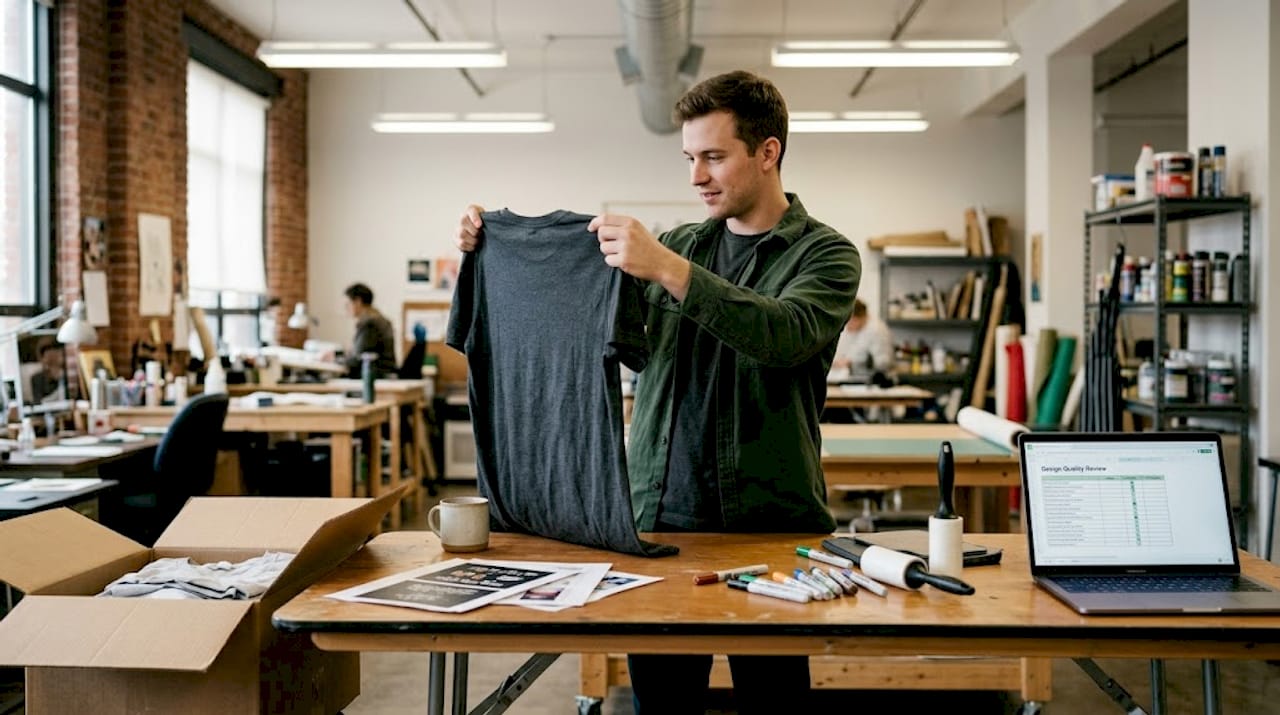
For design themes, think in two tracks: trending and evergreen. Trending designs spike fast but fade. Evergreen designs around hobbies, professions, or personal identity sell steadily for years. A smart catalog includes both. Check out these creative apparel design ideas if you need inspiration for your next drop.
Pro Tip: Before committing to a full product launch, order a sample for yourself. Check the color accuracy, print placement, and feel of the fabric. What looks perfect on screen can surprise you in person, and you want to catch those surprises before your customers do.
For brands that want extra precision on intricate artwork, DTF printing for quality is worth understanding. DTF handles fine lines and gradients better than many traditional screen printing or vinyl methods, especially for smaller runs.
Optimize fulfillment, durability, and costs for lasting success
Great designs need reliable fulfillment and profit-focused thinking. Here is how to optimize for long-term brand health.
Fulfillment expectations your customers hold are high. Meeting them consistently builds loyalty. Keep these in mind:
- Turnaround time: Communicate clearly. Most POD providers need 2 to 5 business days before shipping begins.
- Tracking updates: Automate shipping notifications so customers always know where their order is.
- Returns process: Clarify your policy upfront. POD items are usually non-returnable unless defective, so your policy must be honest and visible.
- Customer communication: A single proactive update reduces support tickets dramatically.
Print durability is often overlooked until customers start complaining about faded prints after a few washes. Fabric choice and print method both matter enormously. Here is a quick reference:
| Fabric type | Print method | Expected wash cycles |
|---|---|---|
| 100% cotton | DTF transfer | 50+ washes with proper care |
| Polyester blend | DTF transfer | 40 to 50 washes |
| Tri-blend | Screen print | 30 to 40 washes |
| Performance fabric | Sublimation | 60+ washes |
Efficient fulfillment and durable prints are crucial for long-term custom apparel success. Customers who receive a shirt that still looks great after 30 washes become repeat buyers.
For cost optimization, consider these moves:
- Bundle products: Offer two-item deals to increase average order value without increasing fulfillment complexity.
- Use hybrid fulfillment: Source some products from Printify for cost efficiency and flagship items from Printful for quality assurance.
- Negotiate volume pricing: As your order volume grows, some providers offer tiered discounts.
For even more ideas on keeping expenses low, these cost-saving print-on-demand tips are worth bookmarking.
Pro Tip: Every dollar you save on production costs is a dollar you can put toward paid ads or organic content. Reinvesting savings into marketing creates a compounding effect that pure cost-cutting never achieves.
What most POD guides miss: Adapting and thriving in a changing market
Here is something most POD guides will not tell you: a strategy that works today may be completely obsolete in 18 months. Platforms update their algorithms. Print technology improves. Consumer tastes shift faster than ever. The brands that grow year after year are not the ones with the best initial setup. They are the ones that never stop testing.
We see this constantly in the DTF space. Creators who locked into one print method two years ago are now struggling with quality expectations that have risen dramatically. Meanwhile, brands that follow DTF best practices and stay curious about emerging techniques keep finding new advantages.
Automation is useful, but it should not replace your voice. Customers can tell the difference between a brand that genuinely cares about its products and one running on autopilot. Answer questions personally. Share behind-the-scenes content. Respond to reviews. That authentic engagement is your competitive edge that no algorithm update can erase.
Finally, pay attention to micro-trends. The next profitable niche is not on the Buzzfeed homepage yet. It is in a Reddit thread, a small Discord community, or an emerging hobby space. Spotting that early and designing for it before the crowd arrives is how you build real momentum.
Make your next move with expert-supported print-on-demand
Everything covered in this guide, from provider selection to design preparation to fulfillment, becomes much easier when you have the right printing partner behind you.
Transfer Kingz specializes in high-quality DTF transfers that bring your designs to life with vibrant color and lasting durability. Whether you need DTF transfers in Dallas for fast local fulfillment or want to explore how well our process handles intricate DTF transfer details, we are ready to support your business at every scale. No minimum orders, quick turnarounds, and premium film make us a natural fit for POD brands serious about quality. Explore Print Point to see how we can plug into your workflow today.
Frequently asked questions
What is print-on-demand and how does it help small apparel businesses?
Print-on-demand lets you sell custom apparel with no upfront inventory, reducing financial risk and enabling flexible product testing without bulk order commitments.
Which print-on-demand provider is better for quality and price?
Printful delivers consistent quality with 99.5% order accuracy, while Printify offers lower base costs and a wider product range suited to budget-focused brands.
How can I make my POD apparel designs stand out?
Focus on print-ready files and follow a design checklist for print-on-demand to ensure color accuracy, correct resolution, and clean artwork that translates well to fabric.
What can I do if my print-on-demand profit margins are low?
Compare base costs across providers since Printify saves 20 to 25% on items like hoodies, and explore hybrid fulfillment strategies to protect margins while maintaining quality where it counts most.
0 comments