

For bulk DTF orders, you can typically expect same-day production on small, print-ready gang sheets ordered before cutoff, 24 to 48 hours for most standard bulk runs, and a few business days for complex or high-volume jobs. Add shipping time on top of the production window. The fastest route through any of these tiers is a clean, print-ready gang sheet submitted before your supplier’s cutoff, and a provider like Transfer Kingz builds its gang-sheet tools around exactly that workflow.
TL;DR:
- Same-day DTF production is limited to small, print-ready gang sheets ordered before supplier cutoffs, typically between 11 AM and 3 PM.
- Artwork issues and approval delays are the main causes of bulk order slowdowns, often adding hours or days before printing can start.
- Prepress habits like using print-ready templates and batching similar jobs significantly reduce turnaround times without requiring new equipment.
- Shipping delays are mostly due to carrier transit time, with ground shipping taking 2 to 5 days, making overnight options more costly but faster for urgent needs.
- Quality checks before shipping, including color match, adhesion, and registration, are essential to avoid reprints that wipe out any time saved.
Table of Contents
- Same-Day, 24-48 Hours, or 3-5 Days: Which Bucket Fits Your Order?
- Why Bulk DTF Orders Actually Slow Down
- The Prepress Habits That Actually Cut Turnaround
- Setting Cutoffs and Shipping Windows Customers Can Trust
- What Transfer Kingz Checks Before a Bulk Order Ships
- When Speed Costs More Than It Saves
- Get Bulk DTF Transfers Without the Guesswork on Timing
- Sources
Same-Day, 24-48 Hours, or 3-5 Days: Which Bucket Fits Your Order?
Every DTF supplier splits turnaround into rough tiers, and knowing which one your order falls into stops you from overpromising to a customer who needed shirts yesterday.
Same-day production is real, but it comes with strings attached. Suppliers that offer it almost always tie it to a cutoff time, commonly somewhere between 11 AM and 3 PM local time, and it usually applies to smaller, print-ready gang sheets rather than sprawling multi-design runs. If your art file is clean, your sizes are locked, and you hit the cutoff, same-day is achievable. Miss the cutoff by twenty minutes and you’ve bumped yourself into the next tier without realizing it.
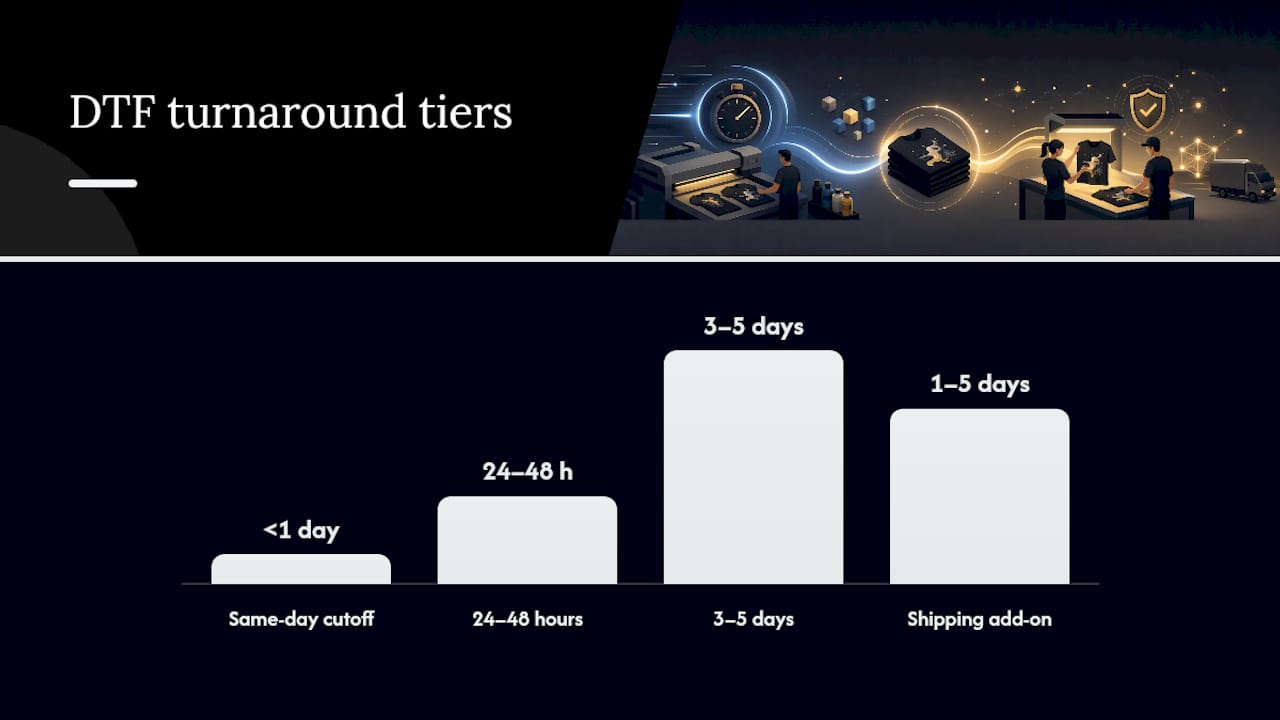
24 to 48 hours covers the bulk of what most shops actually order: multi-design gang sheets, medium-volume runs, and jobs with modest customization like a couple of color swaps or a size adjustment. This is the workhorse tier. It gives the print shop enough buffer to run quality checks without holding orders hostage for a week.
3 to 5 business days applies when something in the order adds friction: specialty finishes like glitter or puff, unusually large volume that requires multiple press cycles, or timing that lands during a peak season when every other shop in the country is also flooding queues with holiday orders. November and December alone can stretch a normally 48-hour turnaround into a full week if you don’t plan ahead.
Here’s how the tiers typically break down:
- Same-day: small, print-ready gang sheets ordered before the posted cutoff, minimal or no custom proofing required
- 24 to 48 hours: standard bulk gang sheets, moderate design counts, light customization
- 3 to 5 business days: specialty finishes, very large volume runs, or peak-season backlogs
- Shipping add-on: 1 to 5 additional days depending on carrier service, layered on top of whichever production tier applies
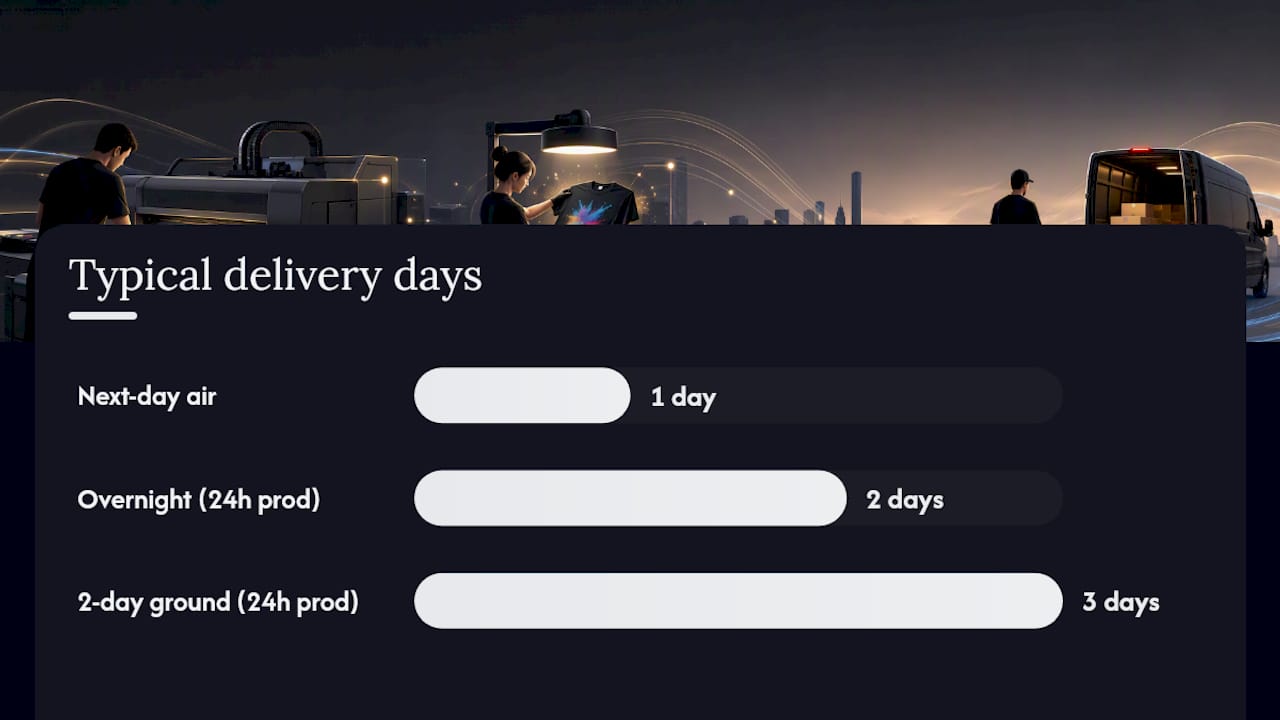
That last point trips up a lot of new shop owners. A “24 hour turnaround” claim usually means 24 hours of production, not 24 hours until the box lands on your porch. Ground shipping can add 2 to 5 days on its own, and networked fulfillment operations that use multiple regional warehouses claim they can hit 2-day ground coverage across most of the country, which matters a lot if you’re quoting a customer an actual delivery date instead of just a print date.
Why Bulk DTF Orders Actually Slow Down
Most turnaround complaints don’t come from the printer running slow. They come from something upstream of the press.
Artwork problems cause more delay than any other single factor. Low-resolution files, missing bleed, unflattened layers, or fonts that didn’t outline properly all force a print shop to stop and either fix the file or bounce it back to the customer. Every round trip costs hours, sometimes a full day if the customer doesn’t respond right away.
Approval delays are the second-biggest culprit, and they’re almost entirely on the customer’s side. A proof sent at 4 PM that doesn’t get approved until the next morning has already cost you a full production cycle. If your order path requires proofing, build that lag into your promised date up front rather than hoping the customer checks email quickly.
Other common slowdowns include:
- Poor gang-sheet nesting that wastes film and forces a re-layout
- Specialty finishes (glow, glitter, puff) that need separate press setups and longer cure times
- Mixed substrates on one sheet that require different press settings
- Capacity crunches during holiday and back-to-school peaks when every queue backs up at once
Pro Tip: Build a one-page “why your order got delayed” reference sheet for your customers. Half the frustration in bulk DTF orders comes from not knowing where the holdup is, and a simple explanation of “your proof sat unapproved for 18 hours” defuses most complaints before they start.
Layout inefficiency deserves its own callout because it’s invisible to most shop owners. Good gang sheet construction isn’t just about cost. It’s a direct lever on how many sheets you need and how long the layout stage takes.
The Prepress Habits That Actually Cut Turnaround
Speed isn’t mostly about the press. It’s about everything that happens before the press.
-
Build print-ready templates for your most common order types (single-location tees, full-front designs, sleeve prints) so customers or your own art team aren’t reinventing file specs every time. A locked template eliminates the back-and-forth over sizing and bleed that eats a full day on custom jobs.
-
Split your order paths into two lanes: ready-to-print files that skip proofing entirely, and custom jobs that require sign-off. Routing these separately at intake means your ready-to-print orders never sit in a queue waiting on someone else’s unanswered proof email.
-
Batch by press run, not by customer. Grouping similar substrates, similar finish types, or similar press temperatures into one run cuts changeover time. A shop running four small jobs back to back on the same settings finishes faster than one that swaps settings four times.
-
Run a preflight checklist on every file before it hits the queue: correct color profile (CMYK, not RGB), a clean white underbase channel, minimum 300 DPI resolution, and a file format the RIP software actually accepts (PNG or PDF, not a flattened JPEG with compression artifacts). Catching a bad file at intake costs five minutes. Catching it after printing costs the whole sheet.
-
Standardize your packing and kitting so finished transfers go straight from the press to a labeled shipping unit without a separate sorting step. Shops that pack as they print, rather than batching everything for a packing session at the end of the day, consistently ship same-day more often.
Pro Tip: Keep a printed (not digital) preflight checklist taped next to the RIP station. Digital checklists get skipped when things get busy; a physical one that has to be manually checked off doesn’t.
None of these fixes require new equipment. They require discipline about what gets into the queue and how it moves once it’s there. A shop with mediocre prepress habits and a great press will still lose to a shop with excellent prepress habits and an average press.
Setting Cutoffs and Shipping Windows Customers Can Trust
Your internal cutoff needs to sit earlier than your supplier’s posted cutoff, not match it. If your DTF supplier cuts off same-day orders at noon, your own customer-facing cutoff should be earlier to allow processing time. That buffer covers the time it takes you to review the order, catch a file problem, and resubmit if needed.
Communicate three things to every bulk customer up front:
- The exact order-by time for same-day or next-day service
- How long proofing takes if their job requires approval (state it as a number, like “proofs are returned within 4 business hours”)
- What expedited options cost extra, and what they actually buy in terms of days saved
To calculate a realistic delivery date, add production time to carrier transit time, not to “business days” in the abstract. A 24-hour production window plus 2-day ground shipping means a Monday order ships Tuesday and typically lands Thursday. Overnight air compresses that same order to a Wednesday delivery, but at a real cost premium. Networked fulfillment partners that operate multiple facilities can sometimes cut that ground window to 2 to 3 days even for larger shipments, which is worth checking if you ship bulk orders regularly enough to justify a 3PL relationship.
Next-day air makes sense for a customer with an event the next morning. For anything with more than 48 hours of slack, 2 to 3 day ground almost always wins on cost without meaningfully hurting the customer relationship.
What Transfer Kingz Checks Before a Bulk Order Ships
Fast turnaround only matters if what ships is actually correct. A reprint erases every hour you saved getting the order out the door quickly.
Before a bulk run ships, run a sample check against a short list:
- Color match against the approved proof, checked under consistent lighting
- Adhesion test on the actual fabric type the customer specified, not a generic substrate
- Wash-test result if the order includes a finish type you haven’t run recently
- Edge and registration check on multi-color or multi-layer designs
- Photo documentation of one sample sheet before the full run ships
Document any defect with a photo and a short note the moment you spot it, rather than relying on memory when a customer disputes a reprint later. Clear quality control documentation also speeds up customer sign-off, since a photo of an approved sample answers most “does this look right” questions before they’re even asked. Transfer Kingz publishes application and ordering guidance that shops can use as a starting template for their own proofing and QC workflow.
When Speed Costs More Than It Saves
Rush fees make sense when a missed date costs more than the fee itself. A last-minute order for a tournament that starts in three days is worth paying extra to expedite. A steady wholesale client who orders every two weeks doesn’t need rush pricing; they need a scheduled slot in your queue.
The trickiest calls come from big last-minute orders that arrive with zero warning. I’ve seen shops turn around a 500-piece order in under 48 hours by splitting the run across two press operators and shipping in two waves rather than waiting for the full batch to finish. That’s not a repeatable process, it’s a one-time scramble, and it only works because the shop already had clean, print-ready files to start from.
If large-volume shipping becomes a recurring bottleneck rather than an occasional emergency, a fulfillment partner that handles palletized freight and dock scheduling can remove that strain entirely, since freight logistics for big runs is a different skill set than running a press.
— Anthony
Get Bulk DTF Transfers Without the Guesswork on Timing
Transfer Kingz is built for shops that need real answers on turnaround, not vague promises. The gang-sheet builder lets you lay out multiple designs on one sheet before you order, which is the single biggest lever for hitting same-day and 24-hour windows. There are no minimum order requirements, so a small test run and a 500-piece wholesale order both move through the same fast production path.
If you’re planning a bulk run and need to know exactly what turnaround to promise your own customers, request a sample pack and a lead-time quote through the Dallas DTF transfers page before you commit to a delivery date you can’t actually hit.
Sources
- B2B Fulfillment USA - FASTEX FULFILLMENT
- B2B Order Fulfillment Services | NovEx
- Order Fulfillment Services - B2B, B2C, Ecommerce | Stord
0 comments