

Most small business owners assume bulk printing is reserved for massive corporations with warehouses full of inventory. That assumption is costing you money. Whether you run a local apparel shop, handle group orders for sports teams, or sell branded merchandise online, bulk printing can dramatically cut your cost per piece, speed up your turnaround, and simplify your entire production process. This guide breaks down exactly how bulk printing works, what the real financial advantages look like, and how you can apply these strategies starting with your next order.
Table of Contents
- What is bulk printing and who benefits?
- How bulk printing reduces costs: The economies of scale
- Bulk printing streamlines production and reduces errors
- When bulk isn’t best: Combining bulk and on-demand for flexibility
- Applying bulk printing advantages to your apparel business
- Enhance your apparel business with modern bulk printing solutions
- Frequently asked questions
Key Takeaways
| Point | Details |
|---|---|
| Lower cost per unit | Bulk printing dramatically reduces the price of each item by spreading setup and production costs. |
| Streamlined production | Bulk orders simplify workloads, cut lead times, and reduce the risk of errors in apparel printing. |
| Best for high-volume designs | Bulk methods shine for uniforms, event gear, and proven best sellers with predictable demand. |
| Combine methods for growth | Use bulk for volume and on-demand for testing so you can stay flexible and maximize profits. |
| Scalable for small businesses | Bulk printing isn’t just for big brands—small apparel decorators can use it to scale quality and sales. |
What is bulk printing and who benefits?
Bulk printing means producing a large quantity of the same design in a single production run. Instead of printing one shirt here and five there, you consolidate everything into one efficient job. Screen printing for events, team uniforms, and branded merchandise are classic examples. DTF printing cost-saving tips show that the same consolidation logic applies to direct-to-film transfers, where gang sheets let you pack multiple designs onto one film.
Bulk printing reduces cost per unit through economies of scale, especially in apparel. That’s the core principle driving every advantage we’ll cover in this article. The more units you produce in one run, the less each unit costs to make.
Who benefits most from bulk printing?
- Sports teams and schools ordering uniforms or spirit wear
- Event organizers needing matching shirts for staff or attendees
- Growing apparel brands with proven top-selling designs
- Local decorators managing group orders for businesses or organizations
- Promotional product companies fulfilling corporate merchandise orders
Pro Tip: Use bulk printing when you have reasonably predictable volume. For new or unproven designs, start with on-demand to test the market, then switch to bulk once you know a design sells.
The key difference between bulk and on-demand comes down to setup costs and flexibility. On-demand is great for variety and zero inventory risk. Bulk wins on margin, speed, and consistency once you know what you’re selling.
How bulk printing reduces costs: The economies of scale
Every print job carries fixed setup costs regardless of how many pieces you produce. Artwork preparation, film output, screen burning for screen printing, or file processing for DTF all happen once per job. When you print 12 shirts, those setup costs are divided by 12. When you print 120 shirts, those same costs are divided by 120. The math is simple, but the impact on your margins is significant.
Bulk screen printing spreads fixed setup costs over many units, lowering the per-piece cost in a way that small runs simply cannot match. Real-world data backs this up. Businesses that optimize their print runs have seen 12 to 15% print cost reductions along with energy savings of $3,000 to $4,000 per month through smarter scheduling and consolidated production.
“A streamlined production process doesn’t just cut costs, it reduces error rates and creates a more predictable, profitable operation.”
Here’s a simple cost comparison to illustrate the difference:
| Order size | Setup cost | Cost per unit (print) | Total cost per unit |
|---|---|---|---|
| 12 units | $45 | $4.50 | $8.25 |
| 48 units | $45 | $3.00 | $3.94 |
| 144 units | $45 | $2.10 | $2.41 |
| 288 units | $45 | $1.75 | $1.91 |
Note: Figures are illustrative examples based on typical screen printing and DTF cost structures.
The advantages of custom transfers follow the same pattern. When you order DTF transfers in bulk, your cost per transfer drops sharply, and you can apply them on demand without holding finished garment inventory.
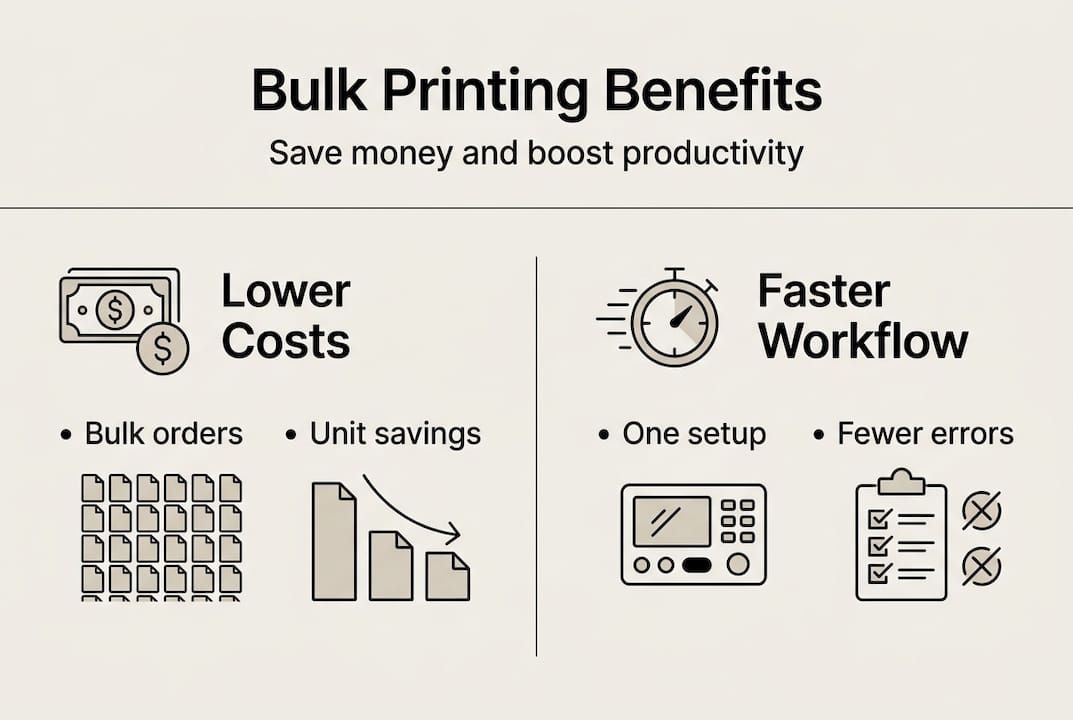
Stat to know: Businesses that adopted bulk printing strategies reported a 15% increase in sales alongside measurable reductions in material waste. Lower cost per unit means you can price more competitively or protect your margins while offering better value to customers.
Bulk printing streamlines production and reduces errors
Lower costs are only part of the appeal. Bulk printing also transforms your entire production workflow in ways that save time and reduce costly mistakes.
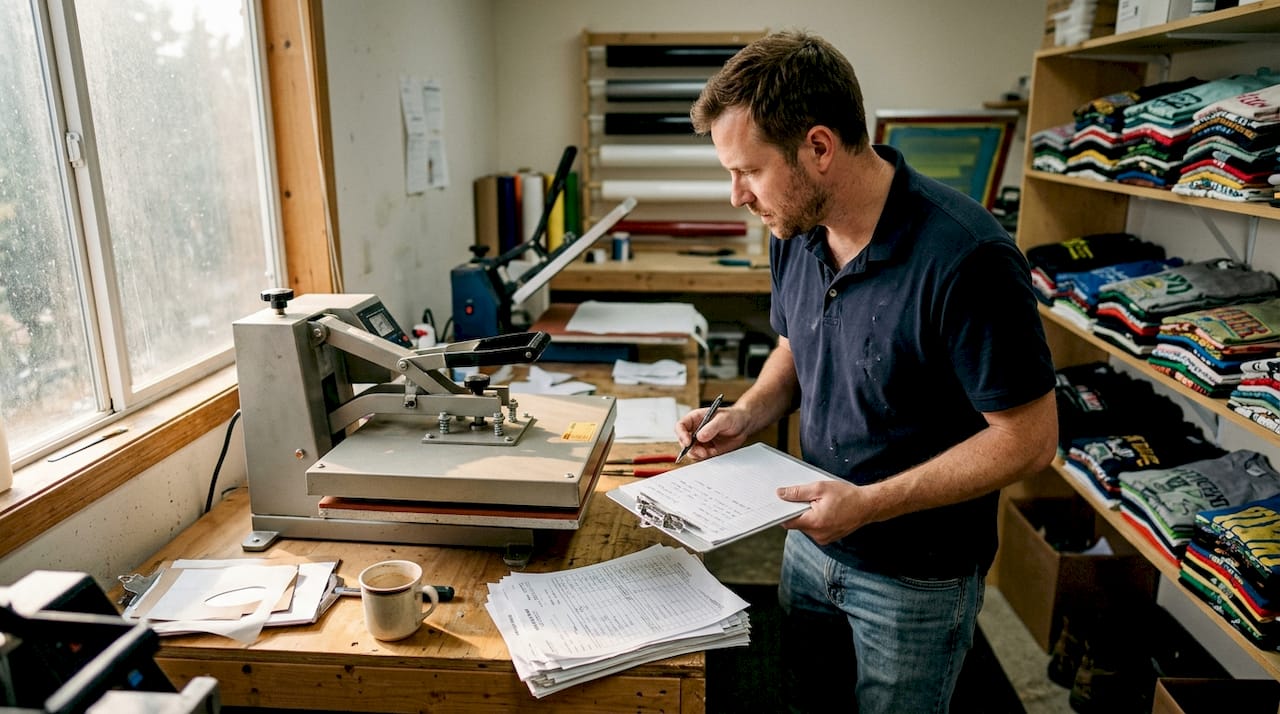
When you run a bulk job, you create one proof and approve it once. Every unit in that run follows the same approved file, the same color settings, and the same placement specs. Compare that to processing 30 separate on-demand orders, each with its own file, its own approval, and its own potential for miscommunication. Streamlined setups and schedules directly reduce lead times and error rates across the board.
Here’s what bulk production simplifies in practice:
- Single file approval covers every unit in the run
- One production schedule instead of multiple overlapping jobs
- Consolidated shipping reduces packaging time and carrier costs
- Easier quality control because you’re checking one consistent output
- Simpler inventory management with predictable quantities coming in at once
For apparel decorators, this operational clarity is a major competitive advantage. When you’re not chasing down individual order files or re-proofing the same design five times, you free up hours every week for higher-value work. Investing in high-quality transfers from the start also means fewer reprints and fewer customer complaints.
Pro Tip: Set up a mid-run quality check at the 10% mark of any bulk job. Catching a placement or color issue after 15 units is manageable. Catching it after 150 units is expensive.
Faster production timelines also mean you can promise shorter delivery windows to your customers. That’s a real selling point when competing against slower decorators or generic online print shops.
When bulk isn’t best: Combining bulk and on-demand for flexibility
Bulk printing has clear strengths, but it’s not the right tool for every situation. Knowing when to use each method is what separates efficient operations from ones that get stuck with unsold inventory.
Bulk printing works best when:
- You have a confirmed order with a fixed quantity
- You’re producing uniforms or event shirts with a deadline
- You’re restocking a proven top-selling design
- You’re fulfilling a corporate or group merchandise order
On-demand printing wins when you’re testing a new design, launching a limited edition, or serving a niche audience where demand is uncertain. For testing new designs, a hybrid print-on-demand and bulk approach is the smart move. Validate demand with small on-demand runs, then bulk up the winners for better margins.
A practical hybrid strategy looks like this: list a new design using on-demand fulfillment, track sales for 30 to 60 days, and once you hit a threshold (say, 40 to 50 units sold), switch to bulk ordering for that design. Your cost per unit drops, your margin improves, and you’re not guessing about demand.
“Automation and hybrid strategies are the future of scalable custom apparel. The businesses that combine both methods intelligently will outpace those locked into a single approach.”
Understanding the technical side helps too. Comparing inkjet vs DTF printing shows that DTF is particularly well suited for hybrid models because transfers can be produced in bulk and applied on demand, giving you the cost benefits of bulk production with the flexibility of on-demand fulfillment. Exploring direct to film printing tools can help you identify the right equipment and workflow for your specific volume.
Applying bulk printing advantages to your apparel business
Knowing the theory is one thing. Putting it into practice is where the real gains happen. Here’s how to set yourself up for a successful bulk printing operation.
Prepare your artwork correctly from the start. Bulk runs amplify both good and bad file quality. Submit print-ready files at 300 DPI or higher, with proper bleed and color profiles. A file issue that’s minor in a 10-unit run becomes a serious problem across 200 units.
Here are the key practices for running efficient bulk orders:
- Organize your SKUs clearly before placing any order, listing garment style, color, size breakdown, and quantity per size
- Communicate placement specs in writing to your printer, including exact measurements and reference points
- Group similar colors together to minimize ink changeovers and reduce setup time
- Plan your inventory around sell-through rates, not just what you think might sell
- Build in a buffer quantity of 3 to 5% for quality rejects or damage during shipping
Case studies show that small businesses can scale sales while reducing waste when they adopt structured bulk printing workflows. The businesses that see the biggest gains are the ones that treat bulk printing as a system, not just a one-time cost-saving move.
Here’s a practical volume benchmark table to help you plan:
| Order volume | Typical turnaround | Cost breakpoint | Best use case |
|---|---|---|---|
| 12 to 24 units | 5 to 7 business days | Minimal savings | Small events, samples |
| 25 to 72 units | 4 to 6 business days | Moderate savings | Team orders, pop-up shops |
| 73 to 144 units | 3 to 5 business days | Strong savings | Branded merch, uniforms |
| 145+ units | 2 to 4 business days | Maximum savings | Large events, wholesale |
For custom DTF transfers for branding, ordering in bulk gives you a ready supply of transfers to apply as orders come in, which is ideal for businesses that want fast fulfillment without committing to finished garment inventory upfront.
Enhance your apparel business with modern bulk printing solutions
If you’re ready to put these bulk printing strategies into practice, Transfer Kingz is built to support exactly that kind of growth. We specialize in high-quality DTF transfers designed for small businesses and apparel decorators who need reliable output at competitive prices.
Our platform lets you order DTF shirt transfers in bulk without minimums, so you can scale at your own pace. Whether you’re fulfilling a 50-piece event order or building inventory for your online store, our transfers deliver vibrant, durable results that hold up wash after wash. We also offer digital transfer film for intricate details, so even your most complex designs come out sharp and clean. Fast turnaround, premium materials, and straightforward application make Transfer Kingz the practical choice for decorators who want to grow without the overhead.
Frequently asked questions
What qualifies as bulk printing in custom apparel?
Bulk printing typically starts at 25 or more units of the same design in a single run, using methods like screen printing or DTF transfer production. The defining factor is consolidating volume into one job to reduce per-unit cost.
How does bulk printing save time compared to on-demand methods?
Bulk printing uses one proof and one production run for all units, eliminating the repeated setup, approval, and scheduling steps that slow down individual on-demand orders.
Can small businesses use bulk printing profitably?
Absolutely. Small businesses often see the biggest margin improvements from bulk printing because fixed setup costs are spread across more units, and predictable designs for events or top sellers are ideal candidates for bulk runs.
When is on-demand printing a better choice?
On-demand printing is the smarter option for testing new designs or fulfilling one-off orders where demand is unpredictable, since it avoids the risk of overproducing unsold inventory.
What real results have businesses seen with bulk apparel printing?
Real-world case studies document 15% sales growth alongside 12 to 15% print cost reductions and thousands of dollars in monthly energy savings for apparel businesses that adopted structured bulk printing workflows.
Recommended
- DTF Printing: 50+ Washes & 40% Lower Setup Costs – Transfer Kingz
- Why DTF printing is ideal for small businesses in 2026 – Transfer Kingz
- Why small businesses use DTF printing in 2026 – Transfer Kingz
- Affordable Bulk DTF Transfers for Your Business Needs: Quality, Speed, – Transfer Kingz
- How to improve production efficiency with data in 2026
0 comments