

The highest-impact custom merch formats for small businesses are apparel (brand awareness), drinkware (daily visibility), tote bags (event lead gen), tech accessories (B2B and conference), and limited-edition stickers or collectibles (loyalty and UGC). Pick one format, tie it to a specific campaign goal, and activate it with a QR code that lands on a tracked page.
Quick-win picks by goal:
- Brand awareness: Custom hoodies or tees worn publicly generate repeated impressions at a fraction of paid-ad cost; custom apparel printing is one of the highest-retention merch categories.
- Event lead gen: Branded tote bags or tech accessories (charging cables, earbuds) with a QR code linking to a post-event landing page.
- Customer retention: Premium insulated tumblers or limited-run apparel sent to repeat buyers or VIP subscribers.
- UGC and community: Sticker packs, enamel pins, or collectible drops that fans photograph and share.
Start here: Define your campaign goal, pick one item from the list above, and add a QR code or short URL before you order a single unit.
Key Takeaways
Custom merch works best when each item is tied to a specific campaign goal, activated with a trackable element (QR code, UTM, or unique discount code), and produced at a quality level that matches the recipient’s relationship with your brand.
| Point | Details |
|---|---|
| Match merch to one goal | Apparel for awareness, tech accessories for lead gen, premium drinkware for VIP retention. |
| Activate every item | Add a QR code, short URL, or unique discount code before ordering a single unit. |
| Test before scaling | Use POD or a small DTF batch to validate demand; move proven designs to bulk runs for better margins. |
| Measure with real KPIs | Track CPI, QR scan rate, merch conversion rate, and CPL to justify and optimize spend. |
| Transferkingz for small batches | No minimum orders, gang sheet builder, and fast turnaround make DTF transfers practical for presales and event kits. |
Table of Contents
- Why custom merch marketing ideas work for small businesses
- Creative merch ideas organized by campaign goal
- How to pick the right merch for your campaign
- Production options: print-on-demand, DTF, and bulk runs
- How to turn merch into measurable marketing
- What to measure: KPIs and simple ROI formulas
- Eight ready-to-run merch campaign templates
- Design rules that make people proud to use your merch
- How to presell and manage fulfillment without overbuilding inventory
- Legal considerations when creating custom merch
- How to price merch to balance appeal and profitability
- Why DTF transfers are worth a closer look for small-batch merch
- Transferkingz makes small-batch merch production fast and flexible
- Sources
Why custom merch marketing ideas work for small businesses
Merch is not a giveaway strategy. It is a media channel with a cost-per-impression that most paid channels cannot match. Arklavo’s ROI guide for branded merchandise documents that apparel delivers strong impressions-per-dollar compared with traditional advertising, and outlines a three-phase event approach that measurably improves lead quality. The math is simple: a $20 hoodie worn twice a week in public generates thousands of impressions over its lifespan.
The business benefits break down cleanly by goal:
- Visibility: Apparel and drinkware generate passive impressions every time they leave the house or desk. Branded merchandise strategy guidance in 2026 emphasizes shifting from mass giveaways to curated, high-retention items tied to measurable outcomes.
- Community: Merch signals belonging. A limited-run hoodie or inside-joke sticker pack creates psychological ownership that a discount code never will.
- Revenue: Merch sold directly (not given away) adds a product line with margins that scale once designs are proven.
- Retention: A well-chosen gift to a repeat customer costs less than a re-acquisition campaign. VistaPrint’s research on promotional merch shows that useful, well-chosen items create psychological ownership and social currency, turning customers into brand advocates.
- Lead generation: Tech accessories and QR-enabled items at events capture contact data and drive traffic to trackable landing pages.
Creative merch ideas organized by campaign goal
The best promotional merchandise strategies start with use-case, not product catalog. Here is a menu organized by what you are trying to accomplish.
Awareness (wear it, carry it, see it daily)
- Hoodies and crewnecks: Gelato’s best-seller research confirms t-shirts and hoodies are consistent top sellers. A quality blank with subtle branding gets worn; a cheap shirt with a giant logo gets donated. Presale a limited run to validate demand before committing to inventory.
- Insulated tumblers and water bottles: Sit on desks, go to gyms, appear in social photos. Gen Z skews heavily toward durable, high-quality water bottles and tech accessories, per SnackNation’s Gen Z swag research, making them strong for younger audiences.
- Tote bags: High daily use, visible in grocery stores and coffee shops, and cheap enough to give at scale. Add a QR code on the interior tag for a frictionless digital touchpoint.
Lead capture (scan it, click it, convert)
- Branded charging cables and power banks: B2B conference staples. Attach a card with a QR code to a post-event offer page. Recipients keep them for months.
- Custom notebooks with QR inserts: A notebook is used daily. A QR code on the inside cover linking to a resource library or discount page gets scanned repeatedly.
- NFC-enabled cards or keychains: Tap-to-link items that open a landing page instantly. Higher perceived value than a sticker, lower cost than most tech items.
Retention and loyalty (make VIPs feel seen)
- Limited-run apparel drops: A numbered hoodie or jacket sent to your top 50 customers signals exclusivity. Shopify’s merch guide recommends validating designs with your audience before committing, and presales are the cleanest way to do that.
- Premium drinkware sets: A branded ceramic mug or insulated bottle with a handwritten note costs under $30 and generates more goodwill than a $30 gift card.
- Custom socks or beanies: Underrated for loyalty kits. Unusual enough to photograph, useful enough to keep.
Events (before, during, after)
- Lanyards and badge holders: Every conference attendee wears one. Your logo gets seen by every person they pass.
- Enamel pins and patches: Collectible, lightweight to ship, and popular with communities that have strong identity (gaming, music, fitness). Printful’s creative merch roundup includes dozens of niche options like these.
- Limited-run sticker packs: Low cost, high shareability. A well-designed sticker ends up on laptops, water bottles, and phone cases, generating organic visibility for months.
Retail and monetization (sell it, not just give it)
- Home goods (candles, prints, ceramics): Lifestyle brands and food businesses do well here. Higher margins than apparel when sold direct.
- Collectible drops: Numbered art prints, trading cards, or branded figurines. Limited supply drives urgency and secondary-market buzz.
- Digital merch: Wallpapers, Lightroom presets, Notion templates, or exclusive digital content sold or given as a bonus. Zero production cost, infinite scale.
How to pick the right merch for your campaign
A decision checklist beats a gut feeling every time. Work through these criteria before placing any order.
The decision criteria:
- Campaign goal: Awareness, lead gen, retention, or revenue? Each maps to a different item type.
- Audience habits: Where does your audience spend time? A gym-goer values a water bottle; a remote worker values a desk item or quality mug.
- Perceived value: Match the item’s quality to the recipient’s relationship with your brand. A VIP gift needs to feel premium; a mass conference giveaway needs to be useful, not expensive.
- Distribution channel: Mailed kits need lightweight items. Event booths need items that fit in a tote. Retail needs items with strong shelf appeal.
- Budget per unit: Set a ceiling before you browse. It is easy to fall in love with a $45 item when your budget is $12.
- Lead-tracking needs: If you need attribution, the item must carry a QR code, short URL, or unique discount code.
- Sustainability preferences: Recycled materials, organic cotton, and locally produced items matter to a growing segment of buyers. Gelato’s seller guidance notes that starting with useful, quality items is more important than chasing trends.
Red flags to avoid:
- Cheap pens, keychains, or stress balls with low keep rates. If recipients throw it away within a week, your CPI is infinite.
- Oversized logos that make items unwearable in public. Subtle branding gets worn; billboard branding gets shelved.
- Ordering without a tracking mechanism. Merch without a QR code or unique URL is spend you cannot measure.
A four-step checklist:
- Define the single goal this merch serves.
- Pick one or two item types that fit that goal and your audience’s habits.
- Set a per-unit budget and choose a tracking method (QR, short URL, discount code).
- Order a sample run and test before committing to volume.
Pro Tip: Match perceived value to the recipient’s stage in your funnel. A cold prospect at a trade show gets a useful $8 item with a QR code. A customer who just spent $2,000 with you gets a $35 premium gift with a handwritten note. Mixing those up wastes both the item and the relationship.
Production options: print-on-demand, DTF, and bulk runs
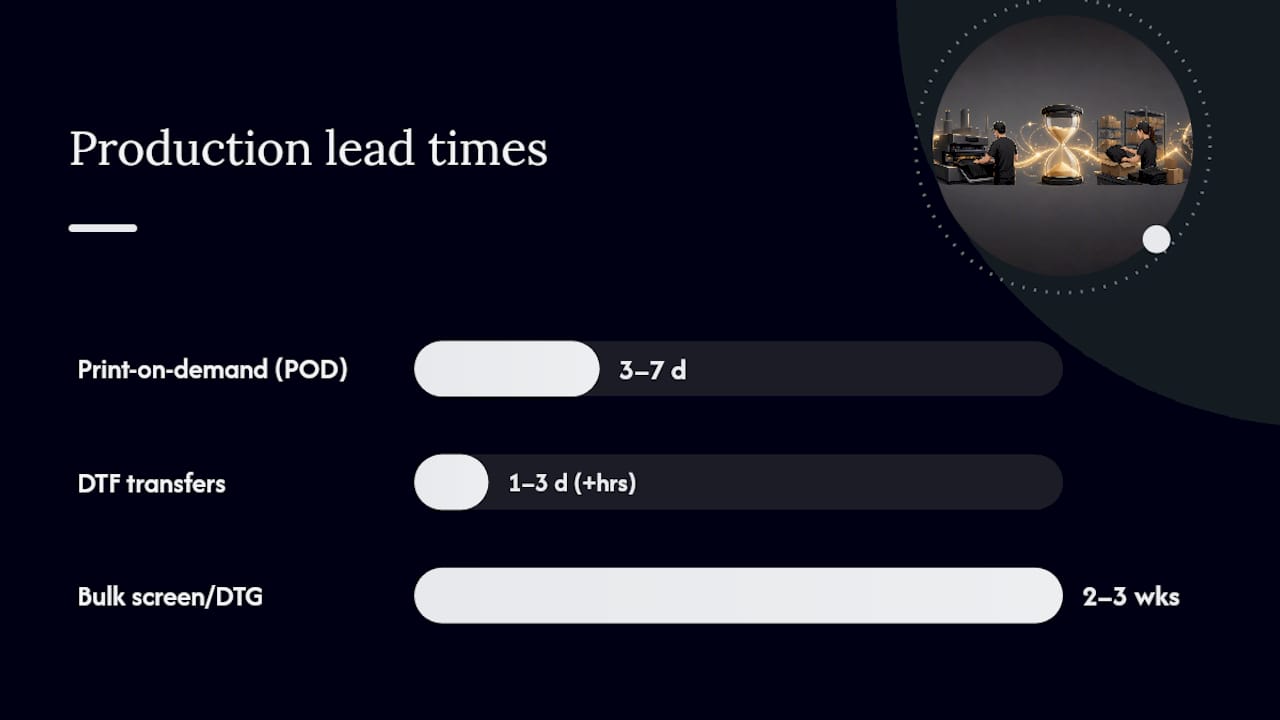
Choosing the wrong production method costs you time, money, or quality. Here is how the three main options compare.
Print-on-demand (POD)
POD services print and ship individual items as orders come in. No inventory, no upfront cost, and you can list dozens of designs without risk. The tradeoff is margin: per-unit costs are high, and you have limited control over blank quality. Inner Sanctum Group’s merch guide recommends starting with POD to test designs, then transitioning proven sellers to bulk orders to improve margins. POD is the right call for a first drop, a presale validation, or a design you are not sure will sell.
Typical lead time: 3–7 business days per order.
DTF transfers (Direct-to-Film)
DTF is the production method that hits the sweet spot between POD flexibility and bulk-run quality. You order printed transfer sheets, apply them to blanks yourself (or have a decorator apply them), and get full-color, durable prints with no minimum order. DTF transfers work on cotton, polyester, blends, and hard surfaces, which makes them practical for apparel, bags, and accessories in the same campaign. Washability is strong when applied correctly, and the color fidelity beats screen printing for complex, multi-color artwork.
Typical lead time: 1–3 business days for transfers; application adds a few hours per batch.
Bulk screen printing or DTG
Screen printing is cost-efficient at 50+ units for simple designs (1–3 colors). Direct-to-garment (DTG) handles complex artwork at medium volumes but costs more per unit than DTF at small scale. Both require longer lead times (2–3 weeks for screen printing) and higher MOQs.
Quality checklist before you approve a production run:
- Request a physical sample before full production.
- Check color accuracy against your brand’s hex codes.
- Test washability on apparel: wash three times and inspect for cracking or fading.
- Confirm placement matches your template (use the manufacturer’s product-specific template to avoid misalignment).
- Verify file resolution: 300 DPI minimum for print; vector files preferred for logos.
Decoration method matters for perceived value. Embroidery and well-executed DTF transfers signal quality and longevity in a way that cheap iron-on heat transfers do not. For a merchandise customization decision that affects how customers perceive your brand, the decoration method is not a detail to cut corners on.
How to turn merch into measurable marketing
Physical merch sitting in a box is not a marketing tactic. The activation is what makes it work.
Core activation tactics:
- QR codes on labels or tags: Link to a campaign-specific landing page with UTM parameters. A QR code on a tumbler’s bottom or a tote’s interior tag is scanned when the recipient is already engaged with the item.
- Unique discount codes: Print a code on the inside tag or a card tucked into the package. Tracks redemption directly in your e-commerce platform.
- NFC-enabled items: A tap-to-link keychain or card opens a landing page instantly. Higher novelty factor than QR, especially at tech-forward events.
- UGC contests: Ask recipients to post a photo with a branded hashtag for a chance to win. Works best with visually interesting items (limited-run apparel, sticker packs, collectibles).
- Influencer seeding: Send a curated kit to 10–20 micro-influencers in your niche. Micro-influencers (10,000–100,000 followers) tend to generate higher engagement rates than macro accounts. Lightspeed’s merch promotion guide recommends social promotion and retargeting as core channels for merch launches.
- Presales: List the item before it exists, collect orders, and produce only what sold. Validates demand and funds production simultaneously.
- Event pre-show mailers: Ship a teaser item (sticker, card, small gift) to registered attendees before the event. It primes them to visit your booth.
The three-phase event approach is one of the most reliable ways to convert event spend into pipeline. Arklavo’s event merch strategy documents this framework: send a pre-show mailer to registered attendees, offer booth swag to anyone who engages, and follow up with a VIP gift for your highest-value conversations. Each phase serves a different conversion goal, and the cumulative effect is measurably better than a single booth giveaway.
A trackable activation example: branded tumbler with a QR code on the base → landing page with UTM parameters → email capture form → automated follow-up sequence. Every step is measurable. VistaPrint’s phygital merch guidance calls these QR-enabled items “phygital” touchpoints, connecting physical objects to digital funnels.
What to measure: KPIs and simple ROI formulas
Merch spend without measurement is a donation. These are the KPIs that matter.
Primary KPIs:
- Cost-per-impression (CPI): Total merch spend ÷ estimated lifetime impressions. Apparel worn twice a week in public generates thousands of impressions over a year; a cheap pen generates almost none.
- QR scan rate: Total scans ÷ items distributed. A visible QR code on a well-used item (tumbler, tote) typically outperforms a hidden tag. Aim for a scan rate above 5% on distributed items as a baseline.
- Merch-led conversion rate: Landing page conversions ÷ QR scans. Tells you whether the landing page offer matches the audience’s intent.
- Cost-per-lead (CPL): Total event merch spend ÷ qualified leads captured. Compare against your paid-channel CPL to justify the budget.
- Retention/keep rate: The percentage of recipients who still use the item 30 days after receiving it. High-quality apparel and drinkware consistently outperform cheap giveaways on this metric.
Simple formulas:
- CPI = Total spend ÷ estimated lifetime impressions
- Merch conversion rate = Merch landing page conversions ÷ QR scans
- CPL (event) = Total event merch spend ÷ qualified leads captured
Branded merchandise strategy guidance emphasizes QR and UTM tracking as the standard attribution method for merch campaigns in 2026. Without those parameters, you are estimating. With them, merch becomes a channel you can optimize like any other.
Eight ready-to-run merch campaign templates
1. Event lead-gen booth kit
Send: Branded tote bag + QR card linking to a post-event resource download. Audience: Trade show or conference attendees. Production: DTF transfers on totes, printed QR cards. Tracking: UTM-tagged landing page, email capture. Budget/timing: Order 2–3 weeks before the event; budget $8–15 per kit.
2. Presale drop for new product launch
Send: Limited-edition t-shirt or hoodie available for pre-order only. Audience: Existing email list or social followers. Production: Print-on-demand to test, then DTF or bulk if demand warrants. Tracking: Presale order count validates demand; discount code tracks channel. Expected outcome: Covers production cost before a unit ships; builds launch momentum.
3. VIP close gift
Send: Premium insulated tumbler or branded jacket with a handwritten note. Audience: Customers who just completed a significant purchase or contract. Production: DTF transfer on a quality blank; small batch of 10–25 units. Tracking: Personalized discount code for next purchase tucked inside. Expected outcome: Repeat purchase rate increases; UGC from recipients who photograph and share the gift. Budget/timing: $25–45 per unit; ship within 5 business days of close.

4. Webinar sign-up incentive
Send: Sticker pack or enamel pin mailed to registrants who attend live. Audience: Webinar registrants. Production: Sticker printing or enamel pin manufacturer; 4–6 week lead time for pins. Tracking: Attendance rate comparison (incentivized vs. non-incentivized cohorts). Expected outcome: Higher show-up rates; recipients share the item on social. Budget/timing: $3–8 per unit; announce the incentive in the confirmation email.
5. Subscriber milestone reward
Send: Exclusive limited-run item (numbered print, custom patch, or collectible) sent to subscribers who hit a milestone (1 year, 100th order, referral threshold). Audience: Loyal customers or newsletter subscribers. Production: Small DTF batch or POD for low volumes. Tracking: CRM tag at send; monitor 90-day purchase behavior vs. control group. Expected outcome: Increased LTV and word-of-mouth referrals. Budget/timing: $10–20 per unit; trigger automatically from CRM milestone.
6. Influencer seeding kit
Send: Curated kit (branded hoodie, sticker pack, and a personal note) to 10–20 micro-influencers. Audience: Creators with 5,000–100,000 followers in your niche. Production: DTF transfers for apparel; sticker printing for the pack. Tracking: Unique discount code per influencer; UTM on any linked page. Expected outcome: 3–8 organic posts per kit sent; trackable sales via discount code. Budget/timing: $30–60 per kit; allow 3 weeks for production and shipping. Lightspeed’s promotion playbook recommends retargeting the audiences who engage with influencer posts.
7. Seasonal limited drop
Send: A seasonal item (holiday ornament, summer tote, winter beanie) available for 72 hours only. Audience: Full email list and social following. Production: Inner Sanctum’s scaling advice applies here: POD for the first drop, DTF batch if it sells out. Tracking: Sales volume, sell-through rate, and email open rate on the launch sequence. Expected outcome: Urgency drives faster conversions; leftover inventory is minimal. Budget/timing: 3–4 week production window; promote 5 days before the drop opens.
8. Referral reward kit
Send: A branded item (quality tote, custom socks, or sticker pack) mailed to customers who refer a new buyer. Audience: Existing customers enrolled in a referral program. Production: Small DTF batch replenished monthly. Tracking: Referral code tied to the reward; CRM tracks referrer and new customer. Expected outcome: Referral program participation increases when the reward is tangible and desirable. Budget/timing: $10–18 per unit; ship within 7 days of referral conversion.
Design rules that make people proud to use your merch
The single biggest design mistake small businesses make is treating merch like a billboard. Subtle branding gets worn everywhere.
Core design rules:
- Sub-brand or secondary mark: Use a smaller logo, a wordmark, or a brand element (icon, pattern, tagline) rather than your full primary logo at maximum size. Items that look like something people would buy in a store get worn in public.
- Limited color palette: Two to three colors maximum for most items. More colors increase production cost and reduce visual clarity.
- Legible typography: If there is text, it needs to be readable at arm’s length. Script fonts look great in mockups and terrible on a tote bag from ten feet away.
- Placement that suits the item: Chest-left for polos, back-neck for hoodies, bottom-corner for totes. Placement signals intentionality; centered-and-giant signals promotional.
- High contrast for visibility: Dark ink on light blanks, light ink on dark blanks. Mid-tone on mid-tone disappears in photos and in person.
Perceived value comes from the blank as much as the print. A $6 Gildan tee with a perfect DTF print still feels like a $6 tee. A $14 Bella+Canvas tee with the same print feels like something worth keeping. Shopify’s merch guide and Printful’s creative examples both emphasize starting with quality blanks as a non-negotiable.
Story hangtags and inside-label details (a small inside joke, a founding date, a niche reference your community will recognize) create psychological ownership. Recipients feel like the item was made for them specifically, which raises the chance they photograph it and share it.
Pro Tip: Before committing to a bulk run, post two or three design options to your Instagram Stories or email list with a simple poll. A 48-hour poll costs nothing and tells you which design your actual audience will wear, not which one you think looks best.
For detailed design templates and file preparation guidance, Transfer Kingz’s merch design guide walks through placement, contrast, and file specs for DTF production.
How to presell and manage fulfillment without overbuilding inventory
Preselling is the cleanest way to validate demand before spending on production. List the item, set a close date, collect orders, and produce only what sold. The risk of a failed drop is a refund; the risk of overproducing without a presale is a garage full of unsold hoodies.
Presell mechanics:
- Set a minimum threshold (e.g., 25 orders) below which the drop does not proceed. Communicate this to buyers upfront.
- Use a close date (72 hours to 2 weeks) to create urgency without indefinite open orders.
- Collect payment at order, not at ship. This funds production and confirms real demand.
- Send a production update email midway through fulfillment. Transparency reduces support tickets.
Limited drops work on the same principle but add scarcity as a feature. A numbered run of 100 units, each with a unique number printed inside the collar, turns a hoodie into a collectible. Sell-through is faster, secondary-market buzz is real, and you never sit on unsold inventory.
Inventory management for ongoing merch:
- Keep a 4–6 week rolling forecast based on sell-through rate from previous drops.
- Reorder at 30% remaining stock, not when you run out.
- Use a gang sheet builder (like the one at Transferkingz) to batch multiple designs onto a single DTF transfer sheet, reducing per-unit cost on small reorders.
- Tag every order in your CRM with the merch item purchased. This data tells you which items correlate with higher LTV customers.
Legal considerations when creating custom merch
Custom merch intersects trademark law in ways that catch small businesses off guard. The core rule: you cannot print another brand’s logo, character, athlete’s likeness, or trademarked phrase on merchandise without a license, even for internal use or small runs.
Common legal pitfalls:
- Trademarked phrases and slogans: “Just Do It,” “I ♥ NY,” and thousands of other phrases are registered trademarks. Printing them on merch, even with modifications, creates infringement risk.
- Sports team logos and player likenesses: Major leagues and their teams hold trademarks and publicity rights. Unlicensed sports merch is one of the most actively enforced categories.
- Fan art and derivative works: Creating merch based on a copyrighted character or artwork without permission is copyright infringement, regardless of how transformative the design is.
- Your own brand protection: File a trademark application with the USPTO for your brand name and logo before scaling merch production. Registration gives you legal standing to enforce against copycats.
Practical steps:
- Run a trademark search on the USPTO TESS database before finalizing any design that includes text or a distinctive mark.
- Use only original artwork or properly licensed assets (stock illustration licenses typically do not cover merchandise use; check the license terms).
- If you are working with a designer, include a warranty clause in your contract confirming the work is original and does not infringe third-party rights.
- For fan-adjacent brands, consult an IP attorney before printing. The cost of a one-hour consultation is a fraction of a cease-and-desist response.
This is general information, not legal advice. Confirm your specific situation with a qualified intellectual property attorney.
How to price merch to balance appeal and profitability
Pricing merch is not the same as pricing a service. The goal is a price that feels fair to the buyer, covers your costs, and leaves a margin worth the effort.
The baseline formula: Production cost × 2.5 to 3 = retail price. A hoodie that costs $22 to produce (blank + DTF transfer + fulfillment) should retail at $55–$66. This covers returns, payment processing fees, and leaves a real margin.
Tiered pricing by purpose:
- Giveaway items: Budget $5–15 per unit. These are not profit centers; they are impression generators. Keep cost low, keep quality high enough to be used.
- Retail merch: Price at 2.5–3x production cost. Buyers expect to pay for quality; underpricing signals low quality.
- VIP gifts: Budget $25–50 per unit. These are relationship investments, not product sales. ROI is measured in retention and referrals, not margin.
Perceived value levers that let you charge more without raising production cost significantly: premium blanks, embroidery instead of print, limited-run numbering, story hangtags, and branded packaging. A $14 blank in a kraft paper mailer with a wax seal and a handwritten note feels like a $45 gift.
Avoid the race to the bottom. Cheap merch at low prices trains your audience to see your brand as low-value. One well-made item at a fair price does more for brand perception than ten cheap items at cost.
Why DTF transfers are worth a closer look for small-batch merch
Most small businesses default to POD because it feels safe, or to bulk screen printing because it is familiar. DTF transfers occupy the middle ground that most SMBs overlook: no minimum order, full-color fidelity, fast turnaround, and the flexibility to apply prints to almost any fabric or hard surface.
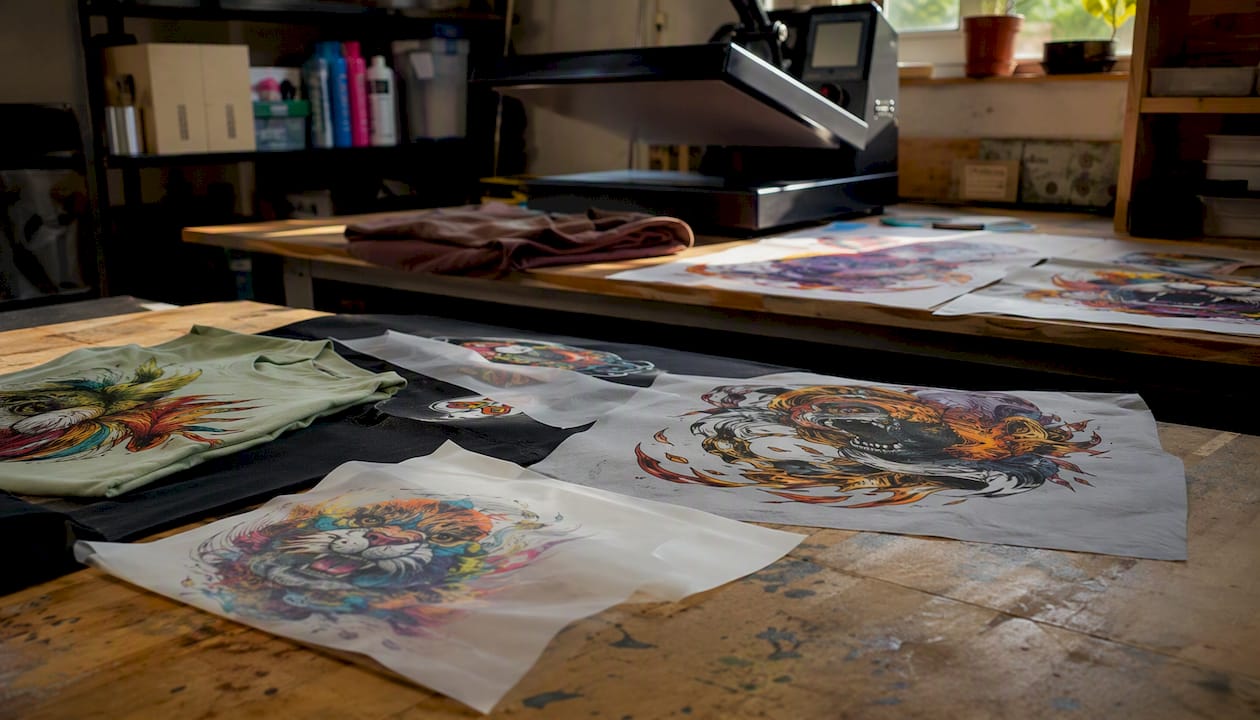
The practical case for DTF at small scale is straightforward. You can order a single gang sheet with six different designs, apply them to blanks you already own, and have finished merch in a day. That speed matters when you are testing a new design, fulfilling a presale, or preparing for an event on a short timeline. The printing workflow for DTF is also more forgiving than screen printing for complex, multi-color artwork, which is where most small-business designs live.
The one honest caveat: DTF requires you (or a decorator) to apply the transfers. That adds a step compared with POD. For businesses that want zero production involvement, POD remains the simpler path. For anyone who wants better margins, faster turnaround, and more design flexibility, DTF is worth the learning curve.
Transferkingz makes small-batch merch production fast and flexible
Running a presale, preparing event kits, or testing a new design does not require a 50-unit minimum or a two-week wait. Transferkingz specializes in custom DTF transfers with no minimum order quantity, same-day local pickup in Dallas, and nationwide shipping that typically arrives within days. Upload your artwork, use the gang sheet builder to batch multiple designs onto one sheet, and apply the transfers to your own blanks at your own pace.
For businesses in Texas, DTF transfers in Dallas and across the state are available with fast local turnaround. Order a sample transfer before committing to a full run, check the color fidelity and washability on your specific blank, and scale from there. Visit Transferkingz’s Print Point page to review production options and place your first order.
Sources
- How to Make, Design, and Promote Merch to Grow Your Brand
- Branded Merchandise Marketing Strategy: A 2026 Guide
- How promotional merch can turn your customers into brand advocates
- Custom Branded Merchandise ROI Guide for Marketing Campaigns – Arklavo
- 17 Best-Selling Merch Ideas for A Profitable Online Business
0 comments