

Small clothing brands and independent designers often struggle to find a printing method that delivers vibrant results on all types of fabrics. Understanding the Direct-to-Film (DTF) design process gives you control over quality, durability, and creative complexity without the high costs and limitations of traditional techniques. This guide makes the DTF workflow clear, highlighting essential steps and technical details so you can confidently create lasting, custom apparel that stands out from the competition.
Table of Contents
- Defining DTF Design In Custom Printing
- Essential Steps In The DTF Process
- Artwork Requirements And File Preparation
- Evaluating DTF Transfer Quality And Durability
- Common Pitfalls In DTF Design Workflow
Key Takeaways
| Point | Details |
|---|---|
| DTF Printing Offers Flexibility | Direct-to-Film printing provides compatibility with various fabrics and allows intricate designs with high resolution and color vibrancy. |
| Critical Workflow Steps | Successful DTF printing requires meticulous attention to detail across several stages, from digital design preparation to final finishing. |
| Evaluate Transfer Quality | Assessing DTF transfer quality involves testing adhesion, color retention, and durability under real-world conditions. |
| Mitigate Common Pitfalls | Identifying and addressing potential workflow challenges can enhance print quality and production efficiency in DTF printing. |
Defining DTF Design in Custom Printing
Direct-to-Film (DTF) printing represents a revolutionary approach to custom textile decoration, offering unprecedented flexibility and quality for designers and business owners. Unlike traditional printing methods, DTF enables creators to transfer vibrant, durable designs onto virtually any fabric type with remarkable precision.
The DTF design process centers on several critical technical components that distinguish it from other printing techniques. Advanced textile pigment inks are utilized alongside specialized PET transfer films and thermoadhesive powder adhesives, creating a unique workflow that produces exceptional results.
Key characteristics of DTF design include:
- High-resolution image transfer capabilities
- Compatibility with multiple fabric compositions
- Minimal fabric pre-treatment requirements
- Superior durability and wash resistance
- Complex color reproduction potential
Designers leveraging DTF technology can create intricate designs that maintain sharp details and vibrant colors across diverse textile surfaces. The process allows for remarkable creative freedom, enabling small businesses and independent designers to produce professional-grade custom apparel with minimal equipment investment.
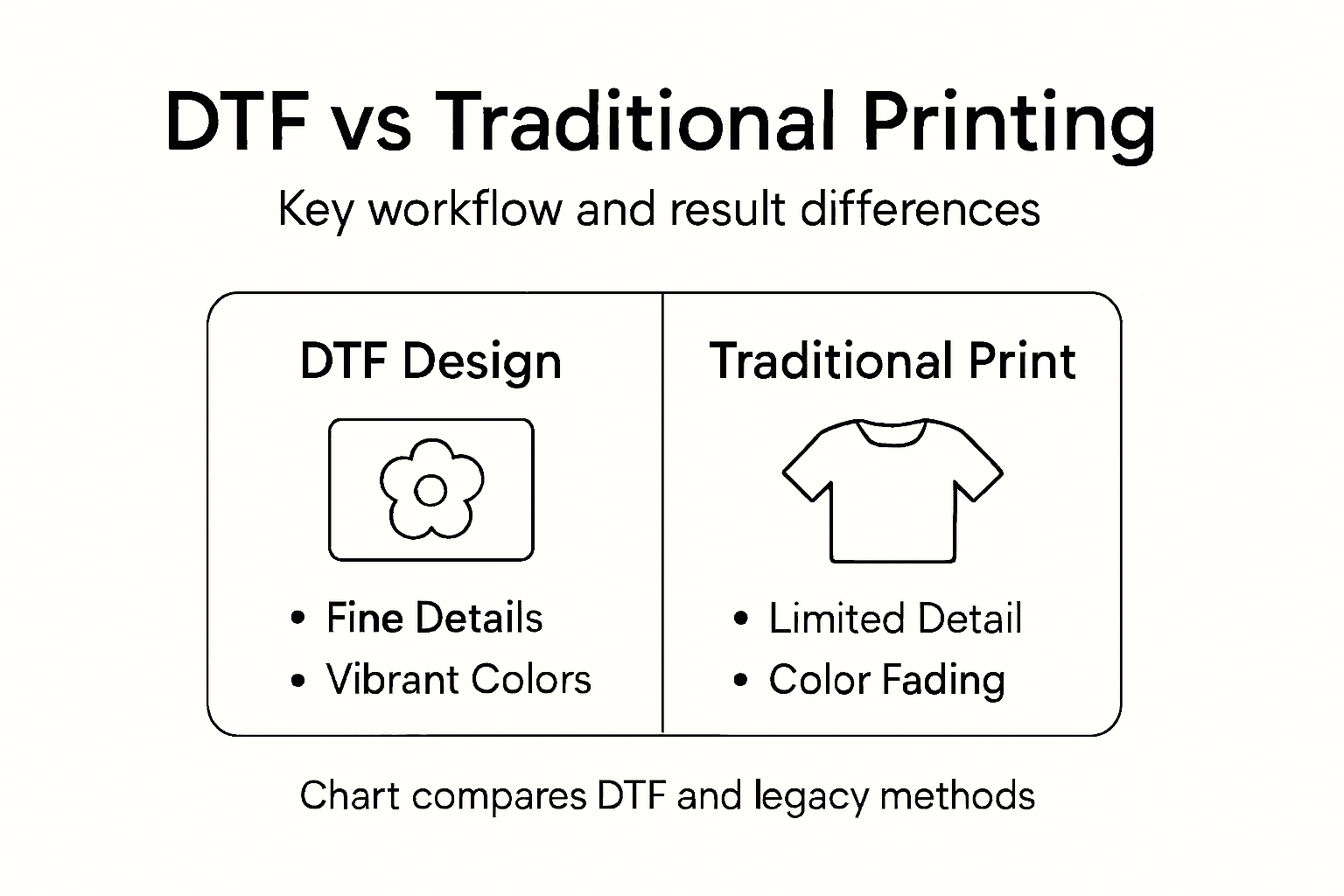
Here’s a comparison of DTF and traditional textile printing methods for custom apparel production:
| Aspect | Direct-to-Film (DTF) | Traditional Printing |
|---|---|---|
| Fabric Compatibility | Works with most fabric types | Often limited to certain fabrics |
| Design Complexity | Handles fine details, gradients | Mainly flat, limited colors |
| Equipment Cost | Relatively low investment | Higher setup costs |
| Durability | Exceptional wash resistance | Varies, often less durable |
| Production Speed | Fast, efficient transfers | Slower, labor-intensive |
Pro tip: Always select high-contrast, clean vector graphics when preparing designs for DTF printing to ensure optimal transfer quality and visual impact.
Essential Steps in the DTF Process
The Direct-to-Film (DTF) printing process is a sophisticated method that transforms digital designs into vibrant textile decorations through a precise, multi-stage workflow. DTF printing involves six critical steps that ensure high-quality, durable custom apparel production.
The comprehensive DTF workflow typically includes the following sequential stages:
- Digital Design Preparation
- Create high-resolution RGB files (PNG or TIFF)
- Optimize graphics for textile transfer
- Ensure color accuracy and contrast
- Film Printing
- Use specialized DTF printer with CMYK + white inks
- Print design directly onto PET transfer film
- Maintain precise color reproduction
- Adhesive Application
- Apply hot melt adhesive powder evenly
- Shake off excess powder
- Ensure uniform powder distribution
- Powder Curing
- Heat powder to activate adhesive properties
- Use controlled temperature settings
- Create strong bonding potential
- Heat Transfer
- Position film on target fabric
- Apply specific temperature and pressure
- Transfer design with precision
- Final Finishing
- Optional secondary press for enhanced durability
- Verify design adherence and softness
Professional DTF practitioners understand that each step requires meticulous attention to detail, with equipment settings and technique playing crucial roles in achieving exceptional results. The process allows for remarkable design complexity and fabric versatility that traditional printing methods cannot match.
Pro tip: Invest in calibration tools and maintain consistent environmental conditions to ensure repeatable, high-quality DTF transfer results.
Artwork Requirements and File Preparation
Successful Direct-to-Film (DTF) printing begins with meticulous artwork preparation, where digital design quality directly impacts the final textile transfer. Creating print-ready files requires understanding specific technical parameters that ensure optimal results across different fabric types and design complexities.
Key artwork requirements for DTF printing include:
- File Format: PNG or TIFF recommended
- Color Mode: RGB color profile
- Resolution: Minimum 300 DPI
- Image Type: High-contrast vector or raster graphics
- Color Depth: 24-bit or 32-bit color recommended
- Transparency: Supported PNG with clear background preferred
Designers must pay careful attention to several critical aspects when preparing artwork for DTF transfers. The design’s visual clarity, color accuracy, and digital file specifications play pivotal roles in determining print quality. Complex designs require careful vector optimization or high-resolution raster preparation to maintain intricate details during the transfer process.

Technical considerations for artwork preparation extend beyond basic file settings. Designers should focus on creating graphics with clean lines, well-defined edges, and minimal color gradients to ensure precise ink deposition and transfer. White ink underlays, color separation techniques, and understanding how different design elements interact with textile surfaces become crucial for achieving professional-grade custom apparel prints.
Summarizing critical artwork specifications for DTF printing:
| Specification | Recommended Setting | Impact on Print Quality |
|---|---|---|
| File Format | PNG or TIFF | Ensures sharp color, clarity |
| Color Mode | RGB | Accurate, vibrant hues |
| Minimum Resolution | 300 DPI | Maintains design sharpness |
| Color Depth | 24-bit or 32-bit | Better gradient handling |
| Transparency | Clear background PNG | Clean edges for fabric |
Pro tip: Always perform a digital test print and color calibration before committing to full production to verify design translation and color accuracy.
Evaluating DTF Transfer Quality and Durability
Direct-to-Film (DTF) transfer quality represents a critical consideration for custom apparel producers, determining the longevity and professional appearance of printed designs. DTF transfer quality depends on multiple interconnected factors that extend far beyond initial visual appeal.
Key evaluation metrics for DTF transfer quality include:
- Adhesion strength
- Color vibrancy retention
- Wash durability
- Fabric flexibility
- Edge definition
- Ink penetration depth
- Resistance to cracking and peeling
Professional assessment of DTF transfers requires comprehensive testing across several performance dimensions. Manufacturers and designers must evaluate transfers under simulated real-world conditions, including repeated washing, stretching, and exposure to different environmental stressors. The transfer’s ability to maintain its original appearance and structural integrity becomes paramount in determining its overall quality and commercial viability.
The most sophisticated DTF transfer evaluations involve quantitative and qualitative analysis. Quantitative measurements might include precise color spectrum assessments, tensile strength tests, and microscopic examination of ink layer adhesion. Qualitative evaluations focus on tactile characteristics, visual consistency, and aesthetic performance across various fabric types and design complexities.
Pro tip: Conduct systematic wash tests using standardized protocols, documenting color fade, design integrity, and fabric interaction to establish comprehensive transfer quality benchmarks.
Common Pitfalls in DTF Design Workflow
The Direct-to-Film (DTF) design workflow presents numerous technical challenges that can significantly impact print quality and production efficiency. Common DTF workflow pitfalls require strategic understanding and proactive management to ensure consistent, high-quality results.
Critical workflow challenges include:
- Environmental instability
- Inconsistent material quality
- Improper powder application
- Suboptimal curing processes
- Design file preparation errors
- Equipment maintenance issues
- Operator training limitations
Environmental factors play a pivotal role in DTF printing success. Uncontrolled humidity can create static electricity, disrupt powder adhesion, and slow drying processes. Temperature fluctuations compromise ink performance and film adhesion, potentially leading to inconsistent transfer quality. Precision in environmental control becomes paramount for maintaining reproducible printing outcomes.
Technical expertise and systematic problem prevention are essential in mitigating DTF design workflow risks. Successful practitioners develop comprehensive strategies that address potential failure points, including rigorous equipment calibration, standardized operating procedures, and continuous operator training. Understanding the nuanced interactions between design files, printing equipment, and material specifications allows businesses to optimize their DTF production processes.
Pro tip: Implement a detailed workflow checklist that documents environmental conditions, equipment settings, and material specifications for each print job to systematically reduce variability and errors.
Elevate Your Custom Apparel with Expert DTF Transfers
Navigating the intricate DTF design process can be overwhelming, especially when aiming for vibrant colors, long-lasting durability, and perfect garment compatibility. Whether you struggle with complex artwork preparation, inconsistent powder application, or managing environmental factors during production, achieving professional results requires reliable resources crafted for your success. Transfer Kingz understands these challenges and offers high-quality solutions tailored to enhance every step of your custom printing journey.
Explore our extensive collection of DTF transfers, custom apparel printing, heat transfers, t-shirt printing, high-quality prints. – Transfer Kingz designed specifically for seamless application and exceptional wash resistance. Take advantage of our easy-to-use online platform https://www.transferkingz.com/ where you can upload your digital designs, use gang sheet builders, and place orders without minimums. Unlock creative freedom and boost your production efficiency with premium inks, films, and comprehensive support including FAQs and application guides. Start elevating your custom apparel printing today by visiting our DTF transfers, UV DTF Permastickers, custom printing supplies, heat transfers, bulk printing. – Transfer Kingz page and discover how effortless professional apparel printing can be.
Frequently Asked Questions
What is the DTF printing process?
The Direct-to-Film (DTF) printing process involves six key steps: digital design preparation, film printing, adhesive application, powder curing, heat transfer, and final finishing. This multi-stage workflow ensures high-quality and durable custom apparel production.
How does DTF printing compare to traditional printing methods?
DTF printing offers advantages such as compatibility with various fabric types, superior design complexity, lower equipment costs, exceptional durability, and faster production speeds compared to traditional printing methods, which often have limitations in fabric compatibility and design detail.
What are the key requirements for artwork preparation in DTF printing?
Key requirements include using PNG or TIFF file formats, setting the color mode to RGB, maintaining a minimum resolution of 300 DPI, and ensuring that images have high contrast and a clear background. This ensures optimal transfer quality and vibrant color reproduction.
How can I evaluate the quality and durability of DTF transfers?
Evaluate DTF transfer quality by assessing factors such as adhesion strength, color vibrancy retention, wash durability, and ink penetration depth. Conducting systematic wash tests and performance evaluations under real-world conditions will help establish the transfer’s quality and longevity.
Recommended
- What Is DTF Printing: Transforming Custom Apparel – Transfer Kingz
- How DTF Printing Works: Boost Custom Apparel Quality – Transfer Kingz
- DTF Printing Industry Trends: Boosting Apparel Brands – Transfer Kingz
- What Is DTF Printing: Transforming Custom Apparel – Transfer Kingz
- What Is Custom Apparel? Streamlining Brand Success – DIYPRINTZ
- What Is Direct-to-film (DTF) Printing In Apparel?
0 comments