

TL;DR:
- DTF printing enables scalable, low-cost mass production with no minimum order requirements.
- It offers high versatility across fabrics, fast turnaround times, and efficient store-and-press workflow.
- Small shops benefit from reduced inventory costs and increased flexibility by adopting DTF.
Mass production used to mean one thing: big machines, big budgets, and big minimums. For small apparel decorators, that reality felt out of reach. But direct-to-film (DTF) printing is changing the rules. DTF reduces inventory costs and enables scalable operations for businesses of any size. Whether you’re running 10 shirts or 500, this technology gives you the flexibility that traditional methods simply can’t match. This guide breaks down what DTF brings to mass production, how it stacks up against other methods, and how you can put it to work in your shop right now.
Table of Contents
- Understanding DTF technology and its rise
- DTF vs. traditional printing: What works best and when
- How DTF supports lean and scalable mass production
- Applying DTF for custom and mass production success
- DTF’s future in mass production: What most overlook
- Level up your apparel production with expert DTF solutions
- Frequently asked questions
Key Takeaways
| Point | Details |
|---|---|
| DTF boosts flexibility | DTF technology empowers small businesses to offer fast, customizable mass apparel production without large-scale investment. |
| Cut costs with pre-made transfers | Producing and storing DTF transfers ahead of time cuts inventory and operational expenses while reducing turnaround. |
| Best for small to medium runs | DTF excels at 1-500 unit orders, while screen printing leads in high-volume, simple jobs. |
| Hybrid approach wins | Combining DTF with other printing methods often gets the best results for efficiency and cost. |
Understanding DTF technology and its rise
DTF printing is a process where designs are printed onto a special film, coated with a hot-melt adhesive powder, cured, and then heat-pressed onto fabric. The result is a vibrant, durable transfer that bonds directly to the material without needing a coating or pre-treatment on the garment itself. That last point is a big deal.
Traditional methods like screen printing require screens, emulsions, and a separate setup for each color. Direct-to-garment (DTG) printing needs pre-treatment on dark fabrics and struggles with certain fabric blends. DTF skips most of those steps. You print the design, cure it, and it’s ready to press whenever you need it.
The unique advantages of DTF include full-color printing with no color limits, compatibility with cotton, polyester, nylon, blends, and even leather. You’re not locked into fabric type or design complexity. A photorealistic graphic with gradients? No problem. A simple two-color logo? Also no problem.
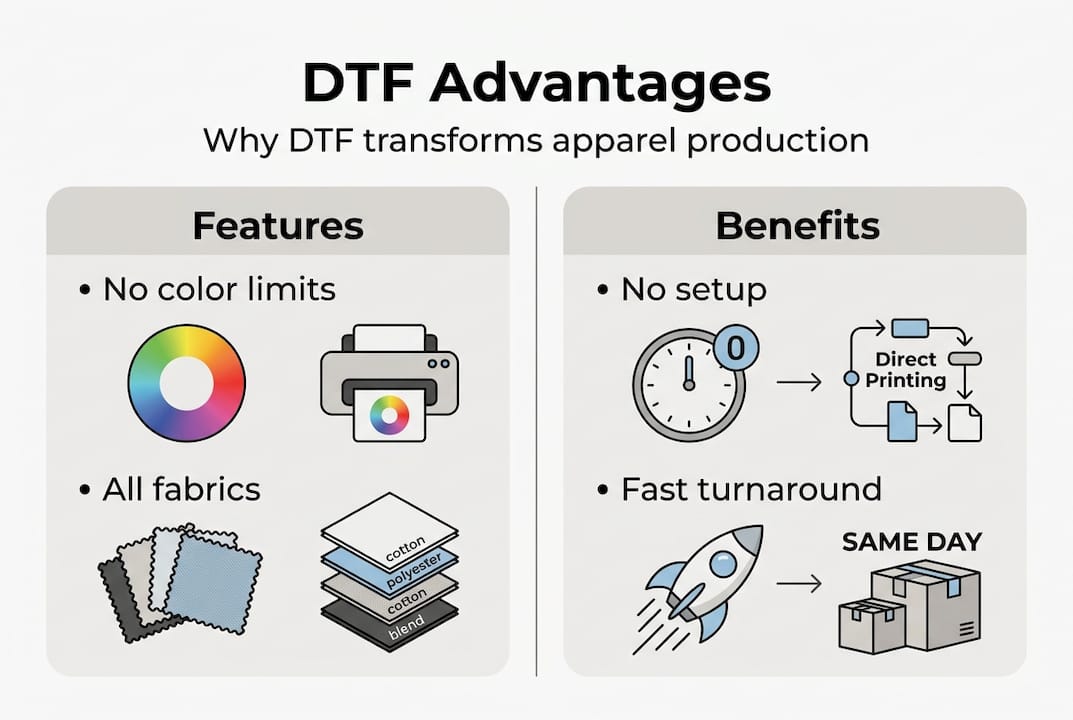
For small and medium production runs, this flexibility is a game changer. You don’t need a minimum order to justify setup costs. You don’t need to commit to a single design before you know demand. DTF lets you pre-produce and store transfers for on-demand application, which means you can print a batch of transfers today and press them onto shirts over the next three months as orders come in.
This is exactly why small businesses use DTF as their primary decoration method. Lower entry costs, faster turnaround, and no wasted inventory make it a practical choice for shops that can’t afford to tie up capital in pre-printed stock.
Key reasons DTF is gaining traction:
- No minimum order quantities
- Works on virtually any fabric type
- Full-color designs with no color surcharges
- Pre-production and storage capability
- Faster setup compared to screen printing
- Consistent quality across short and long runs
Pro Tip: If you’re new to DTF, start by printing gang sheets of your most popular designs. You’ll build a ready-to-press inventory without committing to finished garments, which keeps your cash flow flexible.
DTF vs. traditional printing: What works best and when
Knowing what DTF can do is one thing. Knowing when to use it over other methods is where the real strategy lives.
Screen printing is still the king of high-volume, simple designs. If you’re printing 1,000 identical t-shirts with a two-color logo, screen printing wins on cost per unit. But the moment you add color complexity, drop below 200 units, or need multiple design variations, the math shifts fast.
DTF excels in small to medium runs of 1 to 500 units with zero setup time and lower per-job costs. Screen printing becomes more cost-effective only at ultra-high volumes with simple designs. That’s the break-even reality most decorators don’t calculate until they’re already losing money.
Sublimation is another popular method, but it’s limited to polyester or poly-coated substrates. A subli vs DTF comparison shows DTF wins on fabric versatility every time. You can’t sublimate onto a cotton hoodie. You can DTF it with no issues.
| Method | Best for | Min. order | Setup cost | Fabric types |
|---|---|---|---|---|
| DTF | 1-500 units, complex designs | 1 piece | Low | All fabrics |
| Screen printing | 200+ units, simple designs | Usually 24-48 | High | Most fabrics |
| Sublimation | Polyester only, all-over prints | 1 piece | Medium | Polyester only |
For decorators comparing DTF vs screen printing, the decision usually comes down to run size and design complexity. And when you look at screen printed transfers vs DTF, DTF often wins on turnaround speed and flexibility for mixed-design orders.
When DTF is clearly the better choice:
- Orders under 200 units with multiple design variations
- Custom names, numbers, or personalized elements
- Designs with gradients, fine detail, or more than 4 colors
- Fabric types that sublimation can’t handle
- On-demand or rush orders with no time for screen setup
Stat to know: DTF turnaround time has been reduced by up to 50%, and inventory costs are down 25% for shops that have made the switch from traditional methods.
The bottom line is that no single method rules all situations. But for the majority of what small apparel decorators handle daily, DTF covers more ground with less friction.
How DTF supports lean and scalable mass production
Lean manufacturing is a concept borrowed from large-scale industrial production, but its core idea is simple: eliminate waste, produce only what’s needed, and respond quickly to demand. DTF makes this achievable for a two-person shop.
Here’s how the model works in practice. You print gang sheets, which are large sheets packed with multiple designs or repeats of the same design, and store the finished transfers. When an order comes in, you pull the transfer and press it. No reprinting. No waiting. No minimum batch required.
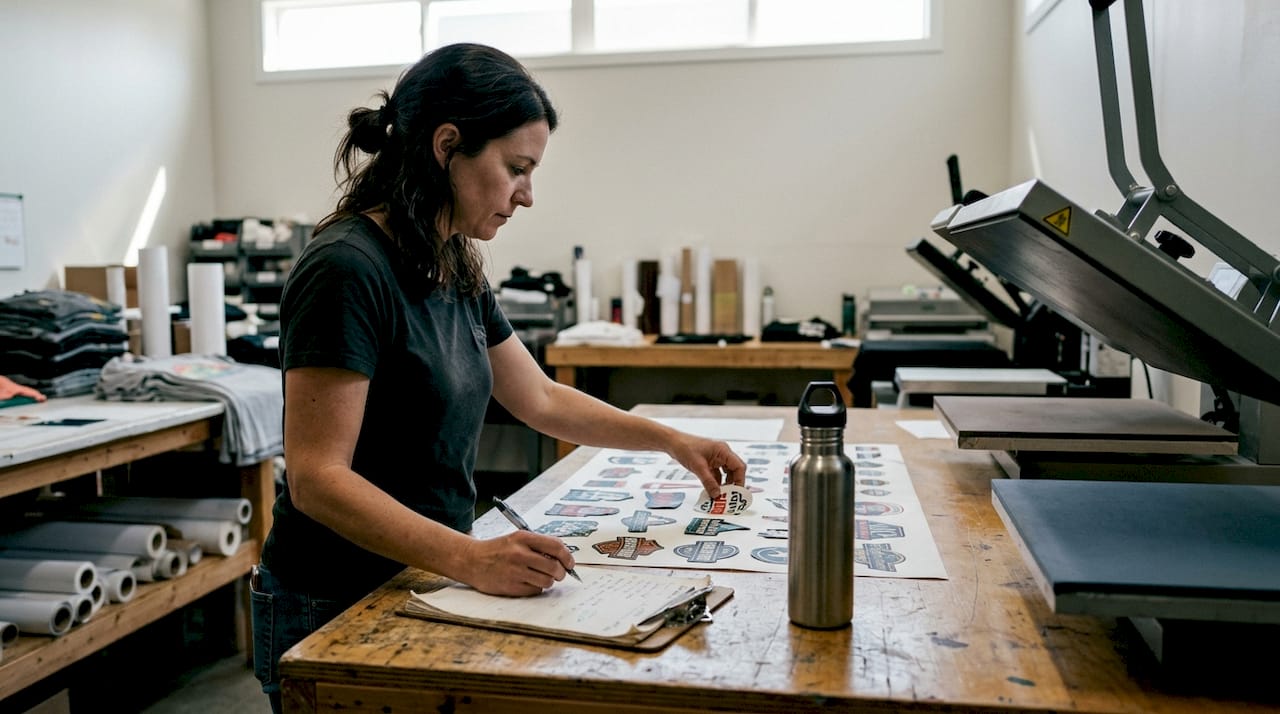
Sales up 40%, profit margins increased by 15%, and inventory costs dropped 25% are real numbers reported by small businesses that adopted DTF-based workflows. Those aren’t marketing claims. They reflect what happens when you stop pre-printing finished garments and start working with stored transfers instead.
The DTF print workflow guide breaks this down step by step, but here’s the core production model:
- Forecast demand based on past orders and seasonal trends
- Design and layout gang sheets to maximize film usage
- Print and cure transfers in batches
- Store transfers flat in a cool, dry space (they stay press-ready for months)
- Apply on demand as orders arrive, pressing in minutes
- Reorder or reprint only when stock runs low
| Production stage | Traditional model | DTF lean model |
|---|---|---|
| Setup time | Hours per design | Minutes per run |
| Inventory type | Finished garments | Stored transfers |
| Minimum run | 24-48 pieces | 1 piece |
| Response to new orders | Days | Same day |
| Wasted stock risk | High | Very low |
Pro Tip: Track your transfer usage by design SKU. After 60 days, you’ll know exactly which designs move fast and which ones sit. That data tells you how to plan your next gang sheet batch without guessing.
This model also reduces the need for large production facilities. You’re not storing 500 pre-printed hoodies. You’re storing flat film transfers that take up a fraction of the space. For small shops, that’s a real operational advantage.
Applying DTF for custom and mass production success
Understanding the theory is one thing. Building a workflow that actually runs smoothly is another. Here’s how to apply DTF effectively across both custom orders and larger batch runs.
Gang sheets are your most powerful tool for efficiency. Instead of printing one design at a time, you fill an entire sheet with multiple designs, or multiples of the same design, and print them all at once. This cuts your cost per transfer significantly and keeps your press time focused on application rather than waiting for prints.
To optimize with gang sheets, group designs by size and color profile when possible. This reduces ink waste and keeps print quality consistent across the sheet. For shops handling custom DTF gang sheets, the layout step is where you save or lose money.
Hybrid use of DTF with other print methods is often the most strategic approach for decorators. Use DTF for the custom, variable, or short-run work. Use screen printing for the large, simple, high-volume jobs. Don’t force one method to do everything.
Practical tips for daily DTF production:
- Batch similar-sized designs together on gang sheets to reduce waste
- Use DTF for player names and numbers on sports uniforms, no extra setup needed
- Outsource larger DTF runs to a provider when your in-house capacity maxes out
- Keep a transfer inventory log so you always know what’s press-ready
- Combine DTF with screen printing for orders that include both simple and complex elements
Pro Tip: For variable data orders like custom names or event-specific text, DTF is unbeatable. You can print 50 different names on one gang sheet and press each one individually with zero reprinting or setup changes.
Your workflow should look like this: order intake, gang sheet layout, print and cure, store, press on demand. Every step is predictable, repeatable, and scalable without adding headcount.
DTF’s future in mass production: What most overlook
Most conversations about DTF focus on cost savings and print quality. Those matter. But the bigger story is what DTF does to your business model.
Small decorators who adopt DTF aren’t just switching print methods. They’re shifting from a reactive production model to a proactive one. They’re building inventory of transfers, not finished goods. They’re responding to orders faster. They’re taking on jobs they would have turned down before because the setup cost wasn’t worth it.
Many shops ignore gang sheet strategy or never calculate their actual break-even point. That’s where money gets left on the table. The hybrid use of DTF and traditional methods is what separates decorators who grow from those who stay flat.
DTF is also evolving fast. Ink formulations are improving for stretch fabrics and outdoor durability. Automation in curing and application is reducing labor per piece. If you’re building your workflow around DTF now, you’re positioning yourself to adopt those upgrades without rebuilding from scratch.
For shops thinking about DTF for business branding, the opportunity goes beyond apparel. Branded merchandise, promotional items, and corporate uniforms are all within reach using the same workflow. That’s a revenue stream many decorators haven’t tapped yet.
Level up your apparel production with expert DTF solutions
You’ve seen what DTF can do for your production capacity, your margins, and your flexibility. The next step is working with a provider who can match your pace and your quality standards.
At Transfer Kingz, we specialize in high-quality DTF transfers built for decorators who need speed, consistency, and no minimums. Whether you’re running small custom batches or scaling toward mass production, our gang sheet builder and fast turnaround times keep your workflow moving. Decorators in the region can take advantage of local fulfillment through our DTF transfers Dallas and DTF transfers Texas services, reducing shipping time and getting you to the press faster. Upload your artwork, build your gang sheet, and see why thousands of decorators trust us for production-grade transfers.
Frequently asked questions
What makes DTF better than other printing methods for mass production?
DTF supports on-demand production with fast setup, no minimums, and full-color flexibility, making it the strongest option for custom or mixed-design runs in the 1 to 500 unit range.
How does DTF reduce inventory and operational costs?
DTF lets you pre-produce transfers and store them until orders arrive, which means inventory costs drop 25% compared to holding pre-printed finished garments that may not sell.
What order size is DTF most cost-effective for?
DTF is most cost-effective for runs of 1 to 500 units, with most shops hitting their break-even point between 200 and 600 transfers per month when compared to outsourcing all decoration work.
Can I combine DTF with other production methods?
Absolutely. Many successful shops use DTF for custom, quick-turn, or complex orders and hybrid use with screen printing for large, simple runs where screen setup costs are justified by volume.
Recommended
- How DTF revolutionizes textile manufacturing for businesses – Transfer Kingz
- Leverage DTF technology for apparel customization in 2026 – Transfer Kingz
- Role of DTF in apparel: guide for clothing businesses – Transfer Kingz
- What Is DTF Printing: Transforming Custom Apparel – Transfer Kingz
- DTF Printing: Transforming Garment Businesses Today – SubliBlanks Ltd
- Custom apparel durability: Screen printing vs DTF longevity
0 comments