

TL;DR:
- Direct-to-Film printing enables indie designers to produce full-color, detailed transfers without minimum orders or high setup costs. It allows rapid, flexible, and cost-effective small-batch production that enhances brand agility and learning. Proper curing and testing are essential to maximize durability, making DTF a valuable tool for iterative, sustainable, and on-demand apparel development.
Custom apparel printing has long been a gatekeeping game. Minimum order quantities, steep setup fees, and the unforgiving economics of traditional methods kept countless indie designers on the sidelines. If you wanted to launch a capsule collection of 20 pieces, screen printing would eat your margin before you sold a single shirt. DTF printing, or Direct-to-Film printing, changes that equation entirely. This guide walks you through the real costs, quality benchmarks, and practical applications of DTF so you can make smarter decisions for your brand right from the start.
Table of Contents
- What is DTF printing and why does it matter for indie designers?
- DTF vs. traditional screen printing: A cost and flexibility comparison
- Durability and quality: What indie designers need to know about DTF results
- Practical applications: How indie brands use DTF to launch, iterate, and scale
- What most indie designers miss about DTF: The hidden ROI of agility and learning
- Boost your indie brand with expert DTF printing solutions
- Frequently asked questions
Key Takeaways
| Point | Details |
|---|---|
| Lower barriers to entry | DTF removes costly setup fees, making small runs viable for indie designers. |
| Durability depends on process | Proper curing, materials, and testing ensure DTF prints hold up after 50+ washes. |
| Maximize creativity and agility | DTF enables rapid design changes and on-demand product launches, ideal for small brands. |
| Quality requires active control | Measuring results and tracking press parameters reduces defects and boosts customer satisfaction. |
What is DTF printing and why does it matter for indie designers?
Direct-to-Film printing is a process where a design is printed onto a special film, coated with a hot-melt adhesive powder, cured, and then heat-pressed directly onto fabric. The result is a full-color, highly detailed transfer that bonds tightly to the textile. No screens. No color separations. No plate fees.
Understanding what is DTF printing at a technical level helps you appreciate why it fits indie production so well. Unlike screen printing, which requires a separate screen for every color in your design, DTF handles gradients, fine details, and unlimited colors in a single pass. That alone removes a massive barrier.
Here is what sets DTF apart for indie designers specifically:
- No minimum order requirements: You can order one transfer or one hundred. Your production quantity matches your actual demand.
- Fast turnaround: Most DTF providers turn files around in 24 to 72 hours, meaning you can react to trend moments without sitting on unsold inventory.
- Works on virtually any fabric: Cotton, polyester, denim, nylon, and even leather all accept DTF transfers cleanly, giving you flexibility that dye-sublimation or traditional screen printing simply cannot match.
- Preserves fine art details: Watercolor-style artwork, photographic textures, and thin linework all reproduce sharply, which matters enormously for designers whose identity lives in intricate visual work.
- Low barrier to iteration: You can test five different colorways on sample garments before committing to a full production run.
The numbers back this up. Small-batch and on-demand apparel sees DTF’s key impact as removing or greatly reducing per-order setup overhead compared with screen printing. For indie brands, that overhead reduction is the difference between a profitable micro-drop and a financial risk.
DTF vs. traditional screen printing: A cost and flexibility comparison
Now that you know the basics, let’s put DTF and traditional screen printing side-by-side to highlight exactly where indie designers benefit most.
Screen printing is a proven, beautiful technique. It produces vivid, highly durable prints and remains the best choice for large runs of simple designs. But its economics are built for volume, and volume is exactly what most indie designers do not have.
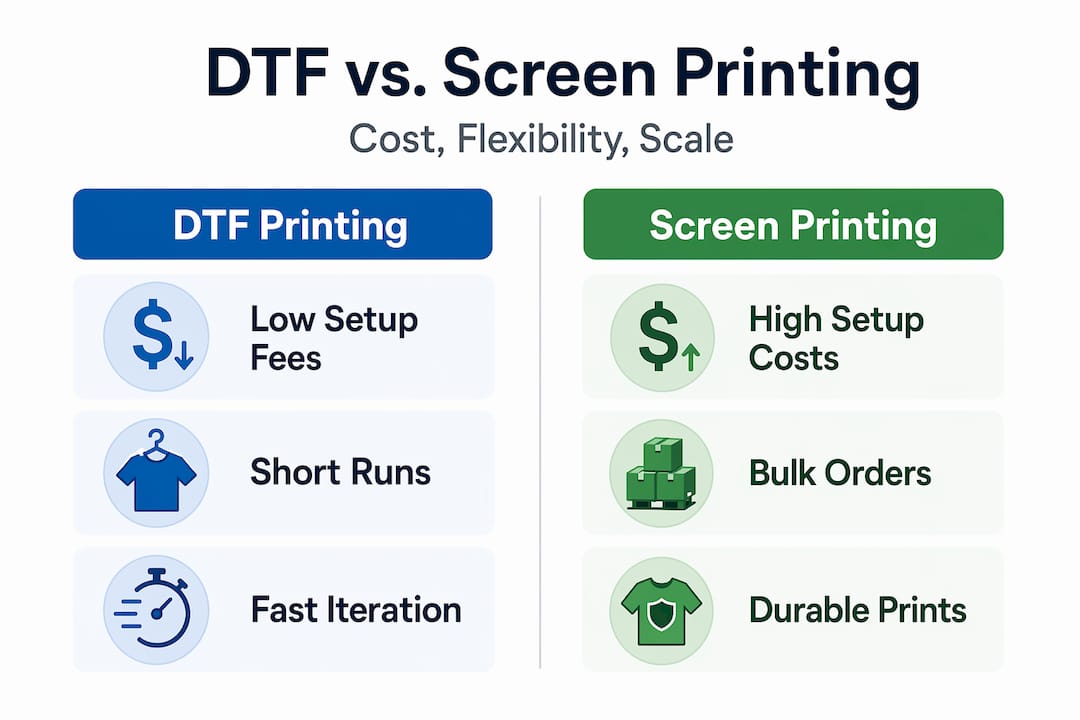
DTF vs. screen printing comes down to one core difference: fixed costs vs. variable costs. Screen printing carries high fixed costs regardless of quantity. Setup fees for a four-color design typically run $50 to $100 per screen, meaning a four-color logo costs $200 to $400 before a single shirt is printed. DTF has almost no setup cost because your artwork file is the setup.
| Order quantity | Screen printing estimated cost per unit | DTF estimated cost per unit |
|---|---|---|
| 12 pieces | $18 to $28 | $6 to $10 |
| 24 pieces | $12 to $18 | $5 to $9 |
| 48 pieces | $7 to $12 | $5 to $8 |
| 100 pieces | $5 to $8 | $4 to $7 |
| 500 pieces | $3 to $5 | $3 to $6 |
At smaller quantities, DTF wins decisively. As order size grows toward 500 units and beyond, screen printing starts to close the gap. For orders under 48 pieces, setup costs make screen printing the wrong tool, while DTF avoids screen and setup overhead entirely.
“The smartest indie brands treat DTF and screen printing as tools in a toolkit, not competitors. DTF for testing and small drops, screen printing for proven bestsellers at scale.”
The digital printing cost savings extend beyond the per-unit price. When you eliminate minimum orders, you eliminate dead inventory. Unsold stock is one of the biggest silent killers of small fashion businesses. DTF lets you print what you need, when you need it.
Pro Tip: Start every new design as a DTF run of 12 to 24 pieces. Gauge actual sell-through data before scaling. If a design moves fast, then evaluate whether a larger screen-printing run makes financial sense for that specific item.
Durability and quality: What indie designers need to know about DTF results
Cost and speed are vital, but DTF’s quality—and how you control it—can make or break your brand’s reputation.
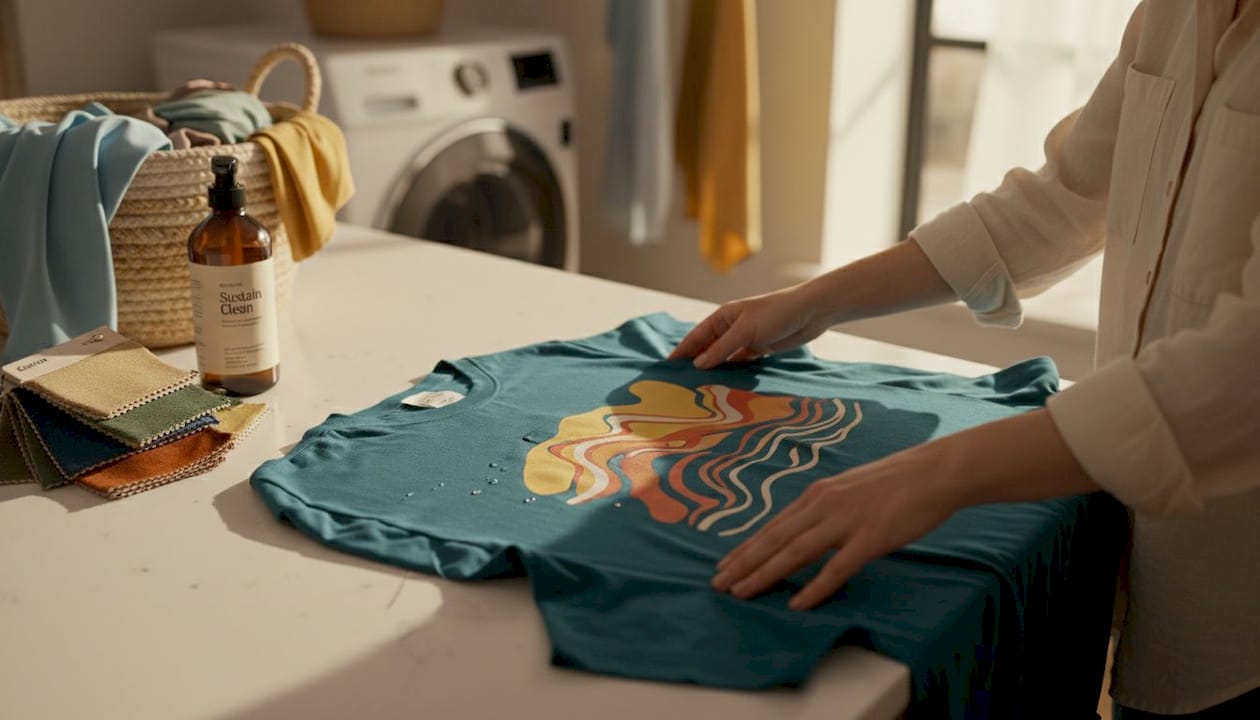
DTF prints are often misunderstood on the durability front. Some designers assume that because DTF is faster and cheaper, it must sacrifice longevity. That assumption is wrong, but it comes with a condition: quality outcomes depend heavily on how transfers are cured and applied. Wash durability and defect rates for DTF are highly sensitive to curing and press parameters, meaning indie designers get better outcomes by treating durability as measurable rather than assuming uniform longevity.
| Cure method and material | Estimated wash cycles | Defect risk |
|---|---|---|
| Proper temp and time, 100% cotton | 50 to 80 washes | Low |
| Proper temp and time, polyester blend | 60 to 100 washes | Low |
| Under-cured, any fabric | 10 to 25 washes | High (peeling, cracking) |
| Over-cured, synthetic fabric | 30 to 60 washes | Medium (fiber damage) |
| Correct settings, performance fabric | 40 to 70 washes | Low to medium |
The standards that matter here are AATCC 61 (a widely used American wash-fastness testing protocol) and ISO 105-C06, which measures color change after repeated washing cycles. You do not need a laboratory to run meaningful tests. You need consistent pressing conditions, a home washing machine, and a logbook.
Here is a numbered process that separates brands that get returns from brands that build loyalty:
- Document your press settings every time. Temperature, dwell time, and pressure are your three variables. Write them down for every production run.
- Run a wash test on a sample before shipping any new design. Wash it five times and inspect for peeling, color fade, or edge lifting.
- Test across your actual fabric suppliers. A transfer that performs beautifully on one blank brand may behave differently on another with a different cotton weave or finish.
- Photograph results at baseline, after 10 washes, and after 25 washes. Visual records give you proof of quality and help you identify trends before they become customer complaints.
- Use a cold-water, inside-out wash standard as your care instruction baseline. This extends DTF print life significantly and should be included on your hangtags or care labels.
Pro Tip: Buy three of every blank you plan to use in a new season and run wash tests before ordering transfers in volume. It costs less than $30 and can save you hundreds in returns and refunds.
Staying current on DTF industry trends helps you track advances in adhesive powder formulations and ink technology that are steadily pushing wash-fastness benchmarks higher. The durable apparel printing landscape is evolving quickly, and the gap between DTF and traditional methods continues to narrow.
Practical applications: How indie brands use DTF to launch, iterate, and scale
Armed with knowledge of DTF’s cost and quality, it’s time to explore how real indie brands are putting that power to work.
DTF is not just a printing method. Used strategically, it becomes a product development engine. Here are the most impactful ways indie designers are using it right now.
Rapid product launches: A designer with a new graphic concept can go from finished art file to wearable sample in 48 hours. That speed means you can test a design at a pop-up market or on social media before committing to production. If the response is strong, you scale. If it falls flat, you move on with minimal financial damage.
Seasonal micro-drops: Many indie brands have found success releasing limited-edition seasonal drops of 15 to 30 pieces. DTF makes these economically viable. You generate urgency with scarcity, avoid overstock, and build a reputation for freshness. Brands experimenting with upcycled and sustainable fashion, like those profiled in upcycled indie brands, use exactly this model to stay lean and creative.
On-demand fulfillment: Some indie designers operate a made-to-order model where no garment is printed until a customer buys it. DTF supports this model perfectly because there is no setup cost per order. The margin stays intact even at quantities of one.
Graphic testing across colorways: Instead of committing to a full run of a design in one colorway, you can print samples in three or four color variations and show them to your audience first. Real purchase data tells you which version to produce at scale.
Here are the most actionable recommendations for maximizing DTF in your indie brand:
- Order gang sheets when possible. A gang sheet lets you pack multiple designs onto a single large transfer film, dramatically reducing your per-design cost.
- Keep an artwork library ready to go. Designs formatted correctly for DTF can be ordered and in production within minutes of your decision to release.
- Build wash-test results into your product descriptions. Saying “tested to 50+ wash cycles” is a genuine selling point that builds consumer trust.
- Partner with a DTF provider that offers no minimums. This is non-negotiable for indie operations where demand is unpredictable.
- Use branding with DTF transfers not just for clothing but for tote bags, hats, and branded merchandise that extend your visual identity beyond apparel.
Reading small business DTF success stories from 2026 reveals a consistent pattern: the brands doing best are not necessarily the ones spending the most. They are the ones iterating the fastest. DTF is the tool that makes that iteration affordable.
Pro Tip: Before launching a new collection, produce five samples in your most versatile colorway and ship them to micro-influencers in your niche. Their organic content generates awareness while you finalize production quantities based on real pre-order signals.
What most indie designers miss about DTF: The hidden ROI of agility and learning
Here is where most conversations about DTF stop short. Designers and small business owners evaluate DTF purely on cost savings versus their old method. That is useful, but it misses the deeper value.
The real return on investment from DTF is not the money you save per unit. It is the speed at which you learn what your customers actually want.
Traditional production cycles force you to commit big before you know anything. You design a collection, source blanks, pay for screens or embroidery setups, produce 100 units, and then find out whether the market responds. That learning cycle can take four to six months and cost several thousand dollars. DTF compresses that cycle to days and costs a fraction of the amount.
When you can test a design with 12 shirts instead of 100, you run more experiments per season. More experiments mean more learning. More learning means your instincts about what resonates with your audience sharpen faster than competitors who are locked into longer production cycles.
There is also a brand transparency angle that is underused. Designers who run their own wash tests and share those results openly are building a form of trust that no marketing budget can buy. Saying “we tested this print to 60 wash cycles before releasing it” tells customers you care about what happens to the product after it leaves your hands. The branding benefits of DTF extend far beyond the print itself when you build quality into your story.
Agility also means responding to culture faster. When a moment happens and your design is relevant to it, a one-week production cycle lets you act on that moment. A six-week traditional cycle means you miss it entirely.
The indie designers who will outpace their peers in 2026 are not the ones with the lowest cost per unit. They are the ones who treat DTF as a learning platform, not just a production tool.
Boost your indie brand with expert DTF printing solutions
Ready to put everything you just learned into action? Partnering with an experienced DTF provider is the fastest path from concept to finished product. Transfer Kingz specializes in high-quality DTF transfers with no minimum order requirements, fast turnaround times, and premium inks that meet the durability standards your brand deserves.
Whether you are based in the Southwest or shipping nationwide, DTF transfers Dallas and DTF transfers Texas fulfillment options give indie brands reliable regional access to fast production. Upload your artwork, build your gang sheet, and get professional-grade transfers delivered to your workspace. No minimums, no guesswork, and no production overhead standing between your idea and the market.
Frequently asked questions
What order size makes DTF more cost-effective than screen printing?
For runs under 48 pieces, DTF usually becomes more economical due to much lower setup costs per order. Screen printing economics only work well at volume, while DTF avoids screen and setup overhead entirely.
How many washes can a high-quality DTF print usually withstand?
Quality DTF prints target durability between 50 and 100 wash cycles when properly cured and applied to quality fabric, referencing standards like AATCC 61 and ISO wash-fastness protocols.
What factors most affect DTF print durability?
Curing temperature, press dwell time, fabric type, and quality assurance testing all directly impact DTF wash-fastness. Incorrect dwell time or temperature can degrade fibers and cause edge cracking, reducing wash durability significantly.
Can DTF support eco-friendly or upcycled apparel brands?
Yes. DTF printing is flexible enough for upcycled and sustainable fashion, allowing quick, low-waste customizations across diverse fabrics without the chemical-intensive setup process that traditional screen printing requires.
0 comments