

Most DTF transfer orders reach customers in about 4 to 6 business days from order confirmation to doorstep, based on measured delivery data from over 2,300 orders across 49 states. The fastest realistic path, rush production paired with overnight carrier service, can put transfers in your hands in one business day, but only when your order clears the daily production cutoff and qualifies for expedited handling.
Here’s the cutoff logic that decides your dispatch date:
- Orders approved before the cutoff (commonly somewhere between 12 PM and 4 PM local time) typically ship the same business day.
- Orders approved after that window roll to the next business day’s production run.
- Same-day and overnight combined is the ceiling for speed. Nothing ships faster than a same-day print paired with an overnight carrier pickup.
Quick fact: State-level shipping averages in the U.S. range from about two to three days on the fast end to about a week or more for slower corridors, a spread wide enough to change how you plan a Friday deadline.
Key Takeaways
DTF shipping times depend on production cutoffs and carrier transit combined, and both must align with your event date to avoid a missed deadline.
| Point | Details |
|---|---|
| Know your average | Most U.S. orders arrive in a few business days, but state averages range widely depending on location. |
| Cutoffs control dispatch day | Orders approved before the daily cutoff typically ship same day; late approvals roll to the next business day. |
| Separate production from transit | Total lead time is production days plus carrier transit days, not transit time alone. |
| Build in a buffer | Add extra days during peak seasons and for bulk gang sheet orders with higher queue depth. |
| Use Transfer Kingz for rush jobs | Transfer Kingz offers same-day options, no minimums, and a gang-sheet builder to help you hit tight deadlines. |
Table of Contents
- How Long Does DTF Shipping Take by State?
- What Determines Your DTF Order Processing Time?
- Which Shipping Speed Should You Choose?
- What Slows Down or Speeds Up Your DTF Delivery?
- How Do You Calculate a Safe Order Date?
- How Transfer Kingz Handles Rush Orders
- Editorial Take: DTF Shipping Times for Decorators
- Skip the Guesswork on Your Next DTF Order
- Sources
How Long Does DTF Shipping Take by State?
Where you live changes your delivery math more than most decorators realize. A shop in a state near a major fulfillment hub might see transfers in 2 days flat, while a shop three time zones away, or in Alaska or Hawaii, should plan for the long end of the range.
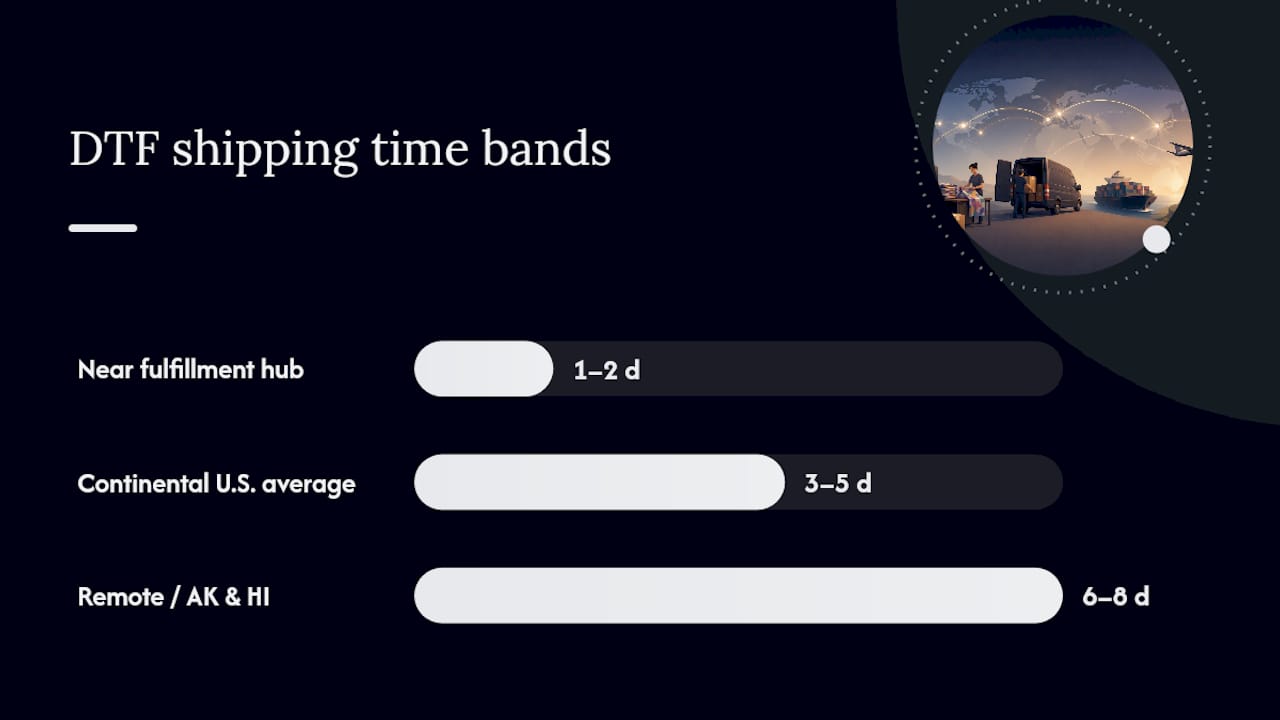
Three rough bands show up consistently in delivery data:
- 1 to 2 business days: Orders shipped to states close to the fulfillment center or served by strong regional carrier routes.
- 3 to 5 business days: The national average band, where most orders in the continental U.S. land.
- 6 to 8 business days: Remote areas, Alaska, Hawaii, and corridors where carrier routing adds extra hops.
The state-by-state shipping data backs this up with real numbers: fastest states averaging around 2.6 days, slowest states pushing toward 7 to 8 days, and a national average sitting near 4 to 6 days.
Why the spread? Carrier hub proximity does most of the work. A fulfillment operation positioned near a major logistics corridor, similar to how regional print facilities map to carrier networks, cuts down the number of transfer points a package needs before it reaches you. States sitting off the beaten path for major carriers simply take longer, regardless of how fast the transfer itself was printed.
One caution worth repeating: site-wide averages are a planning tool, not a promise. A single order can beat or miss the average based on weather, carrier volume that week, or a packaging error that triggers a reship. Customer feedback on platforms like Trustpilot shows this variability firsthand, with reviewers reporting both faster-than-expected arrivals and the occasional delay. Build a buffer into your timeline instead of betting the deadline on the average.
What Determines Your DTF Order Processing Time?
Shipping speed only matters once your order actually leaves the building. Production turnaround, the print, cure, and quality check cycle, is the part decorators tend to underestimate.
- Print and cure time. A standard DTF transfer needs time to print, then cure under heat so the adhesive powder bonds correctly. Rushing this step produces transfers that crack or peel after a few washes, so legitimate rush production compresses the schedule without skipping the cure.
- Order complexity. A single small transfer prints faster than a packed gang sheet with a dozen designs, layered colors, or fine detail work. More elements on the sheet means more time on press.
- Quality check and packaging. Every sheet gets inspected before it ships. A failed check, misaligned print, color drift, film defect, sends the job back to the queue rather than out the door.
- File readiness. Cutoff language on many vendor pages reads something like “orders confirmed before 4 PM CST ship same business day,” a pattern that shows up across the DTF industry broadly. Miss that window with a late artwork fix or an unresolved file error, and your order slides to the next business day automatically.
Some product lines can print and ship within 48 hours even without a formal same-day request, a benchmark major consumer printing platforms have shown is achievable for qualifying transfer types. That’s the industry ceiling for speed on the production side. Getting there consistently requires clean files and simple designs, not just paying for rush service.
Which Shipping Speed Should You Choose?
Once your transfer sheet is printed and packaged, the carrier clock starts. This is a separate countdown from production, and mixing the two up is the single most common planning mistake decorators make.
- Standard ground (USPS, UPS Ground, FedEx Ground): typically 3 to 5 business days in transit.
- Expedited/2-day (UPS 2nd Day Air, FedEx 2Day): typically 2 to 3 business days in transit.
- Overnight (UPS Next Day Air, FedEx Overnight): 1 business day in transit.
These windows echo the tiered structure many DTF vendors publish, separating standard, express, and overnight carrier tiers from the production clock that runs before any of them start.
Total lead time is production days plus carrier transit days, not carrier transit days alone. A same-day-shipped order on overnight carrier service can beat a 3-day-production order sent standard ground, even though standard ground sounds slower on paper.

Pro Tip: Before you pay extra for overnight shipping, check whether ordering one day earlier gets you the same delivery date on standard ground. Expedited shipping fixes a tight calendar. It doesn’t fix a production queue that’s already backed up, so confirm your cutoff first.
What Slows Down or Speeds Up Your DTF Delivery?
A handful of variables decide whether your order beats the average or lands on the slow end of it, and most of them are within your control if you plan around them.
- Order size and complexity. A 22 by 24 inch gang sheet packed with designs takes longer to print and inspect than a handful of small logos.
- Seasonality. Back-to-school season, holiday team orders, and major promotional pushes stack up production queues and carrier volume at the same time, which stretches both halves of your timeline.
- File readiness. Approvals that come in late, or artwork that fails a pre-flight check, bump a job out of the same-day window even if you submitted early in the day.
- Destination distance. A shop three states from the fulfillment center will always see faster transit than one on the opposite coast, regardless of how fast production ran.
- Address accuracy. A mistyped suite number or missing apartment number causes carrier delays that have nothing to do with your printer.
How Do You Calculate a Safe Order Date?
Run the math with a simple formula: production days + carrier transit days + buffer days = total lead time. Work backward from your event date using that number, and you’ll rarely get caught short.
- Example A, local rush order. You need transfers in 3 business days for a local event. Same-day production plus 2-day carrier transit uses your full window with zero buffer, so this only works if your files are already print-ready and approved.
- Example B, 250-transfer bulk order. A gang sheet order at this volume typically needs 2 to 3 production days, since queue depth and color complexity add time beyond a single small transfer. Add 3 to 5 days standard transit, and you’re realistically 5 to 8 business days out, longer if it ships during a peak season.
| Scenario | Recommended lead time |
|---|---|
| Small rush order, same-day production available | 2 to 3 business days |
| Standard order, national average | 4 to 6 business days |
| Bulk gang sheet (250+ transfers) | 6 to 9 business days |
| Peak season (holidays, back-to-school) | Add 2 to 3 extra days to any estimate above |
How Transfer Kingz Handles Rush Orders
Transfer Kingz built its production process around the reality that decorators often don’t have a week to spare. The site offers same-day DTF transfer options for qualifying orders, no minimum order quantities, and a gang-sheet builder that lets you lay out multiple designs on one sheet without juggling separate orders.
The fastest way to protect your deadline is preparing files correctly before you submit. Transfer Kingz’s guide to ordering fast walks through sizing, file formats, and the pre-flight checks that keep a job from bouncing back to the queue. Using a gang-sheet builder with built-in artwork checks meaningfully cuts the odds of a production hold pushing your job to the next business day.
Pro Tip: Confirm your production cutoff can actually meet your deadline before you pay for expedited shipping. Rush shipping on a delayed print job just gets you a fast delivery of a late order.
Editorial Take: DTF Shipping Times for Decorators
Most guidance on this topic treats shipping speed like the whole story. It isn’t. The bigger lever is production readiness, and almost nobody talks about that part.
I’d push back on the instinct to throw money at overnight shipping the moment a deadline feels tight. That fixes exactly one problem, carrier transit, and does nothing for a production queue that’s already backed up or a file that’s going to fail quality check. The decorators who consistently hit deadlines aren’t the ones paying for the fastest carrier. They’re the ones submitting clean, print-ready files before the cutoff, every time, so same-day production is even possible.
The state-by-state variation matters more than most site-wide averages let on, too. If you’re ordering from a state on the slow end of that 2.6 to 8-day range, a 4 to 6 day average is optimistic for you specifically. Build your buffer around your own state’s realistic window, not the national number, and you’ll stop getting surprised.
— Anthony
Skip the Guesswork on Your Next DTF Order
Transferkingz is the alternative to waiting on a slow, minimum-order print shop when your deadline won’t budge. There’s no minimum order quantity, so a single rush transfer gets the same priority as a bulk gang sheet, and the gang-sheet builder lets you lay out complex, multi-design jobs yourself instead of emailing back and forth with a print shop over layout revisions.
If your artwork has fine detail work, small text, gradients, or intricate line art, it’s worth checking whether digital transfer film can hold that level of detail before you finalize your files, since that’s often where production holds start. Once your file is print-ready, submit it before your local cutoff and choose the shipping tier that matches your actual deadline, not the fastest one available by default.
0 comments