

TL;DR:
- Choosing the right apparel decoration method depends on fabric type, design complexity, and order quantity to ensure quality and cost-effectiveness. Digital options like DTF and DTG are ideal for small runs, while screen printing suits larger orders with simpler designs. Proper fabric selection and thorough proof approval are essential to prevent costly errors and achieve durable, high-quality results.
Apparel decoration is defined as the process of applying custom designs to garments using methods such as screen printing, direct-to-film (DTF) transfers, embroidery, heat transfer, and sublimation printing. For entrepreneurs building a brand or launching a merchandise line, understanding these techniques is the difference between a product that lasts and one that peels after three washes. The right method depends on three factors: fabric composition, design complexity, and order quantity. Sources including Artik, Custom Ink, and Dr Tee’s Design confirm that treating decoration as a production decision rather than a simple purchase is what separates successful apparel brands from costly missteps.
What are the main types of apparel decoration methods?
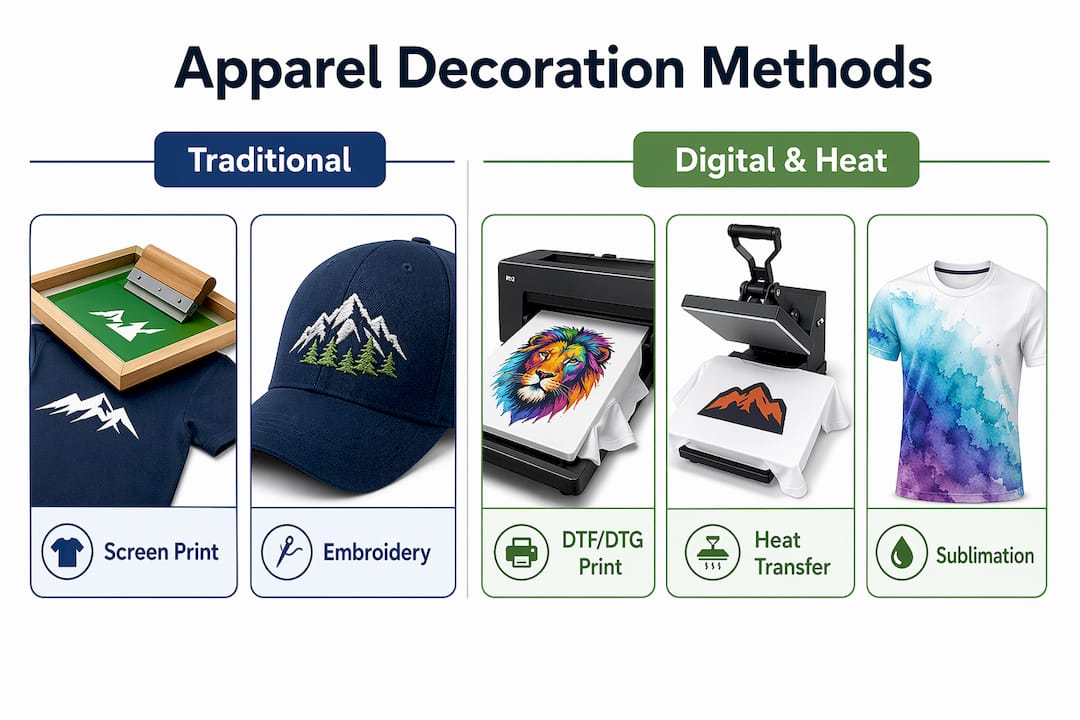
Custom garment decoration covers five primary techniques, and each one serves a different production scenario. Knowing which method fits your project before placing an order saves money and prevents quality failures.
Screen printing bonds ink directly to fabric through a mesh stencil. It produces durable, vibrant results on cotton-heavy garments and performs best at higher volumes where setup costs spread across more units. Each color in the design requires a separate screen, so a four-color logo costs more to set up than a single-color one.
Digital printing, which includes DTF (direct-to-film) and DTG (direct-to-garment), uses inkjet technology to print full-color designs without per-color setup fees. Digital printing provides unlimited colors at no added cost, making photographic or gradient-heavy artwork just as affordable as a simple one-color design. This makes digital methods the go-to choice for short runs, one-off pieces, and highly personalized orders.
Embroidery stitches thread directly into the fabric. The result looks premium and holds up through commercial laundering, which is why it dominates the uniform and corporate apparel market. Design complexity is measured in stitch count rather than color count, and highly detailed artwork often needs to be simplified to translate well into thread.
Heat transfer and vinyl methods apply pre-printed or cut designs using heat and pressure. They work well for small batches and personalization but vary in durability depending on the transfer type and application quality.
Sublimation printing bonds dye directly into synthetic fibers at a molecular level, producing wash-resistant prints with no texture on the surface. It is the standard for performance wear, sports uniforms, and all-over print designs.
| Method | Best for | Minimum order | Color cost | Durability |
|---|---|---|---|---|
| Screen printing | Large runs, simple designs | 12-24 pieces | Per color | High |
| DTF/DTG digital | Short runs, complex art | 1 piece | Flat rate | High (DTF), Medium (DTG) |
| Embroidery | Uniforms, polos, caps | 12 pieces | Per stitch count | Very high |
| Heat transfer/vinyl | Personalization, small batches | 1 piece | Flat | Medium |
| Sublimation | Performance wear, all-over print | 1 piece | Flat rate | Very high |
Pro Tip: Match your method to your garment before finalizing your design. A logo that works beautifully as a DTF print may require significant simplification to translate into embroidery.
For a direct comparison of screen printing and DTF on cost and order thresholds, the DTF vs screen printing breakdown from Transferkingz covers both methods in depth.
How do fabric types affect your decoration choices?
Fabric composition is the most overlooked variable in apparel decoration, and it is also the most common cause of failed orders. Ignoring fabric composition when selecting a decoration method leads to faded prints, ink bleed, and structural damage to the garment.
Here is how the major fabric types interact with decoration methods:
- 100% cotton absorbs water-based inks exceptionally well, making it the preferred base for DTG printing and screen printing. It is not suitable for sublimation.
- Polyester and synthetic blends are required for sublimation. Sublimation requires at least 60-65% polyester content for the dye to bond properly. Below that threshold, prints appear faded and washed out.
- Cotton-polyester blends work with screen printing and DTF but require careful ink selection to prevent dye migration on the polyester fibers, especially with dark garments.
- Fleece and structured fabrics like polo shirts and caps are well-suited for embroidery. Using a topping film during embroidery on fleece keeps stitches clean and prevents thread from sinking into the pile.
- Lightweight performance fabrics are vulnerable to heat damage during heat transfer application. Always check the garment’s heat tolerance before pressing.
Proper fabric selection reduces costly production errors and directly improves print durability and final appearance. Cotton absorbs water-based ink well, polyester enables sublimation, and fleece performs best with embroidery using topping film for stitch clarity. This is not a minor detail. It is the foundation of a quality result.
Before finalizing any decoration order, pull the garment spec sheet from the manufacturer. It lists fiber content, weight, and care instructions, all of which affect how the decoration will perform over time.
Pro Tip: If you are ordering garments and decoration separately, confirm the fabric content of your blanks before choosing a print method. A 50/50 blend that looks like a standard tee can ruin a sublimation run.
What are the cost and quantity factors in choosing a decoration method?
Decoration pricing is not linear. The method you choose has a fixed cost structure that either rewards volume or penalizes it, and understanding that structure prevents budget surprises.
Setup costs for screen printing and embroidery depend on color count and stitch count respectively. A three-color screen print requires three separate screens to be burned and registered before a single shirt is printed. That setup cost is the same whether you print 10 shirts or 500. At low volumes, that fixed cost makes each unit expensive. At high volumes, it becomes negligible.
Orders under 24 pieces are generally more cost-effective using digital decoration methods like DTF or DTG because they avoid per-color screen setup fees entirely. This is the industry-standard threshold that separates analog from digital decoration decisions. Cross it in either direction and your cost-per-unit changes significantly.
Follow these steps to estimate decoration costs accurately before requesting a quote:
- Define your order quantity. Know your exact piece count. Even a rough range (12 vs. 50 vs. 200) changes which method makes financial sense.
- Count your design colors. For screen printing, each color adds a setup fee. For digital methods, color count is irrelevant to price.
- Identify your fabric type. Confirm the garment’s fiber content so you can rule out incompatible methods before pricing them.
- Calculate your break-even volume. Setup costs create significant per-piece impact at low quantities for screen printing. Ask your supplier at what quantity screen printing becomes cheaper than digital for your specific design.
- Factor in turnaround time. Standard turnaround is 10 to 14 business days after artwork approval. Rush orders typically carry a surcharge, so build your timeline before committing to a method.
- Request itemized quotes. Ask for setup fees, per-unit cost, and shipping listed separately so you can compare methods on a true total-cost basis.
For practical strategies on reducing digital print costs, the Transferkingz guide on DTF cost-saving tips covers gang sheet optimization and order batching in detail.
What best practices lead to a successful decoration order?
The production process for custom apparel decoration has several checkpoints where errors compound quickly. Getting these right the first time eliminates delays, reprints, and wasted inventory.
- Submit the correct file format. Vector files (.ai, .eps, .pdf) or high-resolution raster images at 300 DPI are the standard requirement. Low-resolution files are the leading cause of production delays and manual setup fees. If your designer delivers a JPEG at 72 DPI, it will not print cleanly at garment scale.
- Approve your digital proof carefully. Skipping proof approvals is a major production risk. The proof is your last opportunity to catch color mismatches, spelling errors, and sizing problems before ink hits fabric. Treat it as a binding document, not a formality.
- Communicate garment specs upfront. Provide your supplier with the exact garment brand, style number, color, and size breakdown before production begins. Assumptions about garment color affect ink color selection and final appearance.
- Match the decoration method to the use case. A shirt going into commercial laundry needs embroidery or a high-durability DTF transfer, not a standard vinyl cut. A promotional giveaway tee does not need the same durability spec as a staff uniform.
- Plan print placement and contrast. Dark ink on a dark garment disappears. Light ink on a light garment fades visually. Confirm that your design colors contrast with the garment color before finalizing artwork.
- Build your timeline around production windows. Standard decoration runs take 10 to 14 business days after proof approval. Events, product launches, and retail drops require backward scheduling from the delivery date, not the order date.
Pro Tip: Proof approval is not a bureaucratic step. It is the single most effective quality-control action you take in the entire order process. Never skip it.
For deeper guidance on design preparation and method selection, the Transferkingz custom apparel design guide walks through the full decision process for small business owners.
Key takeaways
Apparel decoration succeeds when the method, fabric, design, and order quantity are aligned from the start rather than adjusted after problems appear.
| Point | Details |
|---|---|
| Method selection drives cost | Digital methods (DTF/DTG) are most cost-effective under 24 pieces; screen printing wins at higher volumes. |
| Fabric determines compatibility | Sublimation requires 60-65% polyester; DTG performs best on cotton-rich fabrics. |
| Artwork quality prevents delays | Submit vector files or 300 DPI rasters to avoid setup fees and production holds. |
| Proof approval is non-negotiable | Reviewing and approving digital proofs is the final quality check before production begins. |
| Timeline planning is production planning | Standard turnaround is 10-14 business days; rush surcharges apply when timelines are not built in advance. |
Why I think most entrepreneurs overcomplicate this decision
Most small business owners I talk to approach apparel decoration the same way they approach buying office supplies. They search for the lowest unit price, pick a method, and place an order. Then they are surprised when the result does not match what they imagined.
Viewing apparel decoration as a service rather than a commodity purchase is what changes the outcome. The method, the garment, and the design are a system. Pull one element out of alignment and the whole thing fails. A beautiful logo printed via DTG on a polyester-heavy shirt will look washed out from day one. An embroidered design with too much fine detail will look muddy at small sizes. These are not vendor problems. They are sourcing decisions made before the order was placed.
The other mistake I see consistently is treating the digital proof as a rubber stamp. The proof is the critical final quality-control step, and it is the one moment in the process where you have full control. Entrepreneurs who spend weeks on brand strategy and then approve a proof in 30 seconds without checking color codes or placement are leaving quality entirely to chance.
My honest recommendation: before you place any decoration order, write down your garment fabric, your design color count, your quantity, and your in-hands date. Those four data points determine your method, your budget, and your timeline. Everything else is execution.
— Anthony
How Transferkingz helps entrepreneurs get decoration right
Transferkingz specializes in high-quality DTF transfers that give small business owners the flexibility to decorate apparel without minimum order requirements or per-color setup fees. Whether you are producing five custom tees for a pop-up shop or 500 transfers for a retail launch, Transferkingz delivers vibrant, durable prints with fast turnaround times and no compromise on quality.
The gang sheet builder lets you maximize every print run by nesting multiple designs on a single sheet, cutting your cost per transfer significantly. Premium inks and films mean the transfers hold up through repeated washing without cracking or peeling. For entrepreneurs in Texas and beyond, the DTF transfers Dallas service page is the fastest way to get a quote and start your first order. Transferkingz also provides application guidelines and educational resources so you can apply transfers confidently from day one.
FAQ
What is apparel decoration?
Apparel decoration is the process of applying custom designs to garments using methods such as screen printing, DTF transfers, embroidery, heat transfer, and sublimation. The goal is to produce branded or personalized clothing for commercial, promotional, or retail use.
What decoration method works best for small orders?
Digital methods like DTF and DTG are most cost-effective for orders under 24 pieces because they carry no per-color setup fees. Screen printing becomes more economical as order quantities increase past that threshold.
Does fabric type really affect which print method I should use?
Fabric composition directly determines which decoration methods will work. Sublimation requires at least 60-65% polyester content, DTG performs best on cotton-rich fabrics, and embroidery suits heavier structured garments like polos and caps.
How do I prepare artwork for an apparel decoration order?
Submit vector files (.ai, .eps, .pdf) or high-resolution raster images at 300 DPI or higher. Low-resolution files are the leading cause of production delays and additional setup fees.
How long does a typical apparel decoration order take?
Standard production turnaround is 10 to 14 business days after artwork approval. Rush orders are available from most suppliers but typically carry an additional surcharge, so plan timelines from your in-hands date backward.
0 comments