

Most U.S. DTF printers price gang sheets by sheet length on a standard 22-inch width, or occasionally by square inch, with typical sheets running from the low single-digit dollars up to over one hundred dollars depending on size. That range translates to a low cost per finished shirt once you account for how many designs you pack onto the sheet. To get an exact number for your job, run your artwork through a gang sheet builder and preview the live quote before you commit to a size.
TL;DR:
- Pricing varies mainly by sheet length, with longer sheets offering a lower cost per design due to better nesting efficiency.
- Additional fees such as cut-apart, specialty inks, white underbase, and rush orders can significantly increase the final cost.
- Proper file preparation, including high resolution and clear design separations, is crucial to prevent reprint charges and delays.
- Fast turnaround options exist but carry a premium, and planning orders in advance can reduce overall expenses.
- No minimum order quantities apply, but larger sheets still offer better value, especially when spread across many shirts or designs.
Table of Contents
- How Do U.S. Printers Calculate Gang Sheet Pricing?
- What Factors Push a Gang Sheet Quote Up or Down?
- What Do Standard Gang Sheet Sizes Cost?
- How Can You Lower Your Gang Sheet Costs?
- What File Specs Do You Need to Avoid Reprint Fees?
- How Fast Can You Get Gang Sheets Printed and Shipped?
- How Transfer Kingz Approaches Gang Sheet Pricing
- What Happens If You Need to Cancel or Revise an Order?
- Do Minimum Order Quantities Affect Gang Sheet Pricing?
- How Does Garment Material Affect Gang Sheet Costs?
- Why Most Pricing Advice Gets This Backwards
- Get an Instant Gang Sheet Quote From Transferkingz
- Sources
How Do U.S. Printers Calculate Gang Sheet Pricing?
Three billing models dominate the market, and knowing which one your printer uses changes how you should size and pack your artwork.
Per-square-inch pricing charges you for the exact area your designs occupy, not the sheet as a whole. Printers who run this model usually cater to smaller shops testing designs, because it lets you order oddly-shaped or single-image jobs without wasting a full sheet’s minimum.
Per-sheet-length pricing is the more common approach among established DTF gang sheet builders. The width holds steady at 22 inches, and you pay based on how long a sheet you order. Some builders frame this as paying “only for the space you use,” since longer sheets hold proportionally more designs at a lower cost per linear inch than shorter ones.
Flat-rate sheet pricing locks in a set price per standard tier (a 22"×24" sheet, for example), regardless of how densely you pack it. This model rewards efficient nesting heavily, because a half-empty sheet costs the same as a fully packed one.
Whichever model you’re quoted, watch for these common add-ons that show up as separate line items:
- Cut-apart fees for separating individual designs on a shared sheet
- White underbase surcharges when your design needs an opaque base layer for dark garments
- Specialty ink charges for metallics, glitter, or puff finishes
- Finishing or lamination fees on some premium film types
- Rush production fees for expedited turnaround
Some providers charge a small per-image cut-apart fee on top of the base sheet price, so always ask whether cutting is included before you compare two quotes side by side.
What Factors Push a Gang Sheet Quote Up or Down?
The base sheet price is just the starting point. What actually determines your final invoice comes down to five controllable factors.
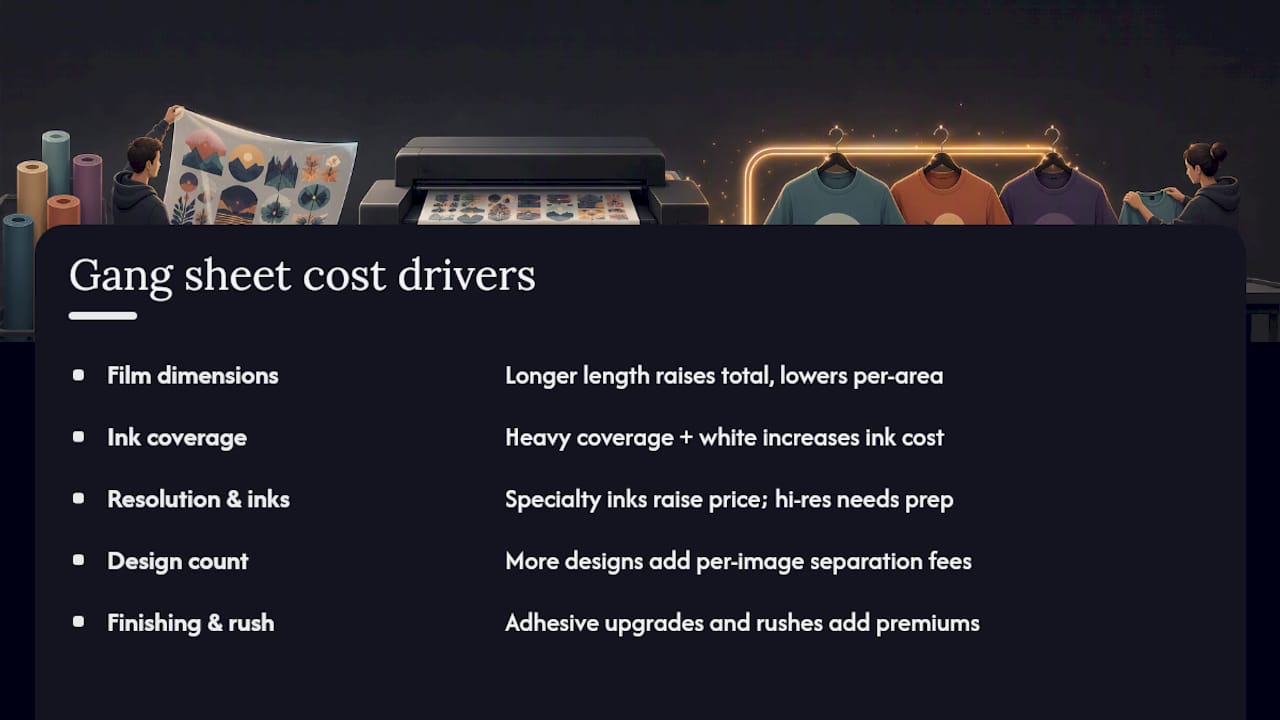
Film dimensions. Length matters more than width here, since 22 inches is the near-universal standard. The longer the sheet, the more you pay in absolute terms, but usually less per square inch, because longer tiers spread fixed costs (setup, film waste at the edges) across more printable area.
Ink coverage and white underbase. A dense, full-color design with heavy white underbase for dark shirts uses significantly more ink than a simple one-color logo. Printers that separate ink cost from film cost will charge more for coverage-heavy artwork, even on an identically sized sheet.
Resolution and specialty inks. Standard four-color process printing costs less than jobs requiring metallic, neon, or glow-in-the-dark inks. High-resolution photographic designs don’t cost more to print, but they do demand tighter file prep to avoid banding or color shift, which can mean rejected files and reprint delays.
Cut-apart charges and design count. Every additional distinct design on a shared sheet can add a per-image separation fee. A sheet with 20 small designs will often cost more in cut-apart fees than a sheet with four large ones, even at the same total ink coverage.
Finishing, adhesive, and rush fees. Some printers offer a choice of adhesive strength for stretch fabrics or performance wear, and that upgrade usually carries a small premium. Packaging for bulk shipments (rolled versus flat) rarely changes price, but rush turnaround almost always does.
Pro Tip: Ask your printer for an itemized quote breakdown before you approve a large order. A sheet quoted at $40 with three hidden add-ons can end up costing $58, and you want to catch that before it becomes your production cost basis, not after.
What Do Standard Gang Sheet Sizes Cost?
DTF gang sheets follow a fairly consistent size ladder across the industry, built around the 22-inch width that fits most standard DTF printers. Length is where the tiers diverge, and length is what drives your price.
Here’s a representative U.S. pricing example from a market gang sheet builder, useful for sanity-checking any quote you receive:
These figures come from one gang sheet builder’s published rate card and represent a snapshot, not a universal rate. Every shop sets its own pricing, and yours may run higher or lower depending on ink coverage assumptions and local market rates.
Now the part that actually matters for your invoice: turning sheet price into cost per shirt.
- Small chest logo, 50 shirts. A 4"×4" chest logo takes up roughly 16 square inches. On a 22"×48" sheet (1,056 square inches, priced at $29.95), you could nest about 60 logos at a generous margin, working out to under $0.50 per logo before ink surcharges. Run 50 shirts and your gang sheet cost lands well under a dollar per unit.
- Full-front print, 25 shirts. A 12"×14" front print eats up 168 square inches. On that same 48-inch sheet, you’d fit around six prints per pass, meaning you’d need roughly four sheets for 25 shirts, pushing per-shirt film cost closer to $2.00 to $2.50 depending on ink coverage.
- Mixed assortment, 100 shirts across 12 designs. This is where a longer sheet earns its keep. A 22"×120" sheet at $59.95 gives you far more room to nest a variety of shapes efficiently, often bringing blended per-shirt cost down near $0.60 to $0.80 once you average across all 12 designs.
Nesting efficiency is the variable that makes those numbers swing wildly. A sheet filled at 60% capacity wastes nearly half its printable area, while a sheet packed to 95% can more than halve your per-piece cost compared to that same loosely-packed layout. The sheet price doesn’t change. What you get out of it does.
How Can You Lower Your Gang Sheet Costs?
Cost control on gang sheets comes down to layout discipline more than it comes down to shopping for a cheaper printer. A few habits make a measurable difference:
- Standardize your common design sizes (chest logos, back prints) so they nest predictably without wasted gaps
- Batch similar jobs together and reuse the same color separations and underbase settings across orders
- Stick with standard finishes and reserve specialty inks for jobs where the customer’s price supports the added margin
- Skip cut-apart requests when you’re comfortable trimming in-house, since that fee adds up fast on high-design-count sheets
- Build a shipping calendar that avoids last-minute rush orders, which almost always carry a premium
Batching deserves special attention. If you’re reordering the same handful of best-selling designs every few weeks, ask your printer about setting up a repeatable template. Gang sheets already lower per-design cost by letting you pack many designs onto one billing unit, and reusing a proven layout compounds that savings further because you’re not paying setup overhead twice.
Markup strategy matters just as much as production cost. A shop-floor breakdown of custom apparel costs shows that material, labor, finishing, and shipping all stack before you even set your retail price. If your gang sheet cost per shirt is $0.75, a common approach is pricing the finished decorated shirt at three to five times your landed material cost, which leaves room for labor, overhead, and profit without pricing yourself out of the local market.
Pro Tip: *Track your fill percentage on every order for a month.
What File Specs Do You Need to Avoid Reprint Fees?
Getting your artwork right the first time saves more money than any discount code ever will. Reprints cost you the sheet, the shipping, and the schedule delay, so file prep is where a lot of quiet savings live.
- Use PNG with a transparent background for most designs, or PSD/AI files when you need to preserve layered separations for white underbase work.
- Set resolution to at least 300 DPI at final print size. Anything lower risks visible pixelation once it’s printed at full scale on the sheet.
- Build in a bleed and safe zone around every design, typically a small margin that keeps text and logos from getting clipped during cutting.
- Flag designs that need a white underbase separately, since this changes both the ink cost and how the file gets processed before printing.
- Preview your layout in a gang sheet builder before submitting, so you can catch spacing issues, see your real-time price, and adjust nesting before you pay for a sheet.
Order rejections almost always trace back to one of two things: a file that’s missing a transparent background when the design calls for one, or resolution too low to hold detail at the requested print size. Following printer-specific file prep rules up front is the single easiest way to avoid a rejected order sitting in a queue while your production window ticks away.
How Fast Can You Get Gang Sheets Printed and Shipped?
Most U.S. DTF shops quote production windows of 24 to 72 hours for standard orders, though that window stretches during high-volume seasons like back-to-school and the holiday run-up. Order size matters too. A single small sheet often clears faster than a bulk order spanning multiple long sheets, simply because of queue position.
A few things to weigh when you’re balancing speed against cost:
- Rush or same-day printing options exist at most shops, but they carry a real premium over standard turnaround
- Shipping carrier choice affects unit cost more than people expect. Ground shipping on a bulk order spreads cheaply across many shirts, while expedited air shipping on a small order can double your effective per-unit cost
- Local pickup, where available, eliminates shipping cost entirely and is worth asking about if you’re near a fulfillment location
- Predictable, non-urgent ordering almost always beats last-minute rush requests on total cost per shirt
If your shop runs on a regular production calendar, planning orders a few days ahead of when you actually need the shirts avoids paying a premium for speed you didn’t actually need.
How Transfer Kingz Approaches Gang Sheet Pricing
Transfer Kingz runs an online gang sheet builder that shows your price in real time as you upload and arrange designs, with no minimum order requirement standing between you and a first order. That structure fits the per-length billing model discussed above directly: you build your sheet, see the cost update as you add designs, and adjust nesting before you check out.
The builder supports the standard 22-inch width and the common length tiers, and turnaround typically runs on the fast end of the industry range, with nationwide shipping alongside local pickup options for Texas-based shops. For readers weighing ink types, film quality, or how coverage affects a quote, the DTF transfer quality checklist covers the technical side in more depth. If you have a pricing question specific to your order, Transfer Kingz’s support team can walk through the numbers with you before you commit to a sheet size.
What Happens If You Need to Cancel or Revise an Order?
Gang sheets sit in an odd category compared to blank apparel: once a sheet enters production, it’s a custom-printed item, not restockable inventory. That reality shapes how most cancellation and revision policies work across the industry.
Cancel before production starts and you’re usually fine, sometimes with a small processing fee if payment has already cleared. Cancel after the file has moved into the print queue, and most shops will charge you for the sheet regardless, because the film, ink, and machine time are already committed. This is one area where speed cuts both ways. Fast turnaround is great for getting product in hand quickly, but it also shrinks your cancellation window to almost nothing.
Revisions work differently depending on when you catch the error. A typo or color shift spotted before you approve the final proof costs nothing beyond your own time. The same mistake caught after printing means a full reprint at close to full price, since gang sheets don’t allow partial redos of a single design once the sheet is cut and packaged.
The practical takeaway: treat the proof approval step as your last real checkpoint. Review every design on the sheet at full size, check colors against your monitor’s known quirks, and confirm underbase placement before you click approve. That five extra minutes is far cheaper than a reprint fee.
Do Minimum Order Quantities Affect Gang Sheet Pricing?
Traditional screen printing and embroidery often require minimum order quantities to justify setup costs, sometimes a dozen or more units before the per-piece price becomes reasonable. Gang sheets flip that model. Because you’re paying for sheet space rather than per-garment setup, many DTF providers accept single-sheet orders with no unit minimum at all.
That said, minimums still show up indirectly through pricing structure. A tiny 22"×12" sheet carries a higher cost per square inch than a 22"×240" sheet, so while there’s no hard “you must order 25 units” rule, the economics still reward larger, better-planned orders. If you’re only decorating five shirts, you’ll pay more per shirt than a shop running the same design across 100 shirts on a longer sheet, purely because the longer sheet spreads its base cost across more usable area.
For decorators just starting out, this no-minimum structure removes a real barrier. You can test a new design on a small sheet, see how it sells, and scale up to a longer sheet once you know the design has legs, without ever committing to a large upfront print run you’re not sure will move.
How Does Garment Material Affect Gang Sheet Costs?
The gang sheet itself doesn’t change based on what fabric it lands on, but the ink and underbase requirements often do, and that shows up in your final cost.
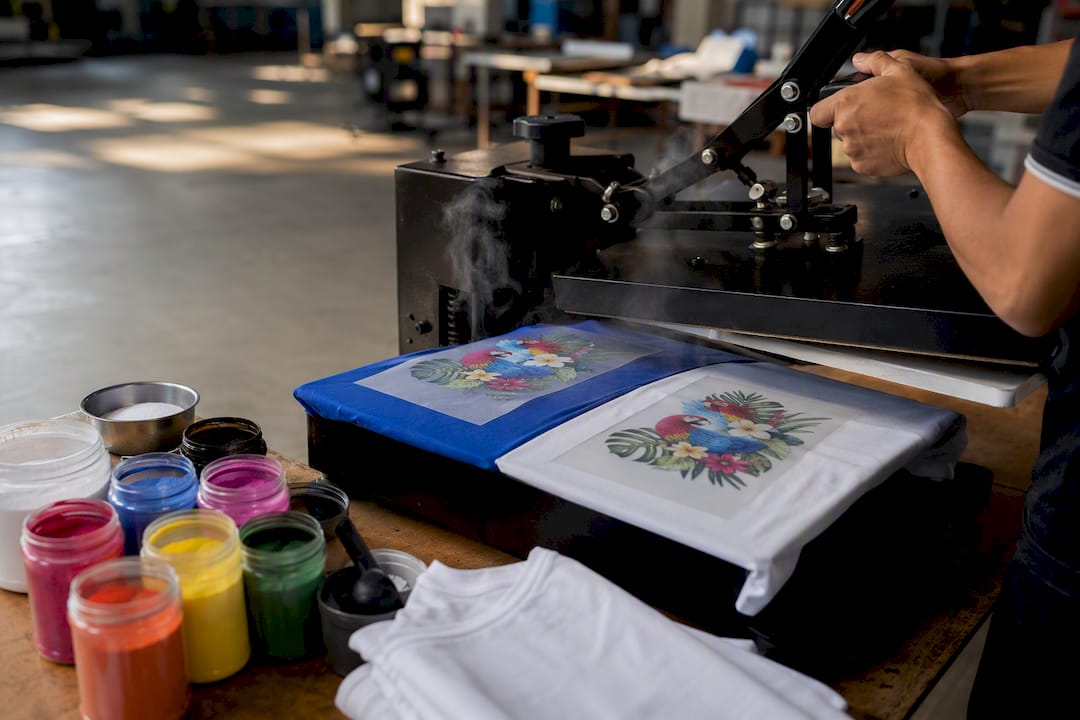
Cotton and cotton-blend shirts are the most forgiving substrate for DTF transfers, generally requiring standard heat press settings and no special ink adjustments. Polyester and performance fabrics run hotter risk for scorching or dye migration (a phenomenon where the garment’s own dye bleeds through the print under heat), which sometimes means a lower-temperature press cycle or an added care step, though this rarely changes the sheet price itself.
Dark garments are where cost differences actually appear on your invoice. Any design printed for a black or navy shirt typically needs a full white underbase layer to keep colors vibrant against the dark fabric, and that underbase consumes measurably more ink than a design destined for a white or light-colored shirt. If your printer bills ink separately from sheet space, expect that line item to run higher on every dark-garment order.
Hard surfaces like glass and acrylic, when using UV DTF transfers rather than standard DTF, involve a different film and adhesive system entirely, which typically carries its own pricing tier separate from apparel gang sheets.
Why Most Pricing Advice Gets This Backwards
The advice you’ll find most often treats gang sheet pricing like comparison shopping: find the cheapest per-inch rate and go. That misses the bigger lever entirely. It comes down to nesting discipline.
The conventional wisdom skips this because it’s less flashy than a price comparison chart, but it’s the difference that actually shows up on your bottom line month over month.
If there’s one thing to prioritize first, it’s building a habit of previewing your layout in a builder before you commit to a size. Don’t guess at how many designs fit on a 48-inch sheet. Load them in, watch the fill percentage, and adjust before you pay. That single habit does more for your margins than switching printers ever will.
— Anthony
Get an Instant Gang Sheet Quote From Transferkingz
Transferkingz gives you real-time pricing the moment you start building your sheet, so you’re never guessing what a job will cost before you commit to it. There’s no minimum order size holding you back from testing a new design on a small sheet, and no waiting on a sales rep to email you a quote days later. You upload, you nest, you see the number, and you order.
That structure suits exactly the kind of decorator this guide is written for: shops running mixed design counts, testing new artwork, or scaling up a proven seller without wanting to overcommit on sheet length. Turnaround runs fast, with nationwide shipping and local options for Texas-based customers who’d rather skip the shipping line item entirely. If you’re weighing DTF against another decoration method for your next run, the Print Point overview walks through how the ordering flow works end to end.
Ready to see what your next order actually costs? Head to the Transferkingz gang sheet builder and load in your designs. The price will update as you go, and you’ll know exactly what you’re paying before you check out.
0 comments