

TL;DR:
- Choosing the right film and ink in DTF printing is crucial for producing vibrant, durable transfers that resist cracking and washing. Proper selection depends on matching peel type, pigment quality, and heat press settings, with thorough testing to ensure compatibility. Regular wash cycles and documentation help maintain consistent quality and prevent costly mistakes.
Choosing the right film and ink is the single most important decision in Direct-to-Film (DTF) printing, directly determining whether your finished transfers are vibrant, durable, and wash-resistant or dull and prone to cracking. DTF printing relies on a precise combination of film type, ink formulation, and heat press settings to bond designs permanently to fabric. Get the combination wrong, and you waste materials, time, and customer trust. Get it right, and your shop produces consistent, professional results at scale. This guide gives printing professionals a clear, step-by-step film and ink selection framework built for real production environments.
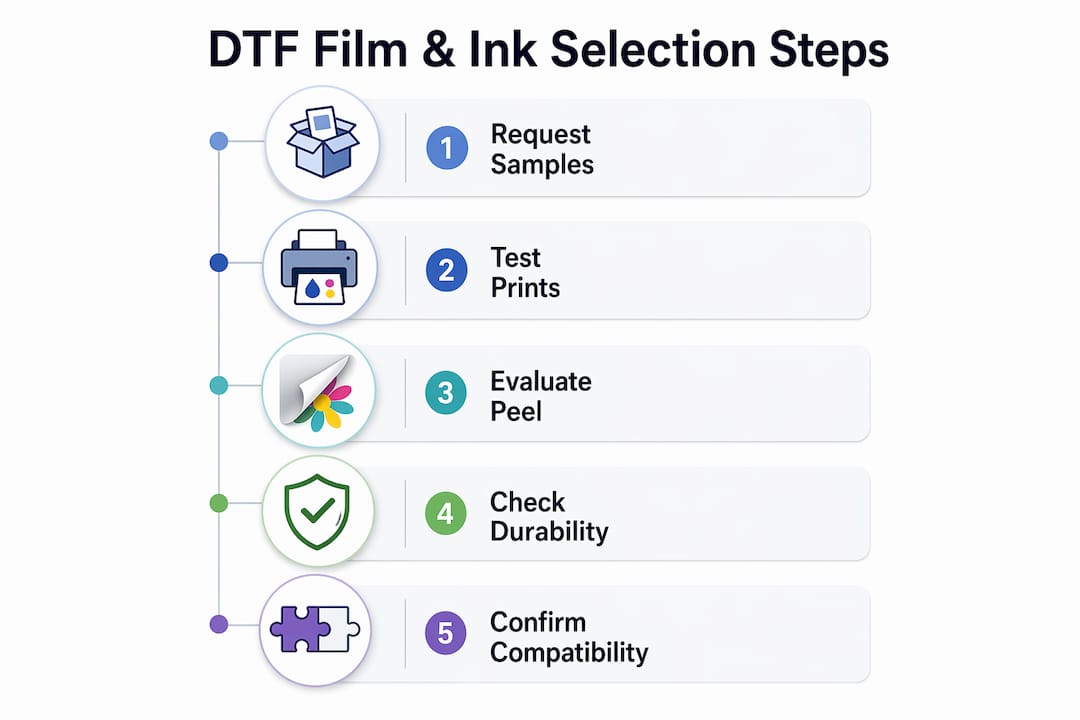
What are the primary factors for choosing printing film and ink?
Film and ink selection in DTF printing comes down to four core variables: film peel type, ink pigment quality, color gamut, and white ink performance. Each variable affects a different part of the final print.
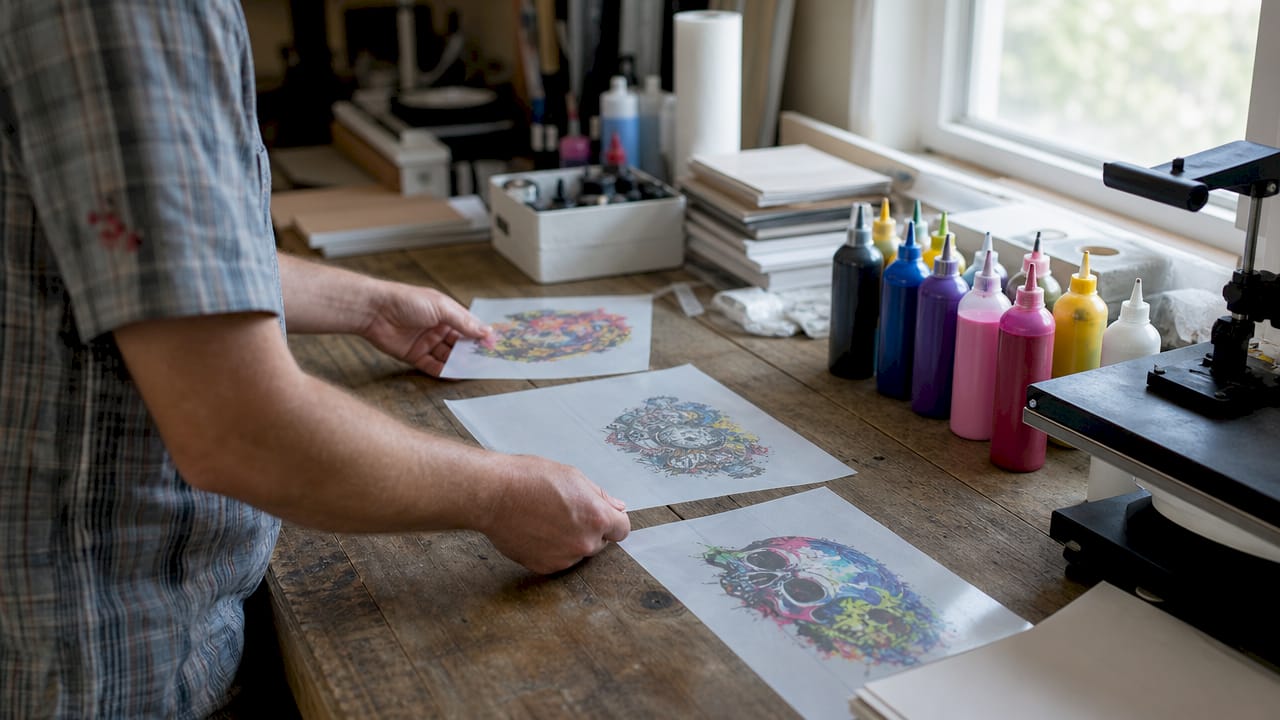
Film peel types and what they mean for your workflow
DTF transfer films fall into three categories: hot peel, warm peel, and cold peel. Each serves a different production priority.
Hot and warm peel films allow removal just 1–3 seconds after the heat press, which speeds up production significantly. The trade-off is that fine details and sharp edges can suffer if the adhesive has not fully set. Cold peel films require the transfer to cool completely before removal. That cooling period preserves edge adhesion and detail retention, making cold peel the better choice for intricate artwork or photographic designs.
Film thickness, opacity, and finish also affect color brightness, hand feel, and wash durability. A matte finish softens the final look and reduces glare. A gloss finish intensifies color vibrancy, which works well on dark garments where contrast matters.
Ink pigment load and color gamut
High-quality DTF inks carry a high pigment load with suspension stability that prevents settling and print head clogging. They also support wide CMYK or ROGB color gamuts, which gives your prints a broader range of reproducible colors. Inks with low pigment density produce flat, washed-out results, especially on dark fabrics.
White ink is the most demanding component in any DTF setup. White ink requires anti-settling agents and active circulation systems because its pigment density is far higher than CMYK inks. Without proper circulation, white ink settles in the lines and produces gray, translucent underbases instead of the bright white layer that makes colors pop on dark garments.
Pro Tip: When evaluating inks, request a technical data sheet from the supplier and check for documented pigment load percentages and viscosity ratings. These numbers tell you more than any marketing claim.
- Hot peel film: Best for high-volume runs where speed matters more than fine detail.
- Cold peel film: Best for detailed artwork, photographic prints, and dark garments.
- Gloss finish film: Maximizes color vibrancy on dark fabrics.
- Matte finish film: Produces a softer, more natural hand feel.
- High pigment ink: Delivers broader color gamut and better opacity.
- White ink with circulation system: Prevents settling and maintains underbase brightness.
How to assess film and ink compatibility with your printer and workflow
Compatibility between film and ink is not automatic. Film and ink chemistry must match your heat press temperature and pressure settings to produce wash-durable, crack-resistant prints. A film designed for lower press temperatures will not bond correctly with an ink formulation that requires higher heat to cure.
Steps to verify compatibility before committing to a supplier
- Check manufacturer compatibility charts. Most reputable film and ink suppliers publish compatibility matrices that list tested pairings. Start there before running any physical tests.
- Verify heat press parameters. Confirm the film’s recommended press temperature, pressure, and dwell time. Cross-reference these with your ink supplier’s curing specifications. A mismatch of even 10–15 degrees can cause adhesion failure.
- Review peer feedback from production shops. Online printing communities and trade forums contain real-world data on film and ink pairings that manufacturer charts sometimes miss. Experienced operators flag failure modes that lab testing does not replicate.
- Assess print head health requirements. Different ink formulations place different demands on print heads. Inks with higher viscosity require more frequent circulation and cleaning cycles. Confirm your printer model supports the ink’s circulation requirements before purchasing in bulk.
- Test adhesive chemistry separately. The adhesive powder used in DTF printing must bond with both the ink layer and the film surface. Some film coatings repel certain adhesive formulations. Run a small adhesion test before scaling up.
Pro Tip: Always request a sample roll from a new film supplier and run it alongside your current film using identical print files. Side-by-side comparison under the same press settings reveals compatibility issues that spec sheets cannot predict.
Maintaining print head health is not optional in a DTF workflow. Ink circulation systems prevent pigment from settling in the lines overnight, which is the leading cause of nozzle clogs and inconsistent output. If your printer lacks an automatic circulation system, run a manual purge cycle at the start and end of every production day.
What is the best process to test film and ink combinations?
Systematic testing is the only reliable way to select the right film and ink combination for your specific projects. Guessing based on supplier claims leads to expensive reprints and inconsistent quality.
Building a baseline test protocol
Testing multiple films with identical prints on the same fabric type is the foundation of any solid selection process. Use 2–3 film types, print the exact same design on each, and apply all transfers under identical heat press conditions. Then document the results across four criteria:
| Test Criterion | What to Measure |
|---|---|
| Color accuracy | Compare printed output to your digital file using a color reference card |
| White underbase opacity | Check brightness on black and dark gray fabric swatches |
| Wash durability | Run transfers through 10 wash cycles and inspect for cracking or peeling |
| Detail retention | Evaluate fine lines and small text at 100% zoom on the physical print |
After washing, examine each sample under consistent lighting. Color shift, edge lifting, or cracking after 10 washes signals a chemistry mismatch between the film, ink, and adhesive. A transfer that survives 10 washes without visible degradation is a reliable candidate for production use.
Balancing production speed against detail quality
Hot peel films save time but cost you edge sharpness on complex designs. Cold peel films protect detail but slow your throughput. The right choice depends on your order mix. If most of your work is simple logos and text, hot peel is the practical choice. If you regularly print photographic artwork or fine-line illustrations, cold peel protects your reputation.
- Print the same design on both film types during testing.
- Measure the time difference per unit between hot and cold peel workflows.
- Compare detail quality on the final transfer under a loupe or macro lens.
- Choose the film type that fits the majority of your order volume, and stock the other as a secondary option.
Selecting the right DTF materials for your specific apparel types also affects how you weight these trade-offs. Stretchy fabrics like athletic wear require films with higher elasticity ratings to prevent cracking during wear.
What are the most common mistakes when choosing film and ink?
Most print quality failures trace back to a small set of repeatable mistakes. Knowing them in advance saves you from learning them the hard way.
- Assuming all white inks perform the same. White ink performance varies significantly by brand, and a white ink that bonds well with one film may fail adhesion or curing with another. Always batch-test white ink against each new film you introduce.
- Skipping ink circulation maintenance. Neglecting ink circulation causes pigment to settle, producing thin, grayish white prints on dark garments. Run circulation cycles daily without exception.
- Ignoring heat press calibration. Press temperature drifts over time. An uncalibrated press running 15 degrees low will under-cure ink and produce transfers that peel after the first wash.
- Mixing film brands mid-production. Switching film suppliers without retesting creates unpredictable results. Treat each new film roll as a new variable that requires validation.
- Skipping wash tests before large runs. Color accuracy on the press bed does not guarantee durability through laundering. Always wash-test before committing to a full production run.
“Films that work well with one white ink brand may fail with another, emphasizing the need for testing before large runs.” — DTF industry guidance on adhesion failure prevention
For a deeper look at resolving specific print defects, the DTF troubleshooting guide from Transferkingz covers the most common failure modes with practical fixes.
Key Takeaways
Choosing the right film and ink for DTF printing requires matching film peel type, ink pigment quality, and heat press parameters to your specific production workflow and fabric types, then validating every combination through structured wash testing before full-scale runs.
| Point | Details |
|---|---|
| Film peel type determines speed vs. detail | Use hot peel for volume runs and cold peel for detailed or photographic designs. |
| White ink needs active management | Run daily circulation cycles to prevent pigment settling and dull underbase prints. |
| Chemistry compatibility is non-negotiable | Match film release chemistry, ink formulation, and press settings before committing to a supplier. |
| Wash testing validates real durability | Run 10 wash cycles on test samples before approving any film and ink combination for production. |
| Document every test result | Recorded data from test runs prevents repeating failed combinations and builds a reliable quality baseline. |
What I’ve learned from years of watching shops get film and ink wrong
The shops that struggle most with film and ink selection are not the ones that lack technical knowledge. They are the ones that skip documentation. A print that looks perfect off the press means nothing if you cannot reproduce it three months later when you reorder from a slightly different batch of film or ink.
The most underrated practice in this industry is keeping a physical sample book. Every time you test a new film and ink combination, press a transfer onto a fabric swatch, wash it 10 times, and staple it to a card with the film brand, ink brand, press temperature, dwell time, and peel type written on it. That card is worth more than any supplier’s spec sheet.
I have also seen shops lose significant money by treating white ink as an afterthought. White ink is the foundation of every color DTF print on dark fabric. If the white underbase is thin, gray, or uneven, every color layer on top of it looks wrong. Invest in a printer with a proper white ink circulation system and treat daily maintenance as non-negotiable.
The other thing worth saying plainly: supplier products change. A film that performed perfectly for 12 months can shift in coating chemistry when a supplier changes their manufacturing process. Keep testing even when things are working. The shops that maintain a quarterly review of their materials are the ones that catch these changes before they become customer complaints.
— Anthony
Premium DTF materials from Transferkingz
Transferkingz supplies printing professionals with premium DTF films and inks built for consistent, production-grade results. Whether you run a small custom apparel shop or a high-volume decoration facility, the materials available through Transferkingz DTF printing services are tested for color accuracy, wash durability, and compatibility across a wide range of heat press setups. You can place orders without minimum quantity requirements, which makes it practical to run the sample tests this guide recommends before scaling up. For shops in the region, DTF transfers in Texas are available with fast turnaround times and expert support to help you dial in your film and ink combination from the first order.
FAQ
What is the difference between hot peel and cold peel DTF film?
Hot peel film releases 1–3 seconds after pressing and speeds up production, while cold peel film requires full cooling to preserve fine detail and edge adhesion. Choose based on your design complexity and throughput needs.
Why does white ink settle and how do I prevent it?
White ink has higher pigment density than CMYK inks, causing it to settle in lines when idle. Running daily ink circulation cycles and purging lines at the start of each session prevents settling and maintains underbase opacity.
How many wash cycles should I use to test film and ink durability?
Run a minimum of 10 wash cycles on test transfers before approving a film and ink combination for production. Transfers that show cracking, peeling, or color shift before 10 washes indicate a chemistry mismatch.
Can I mix film brands from different suppliers in the same production run?
Mixing film brands mid-run without retesting creates unpredictable adhesion and color results. Treat every new film roll as a new variable and validate it against your ink and press settings before using it in production.
How do I know if my film and ink are compatible with my heat press?
Cross-reference the film manufacturer’s recommended press temperature and dwell time with the ink supplier’s curing specifications. A mismatch of even 10–15 degrees can cause adhesion failure and reduce wash durability.
0 comments