

Yes, same-day DTF transfers are possible, but only if you clear a shop’s production cutoff with print-ready art and payment already in hand. Some rush printers can turn artwork into finished transfers the same afternoon, provided the file is correct the first time. The two things that actually determine whether you make it: submitting art that needs zero fixes, and hitting the cutoff time, not just placing the order before it. Expect this to work reliably on weekdays, with holidays and weekends as the usual exceptions.
TL;DR:
- Making same-day DTF transfers depends on passing proof and payment approval before the shop’s cutoff time, not just ordering early.
- Cutoff times vary by shop and time zone, with some shops providing emergency services at higher prices to handle late orders.
- Preparing artwork with vector files, transparent backgrounds, and checking details immediately upon proof receipt prevents delays and rework.
- Gang sheets typically produce faster turnaround for multiple designs, but single transfers suit one-off larger or unique orders.
- Picking up transfers locally or prepaying for courier services ensures the fastest delivery, avoiding shipping delays after production finishes.
Table of Contents
- How Same-Day DTF Production Cutoffs Actually Work
- Prepping Artwork So Your Order Doesn’t Get Held
- Single Transfers vs. Gang Sheets: Which One Prints Faster
- What Same-Day DTF Actually Costs
- Turning “Printed” Into “In Your Hands” Today
- Why Same-Day Orders Miss the Deadline (and How to Not Be One)
- Placing a Same-Day Order With Transfer Kingz
- What Rush DTF Orders Taught Us About Getting It Right
- Sources
How Same-Day DTF Production Cutoffs Actually Work
Print shops rarely mean “order placed by 2 PM” when they say same-day. They mean “art approved and paid by 2 PM,” and that distinction trips up more customers than anything else. A cutoff clock doesn’t stop when you click “place order.” It stops when your file passes proofing and your payment clears, which is why a design that needs revisions at 1:45 PM can knock you out of same-day even if you technically ordered on time.
Cutoffs vary by shop and time zone, so read the specific policy rather than assuming. Some rush operations set the line around noon Eastern, others push it to mid-afternoon in their local time zone. A shop in California working a 2 PM local cutoff gives East Coast customers a real advantage, since that’s already 5 PM their time. Same day printers commonly publish these exact windows, along with backup options for people who miss them.
What to check before you order:
- The exact cutoff time and which time zone it’s based on, not your own
- Whether the policy says “ordered by” or “approved by,” since those are different deadlines
- Whether weekends and holidays follow the same schedule or get pushed automatically
- Whether an emergency or rush service exists for after-cutoff requests, and what it costs
Some same-day DTF and UV DTF printers also run an emergency production tier for orders that land after the standard window closes, usually at a premium price. It’s a real safety net, but it’s not offered everywhere, and it’s not something to count on as your default plan.
Prepping Artwork So Your Order Doesn’t Get Held
Prepress holds are the single biggest reason same-day orders slip to next-day. A file that needs the shop to fix your background, rebuild your outline, or ask what colors you actually want burns the exact minutes you don’t have.
Follow this before you upload anything:
- Use vector files (AI, EPS, SVG) whenever your design has text, logos, or hard edges. They scale cleanly and never need re-tracing.
- For photo-based or gradient designs, export a flattened PNG or PDF at 300 DPI minimum, sized at the actual print dimensions, not a scaled-down mockup.
- Confirm your background is transparent, not white, since DTF film prints exactly what’s in the file, and a white box behind a logo shows up as a white box on the shirt.
- Check that fine text or thin lines aren’t thinner than about 1 point, because DTF film struggles to hold detail below that threshold.
- Open the proof the second it lands and check color accuracy, sizing, and any text for typos, then approve it immediately if it’s correct.
DTF transfers rely on a white ink underbase printed beneath the color layers so designs stay opaque on dark garments, per the basic mechanics of direct-to-film printing. If your file doesn’t separate that underbase correctly, a shop may need to adjust it manually, which adds time you don’t have on a same-day order. A DTF print workflow guide walks through file setup in more depth if you’re building your first few designs.
Pro Tip: Save a print-ready template once you get your first design approved without revisions, then reuse those exact specs for every future order. Shops rarely reject a file format they’ve already accepted from you.
Single Transfers vs. Gang Sheets: Which One Prints Faster
Gang sheets usually win the race when you have several designs, because a shop sets up printing once for the whole sheet instead of once per design. If you need five different logos for five different shirts, that’s five separate setup passes as single transfers versus one pass as a gang sheet.
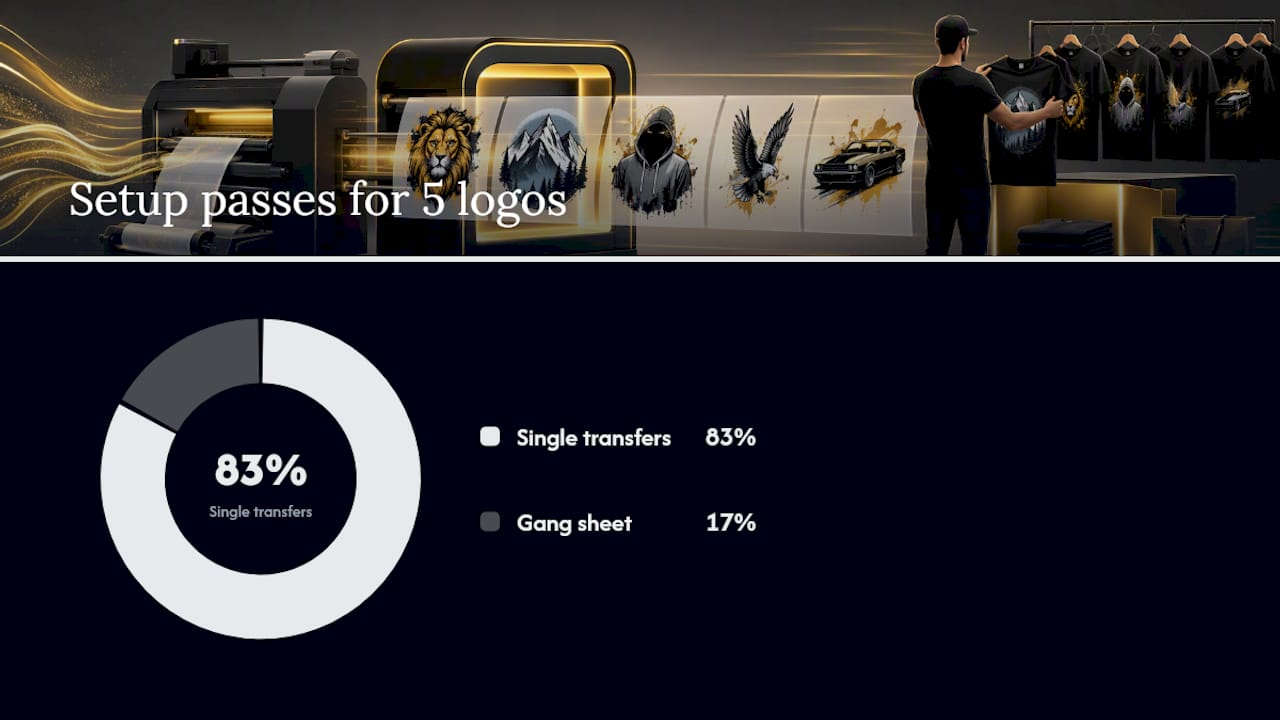
Single finished transfers make more sense for one design that needs a specific, larger size, or when you’re ordering just one or two pieces and don’t want to deal with layout math. Gang sheets earn their keep on volume: multiple small designs, reorders of the same logo in different sizes, or a mixed batch for several customers going out the same day.
To build a gang sheet that won’t blow your cutoff:
- Group designs by similar sizing first, since mismatched dimensions waste sheet space and force extra layout decisions
- Leave the small buffer space most gang sheet builders recommend between designs so cutting doesn’t clip artwork
- Upload your highest-resolution files first, then arrange, rather than resizing after placement
- Skip last-minute swaps once you’ve submitted for proofing, since a layout change after that point restarts the review
A gang sheet built correctly the first time moves through prepress faster than five individual transfers ever will, which is exactly why it tends to be the smarter same-day format for teams and shops running multiple designs at once.
What Same-Day DTF Actually Costs
Price mostly comes down to how much film and ink your order uses, not a flat per-transfer rate. A design covered in white ink (needed for anything going on a dark shirt) costs more to produce than the same design on a light garment that skips the underbase. Sheet size, number of separate designs, and whether you’re paying a rush fee on top of standard pricing all move the number too.
What drives the final price:
- Total ink and film area covered by your design, not just the transfer’s outer dimensions
- White ink coverage, since dark-garment designs need more of it
- Number of distinct designs per order, especially on a gang sheet
- Any rush or same-day service fee layered on top of standard production
- Sheet size selected, since larger sheets cost more but often lower your per-unit price
Many DTF suppliers advertise no minimum order requirements, which means you can order a single transfer without hitting a bulk threshold, according to policies from rush DTF printers. That said, per-unit economics still improve as quantity goes up, since setup and film costs spread across more pieces.
Watch the wording, too. “Printed same day” is not the same promise as “shipped same day” or “delivered same day,” and mixing those up is how orders that were technically on time still show up late.
Turning “Printed” Into “In Your Hands” Today
A finished transfer sitting on a shop’s shelf at 4 PM doesn’t help you if you needed it delivered by 5. Local pickup is your fastest, most reliable option when it’s available, since it skips shipping entirely. Call ahead and confirm a pickup window rather than just showing up, since production can run behind on a busy day.
To lock in same-day receipt:
- Call or message the shop once your proof is approved to confirm your order is actually in the production queue, not just submitted.
- Ask about same-day courier options if you’re not local, since these cost more than standard shipping but can get transfers to you within hours instead of overnight.
- Compare courier pricing against next-flight-out or overnight shipping, since overnight is often cheaper but won’t arrive until the following morning.
- Prepay for shipping or courier service in advance so that step isn’t the thing holding up dispatch once printing finishes.
Why Same-Day Orders Miss the Deadline (and How to Not Be One)
Four things cause almost every missed same-day deadline: unpaid orders sitting in a queue, proofs nobody approved fast enough, files that need rework, and shops running out of a specific film or ink color. Every one of these is preventable on your end.
- Preflight your file before uploading, checking resolution, transparency, and sizing yourself instead of letting the shop catch it
- Pay at checkout rather than choosing an invoice-later option, since instant payment processing clears faster than manual invoicing and keeps your order from sitting in a payment-pending queue
- Watch for the proof notification and approve within minutes, not hours
- Have a backup shipping method ready in case your first choice can’t make the day’s cutoff after all
Pro Tip: If you’re going to miss the cutoff no matter what, call the shop before you miss it, not after. Some run paid emergency services for exactly this situation, and a heads-up gives them a chance to slot you in.
Placing a Same-Day Order With Transfer Kingz
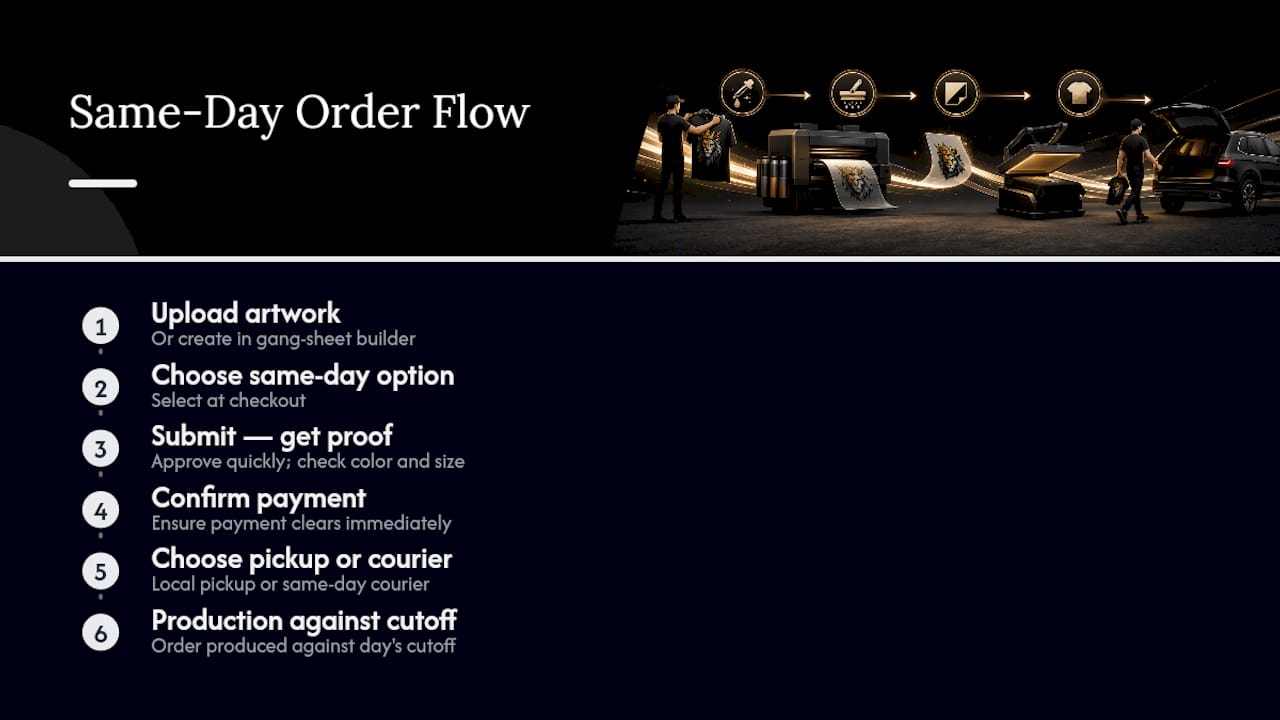
Some print providers offer same-day DTF production with no minimum order requirement, so a single transfer can move through the same fast lane as a bulk order. The process typically starts with uploading your artwork or building it directly in an online gang sheet builder, then selecting a same-day option at checkout.
Once you submit, a proof comes back for approval, and this is the step that determines everything else. Approve it the moment it looks right, check color and sizing carefully, and confirm payment clears immediately rather than leaving it pending. From there, you choose local pickup or a same-day courier option depending on your location, and the print provider moves your order into production against the day’s cutoff.
The same-day DTF transfers page lays out the current cutoff time and file requirements, and it’s worth bookmarking if you order rush transfers more than once. For businesses producing apparel at volume, browsing Print Point shows the full range of formats available, from single transfers to full production runs, so you can match the order type to how fast you actually need it.
What Rush DTF Orders Taught Us About Getting It Right
Two things separate customers who consistently get same-day transfers from those who don’t. First, they treat the proof approval as the real deadline, not the order placement, and they’re watching for that notification the moment they submit. Second, they never send a file they haven’t checked themselves, because every minute a shop spends fixing your artwork is a minute you don’t get back.
If there’s one habit worth adopting permanently: build a reusable template once your first order goes through clean, then keep using those same specs. It’s the fastest way to make every future rush order boring, in the best possible sense.
— Anthony
0 comments