

TL;DR:
- Choosing the right DTF materials ensures vibrant, durable prints and reduces reprints.
- Testing film, ink, and powder combinations on target fabrics prevents costly mistakes.
- Consistent material testing habits build confidence and support scalable, successful DTF businesses.
Wasting a full run of transfers because the film peeled wrong or the ink bled is one of the most frustrating experiences for any small apparel business. The problem almost always traces back to one decision made early in the process: choosing the wrong DTF (Direct-to-Film) materials. Get that choice right, and you get vibrant, wash-resistant prints that keep customers coming back. Get it wrong, and you’re reprinting orders, eating costs, and losing trust. This guide walks you through every major material decision, from films and inks to powders and testing routines, so you can build a workflow that consistently delivers quality results.
Table of Contents
- Understanding core DTF material types and their effects
- How to evaluate and select the right DTF film
- Inks and powders: Matching supplies to production goals
- Avoiding common mistakes when choosing DTF materials
- Testing and verifying your DTF material choices for reliability
- What most DTF beginners get wrong—and how to build lasting success
- Ready to upgrade your DTF materials?
- Frequently asked questions
Key Takeaways
| Point | Details |
|---|---|
| Match film to workflow | Choose hot peel for speed or cold peel for a soft, matte finish and better durability. |
| Invest in reliable inks | Premium white ink can save you time and money by reducing clogs and reprints. |
| Test before scaling up | Always run tests on your chosen materials to avoid costly print failures on large batches. |
| Never skip compatibility checks | Verify all DTF layers work together with your specific garment type for the best results. |
| Small changes pay off | Improving your material selection process leads to longer-lasting, more vibrant prints and happier customers. |
Understanding core DTF material types and their effects
Before you can select the best products, you need to know what sets each DTF material apart. DTF printing relies on three core material categories working together: films, inks, and adhesive powders. Each one affects the final print in a different way, and a weak link in any of them will compromise the whole transfer.
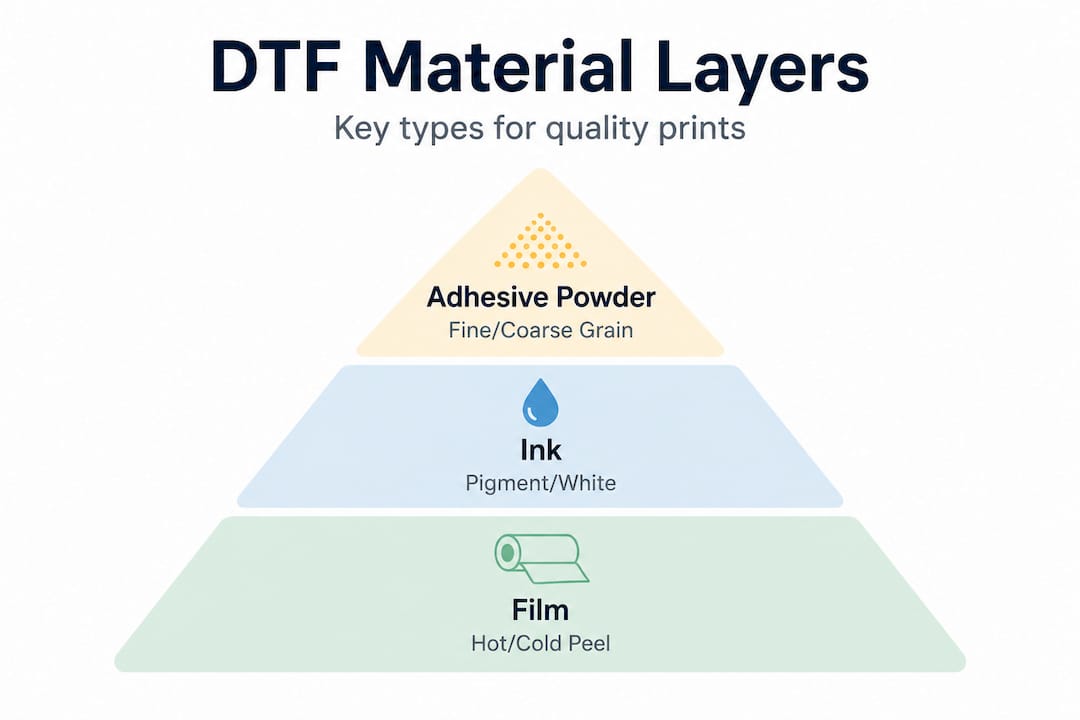
DTF films are the clear or matte sheets that carry your printed design before it’s transferred to fabric. They come in hot peel and cold peel varieties, which we’ll cover in detail in the next section. The thickness and coating of the film also matter. Thinner films tend to produce a softer hand feel (the way a print feels to the touch), while thicker films offer more rigidity and can handle more complex designs without distortion.
DTF inks are pigment-based inks printed directly onto the film. The color channels (CMYK) create your design, but the white ink is the real workhorse. It acts as the base layer that makes colors pop on dark fabrics. White ink stability is one of the most important factors to evaluate because unstable white ink settles, clogs printheads, and produces inconsistent results. As a quick comparison, budget vs premium inks differ significantly in how they handle this challenge.
Adhesive powders are applied to the wet ink before curing. They melt during the heat curing process and create the bond between the print and the fabric. Finer powders produce a softer feel and work well on lightweight fabrics. Coarser powders create a stronger bond and are better suited for heavy-duty applications like workwear or bags.
Here’s a quick overview of how these materials stack up:
| Material | Key function | Main quality factor |
|---|---|---|
| DTF film | Carries the printed design | Peel type, thickness, coating |
| DTF ink | Creates the image | White ink stability, color accuracy |
| Adhesive powder | Bonds print to fabric | Grain size, melt temperature |
Key things to keep in mind when reviewing materials:
- Film coating affects ink adhesion and final color vibrancy
- White ink is the most failure-prone component in the ink set
- Powder grain size directly impacts how soft or stiff the finished print feels
- All three materials must be compatible with each other and your printer
Understanding how these layers interact is the foundation for every material decision you make. If you’re still comparing DTF to other methods, check out this breakdown of DTF vs heat transfer vinyl to see where DTF has a clear edge.
How to evaluate and select the right DTF film
With a grasp of film types, let’s break down how to actually pick one for your custom projects.
The single biggest choice in DTF film selection is between hot peel and cold peel. According to technical film research, hot peel films speed up production but may stiffen hand feel, while cold peel offers a matte finish and better durability on textured fabrics. That tradeoff is real, and it should drive your decision based on what you’re actually printing.
| Feature | Hot peel film | Cold peel film |
|---|---|---|
| Peel timing | Immediately after pressing | After cooling (30-60 seconds) |
| Hand feel | Can feel stiffer | Softer, more natural |
| Finish | Glossy | Matte |
| Best for | High-volume, fast production | Textured fabrics, premium feel |
| Durability | Good | Better on rough surfaces |
Here’s a step-by-step process for testing a new film before committing to a bulk order:
- Order a small sample roll of both hot peel and cold peel film.
- Print the same design on both films using your standard ink and powder settings.
- Apply each transfer to the fabric types you use most, such as cotton tees, polyester blends, or fleece.
- Wash each sample five times on a normal cycle and compare color retention, edge cracking, and feel.
- Choose the film that performs best on your most common fabric and matches your production speed needs.
The best fabrics for DTF printing include cotton, polyester, and blends, but each fabric reacts differently to film type. A cold peel film on a heavyweight cotton hoodie will usually feel better than a hot peel film on the same garment. That kind of nuance only shows up when you test.
Pro Tip: If you run a mix of fast turnaround orders and premium custom pieces, stock both film types. Use hot peel for bulk runs and cold peel for high-end garments where hand feel matters to the customer.
The DTF design process also plays a role here. Designs with fine lines and gradients tend to look sharper on cold peel film because the matte finish reduces glare and makes subtle color transitions more visible.
Inks and powders: Matching supplies to production goals
After films, the next decision is which inks and adhesives will best serve your customers and business needs.
Ink quality has a direct impact on three things: color consistency, printhead health, and reprint rates. Budget ink brands like Inktec and ProColor work well for small runs, but premium options like STS and Kodak reduce reprints through better white ink stability and fewer clogs, making them the smarter choice for scaling businesses.
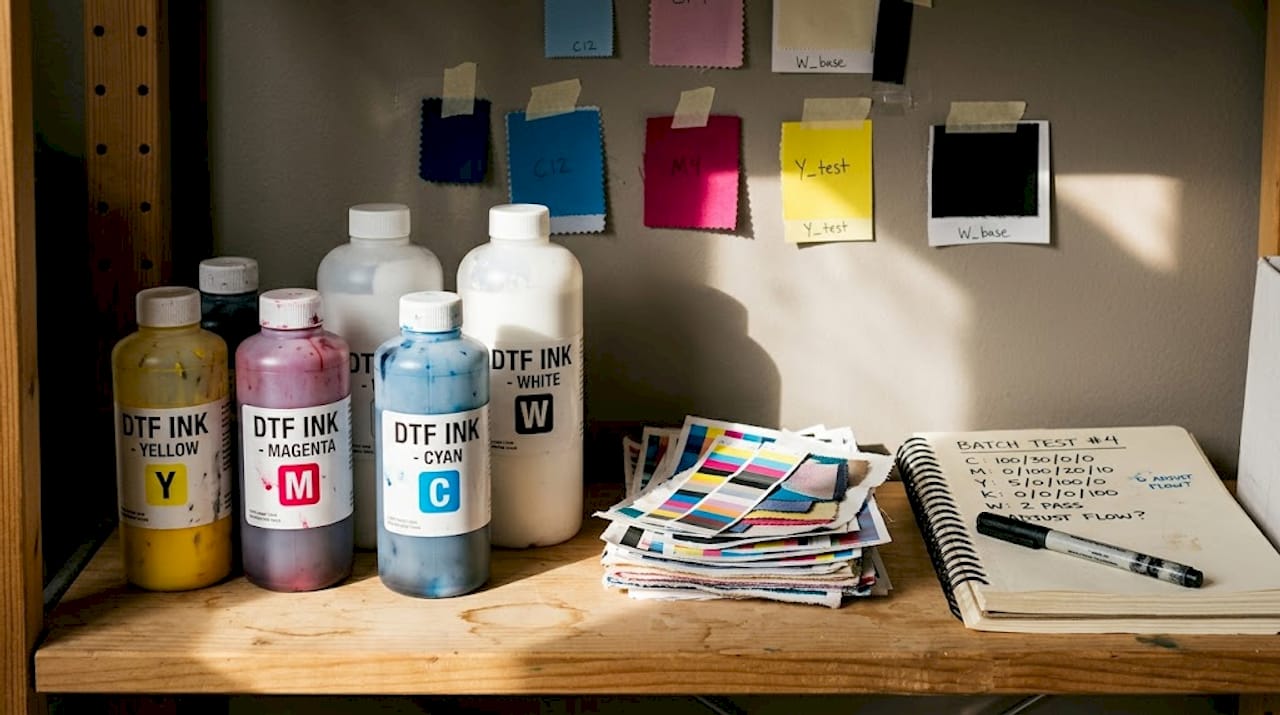
What does that mean in practice? If you’re running 20 transfers a week, budget inks are probably fine. But if you’re doing 200 or more, the cost of a clogged printhead, wasted film, and reprinted orders adds up fast. Premium inks pay for themselves through reliability.
Here’s what to look for when evaluating any ink set:
- White ink viscosity: Should stay consistent without frequent stirring or shaking
- Color gamut: Wider gamut means richer, more accurate colors on finished transfers
- Clog resistance: Check reviews and manufacturer specs for printhead compatibility
- Shelf life: Premium inks typically have longer shelf life, which matters for smaller operations that don’t print daily
- Compatibility: Always verify the ink is rated for your specific printer model
For adhesive powders, you have two main choices: fine grain (around 80 to 120 microns) and coarse grain (150 microns and above). Fine grain powders melt more evenly and produce a smoother, softer finish. Coarse grain powders create a stronger mechanical bond and are better for items that will be washed frequently or subjected to heavy wear.
Pro Tip: Always cure your powder at the manufacturer’s recommended temperature. Under-curing leaves the adhesive partially active, which leads to peeling after the first wash. Over-curing can cause the print to crack. A heat press with accurate temperature control is non-negotiable.
For a broader look at how these material choices fit into a quality workflow, the DTF best practices guide covers application settings, press times, and common setup errors worth avoiding.
Avoiding common mistakes when choosing DTF materials
Knowing how to choose is as important as knowing what to avoid. Here are the top mistakes to watch for.
The most common mistakes DTF printers make:
- Skipping sample tests and ordering large quantities of untested film or ink
- Mixing brands without checking compatibility between film, ink, and powder
- Choosing the cheapest option without accounting for reprint costs
- Ignoring white ink maintenance, leading to printhead clogs and color shifts
- Using the wrong powder grain size for the fabric, resulting in stiff or peeling prints
“The cost of one failed bulk order almost always exceeds the cost of a proper sample test. Test first, scale second.”
The compatibility issue is especially important. Not all films work equally well with all inks. Some films have coatings designed for specific ink chemistries. If you switch ink brands without retesting your film, you may see adhesion problems or color shifts that weren’t there before.
Hot peel and cold peel film performance can also change depending on the ink brand you use. A hot peel film that worked perfectly with one ink set may perform differently with another, even if both are marketed as DTF-compatible.
The reprint cost issue is one that many small businesses underestimate. Budget ink limitations become visible when white ink instability causes color banding or faded areas on finished transfers. Each reprint costs you film, ink, powder, press time, and labor. Those costs compound quickly.
Here’s a checklist to avoid the most common pitfalls:
- Always order samples before committing to bulk purchases
- Test every new material combination on your target fabric
- Document your settings (temperature, pressure, time) for each film and ink combination
- Wash test every new material setup before selling to customers
- Review your reprint rate monthly to catch material issues early
The DTF transfer tips resource goes deeper on application settings that can make or break even good materials.
Testing and verifying your DTF material choices for reliability
You’ve selected your materials. Now make sure they deliver the quality your customers expect.
Testing isn’t a one-time event. It’s an ongoing practice that protects your reputation and your margins. The goal is to catch problems before they reach a customer, not after.
Here’s a reliable testing process for any new material combination:
- Print a small batch of 10 to 15 transfers using your new materials.
- Apply transfers to at least three different fabric types you commonly use.
- Wash each sample five to ten times using standard household laundry settings.
- Inspect each sample for cracking, peeling, color fading, and edge lift.
- Check hand feel after washing. A good transfer should feel soft and flexible, not stiff or rubbery.
- Collect feedback from a small group of customers or collaborators before scaling up.
Understanding how DTF printing works at a technical level helps you interpret test results more accurately. For example, if you see color fading after washing, the issue is likely in the adhesive powder cure rather than the ink itself.
Pro Tip: Create a simple testing log. Record the film brand, ink brand, powder type, press settings, and wash results for every new material combination. Over time, this log becomes a reference guide that saves you hours of troubleshooting.
The feedback loop matters just as much as the physical tests. Ask customers how their garments hold up after a few months of regular wear. That real-world data is more valuable than any lab test. If you want to push your designs further, exploring new DTF design ideas can also reveal whether your current materials handle complex artwork well.
Premium ink performance becomes especially visible during wash testing. Businesses that invest in better inks consistently see less color degradation and fewer customer complaints over time.
What most DTF beginners get wrong—and how to build lasting success
Here’s something most guides won’t tell you directly: the biggest DTF material problems aren’t technical. They’re behavioral. Most beginners fail not because they picked the wrong film or ink, but because they skipped the testing phase entirely and optimized for the lowest upfront cost.
Chasing the cheapest supplies feels smart when you’re starting out and watching every dollar. But the math rarely works in your favor. A roll of budget film that saves you $15 upfront can cost you $150 in wasted transfers, reprints, and customer refunds if it underperforms. That’s a loss, not a saving.
The businesses that scale successfully in DTF for clothing businesses share one habit: they treat material testing as a fixed part of their workflow, not an optional step they do when they have time. They budget for sample orders. They keep testing logs. They track reprint rates and tie them back to specific material choices.
Building that testing habit early is what separates a business that grows confidently from one that keeps hitting the same problems at every new volume level. When you know your materials work, you can take on bigger orders without anxiety. That confidence is worth more than any short-term savings on supplies.
The other mindset shift worth making is thinking about materials as a system, not individual purchases. Film, ink, and powder work together. Optimizing one without considering the others leads to inconsistent results. When you find a combination that works, document it, protect it, and scale from it.
Ready to upgrade your DTF materials?
Armed with insider know-how, here’s how Transfer Kingz can help you elevate your apparel printing business.
At Transfer Kingz, we’ve built our entire operation around the principle that quality materials and fast turnaround aren’t mutually exclusive. Whether you’re a solo artist printing custom tees or a growing shop handling bulk orders, we offer premium DTF transfers that are ready to press and built to last.
Our transfers are produced with top-tier inks and films, so you skip the material sourcing headaches and go straight to pressing. If you’re in the area, our DTF transfers Dallas and DTF transfers Texas services offer fast local turnaround. And if you’re working with intricate artwork, find out exactly how we handle detailed DTF prints without losing sharpness or color accuracy. No minimums, no compromises.
Frequently asked questions
What is the difference between hot peel and cold peel DTF film?
Hot peel film can be removed immediately after pressing for faster production, but it may feel stiffer on the finished garment. Cold peel requires waiting for the transfer to cool before peeling, and it delivers a matte, durable finish that holds up better on textured fabrics.
Are premium DTF inks worth the higher cost for small businesses?
For businesses printing at higher volumes, yes. Premium inks like STS or Kodak reduce printhead clogging and provide more stable white ink, which cuts down on reprints and wasted materials over time.
How can I test the wash durability of my DTF prints?
Print a small batch, apply the transfers to your target fabric, and wash them five to ten times on a standard cycle. Check for cracking, peeling, color fading, and changes in hand feel after each wash cycle.
What are the biggest mistakes when choosing DTF materials?
Skipping sample tests and buying the cheapest available supplies are the top two errors. Incompatible material combinations and ignoring film peel type for your specific fabric also cause frequent print failures and customer complaints.
Which fabrics work best for DTF transfers?
DTF works well on cotton, polyester, and blended fabrics. Always verify that your chosen film and adhesive powder are rated for compatibility with the specific fabric weight and texture you’re using.
0 comments