

TL;DR:
- High-quality DTF inks significantly improve wash durability and color vibrancy, reducing reprints.
- Ink viscosity, particle size, and color density directly impact print quality and machine performance.
- Investing in premium inks enhances customer loyalty and lowers long-term operational costs.
Premium DTF inks can more than double the wash life of your prints, yet most small apparel brands still buy the cheapest ink available and wonder why customers stop reordering. That gap between what ink can do and what cheap ink actually delivers is costing businesses real money every single day. Ink quality is not a background detail in Direct-to-Film printing. It drives color vibrancy, how long a design survives the wash cycle, and how often your printer needs cleaning or repair. This guide breaks down exactly how ink quality shapes your print results, your machine’s health, and your bottom line so you can stop guessing and start printing with confidence.
Table of Contents
- Why ink quality matters in DTF printing
- Comparing DTF ink qualities: What sets top brands apart?
- How ink characteristics affect DTF machine performance
- Choosing the right ink for your apparel business
- The overlooked business advantages of investing in premium DTF inks
- Elevate your prints with trusted DTF ink and transfers
- Frequently asked questions
Key Takeaways
| Point | Details |
|---|---|
| Ink quality drives results | Better DTF ink ensures vibrant prints, long-lasting durability, and fewer costly issues. |
| Premium brands outperform | Top DTF ink brands achieve over 50 washes with superior color and reliability. |
| Invest for business growth | Upfront ink investment cuts reprints and maintenance, boosting profits and reputation. |
| Choose ink carefully | Match ink to equipment and verify compatibility to keep production running smoothly. |
Why ink quality matters in DTF printing
Direct-to-Film printing works by printing a design onto a special film, applying a hot-melt adhesive powder, curing it, and then heat-pressing the finished transfer onto fabric. The ink is the foundation of every step in that chain. If the ink is off, everything downstream suffers. Color density drops, adhesion weakens, and the design starts cracking after just a few washes.
Ink quality in DTF comes down to three core characteristics: color density, particle size, and viscosity (how thick or thin the ink flows). Color density determines how vivid and saturated your final print looks. Particle size affects how smoothly the ink passes through the printhead without causing blockages. Viscosity controls how evenly the ink spreads on the film, which directly shapes edge sharpness and detail clarity.
Here is what poor ink quality actually looks like in practice:
- Blotchy or uneven color coverage on finished transfers
- Nozzle clogs that force you to pause production for cleaning
- Prints that fade or crack after fewer than 20 washes
- Inconsistent color matching across batches
- Increased ink waste from failed test prints
- Higher long-term maintenance costs on your printer
As dtfdatabase.com notes, poor ink causes blotchiness and nozzle blockages, while proper rheology (the science of how ink flows) ensures even prints. That is not a minor inconvenience. A single clogged printhead can cost hours of downtime and hundreds of dollars in repairs.
Premium inks are formulated to deliver vibrant, durable results consistently, which means fewer reprints, less wasted film, and happier customers. The best fabrics for DTF also respond better to high-quality inks, so your fabric choice and ink choice work together, not against each other.
“The difference between premium and budget DTF ink is not just visual. It shows up in your maintenance log, your reprint rate, and your customer return rate.”
Comparing DTF ink qualities: What sets top brands apart?
Not all DTF inks perform the same way in real production environments. Understanding how leading brands stack up gives you a clearer picture before you commit to a supply.
| Brand | Wash durability | Color vibrancy | Printer compatibility | Price tier |
|---|---|---|---|---|
| Dupont Artistri | 5/5 (50+ washes) | Excellent | Broad | Premium |
| STS Inks | 4.5/5 (45+ washes) | Very good | Broad | Mid-premium |
| Sensient | 4.5/5 (45+ washes) | Very good | Broad | Mid-premium |
| Kodak | 4/5 (40+ washes) | Good | Production focused | Mid |
| Nazdar | 4/5 (40+ washes) | Good | Production focused | Mid |
| Generic budget inks | 2/5 (under 20 washes) | Inconsistent | Limited | Low |
According to dtfdatabase.com’s 2026 benchmark, Dupont Artistri achieves 5/5 wash durability at 50 or more washes, while STS and Sensient score 4.5/5, and Kodak and Nazdar excel in high-volume production settings.
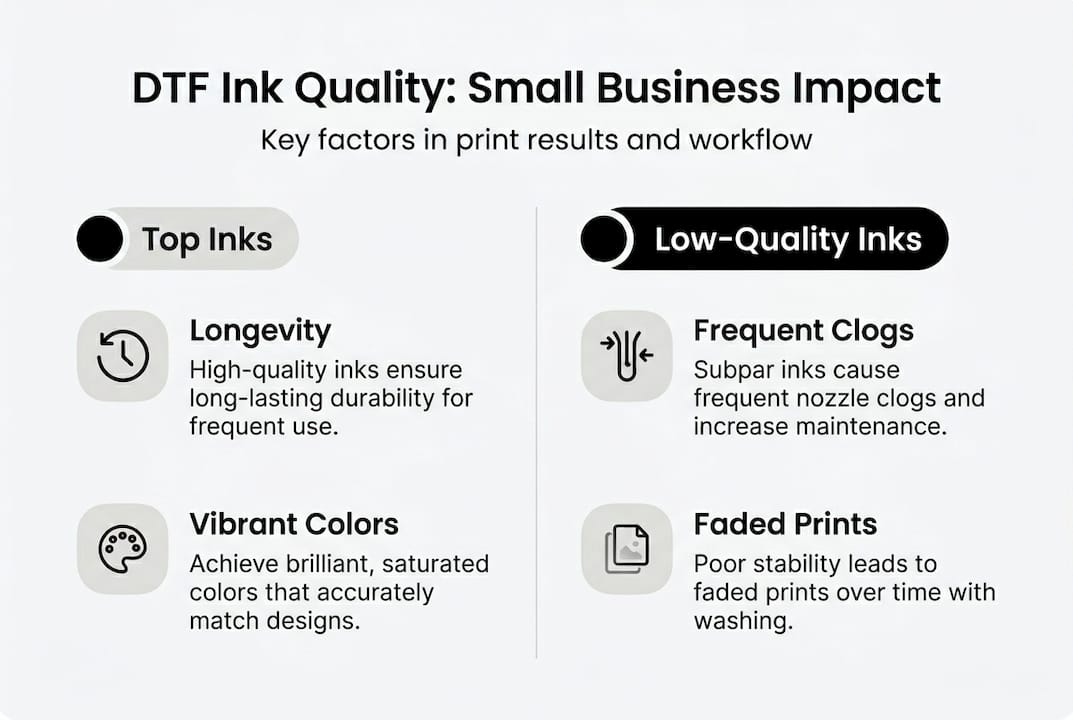
That wash durability gap is enormous from a business standpoint. A customer who buys a custom hoodie expects it to look great after 30 washes. If your ink fades at wash 15, that customer does not come back, and they tell their friends. Checking out best DTF ink brands helps you match your volume and fabric type to the right formulation.
For a deeper look at how DTF wash benchmarks translate into real cost savings, the numbers are compelling. Fewer failed prints mean lower material waste and more predictable profit margins.
When evaluating ink brands, watch for these red flags and green lights:
- Green light: Published wash durability data with independent testing
- Green light: Stated viscosity range matching your printer model
- Green light: Positive reviews from businesses at your production volume
- Red flag: No compatibility specifications listed
- Red flag: Price significantly below market average with no explanation
- Red flag: Inconsistent color output reported across user reviews
How ink characteristics affect DTF machine performance
Your printer is only as reliable as the ink running through it. Ink properties directly shape how often you deal with clogs, how long your printheads last, and how smooth your daily workflow actually runs.
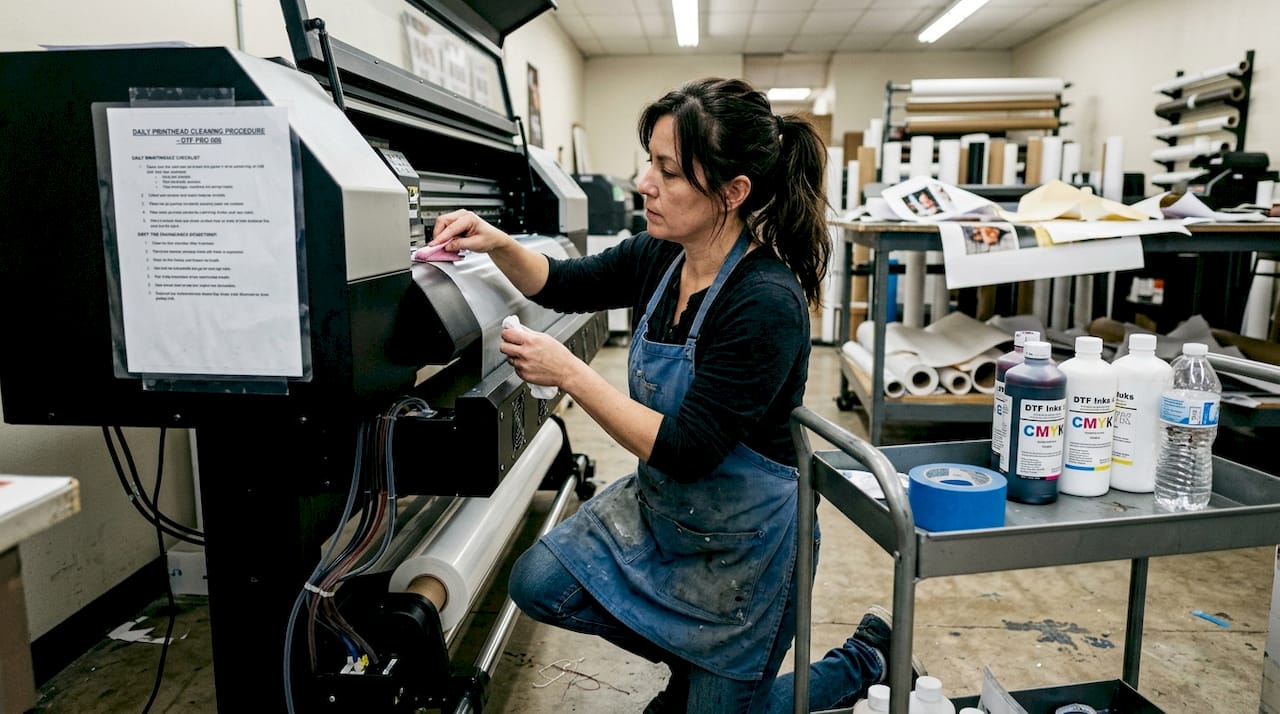
Viscosity is the most critical physical property. Optimal viscosity sits between 1 and 3 mPa·s, and proper rheology prevents clogs while ensuring even ink distribution across the film. Too thick and the ink struggles to pass through the printhead nozzles, causing blockages. Too thin and the ink spreads uncontrollably, producing blurry edges and washed-out color.
| Issue | Likely cause | Prevention strategy |
|---|---|---|
| Nozzle clogging | Ink too thick or low-quality pigment | Use ink within spec viscosity range |
| Blurry print edges | Ink too thin, poor surface tension | Match ink to film type and printer model |
| Color banding | Inconsistent pigment particle size | Choose brands with certified particle uniformity |
| Printhead failure | Incompatible ink chemistry | Verify ink compatibility before switching brands |
| Faded output | Low color density formulation | Select inks with high pigment concentration |
Printhead replacement is one of the most expensive repairs in DTF production. Running incompatible or low-quality ink accelerates wear on those components significantly. Optimizing DTF production speed starts with eliminating the downtime caused by ink-related failures, not by pushing your machine harder.
Pro Tip: Always run a short compatibility test when switching ink brands. Print a test sheet, check nozzle output, and run a wash test before committing to a full production run. This 20-minute check can save you hours of troubleshooting.
Investing in better ink also pays off in DTF cost-saving tips that compound over time. Fewer clogs mean less cleaning solution used, less wasted film, and fewer hours spent on maintenance instead of production.
Choosing the right ink for your apparel business
Knowing the technical differences is useful. Knowing how to apply that knowledge to your specific situation is what actually moves the needle for your business.
Here is a step-by-step process for evaluating DTF ink options:
- Identify your printer model and printhead type. Most DTF printers use Epson printheads. Match ink to Epson printheads and your specific film brand to avoid compatibility failures.
- Estimate your monthly print volume. High-volume shops need inks optimized for production speed and consistency. Lower-volume operations can prioritize color quality over throughput.
- List the fabric types you print on most. Some inks bond better with cotton blends, others with polyester. Cross-reference ink specs with your most common substrates.
- Set a realistic ink budget. Calculate cost per print, not cost per liter. A premium ink that reduces your reprint rate by 20% often costs less per finished piece than a cheap alternative.
- Request samples or small trial quantities. Reputable suppliers offer this. Run your own wash tests before committing to bulk orders.
- Check for certifications. Look for Oeko-Tex or similar certifications that confirm the ink is safe for skin contact, especially if you print children’s apparel.
Pro Tip: Ask your ink supplier for documented wash durability data, not just a verbal claim. Any brand worth buying from will have this on file.
Cutting corners on ink is one of the fastest ways to undermine the DTF ink ROI that makes this printing method so attractive for small businesses. Generic inks often come with vague compatibility claims that fall apart in real production. The savings at purchase evaporate quickly when you factor in reprints, downtime, and unhappy customers. Businesses focused on small business DTF growth consistently report that ink quality was one of the first upgrades that made a measurable difference.
The overlooked business advantages of investing in premium DTF inks
Most conversations about DTF ink quality stop at print results. That misses the bigger picture entirely.
When a customer receives a shirt that holds its color after 40 washes, they come back. They refer friends. They leave reviews. That loyalty is built on the physical quality of your product, and your ink is the single biggest variable in that equation. Premium ink is not just a supply cost. It is a customer retention tool.
Here is what most articles skip: the true cost of cheap ink is not the ink itself. It is the reprints, the machine downtime, the customer service hours spent managing returns, and the orders you never get because a disappointed buyer moved on. Those hidden costs dwarf the price difference between budget and premium ink.
Experience shows that businesses scaling past their first year of DTF printing almost always credit consistency as the key factor. Fewer interruptions, predictable output quality, and a product customers can trust. That is what why DTF is ideal in 2026 keeps coming back to. Stop treating ink as a commodity you buy on price alone. Treat it as a cornerstone of your brand’s reliability.
Elevate your prints with trusted DTF ink and transfers
Switching to quality ink is one of the smartest moves you can make for your print business. But if you want results without the overhead of managing ink, film, and equipment yourself, working with a trusted transfer source is the next logical step.
At Transfer Kingz, every transfer is produced with premium inks and films so you get consistent, vibrant, wash-durable results on every order. No minimums, fast turnaround, and no guesswork about ink compatibility. Whether you are looking for DTF transfers in Dallas or need DTF transfers across Texas, we make it easy to get professional-grade prints delivered to your door and ready to press.
Frequently asked questions
What issues does poor DTF ink quality cause?
Cheap or poorly formulated DTF ink leads to nozzle clogs and blotchy prints, uneven color coverage, and reduced wash durability that results in costly reprints and unhappy customers.
How long do high-quality DTF prints last with the best inks?
With premium ink like Dupont Artistri, prints achieve 5/5 wash durability at 50 or more washes, keeping colors vivid and designs intact far longer than budget alternatives.
How do I know if DTF ink is compatible with my printer?
Check supplier specifications and look for inks matched to your printer model, particularly for Epson printheads, to avoid maintenance issues and inconsistent print quality.
Is it worth paying more for premium DTF inks as a small business?
Yes. Premium inks minimize reprints and reduce machine downtime, making them a stronger long-term investment than the short-term savings of budget alternatives.
0 comments