

Choose matte for product labels, premium merch, and anything with small text, since it kills glare and reads clean at every angle. Choose gloss when a design lives or dies on saturated color or when you’re printing clear stickers that need to stay transparent. Either way, the finish matters less than the vinyl, laminate, and ink underneath it, so order a paired matte and gloss sample on your actual artwork before committing to a bulk run.
TL;DR:
- Gloss finishes can boost perceived color saturation by approximately 15 to 20 percent but create hotspots under direct lighting, which can wash out small text.
- Matte surfaces scatter light to improve readability, hide fingerprints better, and maintain consistent appearance across different lighting conditions.
- Durability mainly depends on the vinyl, laminate, and adhesive used, not the finish, with UV-resistant laminate recommended for outdoor use regardless of gloss or matte.
- For highly saturated colors or photo-realistic designs, gloss is preferable, while matte is better for labels requiring readability without glare or for understated aesthetics.
- Always order paired samples of matte and gloss in the actual artwork and test under real lighting conditions before committing to a bulk order.
Table of Contents
- Matte vs Glossy Stickers: Appearance, Color, and Light Behavior
- Why Laminate, Vinyl, and Ink Quality Matter More Than Finish
- Pros and Cons: Glossy vs Matte Stickers at a Glance
- When Should You Choose Matte vs Glossy Stickers?
- How to Test and Photograph Matte vs Glossy Stickers Before You Commit
- What Transfer Kingz’s Durability Testing Shows About Finish and Longevity
- Stop Picking a Finish Based on a Screen Preview
- Order Real Samples Before You Commit to a Finish
- Sources
Matte vs Glossy Stickers: Appearance, Color, and Light Behavior
Hold the same artwork in matte and gloss side by side and you’re looking at two different products, not two coats of the same paint. Gloss laminate bounces light straight back at the viewer, which is exactly why colors look punchier under it. Several print-industry guides put a number on that difference: gloss finishes can boost perceived color saturation by roughly 15 to 20 percent compared with matte on identical artwork.
That saturation boost comes at a cost. The same reflective surface that makes reds pop also creates hotspots under overhead lighting, store spotlights, or a phone flash, and those hotspots can wash out small text or fine line art. Matte laminate scatters light instead of reflecting it, so readability improves and fingerprints show up far less on a matte surface than a glossy one.
A few specific scenarios worth knowing before you print:
- Dark or black-heavy designs photograph inconsistently on gloss because reflections shift with every angle change, while matte holds a consistent tone in nearly any light.
- Clear stickers behave differently than colored stock: gloss laminate keeps the background genuinely transparent, while matte laminate frosts clear areas so the surface behind it looks hazy rather than invisible.
- Social media product shots tend to go smoother on matte, since brands photographing merch for Instagram or a storefront often treat matte as the safer default. It removes the lighting guesswork gloss introduces during a shoot.
- Holographic or metallic effects only survive under gloss. Matte laminate mutes shimmer effects almost entirely.
Quick numeric callout: Multiple vendor guides converge on that same 15 to 20 percent saturation gap between gloss and matte, which is a big enough swing that a logo looking great on your monitor can look flat once it’s printed matte. That’s the entire reason a physical sample beats a screen preview every time.
Why Laminate, Vinyl, and Ink Quality Matter More Than Finish
Here’s the part most buyers get backwards: finish is a surface texture, not a durability spec. What actually determines whether a sticker survives a dishwasher, a windshield, or two Texas summers is the base material and the laminate layer sitting on top of it, not whether that laminate is matte or gloss.
Vinyl stock resists moisture and UV exposure far better than paper or BOPP film, and a quality laminate, whether matte, gloss, or UV cured, adds a protective barrier against scratches and sun fade. When you print on the same grade of vinyl with the same laminate quality, matte and gloss perform almost identically outdoors. Neither finish inherently lasts longer; the laminate and adhesive underneath do the real work.
A few things worth specifying when you order:
- Ask specifically for UV-resistant laminate if the sticker will sit in direct sunlight for months, regardless of finish.
- Confirm the adhesive class matches the surface (glass, powder-coated metal, fabric) since a mismatched adhesive fails before the laminate ever does.
- Expect gloss to hide light surface scratches slightly better than matte, while matte hides fingerprints and handling marks better in products people touch constantly, like water bottles or laptop lids.
Pros and Cons: Glossy vs Matte Stickers at a Glance
Neither finish wins outright. Here’s the quick breakdown when you need to decide fast.
- Glossy pros: Higher perceived saturation and contrast, added visual depth on photos and product packaging, strong performance for bold or photo-realistic art, and a slight edge resisting visible surface scratches.
- Glossy cons: Glare under bright or angled light, visible fingerprints and smudges on handheld items, and a slick surface that most permanent markers won’t write on reliably.
- Matte pros: No glare under any lighting, a premium and understated look that reads as intentional rather than cheap, a writable surface for markers and pens, and better concealment of fingerprints and minor handling marks.
- Matte cons: Colors read slightly less vibrant than the identical design in gloss, and clear matte stock frosts over rather than staying transparent.
If your design leans on bright, saturated color to grab attention on a shelf, gloss earns its keep. If your product depends on people actually reading the label without tilting it under a light, matte wins that fight every time.
When Should You Choose Matte vs Glossy Stickers?
The right finish depends entirely on where the sticker lives and what job it’s doing, not which one looks nicer as a digital mockup.
Packaging and product labels: Matte dominates premium categories like skincare, candles, and boutique food packaging because it reads as understated and high-end rather than shiny and mass-produced. Gloss still has a place here, though, especially when a brand needs shelf pop next to competitors and is willing to trade subtlety for visibility. Both approaches show up constantly across branding guides, split roughly along that premium-versus-promotional line.
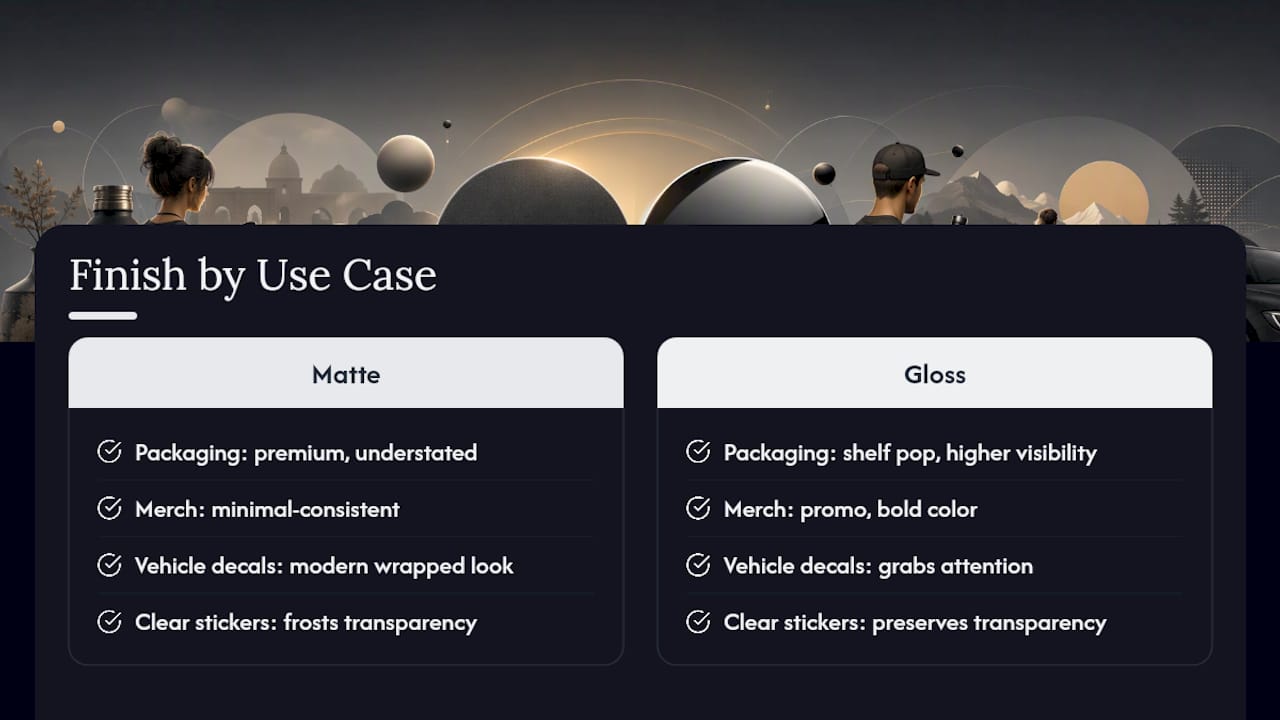
Merch and giveaway stickers: Gloss suits high-energy promo stickers, event giveaways, and kids’ products where bold color does the selling. Matte fits better when a brand wants stickers that feel consistent with an already-minimal aesthetic across packaging and merch.
Vehicle decals and outdoor signage: This comes down to material and laminate quality first, finish second. Gloss tends to grab more attention on a moving vehicle or storefront window; matte has become the go-to for the modern “wrapped” look on cars and equipment.
Clear stickers: If transparency matters to the design, gloss is the only real option. Matte will frost the clear areas and undercut the exact effect you’re trying to achieve.
How to Test and Photograph Matte vs Glossy Stickers Before You Commit
Skipping the sample step is the single most common reason buyers reorder a whole batch. Here’s the sequence that avoids it:
- Order paired samples in matte and gloss at the exact size and on the exact substrate you’ll ship. Never judge finish from a screen mockup.
- View both samples under real lighting, meaning the store shelf, the car dashboard, or the office desk the sticker will actually live on, not a lightbox.
- Test writeability if labeling matters to your workflow. Oil-based permanent markers and paint pens grip gloss reasonably well; standard felt-tip pens skip and smear on it. Matte accepts nearly any pen or marker without resistance.
- Photograph both samples using diffused, indirect light. Gloss usually needs a polarizing filter or a diffusion panel to kill hotspots; matte typically photographs clean without extra gear.
- Run an adhesion check on the final surface material before signing off on a production run.
Pro Tip: Photograph your sample outdoors at midday and again under indoor fluorescent light before approving a gloss finish. That’s where hotspots show up worst, and it’s the fastest way to catch a problem before it’s printed on 500 units.
What Transfer Kingz’s Durability Testing Shows About Finish and Longevity
Transfer Kingz has run its own UV DTF sticker durability review on hard goods, and the pattern lines up with what the broader print industry reports: construction beats finish every time. UV DTF stickers built with the right film, ink, and laminate combination hold up on tumblers, laptops, and outdoor gear regardless of whether the top layer is matte or gloss.
That durability question comes up constantly with waterproofing specifically. Transfer Kingz breaks down what actually makes a sticker waterproof, and again, the laminate and adhesive layer are doing the protective work, not the finish sheen. If you’re speccing a sticker for a water bottle or an outdoor cooler, ask about the laminate grade before you ask about matte versus gloss.
The practical takeaway carries straight into how Transfer Kingz recommends ordering: test the exact material and finish combination on a small sample before committing to a production run, the same standard practice repeated across the vendor guides cited throughout this piece.
Stop Picking a Finish Based on a Screen Preview
The biggest mistake makers make isn’t choosing matte or gloss wrong, it’s choosing based on how a mockup looks on a laptop screen instead of how the physical sticker behaves in someone’s hand or on a shelf under real light. A monitor can’t show you glare, can’t show you how a marker skips across gloss laminate, and can’t replicate the 15 to 20 percent saturation drop that happens the moment you swap gloss for matte.
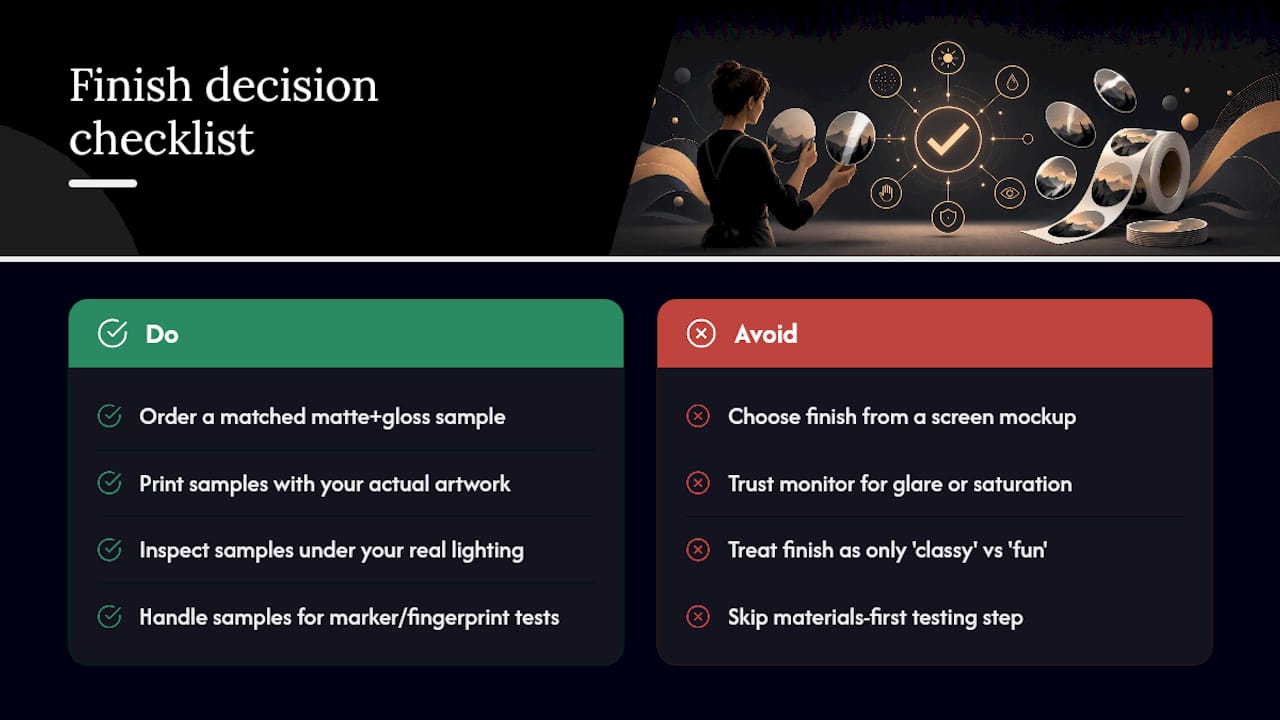
Conventional advice treats this as a purely aesthetic decision, matte for “classy,” gloss for “fun.” That framing skips the functional questions that actually determine whether a customer can read your label, whether a decal survives a Texas summer, or whether your merch collects fingerprints within a week of shipping. Finish is a design decision layered on top of a materials decision, and the materials decision comes first.
If there’s one habit worth adopting from this whole comparison, it’s ordering a matched pair of samples before any bulk order, printed on your actual artwork, viewed under your actual lighting. That five-minute check has saved more reorders than any amount of staring at a color proof on a screen.
— Anthony
Order Real Samples Before You Commit to a Finish
You don’t have to guess which finish will actually work for your product line. Transfer Kingz builds UV DTF PermaStickers with no minimum order requirement, which means you can request a small paired matte and gloss sample on your own artwork instead of committing to a few hundred units sight unseen.
The process is simple: upload your design, request a paired matte and gloss sample run, then approve whichever finish holds up under your own lighting and application before moving to full production. Because there’s no minimum order size, testing costs you almost nothing compared to reprinting a bad batch. Transfer Kingz turns samples around quickly and ships nationwide, and its DTF transfer production in Dallas supports everything from single-sticker test runs to large production orders once you’ve locked in a finish. If you’re weighing durability specifically for outdoor or hard-good applications, the UV DTF sticker product line lists the laminate and material options available for each finish.
Sources
For readers who want more detail beyond this comparison:
- Glossy vs Matte Stickers: Finish Guide for Brands | Paperlust
- Gloss vs Matte Stickers: Which Finish Should You Choose? | StickerNation
- Glossy vs Matte Stickers: How Each Finish Changes Your Design | Jukebox
- Matte vs Gloss Stickers: Which Finish Should You Choose? - PrintReviewer
0 comments