

TL;DR:
- Merchandise customization allows small businesses to create unique products that boost margins and strengthen brand identity.
- Using tools like DTF printing and AI design platforms, small sellers can produce custom items efficiently without holding large inventories.
Merchandise customization is the process of adapting products to meet specific customer preferences by selecting options like colors, materials, print methods, and design elements. The industry term for this practice is product customization, and explaining merchandise customization clearly is the first step any small business or individual needs before spending a dollar on production. Done right, it creates stronger brand identity, commands premium pricing, and reduces the inventory risk that kills small operations. Tools like Shopify, AI design platforms such as Midjourney and DALL-E, and printing methods like Direct-to-Film (DTF) have made this process faster and more affordable than ever before.
What is merchandise customization and how does it work?
Merchandise customization is the structured process of modifying a product’s appearance, material, or function based on buyer-selected options. It sits on a spectrum from simple color choices to fully personalized items with customer-uploaded artwork. Understanding where your product falls on that spectrum determines which tools, suppliers, and pricing models you need.
The industry draws a clear line between customization and personalization. Customization means selecting from structured options like size, color, or finish. Personalization means the customer adds free-form inputs like a name, photo, or custom message. Successful e-commerce stores use both together to justify premium pricing. Confusing the two leads to order management problems that are hard to fix at scale.
Mass customization adds another layer. Design’n’Buy identifies four models businesses use: collaborative (customer co-designs with the brand), adaptive (product adjusts to customer behavior), cosmetic (same product, different packaging or labels), and transparent (product is customized without the customer actively choosing). Each model fits a different business type and budget.
What are the main printing methods for custom merchandise?
The printing method you choose affects cost, durability, color range, and minimum order size. These are the five methods small businesses use most.
| Method | Best For | Pros | Cons |
|---|---|---|---|
| Screen printing | Large runs, simple designs | Low cost per unit at volume | High setup cost, limited colors |
| Direct-to-Garment (DTG) | Small runs, photo-quality prints | No minimums, full color | Slower, higher cost per unit |
| Direct-to-Film (DTF) | All fabric types, detailed art | No minimums, vibrant color, durable | Requires heat press application |
| Sublimation | Polyester and hard goods | Permanent, wash-resistant | Polyester only, light fabrics |
| Embroidery | Hats, polos, workwear | Premium look, long-lasting | Limited detail, higher setup |
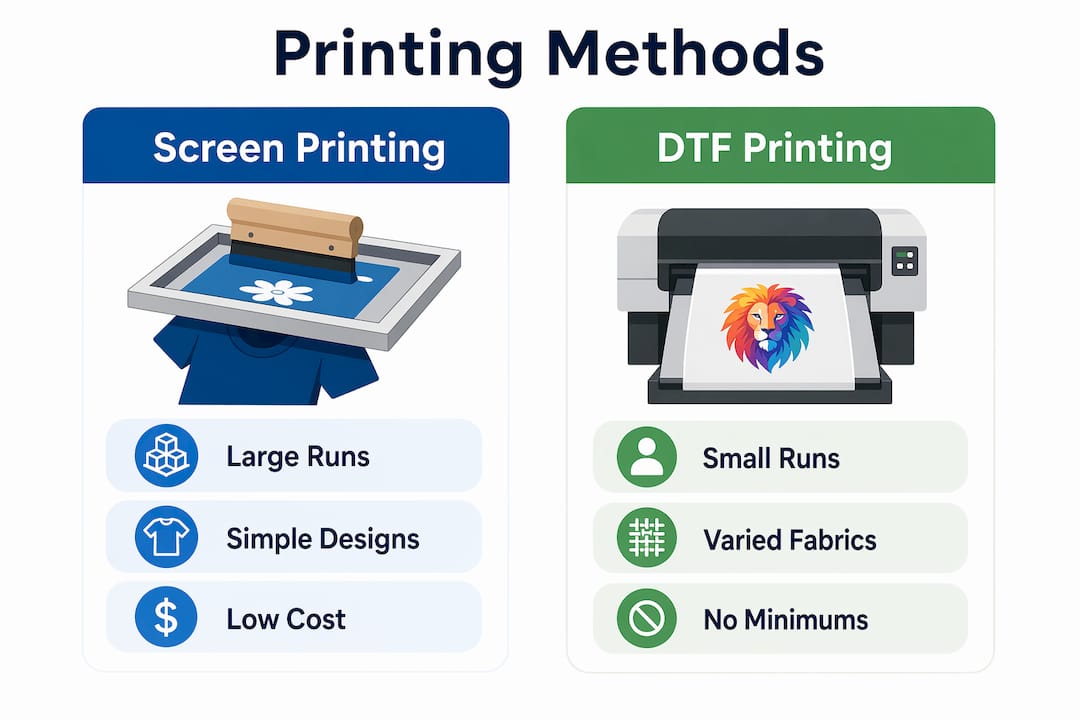
DTF printing stands out for small businesses because it works on cotton, polyester, nylon, and blended fabrics without pretreatment. You can review a full breakdown of textile printing methods to match the right technique to your product goals. DTG requires pretreatment on dark fabrics and slows production. Screen printing only becomes cost-effective above roughly 24 units per design.
Pro Tip: If you sell fewer than 50 units per design, DTF or DTG will almost always beat screen printing on total cost. Screen printing’s setup fees make it a poor fit for small or varied runs.
What tools and platforms enable merchandise customization?
The right software stack determines how fast you can launch and how well your store scales. Three layers matter: the storefront platform, the customization app, and the design tool.
Shopify’s native variants are free and take minutes to set up per product. They handle simple options like size and color well. For anything more complex, such as text input, file uploads, or conditional pricing, you need a third-party app. Popular options include Print It My Way and Bold Product Options, which range from $8.90 to $39.99 per month depending on features. Custom code alternatives can cost $500 or more and take several hours to implement.
AI design tools have changed the speed of concept development. Midjourney and DALL-E can generate 50+ design concepts daily. That volume used to take a design team hours. Now a solo operator can test multiple design directions before committing to production, which cuts waste and speeds up time to market.
Backend integration is where most small businesses make costly mistakes. A proper custom product builder must include cart transform pricing so that customization fees update in real time and appear as a single line item at checkout. Without it, customers see confusing fee breakdowns, and you end up correcting invoices manually.
Pro Tip: Store all customer-entered personalization data as line-item properties in your cart, not as product variants. This keeps your product catalog clean and makes order fulfillment far easier to manage at scale.
What are the benefits and challenges of product customization?
The financial case for customization is direct. Custom t-shirts net $3–$8 profit per unit, while premium items like hoodies can net $10–$20 per unit. That margin is achievable without holding inventory when you use a print-on-demand or DTF transfer model. Digital goods push margins even higher, but physical customized products offer the brand-building value that digital cannot replicate.
The strategic case is equally strong. Businesses that skip customization compete only on price, which is unsustainable for small operations. Offering custom merchandise options creates a product that a competitor cannot directly copy or undercut. That uniqueness protects your margin and builds repeat purchase behavior.
The challenges are real, though. Managing production complexity grows fast when you offer too many options too soon. The most common operational problems small businesses face include:
- Choosing a supplier who cannot maintain consistent material quality across reorders
- Offering too many customization combinations before testing what customers actually want
- Setting up pricing that does not account for customization add-ons at checkout
- Ignoring regional fulfillment, which increases shipping times and return rates
Regional production and consistent material quality reduce return rates and build brand trust more reliably than a wide product catalog. A focused product line with dependable quality outperforms a sprawling catalog with inconsistent results every time.
How to implement merchandise customization from concept to sale
A clear implementation process prevents the most common and expensive mistakes. Follow these steps in order.
- Define your objective. Decide whether you are building a brand, testing a product idea, or fulfilling custom orders for clients. Your goal shapes every decision that follows.
- Select your product type. Start with one or two products. T-shirts, hoodies, and tote bags are the most forgiving for first-time customization because suppliers are plentiful and print methods are well-established.
- Choose your print method. Match the method to your order volume and fabric type. DTF works for low-volume, high-variety runs. Screen printing suits high-volume, low-variety runs.
- Set up your design workflow. Use Midjourney or DALL-E to generate initial concepts fast. Refine the best options in Adobe Illustrator or Canva before sending files to production.
- Configure your store. Set up Shopify variants for simple options. Add a third-party app for personalization inputs. Confirm cart transform pricing is active before launch.
- Order samples. Test every product and print combination before selling. Samples reveal color accuracy, print placement, and wash durability issues that file previews never show.
- Launch with a focused SKU count. Start with three to five products. Expand only after you have real sales data showing what customers want.
Merchandise on demand works best when product type, fulfillment region, pricing, and buyer intent all align. Rushing to a wide catalog before validating your core products is the single most common reason small businesses stall. For a deeper look at growing beyond the launch phase, the 2026 custom printing growth guide covers scaling strategies in detail.
Pro Tip: Run a soft launch with a small paid audience before your full release. Ten to twenty orders will reveal fulfillment gaps, pricing confusion, and design issues that internal testing always misses.
Avoid these common mistakes:
- Skipping samples and relying only on digital mockups
- Offering personalization without capturing data as line-item properties
- Using a supplier with a wide catalog but inconsistent print quality
- Launching with more than ten SKUs before validating demand
Key Takeaways
Merchandise customization gives small businesses a direct path to higher margins, stronger brand identity, and reduced inventory risk when implemented with the right methods and tools.
| Point | Details |
|---|---|
| Customization vs. personalization | Customization uses structured options; personalization uses free-form inputs. Use both together for premium pricing. |
| DTF is the most flexible print method | DTF works on all fabric types with no minimums, making it ideal for small and varied runs. |
| Profit margins are real | Custom hoodies can net $10–$20 per unit using a print-on-demand model with no inventory risk. |
| Cart pricing must be configured correctly | Cart transform pricing prevents checkout confusion and eliminates manual invoice corrections. |
| Start focused, then scale | Launch with three to five products and real sales data before expanding your catalog. |
Why I think most small businesses overcomplicate this from day one
The most common mistake I see is small businesses treating merchandise customization like a technology problem when it is actually a product focus problem. They spend weeks evaluating apps, comparing print methods, and building complex Shopify setups before they have sold a single unit. The technology is the easy part. Knowing what your customer actually wants to customize is the hard part.
The distinction between customization and personalization matters more than most people realize. I have watched store owners set up elaborate free-form input fields when a simple dropdown of three color options would have converted better and been far easier to fulfill. Combining structured options with free-form personalization yields the highest satisfaction, but only when you have enough order volume to justify the backend complexity.
AI tools like Midjourney have genuinely changed what a solo operator can do. Generating dozens of design concepts in a morning and testing them with a small ad budget before committing to production is a real advantage. The businesses that use this well are the ones that treat design as a hypothesis to test, not a final decision to protect.
My honest advice: pick one product, one print method, and one fulfillment partner. Get ten real orders. Learn what breaks. Then build from there. The custom apparel design guide for small business owners is a solid starting point for that first product decision.
— Anthony
Transferkingz DTF printing for your custom merchandise
Transferkingz specializes in Direct-to-Film transfers that work on virtually any fabric, with no minimum order requirements and fast turnaround times. That combination makes it a practical fit for small businesses testing new designs or fulfilling custom orders without committing to large print runs.
Transferkingz serves customers across Texas with custom DTF transfers in Dallas and statewide through its Texas DTF printing services. You upload your artwork, configure your order, and receive production-ready transfers that apply with a standard heat press. The process is straightforward whether you are a hobbyist printing one shirt or a small brand fulfilling weekly orders.
FAQ
What is merchandise customization?
Merchandise customization is the process of modifying a product’s colors, materials, design, or text based on buyer-selected options. It differs from personalization, which involves free-form customer inputs like names or photos.
What is the difference between DTF and DTG printing?
DTF (Direct-to-Film) transfers work on all fabric types without pretreatment and suit low-volume, high-variety runs. DTG (Direct-to-Garment) prints directly onto fabric but requires pretreatment on dark garments and is slower per unit.
How much profit can I make from custom merchandise?
Custom t-shirts typically net $3–$8 per unit, while premium items like hoodies can net $10–$20 per unit using a print-on-demand model with no inventory holding costs.
Do I need a minimum order for DTF printing?
Transferkingz offers DTF transfers with no minimum order requirement, making it practical for small businesses and individuals who need single units or small runs.
What is the biggest mistake when setting up a custom product store?
The most common mistake is failing to configure cart transform pricing, which causes customization fees to display incorrectly at checkout and leads to manual invoice corrections that do not scale.
0 comments