

TL;DR:
- Most small-to-medium apparel decorators should consider outsourced DTF transfers as the best initial choice. Transferkingz offers no minimums, gang-sheet pricing, and quick domestic turnaround, making it practical for most shops. Larger volume or specialty needs may benefit from screen printing, white-toner systems, HTV, or DTG, depending on order size and design complexity.
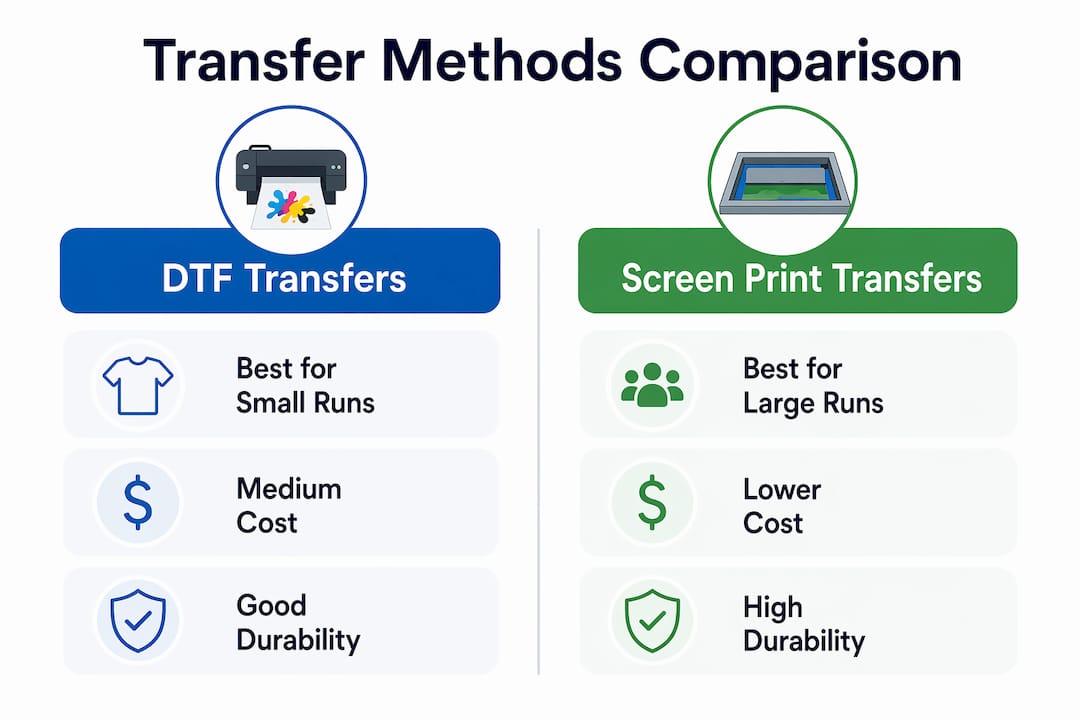
For most small-to-medium apparel decorators, the strongest perfectdtf.com alternatives are Transferkingz (outsourced DTF transfers, no minimums), screen-printed transfers (best for large runs of simple designs), white-toner systems (in-house control for short runs), HTV (single-color personalization), and DTG/on-demand printing (photo-realistic art on cotton). Transferkingz is the practical first pick for most shops: no capital expense, gang-sheet pricing, and domestic turnaround.
Quick shortlist:
- Transferkingz — outsourced DTF, no minimums, gang-sheet builder; best all-around for SMBs watching cash flow
- Screen-printed transfers — cheaper per piece at scale for low-color designs; setup cost is the tradeoff
- White-toner systems — in-house equipment around $8,000 entry cost; no nozzle clogs, diverse substrates
- HTV — lowest equipment cost; limited to block-color graphics and slow per-piece application
- DTG/on-demand — soft hand-feel on cotton, photo-realistic detail; substrate limits on poly blends
Table of Contents
- Which perfectdtf.com alternative fits your shop?
- Why Transferkingz is the practical first choice for most SMBs
- When do screen-printed transfers beat DTF?
- Are white-toner systems worth the investment for a small shop?
- How does HTV fit into a modern print shop?
- DTG and on-demand printing: when to outsource instead of transfer
- How to choose the right alternative for your shop
- What’s the best pick for most small-to-medium decorators?
- Key Takeaways
- The part most shops get wrong when switching methods
- Get started with Transferkingz today
- Sources and further reading
Which perfectdtf.com alternative fits your shop?
| Method | Best for | Typical cost drivers | Turnaround & minimums | Durability / washability | Hand-feel / thickness | Equipment / setup | Throughput | Scalability |
|---|---|---|---|---|---|---|---|---|
| Outsourced DTF (Transferkingz) | 1–250 pieces, full-color | Per-piece + shipping; gang sheets cut unit cost | 1–3 business days; no minimum | Excellent; high wash fastness | Slightly thicker film feel | Heat press only | ~15 sec/piece | High — just order more |
| Screen-printed transfers | 72+ pieces, 1–4 colors | Setup/separation fees; cheap per-piece at volume | 5–10 business days; minimums vary | Excellent for solids | Soft, minimal hand | Screen setup cost | ~10 sec/piece | High for repeat designs |
| White-toner (in-house) | Short runs, mixed substrates | ~$8,000 hardware; toner + film consumables | Same-day in-house; no vendor minimum | Good; varies by film | Moderate | ~$8,000 printer | Moderate | Limited by machine speed |
| HTV | 1–24 pieces, 1–2 colors | Vinyl + cutter; low per-piece material cost | Same-day in-house; no minimum | Excellent for block color | Thick, stiff on fine detail | Vinyl cutter + heat press | 3–8 min/piece (weeding) | Low — labor-intensive |
| DTG / on-demand | Cotton-heavy, photo art | Per-piece pricing; pretreatment on darks | 2–5 business days; varies | Good on cotton; fades faster on poly | Softest hand-feel | None (outsourced) | N/A (outsourced) | Medium |
Pick your method by matching order size and color count first, then budget.
Why Transferkingz is the practical first choice for most SMBs
Transferkingz sells custom DTF transfers, gang sheets, UV DTF transfers, and sticker printing through a straightforward online order flow. You upload your artwork, configure your gang sheet using the web-based builder, and choose standard shipping or same-day local pickup. No minimums means a 1-piece test order costs the same per-piece rate as a 50-piece run — which is rare in the outsourced transfer market.
Pros:
- Zero capital expense; pay only for what you order
- Gang-sheet builder packs multiple designs onto one sheet, dropping unit cost materially at 50+ pieces
- Full-color, photo-realistic output on cotton, polyester, blends, and hard goods
- Domestic turnaround (typically 1–3 business days) with no overseas shipping delays
- DTF transfer benefits include strong wash durability and vibrant color on dark garments without pretreatment
Cons:
- Per-piece cost is higher than screen-printed transfers at large volumes (250+ identical pieces)
- Film layer adds slight thickness compared to DTG or screen ink
- Shipping lead time still applies if you’re not local to Dallas
Ordering notes: Request a sample or small pilot run before committing to a large gang sheet. Pack designs tightly on your gang sheet — wasted film space is wasted money. Transferkingz ships nationwide, so turnaround includes transit; factor that into your customer promise. For the DTF design process and gang-sheet layout tips, the brand’s own guides walk you through file prep.
Price shape: At 12 pieces, outsourced DTF transfers typically run $1.50–$3.00 per piece depending on design size. At 50 pieces on a gang sheet, unit cost drops noticeably. At 250 pieces, gang-sheet pricing can bring per-piece cost below $1.00 for standard-size designs. Exact pricing depends on design dimensions and sheet configuration.
When do screen-printed transfers beat DTF?
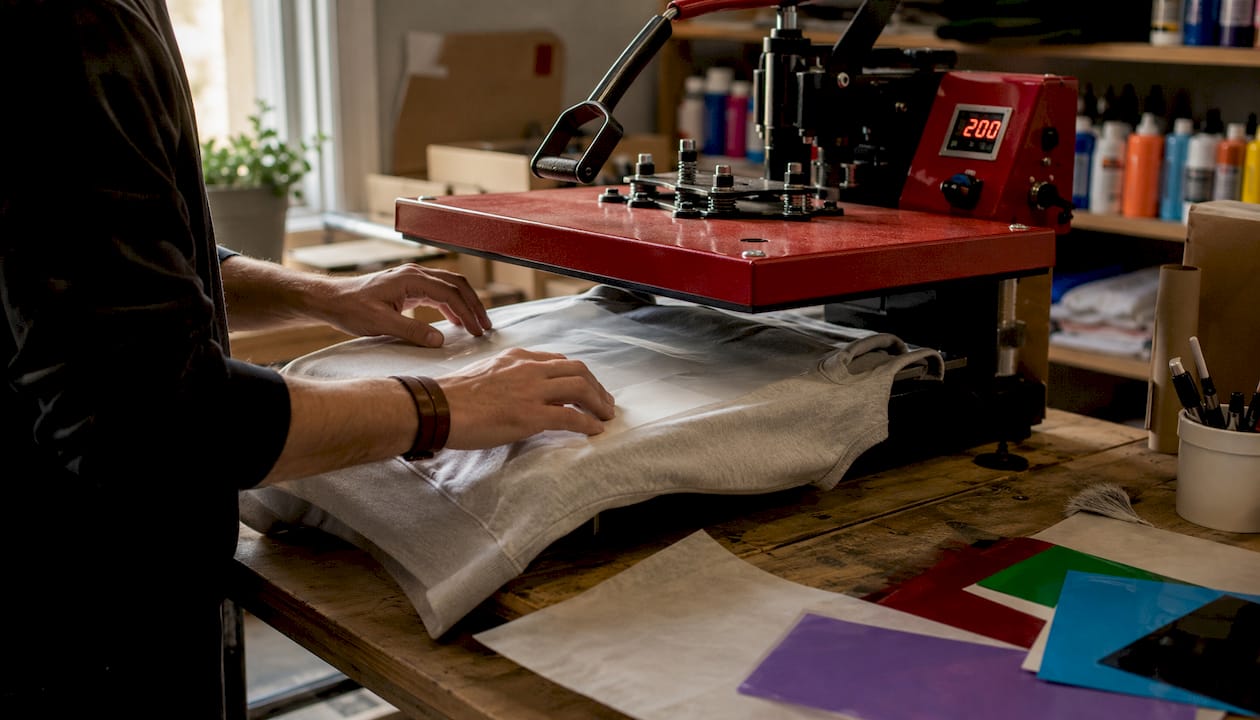
Screen-printed transfers are produced by printing plastisol ink through a screen onto release paper, then heat-pressing that pre-printed sheet onto a garment. The shop never touches a screen directly — the transfer supplier handles production and ships finished sheets.
Pros:
- Lowest per-piece cost at high volume with few colors (72+ pieces, 1–4 colors)
- Excellent hand-feel for solid-color designs; ink sits on top of the fabric rather than bonding through a film
- Proven durability; plastisol on cotton is well-documented for wash longevity
- No in-house printing equipment needed
Cons:
- Setup fees for color separations add fixed cost that hurts small runs
- Color count is a hard limit — photographic or gradient art is impractical
- Longer lead times (5–10 business days is common)
- Minimum order quantities vary by supplier and can be 24–72 pieces per design
Cost breakpoint: Screen-printed transfers typically become cheaper than per-piece digital transfers somewhere around 72–144 identical pieces for a 1–2 color design, once setup cost is amortized. Below that threshold, outsourced DTF almost always wins on total cost. For a deeper look at how these two methods stack up, the DTF vs screen printing breakdown covers the tradeoffs in detail.
Best use cases: Team uniforms, event shirts, and branded workwear where the design is simple, the run is large, and the same artwork repeats across many garments.
Are white-toner systems worth the investment for a small shop?
White-toner transfer printers are laser or LED printers retrofitted with white toner, printing CMYK plus white onto transfer film without any liquid ink. That means no nozzle clogs and no daily maintenance purges — the machine can sit unused for weeks and start printing immediately. The workflow differs from ink-based DTF: you print, apply a clear adhesive layer, and heat-press onto the garment.
Pros:
- No ink-clog downtime; dry toner tolerates idle periods that would ruin an inkjet head
- Prints on virtually any fabric color and type, plus hard substrates like wood, acrylic, glass, and ceramic
- Eliminates the shaker/dryer powder stage entirely, keeping the shop cleaner
- Same-day turnaround with no vendor dependency
Cons:
- Entry-level apparel-capable models are typically priced around $8,000, plus ongoing toner and film consumables
- Design workflow differs from standard DTF — color profiles and white-layer sequencing require a learning curve
- Output quality on photographic gradients can fall short of ink-based DTF
- Throughput is moderate; not suited for high-volume production runs
When it makes sense: A shop doing consistent short runs across diverse substrates — apparel, mugs, wood signs — can justify the hardware cost. If your volume is unpredictable or you’re still growing, outsourcing transfers keeps capital risk near zero until the math clearly favors ownership.
How does HTV fit into a modern print shop?
Heat-transfer vinyl is cut from rolls of colored vinyl using a plotter cutter (like a Cricut or Roland), weeded by hand, and pressed onto garments with a heat press. No printing involved — the color comes from the vinyl itself.
Pros:
- Very low equipment cost; a decent vinyl cutter and heat press can be had for under $1,000 combined
- Outstanding wash durability for solid block-color designs
- Great for personalization: names, numbers, single-color logos on jerseys or hats
- No minimum quantities; one piece is as easy as fifty
Cons:
- Hard limit on design complexity — gradients, photos, and fine detail are not viable
- Weeding time per piece is significant, especially for intricate cuts; throughput drops fast
- Multi-color designs require layering multiple vinyl cuts, which multiplies application time
- Not competitive on cost or speed once designs exceed 2–3 colors or quantities exceed 24 pieces
Sweet spot: HTV earns its place for personalization work — a single name on a jersey, a one-color logo on a hat, or a small batch of custom gifts. Beyond that, outsourced DTF transfers almost always deliver better results faster.
DTG and on-demand printing: when to outsource instead of transfer
Direct-to-garment printing jets water-based ink directly onto the fabric surface, producing a genuinely soft hand-feel that no transfer method fully replicates. The difference between DTG and DTF comes down to substrate and workflow: DTG excels on 100% cotton with photo-realistic art, but dark garments require pretreatment, and polyester blends produce inconsistent results.
Pros:
- Softest hand-feel of any decoration method — ink becomes part of the fabric
- Photo-realistic detail and smooth gradients on light cotton
- No transfer film; no heat-press step for the end customer
Cons:
- Pretreatment required on dark garments adds time and cost
- Poly blends and synthetic fabrics produce faded, inconsistent output
- Per-piece cost is typically higher than DTF transfers at equivalent quantities
- Wash durability on poly blends is weaker than DTF
When to prefer DTG over DTF: Cotton-dominant orders with photographic artwork and a customer who specifically wants a soft, no-feel print. When your order mix includes poly blends, dark synthetics, or non-apparel substrates, DTF transfers handle the range better.
How to choose the right alternative for your shop
Work through this checklist before committing to a method or vendor:
- Define your typical order size. Under 24 pieces? Outsourced DTF or HTV. 72–250 pieces of the same design? Screen-printed transfers start making economic sense. Over 250 identical pieces in 1–3 colors? Screen transfers likely win on cost.
- Count your colors. Full-color or photographic art points to DTF or DTG. Three colors or fewer on a large run points to screen-printed transfers.
- Assess your capital budget. No budget for equipment? Outsource. Have $8,000 and consistent short-run volume across multiple substrates? White-toner hardware is worth modeling.
- Estimate your labor tolerance. HTV and in-house white-toner both require operator time. Outsourced DTF and DTG eliminate in-house production labor entirely.
-
Ask vendors the right questions before ordering:
- What wash-test results do you have, and at what cycle count?
- What is your actual turnaround from file approval to ship?
- Do you support gang sheets, and what is the minimum gang-sheet size?
- What is your reprint or remake policy for production errors?
- Can I order a sample or 12-piece pilot before a full run?
- Run a pilot. Industry best practice is to validate any new method or vendor with a 12–24 piece test run before committing to a large order. Check hand-feel, wash results after 10+ cycles, and application time per piece.
Red flags to avoid:
- No wash-test data available or vendor deflects the question
- Vague turnaround (“ships when ready”) with no committed window
- Hidden setup fees not disclosed until checkout
- No sample or proof policy
- Gang-sheet support absent or poorly documented
Pro Tip: If you do more than 250 units per design and solids dominate your order mix, get a screen-transfer quote alongside your DTF quote. The setup cost amortizes quickly at that volume, and the per-piece savings add up fast.
Decision rules by shop profile:
- Growing SMB, mixed designs, limited capital → Outsourced DTF via Transferkingz
- High-volume uniforms or branded workwear, 1–4 colors → Screen-printed transfers
- Short-run, multi-substrate shop with steady volume → White-toner in-house
- Personalization-only shop, 1–2 colors → HTV
- Cotton-focused, photo-art orders → DTG outsourced
What’s the best pick for most small-to-medium decorators?
For the majority of growing apparel shops, outsourced DTF transfers through Transferkingz are the right starting point. Zero capital risk, no minimums, gang-sheet economics, and domestic turnaround cover most order profiles without locking you into equipment or long-term commitments. Shops doing 250+ identical pieces of simple designs should get a screen-transfer quote to compare. Shops with consistent multi-substrate short-run work should model the white-toner hardware cost against their monthly outsourcing spend.
The immediate next step: place a 12-piece pilot order using a gang sheet. Apply the transfers, run them through 10 wash cycles, and check hand-feel and adhesion before scaling. That single test eliminates most of the guesswork.
Key Takeaways
Outsourced DTF transfers are the lowest-risk starting point for most small-to-medium apparel decorators, with gang-sheet pricing and no minimums making them cost-effective from a single piece up to several hundred.
| Point | Details |
|---|---|
| Match method to order size | Under 24 pieces: outsourced DTF or HTV. 72+ identical pieces in few colors: screen-printed transfers. |
| Capital vs. per-piece tradeoff | White-toner hardware requires an upfront investment of around $8,000; outsourcing keeps capital near zero until volume justifies ownership. |
| Hand-feel varies by method | DTG is softest; HTV is thickest for block color; DTF film adds slight thickness but handles full color on any fabric. |
| Always run a pilot | Test 12–24 pieces and wash them 10+ cycles before committing to a new vendor or method. |
| Transferkingz for most SMBs | No minimums, gang-sheet builder, and domestic turnaround make Transferkingz the practical first choice for growing shops. |
The part most shops get wrong when switching methods
The conventional wisdom in the decorator community is that switching methods is mainly a cost decision. Run the numbers, find the cheaper option, switch. That framing misses the real variable: throughput and labor.
A method that saves $0.40 per piece but adds three minutes of weeding or application time per garment can easily cost more in total shop labor than the transfer savings recover. HTV is the clearest example — the material cost looks attractive until you price your own time at any reasonable hourly rate and multiply it across a 50-piece order. Screen-printed transfers have a similar hidden cost in the form of setup time and the minimum-order discipline they require.
The shops that navigate this well treat the pilot order as a labor audit, not just a quality check. They time the application, count the steps, and factor in the reorder cycle. Outsourced DTF transfers tend to win that audit for most SMBs not because the transfer itself is magic, but because the workflow is genuinely simple: press, peel, done. For shops exploring eco-friendly graphic clothing options, powderless DTF workflows also reduce shop waste compared to traditional powder-based systems, which is worth factoring into the total-cost picture.
The honest admission: in-house equipment — white-toner or otherwise — is the right strategic investment for some shops. If your substrate mix is genuinely diverse and your volume is steady, owning your production gives you speed and margin control that outsourcing cannot match. The mistake is buying equipment to solve a volume problem you don’t yet have.
Get started with Transferkingz today
If you’ve been comparing DTF printing services and want to skip the equipment headache entirely, Transferkingz delivers custom DTF transfers with no minimum order, a gang-sheet builder that packs multiple designs onto a single sheet, and same-day local pickup in Dallas or nationwide shipping for everyone else.
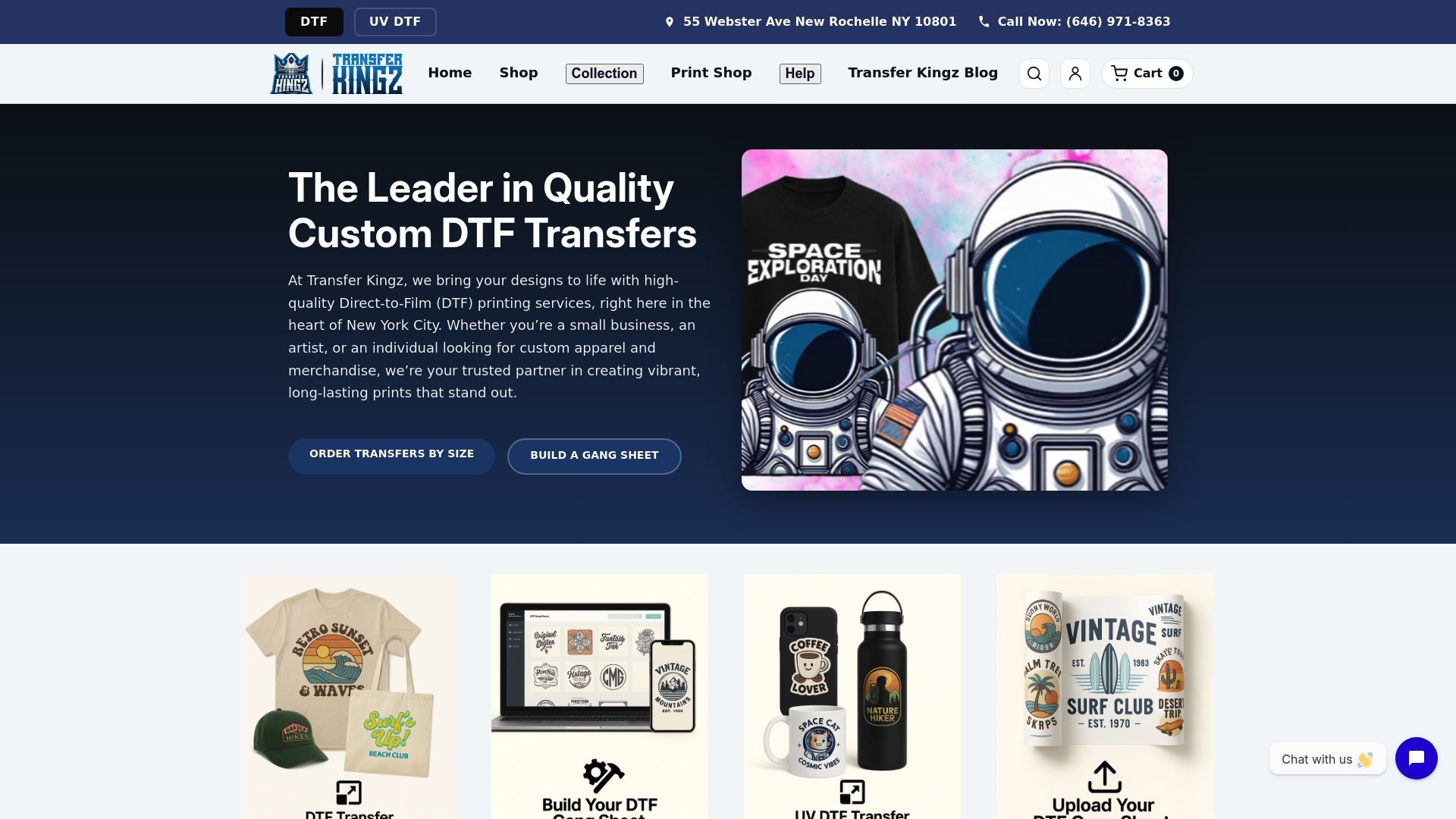
Getting started takes three steps: upload your artwork, configure your gang sheet or full-sheet order using the online builder, and select your shipping option or local pickup. For shops in Texas, custom DTF printing in Dallas is available with same-day pickup. Shops anywhere in the country can order through the Texas DTF transfer service and receive transfers within a few business days. Place a 12-piece pilot order, run the wash test, and see the results before you scale.
Sources and further reading
- INKBANK Powderless DTF Technical Report — wash fastness data and powderless DTF workflow explanation
- White Toner Transfer: A Distinct Alternative to DTF Printing (Crio) — capital cost figures and outsourcing vs. ownership analysis
- Uninet White Toner Review (Swing Design) — maintenance comparison and substrate versatility for white-toner systems
- DTF vs Screen Printing Explained — Transferkingz — cost-breakpoint and workflow comparison for apparel shops
- Difference Between DTG and DTF — Transferkingz — substrate and quality tradeoffs between DTG and DTF
- Benefits of DTF Transfers — Transferkingz — wash durability, color vibrancy, and fabric compatibility
- DTF Design Process and Gang-Sheet Best Practices — Transferkingz — file prep and layout guidance for outsourced DTF orders
- Why Choose Custom DTF — Transferkingz — use-case guidance for shops evaluating outsourced transfers
- Eco-Friendly Graphic Clothing Guide — 3 Wizard Clothing — sustainability context for powderless and low-waste printing methods
0 comments