

TL;DR:
- Durability depends on standardized testing, material choice, and proper application, not just vibrant ink.
- Proper tests evaluate wash, light exposure, and friction resistance, with grade 4+ indicating high durability.
- Selecting the right printing method like DTF can ensure prints survive numerous washes and daily wear.
Many small business owners assume that a vivid, eye-catching print equals a long-lasting one. That assumption costs real money. True print durability is built on standardized testing, smart material selection, and precise application technique, not just saturated ink. Whether you’re producing team jerseys, branded merchandise, or fashion drops, understanding what makes a print survive repeated washing, stretching, and daily wear is the difference between customers who reorder and customers who complain. This article walks you through how durability is defined and measured, which tests matter, how printing technologies compare, and what practical steps you can take right now to get longer-lasting results.
Table of Contents
- The fundamentals of print durability
- Understanding common print durability tests
- Print durability in action: DTF vs. DTG and other methods
- How to maximize print durability for your apparel
- Why most businesses underestimate print durability—and how you can outlast competitors
- Want vibrant prints that last? Discover the difference with Transfer Kingz
- Frequently asked questions
Key Takeaways
| Point | Details |
|---|---|
| Understand durability grades | Commercial-grade prints typically require a minimum durability grade of 4 out of 5. |
| Choose the right print method | DTF often offers superior durability over DTG and vinyl for apparel. |
| Test and verify | Request colorfastness or Tri-Test results when sourcing prints for assurance. |
| Care impacts longevity | Proper garment washing and handling can dramatically extend print life. |
The fundamentals of print durability
Print durability in custom apparel refers to how well a printed design holds up against the physical and chemical forces it faces during normal use. That includes washing, drying, friction, sunlight, and stretching. A print that looks sharp on day one but cracks after five washes is not durable. A durable print maintains its color, adhesion, and structural integrity across dozens of wash cycles.
The industry measures this through colorfastness, which is a print’s resistance to color loss or change under specific stress conditions. Print durability is measured by standardized colorfastness tests with grades from 1 to 5, where 1 means severe color change and 5 means no change at all. Most commercial apparel applications require a minimum grade of 4.
Here’s what durability actually covers:
- Colorfastness to washing: Does the color bleed or fade after laundering?
- Resistance to cracking: Does the print surface fracture with wear or stretching?
- Peeling resistance: Does the ink or film lift away from the fabric over time?
- Fade resistance: Does UV light degrade the print’s vibrancy?
- Abrasion resistance: Does rubbing against surfaces wear down the print?
“A durable print isn’t just about looking good at the point of sale. It’s about maintaining that quality through the entire life of the garment.”
For small business owners, this matters beyond aesthetics. A customer who receives a shirt where the print cracks after three washes won’t reorder. They’ll also tell others. Investing in DTF print durability upfront reduces returns, builds brand trust, and lowers your cost per unit over time because you’re not reprinting or replacing defective orders.
The bottom line is that durability is a measurable, achievable standard, not a vague promise. When you know what the benchmarks are, you can hold your suppliers accountable and make smarter sourcing decisions.
Understanding common print durability tests
Knowing that tests exist is one thing. Understanding what they actually measure gives you real leverage when evaluating suppliers or troubleshooting quality issues.
The three core test categories are washing, light exposure, and rubbing. AATCC 61/ISO 105-C06 covers wash, AATCC 16/ISO 105-B02 covers light, and AATCC 8/ISO 105-X12 covers rubbing, with grades from 1 to 5 and a commercial minimum typically at grade 4.
Here’s a quick breakdown of each:
- Wash test (AATCC 61 / ISO 105-C06): Simulates repeated laundering in a controlled environment. Evaluates color change in the print and color staining on adjacent fabrics.
- Light fastness test (AATCC 16 / ISO 105-B02): Exposes the print to UV light over a set period. Measures how much the color fades under sunlight conditions.
- Rub test (AATCC 8 / ISO 105-X12): Uses a weighted cloth rubbed across the print surface, both dry and wet. Measures how much color transfers off the print.
| Test | Standard | What it measures | Passing grade |
|---|---|---|---|
| Wash fastness | AATCC 61 / ISO 105-C06 | Color change and staining after washing | Grade 4 or higher |
| Light fastness | AATCC 16 / ISO 105-B02 | UV-induced fading | Grade 4 or higher |
| Rub fastness | AATCC 8 / ISO 105-X12 | Color transfer from friction | Grade 4 or higher |
When reviewing a DTF transfer quality checklist, these three tests should appear as baseline requirements. If a supplier cannot provide test data or certifications, that’s a red flag worth taking seriously.
Pro Tip: Ask your print supplier for third-party test results before placing a large order. Legitimate suppliers who use quality materials will have this documentation ready or be willing to run a sample test batch for you.
Understanding these grades also helps you set realistic expectations with your customers. If you’re selling outdoor event shirts, light fastness becomes especially important. If you’re producing athletic wear, rub and wash resistance take priority.
Print durability in action: DTF vs. DTG and other methods
Not all print technologies are created equal when it comes to durability. The method you choose directly affects how your print performs across every test category.
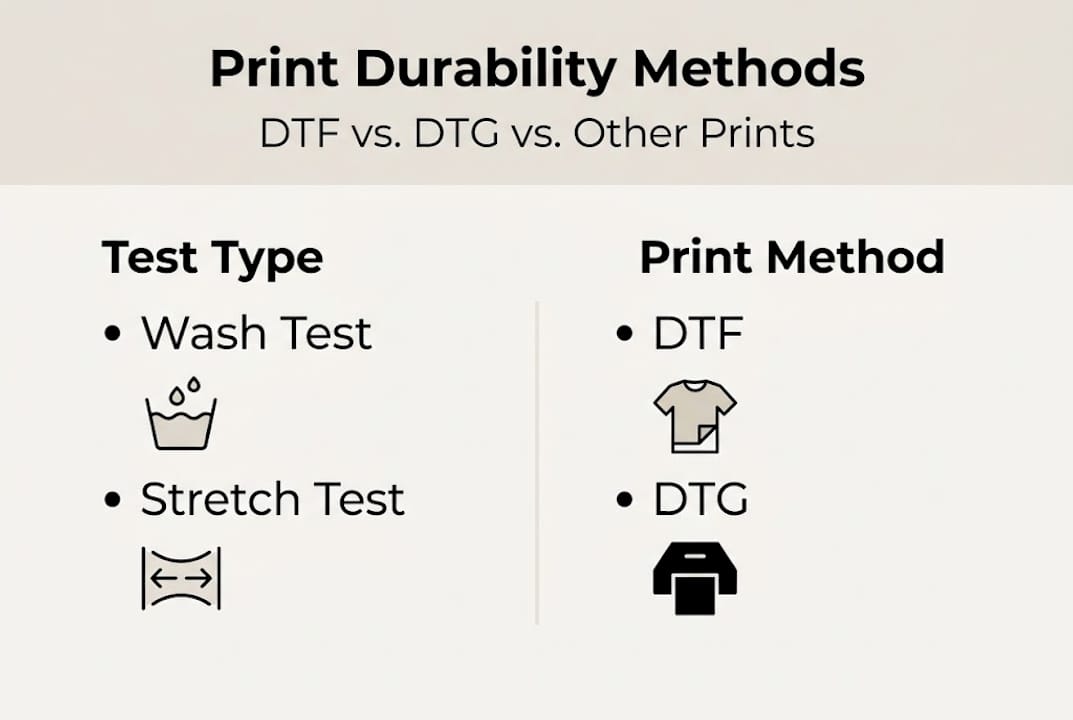
A Tri-Test covering wash, stretch, and abrasion is commonly applied to DTF prints, and DTF prints often survive 50 or more washes with proper process execution. That’s a strong benchmark compared to several competing methods.
| Print method | Wash durability | Crack resistance | Fade resistance | Best use case |
|---|---|---|---|---|
| DTF (Direct-to-Film) | 50+ washes | Excellent | High | All fabric types, detailed designs |
| DTG (Direct-to-Garment) | 30 to 50 washes | Moderate | Moderate | Cotton-heavy garments |
| Screen printing | 50+ washes | Good | High | Large runs, simple designs |
| Heat transfer vinyl | 20 to 40 washes | Low to moderate | Moderate | Simple text, small runs |
DTF stands out because the film layer bonds to fabric fibers at a molecular level during heat pressing, creating a flexible, resilient surface. Unlike DTG, which deposits ink directly into the fabric and can fade faster on non-cotton blends, DTF works across a wide range of materials. The DTF vs DTG printing guide covers these differences in depth if you want to dig further.
Common use cases where DTF durability shines:
- Fashion and streetwear: Designs need to survive frequent washing and remain vibrant
- Team and athletic wear: High-stretch fabrics require crack-resistant prints
- Business merchandise: Branded items represent your company long-term
- Event apparel: Commemorative pieces need to hold up as keepsakes
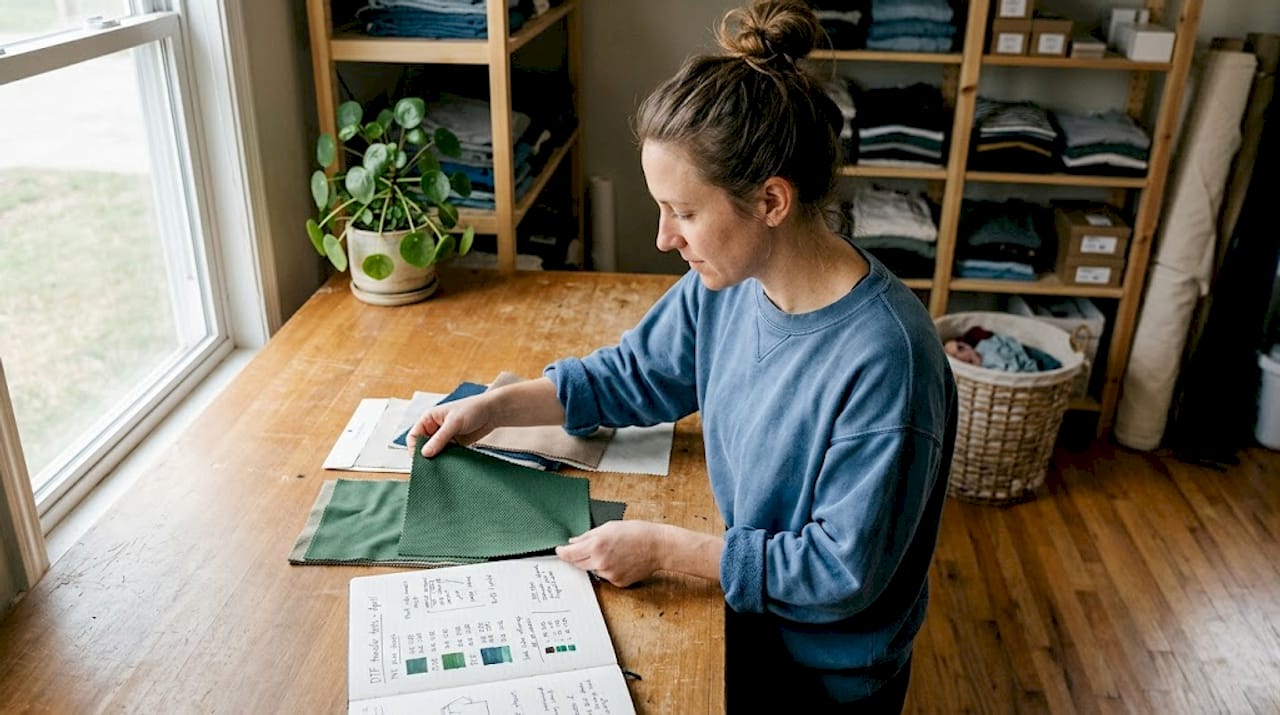
Fabric choice also plays a major role. Choosing the best fabrics for DTF printing can dramatically improve your results. Polyester blends and cotton-poly mixes tend to hold DTF transfers exceptionally well. Pure cotton works too, but the surface texture affects adhesion differently.
For more on what separates DTF from other methods in terms of longevity, the DTF durability details page breaks it down clearly.
Pro Tip: Match your print method to both the fabric and the end use. A high-stretch athletic shirt demands a different approach than a rigid canvas tote. Getting this pairing right is more important than picking the “best” technology in isolation.
How to maximize print durability for your apparel
Understanding the technology is only half the battle. What you actually do before, during, and after printing determines whether your results match the benchmarks or fall short of them.
Best practices can greatly increase print lifespan, saving cost and improving customer satisfaction across every order you produce.
Here are the key action steps:
- Choose quality base garments. Thin, low-thread-count blanks degrade faster and cause adhesion problems. Start with a solid foundation.
- Match ink and film to your fabric. Not all DTF inks and films perform equally on all materials. Confirm compatibility before a full run.
- Follow proper curing temperatures and times. Under-curing is one of the most common causes of early print failure. Always verify your heat press settings.
- Communicate care instructions clearly. Your customers need to know how to wash the garment. Include a tag or insert with every order.
- Store transfers correctly before pressing. Heat, humidity, and light can degrade transfer quality before you even apply them.
Care tips to pass along to your end customers:
- Wash inside out in cold water
- Avoid bleach and fabric softeners
- Tumble dry on low or hang dry
- Do not iron directly on the print
- Avoid dry cleaning unless the garment specifically requires it
For a deeper look at DTF best practices that apply directly to apparel brands, the process details are worth reviewing before you scale up production. Using high-quality DTF ink is another variable that separates shops producing consistent results from those dealing with constant quality complaints.
Pro Tip: Run a wash and rub test on the first unit of every new print run before shipping the full batch. It takes 30 minutes and can save you from a costly customer service nightmare.
Why most businesses underestimate print durability—and how you can outlast competitors
Here’s something most people in this industry won’t say out loud: the majority of print quality problems are not caused by bad equipment. They’re caused by skipping steps because of time pressure or cost cutting.
Shops that focus only on vibrant output at the point of sale are optimizing for the wrong metric. A print that photographs beautifully but fails after 10 washes creates a customer who never returns. Meanwhile, shops that invest in proper curing, quality films, and consistent testing build something more valuable: a reputation.
Durability is a competitive differentiator that most of your competitors are ignoring. When you can honestly tell a customer that your prints are tested to survive 50 or more washes and you can back that up with data, you’re no longer competing on price alone. You’re competing on reliability.
Brand loyalty grows when customers trust the product. That trust is built wash by wash. Reviewing cost-saving tips for apparel brands shows that investing in quality upfront consistently outperforms the short-term savings of cutting corners. The math is simple: fewer reprints, fewer returns, and more repeat customers.
Want vibrant prints that last? Discover the difference with Transfer Kingz
If you’ve made it this far, you now have a clearer picture of what separates a durable print from a disappointing one. The next step is working with a supplier who takes these standards as seriously as you do.
At Transfer Kingz, our custom DTF printing services are built around the same durability principles covered in this article. We use premium inks and films designed to meet commercial-grade colorfastness standards. Whether you need detailed DTF prints for complex artwork or want to understand how DTF is revolutionizing custom apparel, we’re here to help you produce results that last. No minimums, fast turnaround, and quality you can test.
Frequently asked questions
What does a grade 4 colorfastness rating mean?
A grade 4 rating indicates above-average resistance to fading or color change, and it’s the commercial minimum most apparel buyers and brands require for production approval.
How can I test print durability at home?
You can run a simple Tri-Test by washing, stretching, and rubbing your printed garment repeatedly, then comparing the print condition before and after to spot any early failure signs.
Is DTF printing really more durable than other methods?
Yes, DTF prints survive 50+ washes when produced correctly, outperforming heat transfer vinyl and often matching or exceeding DTG on non-cotton fabrics due to stronger film bonding.
What garment care tips help prints last longer?
Wash inside out in cold water, skip bleach and fabric softeners, and hang dry when possible. These simple steps significantly extend the life of any printed design.
Recommended
- 7 Essential DTF Printing Best Practices for Apparel Brands – Transfer Kingz
- 7 Essential DTF Printing Tips for Custom Apparel Success – Transfer Kingz
- High-Quality DTF Ink for Stunning Transfers: Achieve Vibrant, Durable – Transfer Kingz
- 7 Essential DTF Printing Cost-Saving Tips for Apparel Brands – Transfer Kingz
- Sustainable Options in Custom Clothing: What Matters – Prima Dons & Donnas
0 comments