

TL;DR:
- Print-on-demand transforms merchandise launching by eliminating inventory risk and enabling almost zero startup costs.
- It involves creating designs, choosing providers, listing products online, and fulfilling orders automatically, making it accessible for small brands.
Starting a merchandise brand used to mean one thing: spending thousands of dollars on inventory before selling a single item. That upfront risk stopped countless great ideas from ever becoming real businesses. Print-on-demand eliminates the need for inventory, flipping the entire model on its head and making it possible for anyone with a strong design concept and a clear audience to launch a product brand with almost zero financial exposure. This guide walks you through everything you need to know, from the basic mechanics to choosing providers and making smart decisions about when and how to scale.
Table of Contents
- Print-on-demand explained: The basics
- How the print-on-demand process works
- Comparing top print-on-demand providers
- Realities of running a print-on-demand business
- Is print-on-demand right for you?
- Our perspective: What most guides don’t tell you about print-on-demand
- Start building your custom apparel brand with expert support
- Frequently asked questions
Key Takeaways
| Point | Details |
|---|---|
| No inventory required | Print-on-demand lets you launch a product line without buying in bulk or holding stock. |
| Step-by-step workflow | Success with POD comes from understanding each step from design creation to customer delivery. |
| Provider choice matters | Choosing the right POD provider impacts cost, speed, and product quality for your customers. |
| Success demands strategy | Effective marketing, unique designs, and careful provider vetting are key to making money with POD. |
| Flexible, scalable model | POD is perfect for testing ideas or scaling with minimal risk and operational complexity. |
Print-on-demand explained: The basics
Print-on-demand (POD) is a business model where custom products are produced only after an order is placed, meaning nothing gets made until a customer pays. That single difference changes everything about how you manage cash flow, product variety, and risk.
In a traditional inventory model, you order bulk quantities, pay upfront, store products, and hope your predictions about demand were right. Get it wrong, and you’re sitting on boxes of unsold merchandise. POD flips that logic entirely. You create the design, list the product, and only trigger production when a real sale happens.
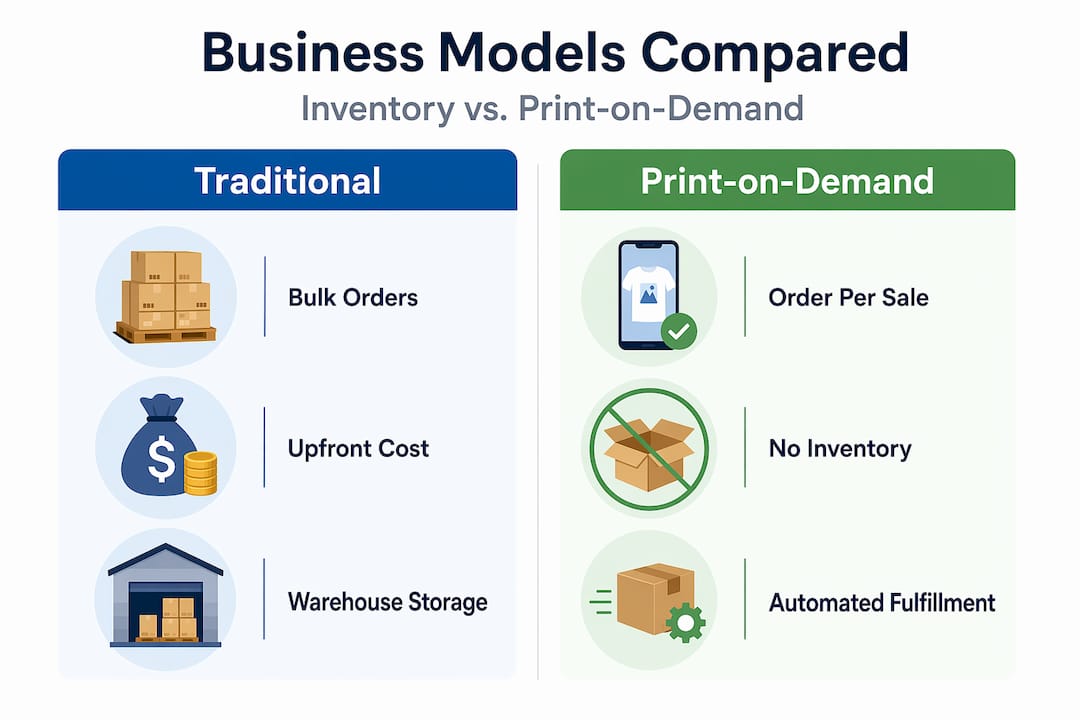
The ecosystem has three main players. First, you (the seller) create and market the products. Second, the POD provider handles printing, packaging, and shipping. Third, the end customer receives a finished product, often without ever knowing you didn’t touch it yourself. Understanding DTF printing basics is useful here, since Direct-to-Film technology is one of the leading production methods that many providers now use to deliver sharp, vibrant results on textiles.
Popular POD product categories include:
- Apparel (t-shirts, hoodies, tank tops, sweatshirts)
- Accessories (hats, bags, phone cases, socks)
- Home goods (pillows, blankets, mugs, wall art)
- Stationery and paper products (notebooks, prints, posters)
- Pet accessories and niche lifestyle items
“The real appeal of print-on-demand isn’t just convenience. It’s that it turns creative ideas into testable products without betting your savings on an unproven concept.” This shifts entrepreneurship from a capital game into a creativity game, which is a meaningful change for small business owners.
How the print-on-demand process works
The workflow is straightforward once you see it end to end. What looks complicated from the outside is actually a clean, repeatable process that you can run from a laptop.
The core steps in a POD business:
- Create your design. Use software like Adobe Illustrator, Canva, or Procreate to produce print-ready artwork.
- Choose a provider and product. Select your POD platform and pick which products to apply your design to.
- List online. Upload your product to your storefront, whether that’s Shopify, Etsy, or your own website.
- Customer places an order. Your store collects payment and automatically sends order details to your provider.
- Provider prints and ships. The POD company produces the item and ships it directly to your customer.
- You collect your profit. You keep the difference between your sale price and the provider’s base cost.
The POD process typically involves design creation, product selection, online listing, order flow, provider fulfillment, and profit collection, and the best part is that steps four through six happen without you lifting a finger.
POD fulfillment speed comparison by provider model:
| Provider model | Avg. production time | Avg. shipping time (domestic) | Best for |
|---|---|---|---|
| US-based local provider | 1 to 3 days | 2 to 5 days | Speed-sensitive brands |
| Large global platform | 3 to 7 days | 5 to 14 days | Wide product catalog |
| Hybrid (POD + local stock) | 1 to 2 days | 1 to 3 days | Bestseller scaling |
| International supplier | 5 to 10 days | 10 to 21 days | Low-cost experimentation |

Speed matters more than most new sellers realize. Slow fulfillment leads to negative reviews, return requests, and lost repeat customers.
Pro Tip: Always order a sample of each product before you list it publicly. What looks good in a digital mockup does not always match real-world print quality, fabric feel, or sizing accuracy. Budget $50 to $100 in sample orders before launching any new product line. For detailed guidance on building a stronger apparel brand, these apparel brand POD tips are worth reviewing before you go live.
Comparing top print-on-demand providers
Not every POD platform is built for the same type of business. Providers like Printify and Printful differ in cost and quality; select based on business priorities, so understanding where each one excels will save you a lot of trial and error.
POD provider comparison:
| Provider | Base cost level | Avg. fulfillment speed | Location coverage | Best for |
|---|---|---|---|---|
| Printify | Low to medium | 3 to 7 days | Global network | Cost-conscious sellers |
| Printful | Medium to high | 2 to 5 days | US, EU, Mexico | Quality-focused brands |
| Gooten | Low | 4 to 8 days | US, international | Wholesale and scaling |
| SPOD | Medium | 2 to 4 days | US and EU | Fast fulfillment priority |
| Local DTF provider | Varies | 1 to 3 days | Regional | Small batch, high quality |
Printify connects you to a network of third-party print shops, which keeps costs lower but can introduce quality inconsistencies between orders. Printful owns its production facilities, which means more consistency but at a slightly higher base price per item. For apparel-focused brands, exploring the benefits of apparel printing can help you understand which printing method and provider pairing makes sense for your product line.
What to consider when choosing a provider:
- Your niche. A streetwear brand needs different quality standards than a novelty gift shop.
- Fulfillment speed. US-based customers expect fast shipping, and slow delivery hurts your reviews.
- Product range. Some providers specialize in apparel; others excel at home goods or accessories.
- Scalability. Can the provider handle sudden volume spikes during peak seasons?
- Customer support. When a misprint happens (and it will), you need a responsive team behind you.
- Integration. Make sure the platform connects smoothly with your chosen storefront technology.
Running a quick pilot with two or three providers simultaneously using the same design is a smart way to compare real-world quality before committing to one.
Realities of running a print-on-demand business
Here’s where things get real. POD has genuine advantages, but it also comes with challenges that first-time sellers often underestimate.
The advantages are significant:
- Low startup costs. You can launch with under $100 in most cases.
- Reduced waste. Products are only made when ordered, which aligns with sustainable business practices.
- Flexible testing. You can list 50 designs and let sales data tell you which ones actually resonate.
- No fulfillment headaches. Storage, packaging, and shipping are completely handled.
POD minimizes risk, but success requires unique designs and marketing; tight margins are common. The average markup on a POD product sits between 20% and 40%, which sounds reasonable until you factor in advertising costs. If you’re running paid ads, thin margins can disappear quickly.
POD is praised for low-barrier entry and sustainability, but also criticized for variable quality and shipping delays. A delayed shipment or a faded print reflects on your brand, not the provider, in the customer’s eyes. That’s a critical thing to internalize early.
Common pitfalls and how to avoid them:
- Relying on generic designs. Copying trending designs leads to a race to the bottom. Build something distinctly yours.
- Ignoring customer reviews. One bad review about print quality can tank conversion rates on a listing.
- Skipping sample orders. Never list a product you haven’t physically inspected yourself.
- Underpricing. Pricing too low to compete on cost kills your margins and positions your brand poorly.
- Neglecting marketing. A well-designed product listed on a quiet storefront earns zero sales.
Pro Tip: Build a content strategy around your niche before you launch. If you’re selling apparel for a specific community (gamers, dog owners, nurses, etc.), create content that speaks to that community first. The product comes second. This approach builds an audience you can sell to repeatedly rather than chasing one-time buyers. For a broader picture of environmental considerations, the data around POD sustainability is worth reading as consumer preferences increasingly favor responsible production.
Is print-on-demand right for you?
Before committing fully, it helps to honestly assess whether POD matches your business goals and working style.
The market signals are encouraging. The POD market is projected to grow at 22 to 26% CAGR through 2032 to 2033, which means demand for custom products is accelerating. More competition is entering the space, but more customers are also looking for personalized, unique items they can’t find in big-box stores.
Ask yourself these questions before launching:
- Do you have a clearly defined audience who would pay for your specific design aesthetic?
- Are your designs genuinely different from what already exists on the major platforms?
- Can you invest time into marketing, even if upfront product costs are low?
- Are you comfortable with lower per-item margins in exchange for zero inventory risk?
If most of your answers lean yes, POD is a strong fit. If you’re still unsure about your niche or design direction, use POD specifically as a testing tool before committing to anything larger.
Steps to launch your first POD product:
- Define your niche and target customer in one clear sentence.
- Create three to five strong designs tailored to that audience.
- Choose a POD provider that matches your quality and speed requirements.
- Set up a storefront (Shopify, Etsy, or your own domain).
- Order samples and verify quality before going live.
- Launch with organic content marketing before spending on ads.
- Analyze which products sell, then double down on what works.
When hybrid models make sense: If one or two products become consistent bestsellers, consider stocking a small quantity of those specific items locally. This lets you fulfill fastest for your top sellers while keeping the rest of your catalog on-demand. This hybrid approach is what many scaling brands quietly use to balance speed with flexibility. Exploring digital apparel printing methods can help you understand which production routes fit into that kind of mixed strategy.
Our perspective: What most guides don’t tell you about print-on-demand
Everyone talks about how easy it is to start a POD business. Create a design, connect a store, and watch orders roll in. That narrative is dangerously incomplete.
The truth is that most POD stores fail quietly within six months, not because the printing was bad or the products were wrong, but because there was no real brand behind them. A logo on a t-shirt is not a brand. A color palette is not a brand. What keeps customers coming back is a feeling tied to a clearly articulated identity. Success with POD requires more than just setting up; unique products and ongoing marketing are essential. That’s not a mild suggestion. It’s the whole game.
There are also hidden costs that nobody puts in the headline. The time you spend iterating on designs, testing new products, managing customer service inquiries about shipping delays, and updating listings adds up fast. Treat POD like a passive income stream and it will perform like one (which is to say, poorly). Treat it like a real business and it can be one.
The brands that genuinely thrive in POD tend to follow a pattern: they start with a passionate, specific niche (not “people who like dogs” but “golden retriever owners who do agility training”), they build content and community before and alongside their product launches, and they use branding with custom DTF transfers to create physical products that look and feel premium, not like they came out of a generic fulfillment center.
Our advice: slow down on the launch and speed up on the brand-building. The technical side of POD is genuinely easy. The brand side is where the real work happens, and that’s also where the real competitive advantage is built.
Start building your custom apparel brand with expert support
Ready to move from concept to product? Building a merchandise line that customers trust starts with production quality they can feel.
Transfer Kingz specializes in high-quality DTF transfers in Dallas and serves entrepreneurs and small brands across the country with fast turnaround times, no minimum order requirements, and professional-grade print results. Whether you’re testing a new design or fulfilling a growing volume of orders, our DTF transfers in Texas give you the flexibility to scale on your terms. See firsthand how DTF shirt transfers are revolutionizing custom apparel and why more small brands are choosing this method to produce vibrant, durable merchandise that stands out. Upload your design, choose your products, and start building a brand your customers will recognize.
Frequently asked questions
What types of products can I sell with print-on-demand?
Custom products like apparel, accessories, and home goods are the most common categories, and the range continues to expand into pet accessories, drinkware, and stationery.
Do I need to buy inventory upfront with print-on-demand?
No. In POD, products are produced only after an order is placed, so you pay for each item only after a customer has already purchased it from you.
How fast will my customers receive their print-on-demand orders?
Fulfillment speed varies by provider location versus where your customer is located, with US-based providers typically delivering domestic orders in under a week.
Can I change my designs after listing products?
Yes, since POD manufacturing is entirely on-demand, you can update, swap, or replace designs on any listing at any time without losing money on unsold stock.
0 comments