

TL;DR:
- Digital printing marketplaces serve as infrastructure that handles customer discovery, order routing, and logistics, enabling sellers to focus on design.
- They reduce risk by supporting on-demand, short-run production, eliminating inventory costs and facilitating rapid market testing.
- Automation ensures consistent quality and efficient workflows, safeguarding margins and enhancing scalability for small apparel brands.
Most small apparel brands assume launching a custom product line means building a website from scratch, buying blank inventory, and hoping sales cover storage costs. That picture is wrong, and it costs businesses time and money before they even print their first shirt. The role of digital printing marketplaces is to collapse that entire setup into a repeatable workflow: one platform handles customer discovery, order routing, and production handoff while you focus on design and marketing. This article breaks down exactly how these platforms function, where they add the most value for custom apparel sellers, and how to use them without letting fees and dependency quietly drain your margins.
Table of Contents
- Understanding the role of digital printing marketplaces and their core functions
- Why marketplaces matter for small custom apparel brands: risk reduction and personalization
- Expanding digital storefronts: how web-to-print software enhances customer customization
- How automation and workflow standardization protect margins and improve quality
- Applying marketplace tools in your custom apparel business: practical strategies
- Rethinking the role of digital printing marketplaces in your custom apparel journey
- How Transfer Kingz supports your digital printing marketplace success
- Frequently asked questions
Key Takeaways
| Point | Details |
|---|---|
| Marketplaces drive sales | Digital printing marketplaces provide built-in customer traffic and simplify order fulfillment for small apparel brands. |
| On-demand reduces risk | Short-run, personalized printing minimizes inventory risk and supports fast trend adaptation. |
| Automation safeguards margins | Workflow automation lowers waste, errors, and manual labor costs, helping maintain profits. |
| Own your customers | Rely on marketplaces for exposure but build your own brand channels to retain customer relationships. |
| Customization expands reach | Web-to-print software in marketplaces enhances customer design control and order accuracy. |
Understanding the role of digital printing marketplaces and their core functions
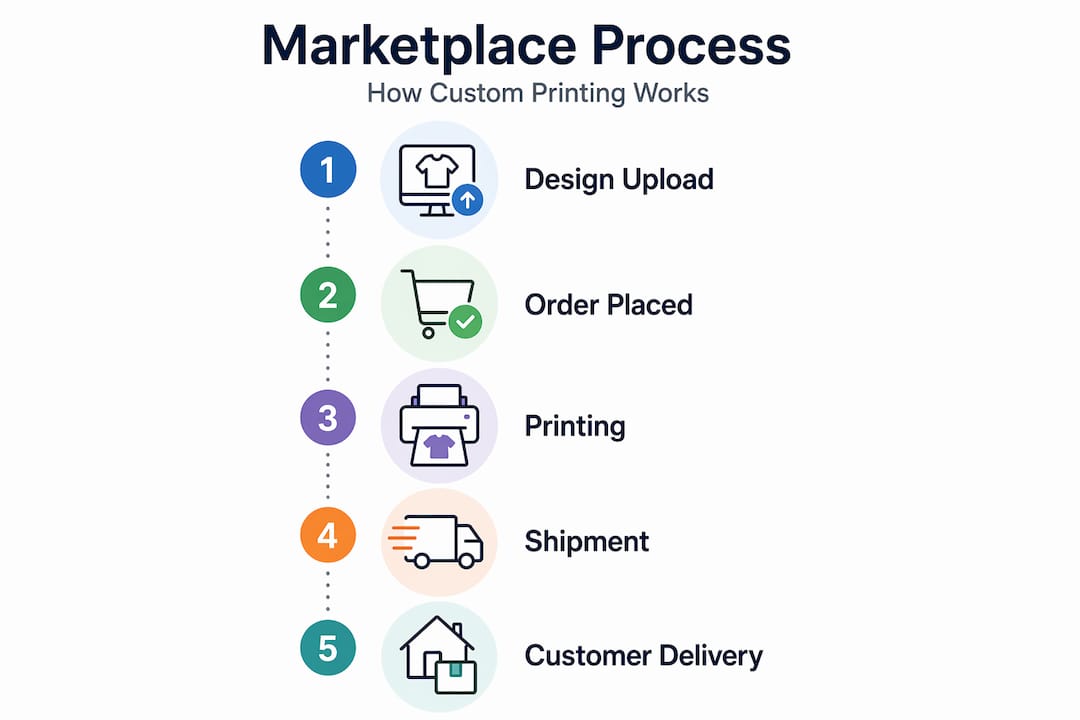
Digital printing marketplaces are not just online stores. They are infrastructure. When a customer lands on a marketplace listing, browses product options, and places an order, the platform handles everything after that click: payment processing, order routing to a print provider, and in many cases, shipping and tracking updates. As a seller, your job is to show up with a good design and the right product listing.
The role of customer-acquisition in these platforms is their primary function, not inventory management. This distinction matters because many new custom apparel sellers build their strategy around the wrong assumption. They treat marketplaces like warehouses when they should treat them like storefronts with built-in foot traffic.
Here is what digital print service providers and marketplace platforms actually handle for you:
- Customer discovery: Marketplace algorithms and search functions surface your products to buyers already looking to purchase custom apparel.
- Order routing: Once a purchase is made, orders route automatically to backend fulfillment systems, triggering print production without you lifting a finger.
- Logistics management: Shipping, tracking, and returns are handled within the platform or through connected fulfillment partners.
- Payment processing: Secure checkout and fraud protection are built in, removing a significant technical burden from small sellers.
Understanding how digital printing empowers custom apparel brands requires seeing these functions as a connected system, not separate features. When the system works, you scale without hiring. When it breaks down, usually at the file handoff or order routing stage, costs spike fast.
The role of ecommerce in printing has pushed these platforms beyond simple order-taking. Today’s digital printing platforms act as matchmakers between consumer demand and production capacity, often in real time. That is a structural advantage print-on-demand for business models depend on.
Why marketplaces matter for small custom apparel brands: risk reduction and personalization
Inventory is the silent killer of small apparel brands. Order 200 hoodies in three colorways and two sizes, and you need a single design to sell at least 1,200 units before you see a profit. Digital printing marketplaces eliminate that math entirely by enabling on-demand, short-run production.
The demand for on-demand personalization is one of the strongest forces driving digital printing industry growth right now. Customers want products that feel made for them, and they are willing to pay more for that experience. Marketplaces position small brands to serve that demand without the capital risk of pre-production.
The benefits of digital print marketplaces for risk reduction include:
- Zero unsold stock: Products are printed after purchase, so there is no overstock to liquidate.
- Low startup cost: You can list products the same day you have a design without buying equipment or blanks upfront.
- Fast iteration: Test ten designs this week. Pull what doesn’t sell. Scale what does. No wasted inventory.
- Geographic reach: Marketplace traffic is not limited to your local area, which means a well-positioned product reaches buyers nationally or globally.
The short-run printing approach that digital print marketplaces enable also gives smaller brands a competitive edge over larger players who are locked into bulk production cycles. When a trend breaks, you can have a product listed and selling within hours.
For print-on-demand tips for apparel brands, the most important mindset shift is understanding that your real asset is the design and the audience, not the product itself.
Pro Tip: Before listing on any marketplace, calculate your break-even price after fees. Most platforms take 20 to 40 percent of the sale price. Know your floor before you set your price, not after.
Expanding digital storefronts: how web-to-print software enhances customer customization
Web-to-print software (tools that let customers design or personalize products directly in a browser) is what separates a basic marketplace listing from a genuinely engaging buying experience. Instead of selecting from a fixed catalog, customers can add a name, change a color, or upload a logo and see the result on the product in real time before they order.

This technology supports the complete order lifecycle, covering customization, pricing, proofing, and production-ready file generation, all without a human touching the order until it hits the printer. That end-to-end automation is what makes digital print service providers competitive on turnaround time.
Here is how a typical web-to-print workflow functions inside a marketplace:
- Customer selects a product and opens the customization tool directly in their browser.
- They upload artwork or use a built-in design editor to personalize the item with text, graphics, or uploaded files.
- The platform validates the file automatically, flagging resolution issues or color mode problems before checkout.
- A digital proof is generated and approved by the customer, eliminating back-and-forth with the seller.
- The order converts into a production-ready file formatted to the printer’s exact specifications.
- Production begins without any manual prepress work from the seller or the print provider.
The impact of online printing tools like these goes well beyond convenience. When customers can see exactly what they are getting before they buy, return rates drop. When files arrive print-ready, production errors drop. Both outcomes protect your margins and your reputation at the same time.
For a deeper look at what this means for sellers, the benefits of custom apparel printing through these platforms go far beyond the obvious time savings.
Pro Tip: If you are using a marketplace with a built-in design tool, test it from the customer’s perspective before you list anything. Confusing customization flows are one of the top reasons customers abandon cart on custom apparel products.
How automation and workflow standardization protect margins and improve quality
Margins in custom apparel are thin. Marketplace fees, blank costs, shipping, and the occasional misprint can turn a profitable product into a money-losing one faster than you expect. Automation is the best defense you have against margin erosion.
The core issue is variation. Every custom order is technically different, which creates endless opportunities for error. Automation eliminates manual sampling and misprints by standardizing the prepress and production workflow, so the first print looks like the hundredth.
“Operational differentiation comes more from workflow automation and margin protection than just print quality alone in a marketplace-driven business.” — FESPA
Here is a direct comparison of manual versus automated workflows in marketplace printing:
| Factor | Manual workflow | Automated workflow |
|---|---|---|
| File validation | Human review, prone to delays | Instant, rules-based checking |
| Color consistency | Varies by operator | Standardized ICC profiles |
| Error rate | Higher, especially at volume | Significantly reduced |
| Turnaround time | Dependent on staff availability | Predictable and consistent |
| Cost per order | Higher due to labor | Lower with volume |
| Scalability | Limited by team size | Scales with order volume |
The digital printing advantages of automated workflows also support sustainability goals. Less waste from reprints means lower material costs and a smaller environmental footprint, which is increasingly a selling point with buyers.
Key benefits of automation in your marketplace printing setup:
- Consistent ink layering across all substrates reduces color variation between orders
- Automated file format checking catches issues before production, not after
- Standardized templates speed up new product listings significantly
- Reduced manual touchpoints lower labor costs at every order volume
Applying marketplace tools in your custom apparel business: practical strategies
Knowing how marketplaces work is only useful if you apply that knowledge in a way that actually grows your business. The most common mistake sellers make is treating a marketplace as their entire business strategy rather than one channel within a broader plan.
Marketplaces take significant fees and limit how much you know about your customers. You rarely get direct access to buyer emails, purchase history, or behavioral data. That means the relationship you build through a marketplace belongs to the platform, not to you.
Here is how to use marketplaces as a launch tool without becoming dependent on them:
- Use marketplace traffic to validate designs before investing in your own store
- Collect reviews and social proof on the marketplace, then reference that credibility on your own site
- Price products on the marketplace to cover fees and generate a modest margin, not to maximize profit
- Run your highest-margin products through your own channel where you control the customer relationship
- Treat marketplace revenue as a marketing budget offset, not your primary income stream
When preparing files for marketplace submission, follow these steps every time:
- Export designs at 300 DPI minimum, in RGB color mode unless the platform specifies CMYK
- Use transparent backgrounds for designs that will be placed on colored garments
- Keep text converted to outlines to prevent font substitution errors
- Check bleed and safe zone requirements for each product template before uploading
- Review the automated proof carefully before approving, especially around edges and fine detail
The full digital textile printing guide covers file preparation in detail, including specs that apply across most major platforms. Market trends in digital printing show that sellers who combine strong file discipline with smart marketplace positioning consistently outperform those who treat it as a set-it-and-forget-it channel.
Rethinking the role of digital printing marketplaces in your custom apparel journey
Here is the uncomfortable truth most marketplace guides skip: the platforms that give you access to thousands of buyers are also the platforms most likely to commoditize your brand. When you sell on a large marketplace, you are competing for the same eyeballs as thousands of other sellers, often in the same category, with the same products, differing only by design.
The brands that win long-term are not the ones with the best marketplace presence. They are the ones that use the marketplace to get started, collect data, and then build something the platform cannot take away from them. That means an email list, a recognizable brand identity, and a direct sales channel where margins are not split three ways.
The operational differentiation that actually moves the needle comes from workflow automation and margin control, not just having good art. A seller with average designs and an airtight production workflow will outlast a seller with great designs and a chaotic fulfillment process.
The future of digital print is not about choosing between marketplaces and owned channels. It is about using both intelligently. Marketplaces are your top-of-funnel. Your own store, your email list, and your repeat customers are your foundation. The role of ecommerce in printing has matured to the point where the tools to build both exist and are accessible to businesses of every size.
DTF printing for business branding is one of the most effective ways to maintain print quality consistency as you scale across both channels, because the transfer format removes the printer variable from your production equation entirely.
How Transfer Kingz supports your digital printing marketplace success
You now understand what digital printing marketplaces do well and where they fall short. The next step is making sure your production quality matches the expectations those platforms create.
Transfer Kingz specializes in premium DTF transfers in Dallas and across Texas, offering fast turnaround and vibrant, durable prints built for marketplace-volume sellers. Whether you are fulfilling ten orders a week or five hundred, the consistency of DTF transfer quality means fewer reprints, fewer customer complaints, and better margins. Our gang sheet builder lets you maximize every sheet, cutting per-print costs significantly. Explore how DTF shirt transfers are changing what small apparel brands can produce at scale, and see why sellers who run tight, automated workflows choose Transfer Kingz as their production backbone.
Frequently asked questions
What exactly do digital printing marketplaces do for apparel sellers?
They provide a platform with built-in customer traffic and handle order routing to print providers, so sellers focus on design and marketing without managing inventory or fulfillment. As the marketplace’s core role confirms, their primary value is customer acquisition and storefront discovery.
How do marketplaces help reduce risks for small apparel brands?
By enabling on-demand, short-run printing, marketplaces eliminate the need to hold inventory upfront. On-demand production reduces overstock risk and lets sellers test new designs without financial exposure.
What are the key limitations of selling exclusively through marketplaces?
Marketplaces charge significant fees and limit direct access to customer data, making algorithm-dependent visibility a real business risk. Treating them as acquisition channels rather than your entire strategy is essential for long-term stability.
How does automation improve the printing process in marketplaces?
Automation standardizes file validation, color profiles, and production workflows, which reduces misprints and manual labor. Consistent automated output protects margins in environments where fees are already compressing profitability.
Can I customize apparel designs directly on marketplaces?
Yes. Most modern platforms use web-to-print software that allows customers to personalize products, approve proofs, and order without seller involvement. This complete customization workflow covers pricing, proofing, and production-ready file generation automatically.
0 comments