

Custom stickers run roughly $0.30 to $4.00 per sticker depending on quantity, material, and finish, with small runs of 10 to 25 pieces landing near $2 to $4 each and bulk orders of 500 to 1,000+ dropping to about $0.30 to $0.50 each. Quantity, material, or finish, and turnaround speed drive nearly all of that swing. If you need exact numbers for your project, run your specs through a sticker price calculator or request a custom quote before you commit to a design.
TL;DR:
- The cost per sticker drops nearly 90% when increasing order size from 10 to 1,000 units, emphasizing the importance of bulk purchasing for savings.
- Material choice, finish, and size significantly influence price, with specialty finishes like holographic doubling costs and larger sizes adding 30% to 50% per unit.
- Switching from die-cut singles to sheet or roll formats becomes cost-effective at volumes above 250 to 500 pieces, especially for standard shapes.
- Additional charges such as proofs, color matching, rush fees, and shipping can add 20% to 50% to the final price, so asking upfront about these is crucial.
- UV DTF stickers, although pricier, are worth the extra cost for durable, outdoor, or textured surface applications that standard vinyl cannot withstand.
Table of Contents
- Sticker Printing Prices By Quantity: A Quick Reference Table
- What Actually Drives Custom Sticker Pricing?
- Die-Cut Singles, Sheets, Rolls, and UV DTF: Which Format Wins on Price?
- How To Estimate Your Sticker Budget: Four Worked Examples
- How Small Businesses Cut Sticker Costs Without Cutting Corners
- What To Ask A Sticker Printer Before You Order
- When Specialty UV DTF Stickers Are Worth the Higher Price
- Get A Custom Sticker Quote From Transfer Kingz
- Sources
Sticker Printing Prices By Quantity: A Quick Reference Table
Quantity is the single biggest lever in any sticker quote. The jump from 10 to 1,000 units can cut your per-sticker cost by nearly 90%, because setup work and digital press time get spread across more pieces.
Here’s what a standard 3 inch die-cut vinyl sticker with laminate typically costs across common order sizes:
| Quantity | Price per sticker | Estimated order total |
|---|---|---|
| 10 | $2.00–$4.00 | $20–$40 |
| 50 | about $0.60 to $0.90 | around $60 to $90 |
| 100 | approximately $0.35 to $0.55 | near $70 to $110 |
| 250 | $0.35–$0.55 | $175 to $275 |
| 500 | $0.35–$0.55 | $175–$275 |
| 1,000 | about $0.20 to $0.40 | approximately $200 to $400 |
Those numbers echo what Stickerine’s 2026 pricing breakdown shows for die-cut vinyl with laminate, and Avery’s published calculator lands in a similar range, quoting standard label stickers around $0.65 each at 100 units and roughly $0.20 each at 1,000. The two sources don’t match exactly because Avery’s numbers reflect its own catalog of stock sizes and finishes, while Stickerine’s figures track a broader market average across vendors.
A few things move these numbers around before you ever see a final invoice:
- Sales tax applies based on your state and, in some cases, the printer’s state of operation, so a quote that looks identical to a competitor’s can differ once tax lands.
- Shipping costs vary by weight, distance, and whether the vendor offers a free-shipping threshold, which can add $5 to $25 to smaller orders.
- Regional printing capacity affects turnaround and occasionally price. A shop with in-house equipment in your region often quotes faster and cheaper than one shipping cross-country.
If you’re stepping up from a standard 3 inch die-cut to something bigger, like a 5 inch or 6 inch sticker, expect your per-unit price to climb by roughly 30% to 50% for the same quantity tier. Specialty finishes like holographic or reflective vinyl push costs up further, sometimes doubling the base rate. The table above is a starting point, not a ceiling. Treat it as your baseline and adjust upward for size, finish, or rush production.
What Actually Drives Custom Sticker Pricing?
Every quote you get boils down to five variables: material, size, finish, quantity, and how fast you need it. Understanding each one lets you spot where a printer is charging fairly and where they’re padding the invoice.
Material and finish account for the widest price swings. Paper stickers are the cheapest option but don’t hold up outdoors or through a dishwasher cycle. Vinyl costs more upfront but survives sun, water, and scuffing, which matters for product labels or car decals. Layer on a gloss or matte laminate and you’re adding a protective coat that typically raises the base price by 15% to 25%. Holographic and reflective vinyl sit at the top of the material ladder, often 40% to 80% above standard glossy vinyl, because the specialty film itself costs more to source and run through a press.
Size follows a simple rule: doubling the printed area usually adds 30% to 50% to the per-unit cost, not double the price, since ink and material costs don’t scale linearly with press time. Printing method matters too. Digital printing has no setup fee and suits short runs, while offset and screen printing carry setup costs of $30 to $100 or more, but that fee gets absorbed cheaply once you’re ordering thousands of pieces.
Watch for these add-ons, which rarely show up in a headline price:
- File prep or artwork cleanup fees if your design isn’t print-ready
- Pantone color matching charges for exact brand-color reproduction
- Extra proof rounds beyond the first free revision
- Rush production fees, commonly $10 to $25 flat or 20% to 30% of the order
- Shipping and sales tax, calculated separately from the sticker price itself
Pro Tip: Ask upfront how many free proof rounds you get. Printers that charge for a second look after you’ve already approved a design will quietly add $10 to $20 to what looked like a locked-in quote.
Die-Cut Singles, Sheets, Rolls, and UV DTF: Which Format Wins on Price?
Format changes your per-unit math more than most buyers realize. Die-cut singles, where every sticker is cut to its own custom shape, give you maximum design flexibility but cost more at low quantities because each cut requires individual tooling or plotting time.
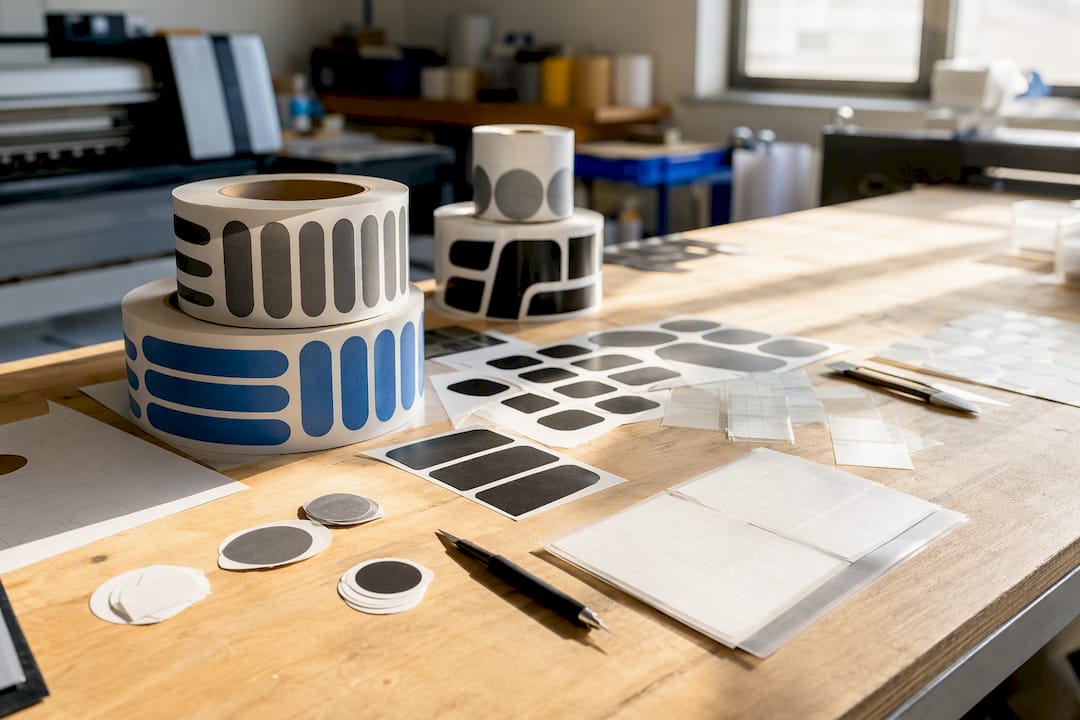
Sheets and rolls flip that equation once volume climbs. A sheet groups multiple stickers into one printed unit, cutting per-piece labor, while rolls are fed continuously through a press and cut in sequence, which is why large-scale label runs almost always default to roll format. The crossover point where rolls start beating die-cut singles on price typically falls somewhere between 250 and 500 units, depending on the printer’s equipment.
Here’s how the three formats stack up:
- Die-cut singles: best for low quantities, promotional giveaways, or designs with irregular shapes; costs the most per unit below 250 pieces.
- Sheets: a middle ground that works well for gang-running several small designs together, spreading setup cost across a mixed batch.
- Rolls: the cheapest per-unit option at high volume, standard for product labeling where you need thousands of identical pieces.
Specialty processes like UV DTF sit outside this quantity curve entirely. UV DTF PermaStickers apply a cured UV coating that resists scratching, fading, and moisture in a way standard vinyl laminate can’t match, and they’re one of the few sticker formats that stick to curved or textured surfaces like tumblers, coolers, and glass. That durability comes at a premium per piece, but for a product label that needs to survive a dishwasher or a decal that lives on a car exterior for years, the math often favors paying more upfront rather than reprinting a batch that faded after one summer.
How To Estimate Your Sticker Budget: Four Worked Examples
Run the numbers yourself before you request a quote, and you’ll know within a few dollars whether a printer’s price is fair. Each example below assumes a standard 3 inch die-cut vinyl sticker with gloss laminate and normal (non-rush) turnaround.
- 10 stickers: At $2.00 to $4.00 each, budget $20 to $40 total. This tier absorbs the most setup overhead per piece, so don’t expect much of a bulk discount at this size.
- 100 stickers: Per-unit price drops to roughly $0.60 to $0.90, putting your total around $60 to $90. Some vendors quote closer to $0.65 each here, matching Avery’s published calculator for standard sizes.
- 500 stickers: You’re now in bulk territory at $0.35 to $0.55 per sticker, totaling roughly $175 to $275. This is where sheet or roll formats start beating die-cut singles on price.
- 1,000 stickers: Expect $0.20 to $0.40 each, or $200 to $400 total, assuming standard vinyl and no rush fee.
100 stickers typically lands around $70 to $110 once you factor in a mid-range laminate finish and standard shipping, a useful anchor number when you’re comparing quotes that look wildly different on paper.
Rush turnaround adds its own flat fee or percentage on top, separate from any material upgrade.
How Small Businesses Cut Sticker Costs Without Cutting Corners
You don’t need to sacrifice quality to bring your sticker budget down. A few practical moves make the biggest difference.
- Stick to standard sizes and shapes (circles, squares, simple die-cuts) instead of custom contours, which avoid extra tooling charges.
- Gang multiple designs onto a single sheet order rather than running separate small batches.
- Switch to sheet or roll format once your quantity clears the 250 to 500 unit range.
- Skip laminate on indoor-only pieces like promotional giveaways where durability doesn’t matter as much.
- Plan your order two to three weeks ahead so you never pay a rush fee for something that wasn’t actually urgent.
- Ask printers directly whether you’re buying factory-direct or through a reseller, since resellers commonly mark up 30% to 50% over the factory rate.
Pro Tip: Always compare the landed cost, meaning unit price plus shipping plus tax, rather than the advertised per-sticker rate. A $0.25 sticker with $30 flat shipping on a 100-piece order can cost more per piece than a $0.40 sticker with free shipping.
What To Ask A Sticker Printer Before You Order
A clean quote comparison depends on asking the same questions of every vendor. Run through this list before you approve any order:
- What material and laminate are included, and what’s the expected outdoor life if the sticker will face sun or water?
- What are the exact size and bleed specifications, and does the quote match those dimensions?
- Are there setup fees, and how many proof rounds are included before extra charges kick in?
- What’s the rush fee structure if you need faster turnaround than the standard timeline?
- Does the quote include shipping, and is sales tax calculated separately?
- Can you get a physical sample or high-resolution proof image before the full run prints?
- What’s the standard production lead time from art approval to shipment?
When Specialty UV DTF Stickers Are Worth the Higher Price
Standard vinyl covers most promo and packaging needs, but some jobs demand more. If your sticker rides on a product that gets handled, washed, or left in direct sun for years, a scratch-resistant, UV-cured option earns its higher price tag through fewer reprints and fewer complaints down the line. Textured surfaces, curved containers, and photo-realistic detail also favor UV DTF over standard vinyl laminate.
Transfer Kingz builds its UV DTF PermaStickers around exactly this use case, with no minimum order requirement and a gang sheet builder that lets you combine several designs into one efficient print run. For small brands weighing a cheap promo sticker against a label meant to last on a product for years, that distinction is the whole decision.
— Anthony
Get A Custom Sticker Quote From Transfer Kingz
Transfer Kingz gives you a faster path to durable, U.S.-produced stickers than sending a design off to an overseas print broker and hoping the laminate holds up. Every order runs through UV DTF PermaStickers built to resist scratching, fading, and water exposure, with no minimum order size holding back small batches.
Here’s what you get when you order through Transfer Kingz:
- No minimum order quantity, so a 10-piece test run costs the same attention as a 1,000-piece batch
- A gang sheet builder that lets you combine multiple designs into one efficient print run
- Same-day local pickup or nationwide shipping depending on your location
- Durable UV DTF PermaStickers built for textured, curved, or outdoor-exposed surfaces
Small business owners in Texas can start with a regional quote through the Transfer Kingz Dallas page, where local pickup often shaves a day or two off standard shipping timelines. Upload your artwork, pick your size and finish, and you’ll see your exact price before you commit to the order.
0 comments