

TL;DR:
- Garment type is essential in apparel production because it influences fabric choice, construction complexity, and decoration methods. Understanding the specific needs of each category ensures better material selection, reduces errors, and enhances product durability. Early collaboration between designers, decorators, and manufacturers prevents costly mistakes and improves brand reputation.
Garment type is the primary classification system in apparel production, defining every downstream decision from fabric selection to print placement. Clothing designers, small business owners, and apparel decorators who understand the role of garment type make better material choices, reduce production errors, and deliver products customers actually keep. Fabric accounts for 40–60% of total production cost, and garment type determines which fabrics are even viable. Industry standards like GSM weight thresholds and shrinkage limits exist specifically because different garment categories demand different performance benchmarks.
How does garment type affect fabric and material selection?
Garment type is the first filter in fabric selection. A hoodie, a performance tank, and a tailored blazer share almost nothing in common from a materials standpoint, even though all three are “tops.” Each category carries distinct functional requirements that eliminate certain fabrics before a designer ever touches a swatch.
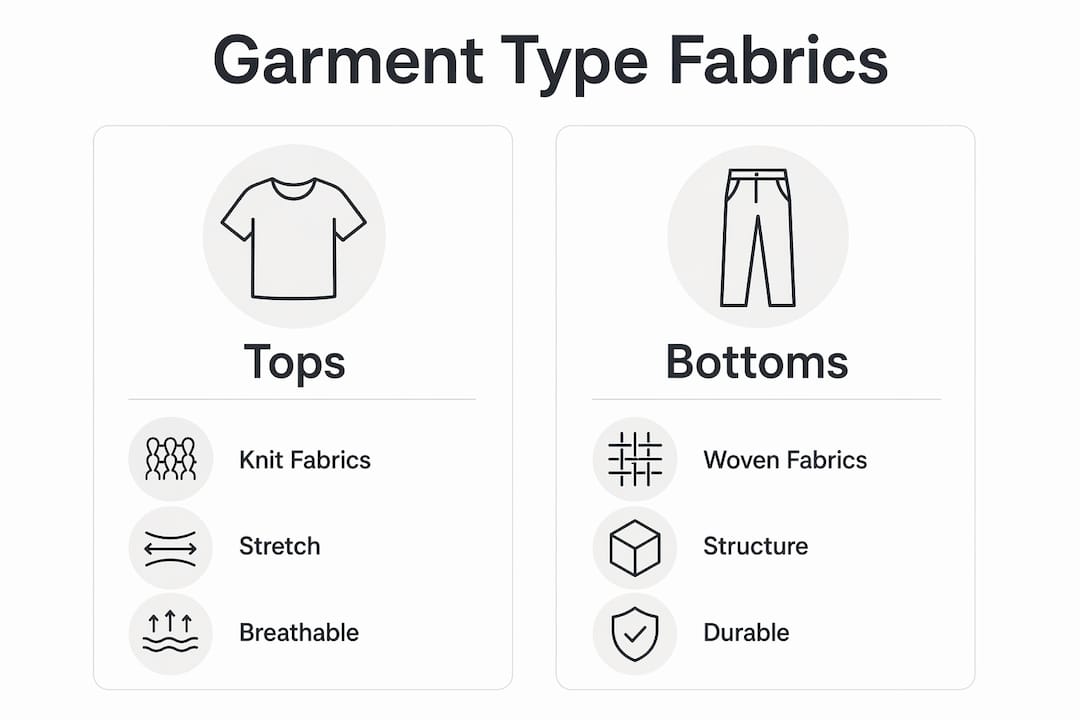
Knit fabrics provide stretch and dominate tops and activewear, while woven fabrics offer structure suited to trousers and formalwear. That structural difference is not aesthetic preference. It is a functional requirement. A woven fabric on a fitted athletic top will restrict movement and fail at stress points within weeks.
The fiber content matters just as much as the fabric structure. Cotton breathes and absorbs moisture, making it the default for everyday tees. Polyester resists wrinkles and dries fast, making it the backbone of performance wear. Modal is soft and drapes well, which is why it shows up in loungewear and premium basics. Nylon adds abrasion resistance, so outerwear and bags rely on it heavily.
| Garment category | Recommended fabric | Key performance requirement |
|---|---|---|
| T-shirts and basics | 100% cotton or cotton/poly blend | Breathability, softness, print compatibility |
| Activewear | Polyester, nylon, or moisture-wicking blends | Stretch, moisture management, durability |
| Hoodies and fleece | Cotton/poly fleece, French terry | Warmth, weight, structure |
| Outerwear | Nylon, ripstop, or coated woven fabrics | Water resistance, wind protection |
| Formalwear | Woven wool, linen, or structured blends | Drape, structure, wrinkle resistance |
Pro Tip: When building a new product line, define the garment category before selecting any fabric. Starting with fabric and working backward to garment type almost always produces a mismatch in either function or cost.
Choosing fabric aligned to garment type is the single most reliable way to protect brand reputation and avoid early product failure. A loungewear brand that uses a stiff woven fabric because it was on sale will see returns, negative reviews, and lost repeat customers.
How does garment complexity drive production costs?
Garment category complexity raises production cost through the number of manufacturing operations required. Seams, trims, closures, linings, and pockets each add a step. More steps mean more labor, more machinery time, and more opportunities for defects.
A basic crew neck tee might require 8–12 operations from cut to finished garment. A structured jacket with a zipper, pockets, and a lining can require 60 or more. That difference shows up directly in sampling time, unit cost, and quality control complexity.
Four production factors shift significantly based on garment type:
- Fabric weight standards. Premium t-shirts perform best at 180–200gsm, while hoodies require 270gsm or heavier to deliver the durability and hand feel customers expect. Ordering the wrong weight for a garment category wastes money and produces a product that feels wrong.
- Shrinkage control. Industry standard shrinkage rates must stay at or below 3% in both warp and weft directions. That threshold exists to maintain fit consistency after washing. A garment that shrinks beyond that threshold generates returns and erodes trust.
- Machinery requirements. Knit garments need overlock and coverstitch machines. Woven garments need lockstitch machines and often fusing equipment for interfacing. Running the wrong garment type through the wrong production line produces defects at scale.
- Quality control checkpoints. Complex garments require more inspection points. A five-panel hat needs seam alignment checks, brim stiffness tests, and closure function tests. A basic tee needs far fewer. Mapping QC to garment type prevents defects from reaching customers.
Pro Tip: Request a tech pack that specifies GSM, shrinkage tolerance, and operation count before approving any sample. Factories that cannot provide this data are not equipped to produce consistently.
Garment analysis now integrates Industry 4.0 technologies, including AI-driven defect detection, to improve consistency across production runs. Small brands can access this level of quality assurance by partnering with factories that have adopted digital inspection systems.
How does garment type impact decoration methods and print quality?
Garment type determines which decoration methods work and which ones fail. This is the section most apparel decorators learn the hard way. A print that looks perfect on a 100% cotton tee can crack, fade, or bleed on a polyester blend within five washes.
Fabric content and weight are the two variables that control print adhesion. Cotton fibers absorb ink well, which is why 100% cotton tees are the standard for direct-to-garment printing. The ink bonds at the fiber level and produces vibrant, durable results. Polyester does not absorb ink the same way, which creates adhesion challenges and a higher risk of color bleeding.
Polyester content in blends demands lower heat during printing to prevent dye migration. When polyester dyes activate at cotton-level temperatures, they bleed into the transfer ink and dull the design immediately. This is not a minor quality issue. It is a production-planning requirement that must be addressed before the first print run.
Heavier garments create their own set of challenges. Heavier fabrics require longer dwell times during heat pressing to avoid scorching and ensure transfer ink bonds properly. A fleece hoodie at 320gsm needs more time and heat than a 180gsm tee, but too much heat on a polyester-rich fleece causes surface damage. Decorators who do not adjust curing parameters by garment type produce inconsistent results across their catalog.
Physical garment construction also limits where decoration can go. Seams and bulky pockets restrict the print area and require artwork adjustments before production. A left-chest logo on a jacket with a chest pocket needs to be repositioned or resized. A full-back print on a hoodie with a center seam needs artwork that accounts for the seam line. Ignoring these constraints produces prints that look misaligned or distorted on the finished garment.
Direct-to-Film (DTF) transfers handle garment type variation better than most decoration methods. DTF transfers apply to cotton, polyester, blends, nylon, and even some leather surfaces. Transferkingz produces DTF transfers that maintain color fidelity across a wide range of garment types, which makes them a reliable choice for decorators working across multiple categories. Understanding how garment type affects print durability helps decorators select the right transfer specs before placing an order.
What are the most common garment type mistakes to avoid?
The most damaging mistake in apparel production is treating garment category and fabric content as the same thing. They are not. Garment category describes what the item is and how it functions. Fabric content describes what it is made from. Confusing the two leads to production errors that are expensive to fix after bulk production begins.
Mismatch between garment function and fabric causes shape distortion, pilling, and early product failure. These failures damage brand reputation in ways that are difficult to recover from, especially for small brands with limited customer bases. A single bad product run can generate enough negative reviews to suppress sales for months.
Before committing to bulk production, verify these factors for every garment type in your line:
- Fabric GSM. Confirm the weight matches the garment category standard. T-shirts at 150gsm feel cheap. Hoodies at 220gsm feel thin and flimsy.
- Shrinkage test results. Require pre-production wash tests showing shrinkage at or below 3% in both directions.
- Decoration method compatibility. Confirm the fabric content and weight work with your chosen print method before ordering transfers or inks.
- Print area mapping. Identify seams, pockets, zippers, and other obstructions that limit usable print area on each garment type.
- Supplier minimum order quantities. Confirm MOQs align with your production volume before selecting a fabric or blank supplier.
Pro Tip: Bring your decorator into the conversation before finalizing garment selection. Decorators who work across multiple garment types will flag compatibility issues that designers and brand owners often miss.
The apparel printing process becomes significantly more efficient when garment type decisions are made with decoration in mind from the start. Brands that treat decoration as an afterthought spend more on reprints, adjustments, and wasted samples. Aligning garment type with high-impact print design from the beginning produces better results at lower cost.
Key Takeaways
Garment type is the foundational variable in apparel production, and every decision about fabric, construction, and decoration must trace back to it.
| Point | Details |
|---|---|
| Fabric cost is garment-driven | Fabric accounts for 40–60% of production cost, and garment type determines which fabrics are viable. |
| GSM standards vary by category | T-shirts require 180–200gsm; hoodies need 270gsm or more to meet quality expectations. |
| Shrinkage tolerance is non-negotiable | Industry standard requires shrinkage at or below 3% in both directions to maintain fit after washing. |
| Decoration parameters depend on garment type | Heavier fabrics need longer curing; polyester blends need lower heat to prevent dye migration. |
| Early collaboration prevents costly errors | Involving decorators before garment selection eliminates compatibility issues before bulk production begins. |
Why garment type knowledge separates good brands from great ones
Most brand failures I have seen in custom apparel come down to one thing: the garment type decision was made last, not first. A designer falls in love with a fabric, builds a product around it, and then discovers the garment does not perform the way the customer expects. By that point, the samples are done, the factory is booked, and the cost of changing course is prohibitive.
The brands that get this right treat garment type as the brief. They define the category, the function, the end user, and the use case before they touch a fabric swatch or open a design file. That discipline produces products that hold up, print well, and generate repeat purchases.
Small brands and decorators have a real advantage here. They can move faster than large manufacturers and test garment type decisions at small scale before committing to bulk. The 2026 garment printing trends show that decorators who understand fabric behavior across garment categories are winning more business from brands that have been burned by generalist printers.
The technology side is also shifting. AI-driven garment analysis and Industry 4.0 quality systems are making it easier to catch garment type mismatches before they reach production. Small brands that partner with factories and decorators using these tools get better consistency without needing a full quality team in-house. That is a meaningful competitive advantage for anyone operating at low to mid volume.
— Anthony
Custom DTF printing built for every garment type
Transferkingz works with clothing designers, small business owners, and apparel decorators across a wide range of garment categories. Whether you are printing on 100% cotton basics, polyester performance wear, or heavyweight fleece, the right transfer specs make the difference between a print that lasts and one that fails after three washes.
Transferkingz produces DTF transfers in Dallas and ships across the country with no minimum order requirements. Decorators working across multiple garment types can order transfers sized and configured for each category without committing to large runs. For apparel brands across the region, DTF printing in Texas through Transferkingz delivers consistent color, strong adhesion, and fast turnaround on every garment type in your catalog.
FAQ
What is the role of garment type in fabric selection?
Garment type defines the functional and structural requirements that determine which fabrics are appropriate. A garment’s category, such as activewear or outerwear, dictates fiber content, fabric structure, and performance standards before any other design decision is made.
How does GSM relate to garment category?
GSM is the standard measure of fabric weight, and each garment category has an accepted range. T-shirts perform best at 180–200gsm, while hoodies require 270gsm or more to deliver the durability and hand feel customers expect.
Why does polyester content affect print quality?
Polyester dyes activate at high temperatures and bleed into transfer ink when heat is applied at cotton-level settings. Decorators must use lower heat settings on polyester-rich blends to prevent dye migration and color degradation.
What shrinkage rate is acceptable for apparel production?
Industry standard requires shrinkage at or below 3% in both the warp and weft directions after washing. Garments that exceed this threshold produce fit inconsistencies and generate customer returns.
When should decorators get involved in garment selection?
Decorators should be consulted before garment selection is finalized. Early involvement allows them to flag print area limitations, curing parameter requirements, and fabric compatibility issues that would otherwise cause problems during production.
0 comments