

TL;DR:
- High-quality ink is essential for durable, vibrant custom apparel prints and reduces maintenance costs.
- Using premium ink improves color retention, extends printhead lifespan, and enhances customer satisfaction.
Ink quality is the single most decisive factor in whether a custom apparel print survives 50 washes or fades after five. The role of ink quality extends far beyond color on fabric. It governs print durability, color accuracy, printer maintenance costs, and your shop’s reputation with every order you ship. Printing professionals who treat ink as a commodity consistently face higher reprint rates, more downtime, and customer complaints that erode margins. The chemistry inside your ink cartridge determines outcomes that no printer setting or operator skill can fully compensate for.
How does ink quality affect print durability and color vibrancy?
Print durability and color vibrancy are direct products of ink formulation, not printer resolution. Two prints made on identical equipment with different inks will perform completely differently after washing, UV exposure, and daily wear.
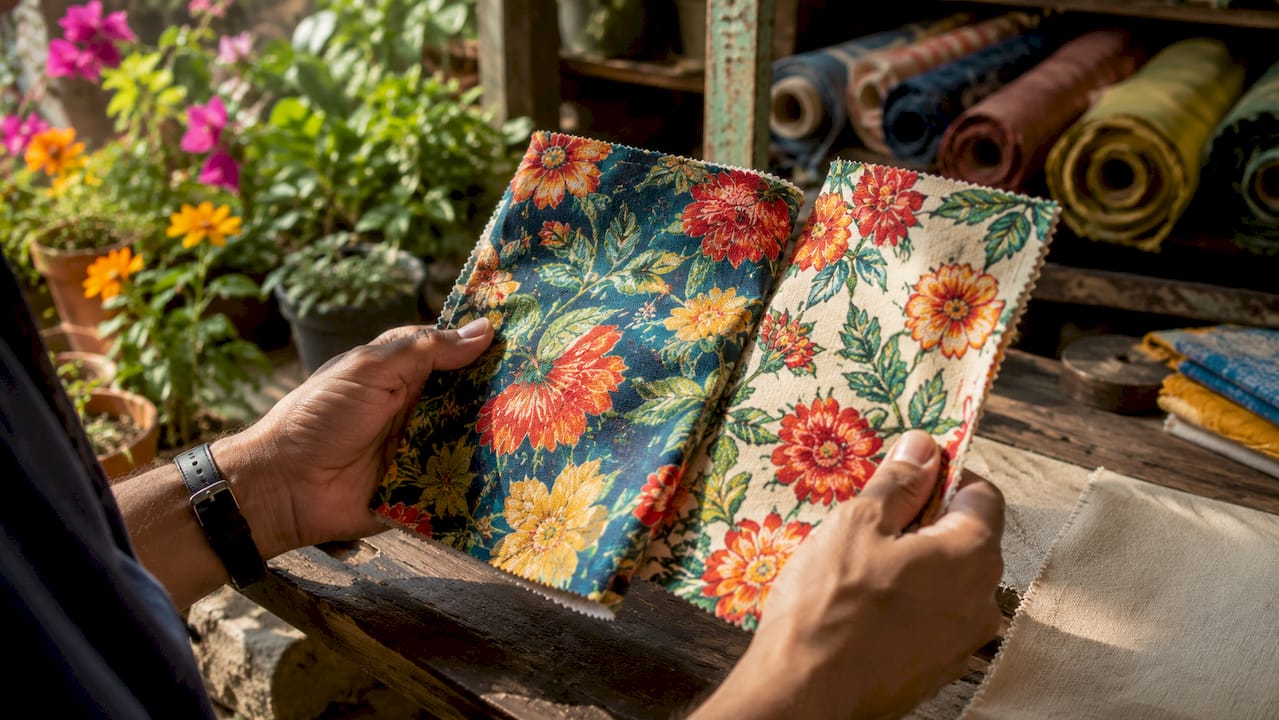
Pigment stability and lightfastness are the foundation of color retention. Professional-grade pigments with high lightfastness ratings stay vibrant for years, resisting UV degradation that cheap inks cannot withstand. A print using low-grade pigments may look sharp on day one and appear washed out after a single summer season outdoors.
Viscosity and surface tension control how evenly ink deposits on fabric. Optimal inkjet printing quality is achieved when ink viscosity falls between 8.0–11.0 mPa·s and surface tension sits between 23.0–25.5 mN/m. These numbers are not arbitrary. Ink outside this range produces streaking, uneven saturation, and color deviation that no post-processing step can correct.
Wash resistance depends on ink-substrate chemistry. Eco-solvent inks bond well with coated substrates and vinyl but require proper outgassing time before lamination. UV-curable inks cure instantly under UV light and deliver excellent scratch resistance on rigid materials. Direct-to-Film (DTF) inks rely on a hot-melt adhesive layer, so the ink formulation must be compatible with both the PET film and the target fabric to survive repeated laundering.
- Pigment particle size affects penetration depth into fabric fibers
- Binder chemistry determines adhesion strength after heat transfer
- pH balance influences drying speed and color consistency across a print run
- Ink-substrate compatibility reduces bleeding and halo effects around fine details
Pro Tip: Test new ink batches on your most demanding substrate first. If the ink performs on a 100% polyester blend with a tight weave, it will perform everywhere else in your lineup.
How does ink quality influence printer maintenance and production efficiency?
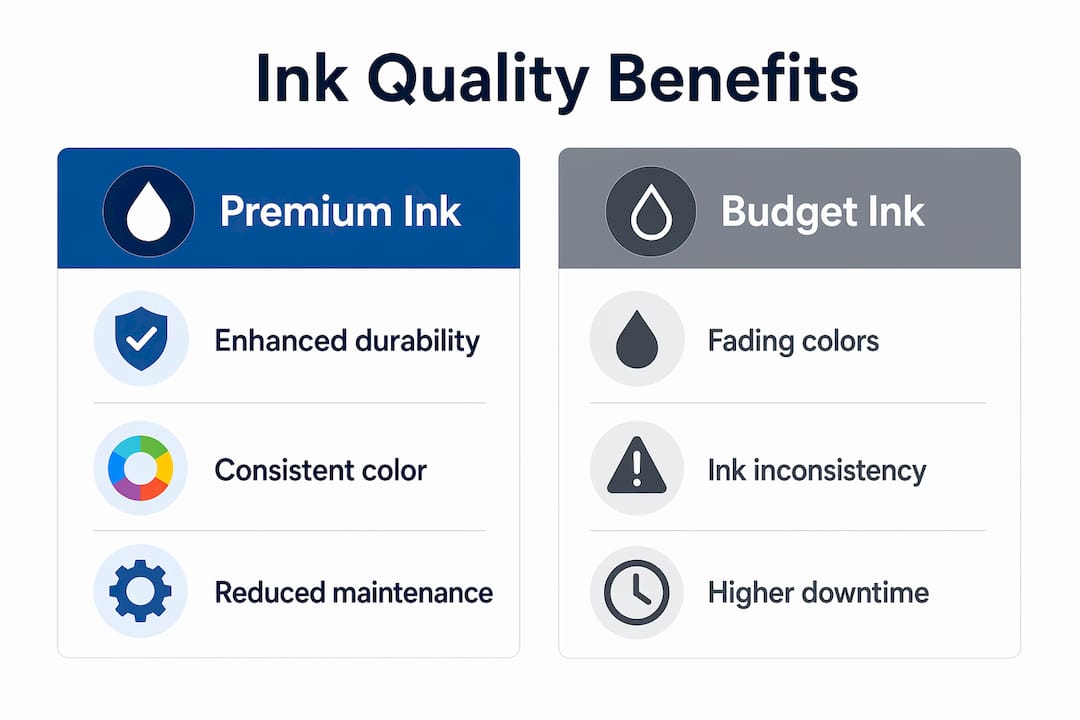
Poor ink chemistry costs print shops far more than the price difference between budget and premium inks. The damage shows up in cleaning cycles, printhead replacements, and lost production hours.
Low-quality ink causes pigment sedimentation, nozzle clogging, and printhead abrasion that leads to premature failure. Sedimentation is particularly destructive in white DTF inks, which use titanium dioxide particles that settle quickly when the ink formula lacks proper suspension agents. A clogged white channel on a DTF printer can halt an entire production run.
The maintenance math is clear:
- Cleaning cycle reduction. Switching to high-quality, printhead-friendly ink reduces cleaning cycles by 45%. Fewer cleaning cycles mean less ink waste per shift and more time printing billable jobs.
- Maintenance cost savings. Quality ink reduces total maintenance costs by 30%. That figure compounds quickly across a shop running two or three printers simultaneously.
- Printhead lifespan extension. Viscosity-optimized inks reduce abrasion on printhead nozzle plates. Less abrasion means fewer replacements, which are among the most expensive single-component costs in inkjet production.
- Downtime reduction. Shops using printhead-friendly formulations report fewer mid-run failures. Consistent ink flow prevents the partial nozzle dropout that forces operators to reprint entire sheets.
- Throughput improvement. When cleaning cycles drop and reprints decrease, the same equipment produces more finished goods per shift without adding labor.
Many printing faults that shops attribute to equipment failure or operator error actually stem from improper ink viscosity and fluidity control. Recognizing this shifts the diagnostic process. Before replacing a printhead or recalibrating a printer, check the ink first.
Pro Tip: Keep a maintenance log that tracks cleaning cycle frequency alongside ink batch numbers. Patterns will reveal which ink lots are causing problems before they escalate into printhead failures.
What are the measurable benefits of high-quality ink for customer satisfaction?
Customer satisfaction in custom apparel printing is built on consistency. A client who orders 200 shirts expects every piece to match the approved proof. Ink quality is what makes that possible at scale.
Using stable, high-quality ink in professional environments increases customer satisfaction ratings by 85%. That figure reflects the direct connection between color integrity, print clarity, and repeat business. Shops that invest in premium inks report fewer customer complaints and higher reorder rates.
Consistent pigment dispersion prevents the color deviation and patchiness that appear when ink quality varies between batches. Output quality depends more on precise droplet control and ink-substrate chemistry than on printer resolution alone. A 1440 dpi printer running poor ink will produce worse results than a 720 dpi printer running a well-formulated ink matched to the substrate.
| Factor | Budget ink | Premium ink |
|---|---|---|
| Color consistency across a run | Variable, prone to deviation | Stable, batch-to-batch reliable |
| Wash durability | Fades within 10–20 washes | Maintains vibrancy beyond 50 washes |
| Printhead cleaning frequency | High, multiple times per shift | Low, reduced by up to 45% |
| Reprint and waste rate | Elevated due to clogging and streaks | Minimal with proper substrate matching |
| Customer satisfaction impact | Complaints and chargebacks | Repeat orders and referrals |
Reduced waste from aligned ink-substrate chemistry also cuts material costs directly. Every reprint consumes film, ink, and labor. Shops that match ink formulation to substrate type from the start eliminate most of those losses before they occur.
How do professionals select the right ink for various printing needs?
Choosing the right ink starts with understanding the job requirements, not the price tag. The goal is matching ink properties to the specific demands of each print category.
- Evaluate viscosity and surface tension before committing to a new ink supplier. Request technical data sheets and verify that viscosity falls within the 8.0–11.0 mPa·s range for inkjet applications. Suppliers who cannot provide this data are not worth the risk.
- Assess substrate compatibility for every new material you add to your lineup. DTF inks behave differently on cotton, polyester, and blended fabrics. Run adhesion tests before scaling any new substrate into production.
- Prioritize white ink quality above all other channels in DTF printing. White ink carries the underbase that makes all other colors pop on dark garments. Ink wipeability is a critical but often overlooked metric. Inks engineered for high color density with good wipeability reduce setup time and scrap rates by minimizing staining and smudging.
- Use a tiered ink inventory strategy. Successful print shops use premium inks for color-critical, high-margin jobs and standard inks for less demanding applications. This approach controls costs without sacrificing quality where it matters most.
- Run A/B tests across job classes. Print the same design with two ink formulations on the same substrate, wash both samples 25 times, and compare results. The data from this test is more reliable than any supplier claim.
Treating ink as a dynamic chemical system aligned with substrate properties improves production throughput and reduces defects. Shops that adopt this mindset stop chasing print problems after they appear and start preventing them at the formulation stage.
Pro Tip: When evaluating a new ink supplier, request a sample run on your most problematic substrate. Real-world performance on your equipment matters more than lab specifications.
Key takeaways
Ink quality determines print durability, color accuracy, and maintenance costs more than any other single variable in custom apparel production.
| Point | Details |
|---|---|
| Ink chemistry drives durability | Pigment stability and substrate compatibility determine wash resistance and color retention over time. |
| Viscosity controls print quality | Ink viscosity between 8.0–11.0 mPa·s prevents streaking, color deviation, and uneven saturation. |
| Premium ink cuts maintenance costs | Quality ink reduces printhead cleaning cycles by 45% and total maintenance costs by 30%. |
| Customer satisfaction follows ink quality | Stable, high-quality ink increases customer satisfaction ratings by 85% in professional print environments. |
| Tiered ink strategy optimizes cost | Use premium inks for color-critical jobs and standard inks for lower-margin work to control expenses. |
What I’ve learned after years of watching shops get ink wrong
The most common mistake I see in production shops is treating ink as an afterthought. Operators spend hours calibrating printers, profiling substrates, and fine-tuning heat press settings. Then they buy the cheapest ink available and wonder why results are inconsistent.
The cost-benefit math on premium ink is not complicated. A printhead replacement on a commercial DTF printer costs several hundred dollars. A quality ink upgrade that extends printhead life by even a few months pays for itself immediately. The shops that understand this stop viewing ink as a consumable expense and start treating it as a capital protection decision.
The other pattern I see constantly is misdiagnosed print faults. A shop will replace a printhead, recalibrate the entire system, and still get color deviation on every run. The problem was the ink viscosity all along. Checking the ink first would have saved the cost of the replacement and two days of downtime.
Quality in ink is measured not only by immediate color output but also by performance through curing, drying, and longevity stages. A print that looks perfect coming off the press but fails after ten washes is not a quality print. Shops that evaluate ink at every stage of the print lifecycle make better purchasing decisions and build stronger customer relationships as a result.
If you want to know more about choosing ink for DTF, the technical details of formulation selection are worth studying before you commit to a supplier.
— Anthony
Get vibrant, durable DTF prints with Transferkingz
Transferkingz uses premium DTF ink formulations specifically selected for color stability, wash durability, and printhead compatibility. Every transfer ships with consistent pigment dispersion and adhesive chemistry matched to a wide range of fabric types, from 100% cotton to performance polyester blends.
Whether you run a small custom apparel shop or a high-volume production facility, Transferkingz delivers custom DTF transfers in Dallas with no minimum order requirements and fast turnaround. You get the high-quality ink benefits of a professional print operation without the overhead of running your own DTF printer. Explore premium DTF ink transfers and see what the right ink formulation does for your finished product.
FAQ
What is the role of ink quality in DTF printing?
Ink quality in DTF printing determines color vibrancy, wash durability, and printhead longevity. Poor ink formulation causes sedimentation, nozzle clogging, and color deviation that no printer setting can correct.
How does ink viscosity affect print results?
Ink viscosity directly controls droplet formation and ink distribution across the substrate. Optimal inkjet printing quality requires viscosity between 8.0–11.0 mPa·s. Ink outside this range produces streaking and uneven color.
Does high-quality ink reduce printer maintenance costs?
Yes. Switching to printhead-friendly, high-quality ink reduces cleaning cycles by 45% and cuts total maintenance costs by 30%, according to performance data from professional inkjet environments.
How do I choose the right ink for custom apparel printing?
Match ink viscosity, pigment stability, and binder chemistry to your specific substrate and application method. Run wash tests on new ink batches before scaling them into full production runs.
Is premium ink worth the higher cost for small print shops?
Premium ink reduces reprints, extends printhead life, and increases customer satisfaction by 85% in professional settings. The reduction in maintenance and waste costs typically offsets the higher per-unit ink price within a single production cycle.
Recommended
- High-Quality DTF Ink for Stunning Transfers: Achieve Vibrant, Durable – Transfer Kingz
- Inkjet vs DTF printing: best method for custom apparel 2026 – Transfer Kingz
- Why Use Premium Inks for Custom Apparel Printing – Transfer Kingz
- How ink quality impacts DTF printing: guide for small businesses – Transfer Kingz
0 comments