

TL;DR:
- Transfer application guides ensure consistent, high-quality results and reduce waste in DTF printing.
- Effective guides are customized, include visual cues, and are regularly updated based on production feedback.
- Using structured, evolving guides boosts efficiency, lowers reject rates, and enhances business scalability.
Applying DTF transfers looks straightforward until you ruin your third shirt in a row and realize something is off. Small business owners and independent artists lose real money every time a transfer peels, bubbles, or misaligns, and most of those losses trace back to one missing ingredient: a structured application guide. Not a vague instruction sheet, but a proven, step-by-step framework built around your specific materials and equipment. This article breaks down why transfer application guides are the most underrated tool in custom apparel production, what separates a great guide from a useless one, and how to put one to work in your shop starting today.
Table of Contents
- Why transfer application guides matter for custom apparel
- Key components of an effective transfer application guide
- How transfer application guides boost DTF print quality and business success
- Implementing and customizing transfer application guides for your shop
- The overlooked power of transfer guides: Lessons from the field
- Upgrade your apparel business with expert DTF transfer support
- Frequently asked questions
Key Takeaways
| Point | Details |
|---|---|
| Consistency with guides | Transfer application guides ensure repeatable, high-quality results regardless of operator skill. |
| Reduced production errors | Using structured guides significantly cuts down waste and the need to redo costly misprints. |
| Scalable workflows | Guides make it easier to train new team members and expand custom apparel operations smoothly. |
| Customization advantage | Tailoring guides to your shop and equipment unlocks even higher efficiency and print quality. |
Why transfer application guides matter for custom apparel
With the challenge clear, let’s dig into why transfer application guides make all the difference. Most small shops and solo artists start out learning DTF transfer application through trial and error. That approach works, eventually, but it is expensive and slow. Every misprinted garment, every wasted transfer sheet, and every hour spent troubleshooting a mystery adhesion problem adds up fast. Without a guide, your results depend entirely on memory and mood, and that is a shaky foundation for any business trying to grow.
Transfer application guides solve that problem by turning your best results into a repeatable process. When you document the exact settings, steps, and checks that produce a clean, vibrant print, you can replicate that outcome every single time. That matters even more when you bring on a new team member or volunteer who has never touched a heat press. Instead of shadowing you for a week, they follow the guide and produce consistent output from day one.
The benefits of custom DTF transfers go well beyond color and durability. Expert-built guides also include troubleshooting tips for common problems like cold spots, incomplete adhesion, and film lifting. They account for substrate differences, so your team knows to adjust pressure and temperature when switching from a cotton tee to a polyester blend. That kind of built-in intelligence is what separates a professional operation from a hobbyist setup.
As noted in the DTF Transfer Quality Checklist 2026: 60% Cost Savings, guides lead to better alignment, adhesion, and higher overall production value, with shops using checklist-based systems saving up to 60% in material and redo costs. That is not a small number. For a shop running 200 shirts a week, that kind of waste reduction can mean the difference between profit and loss.
Here is a quick look at what structured guides deliver:
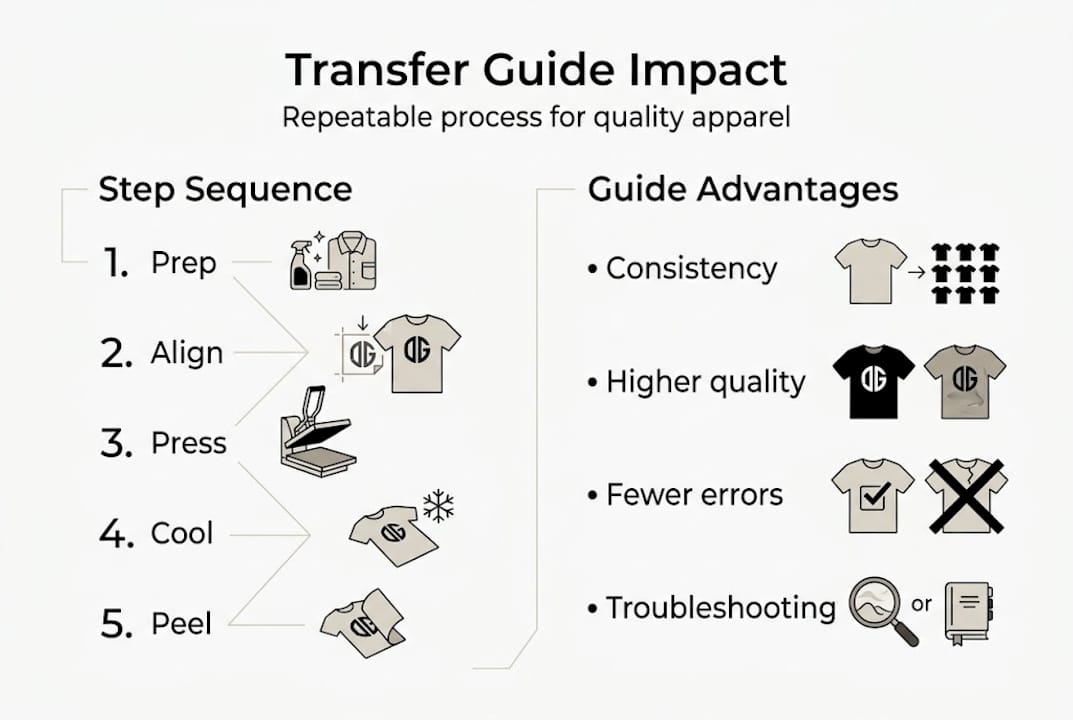
- Consistency: Every press produces the same result, regardless of who is operating the machine
- Speed: Operators spend less time second-guessing settings and more time producing
- Fewer errors: Clear steps eliminate the most common causes of failed transfers
- Scalable processes: Guides make it easy to train new staff and expand production without sacrificing quality
- Lower costs: Less rework means less wasted film, ink, and garment inventory
“A well-built guide is not just documentation. It is the institutional knowledge of your best production day, captured and made available to everyone on your team, every single day.”
Key components of an effective transfer application guide
Understanding why guides matter, let’s get specific about what makes a guide truly useful. Not all guides are created equal. A generic instruction sheet that ships with your heat press is a starting point, nothing more. A genuinely effective guide is built around your machine, your materials, and your team’s specific workflow.
The best guides follow a clear step-by-step sequence: garment prep, transfer alignment, pressing, cooling, and peeling. Each stage has its own variables, and skipping even one check can compromise the final result. According to a perfect transfer checklist, step-by-step checklists improve transfer success rates significantly by removing ambiguity at every stage of the process.
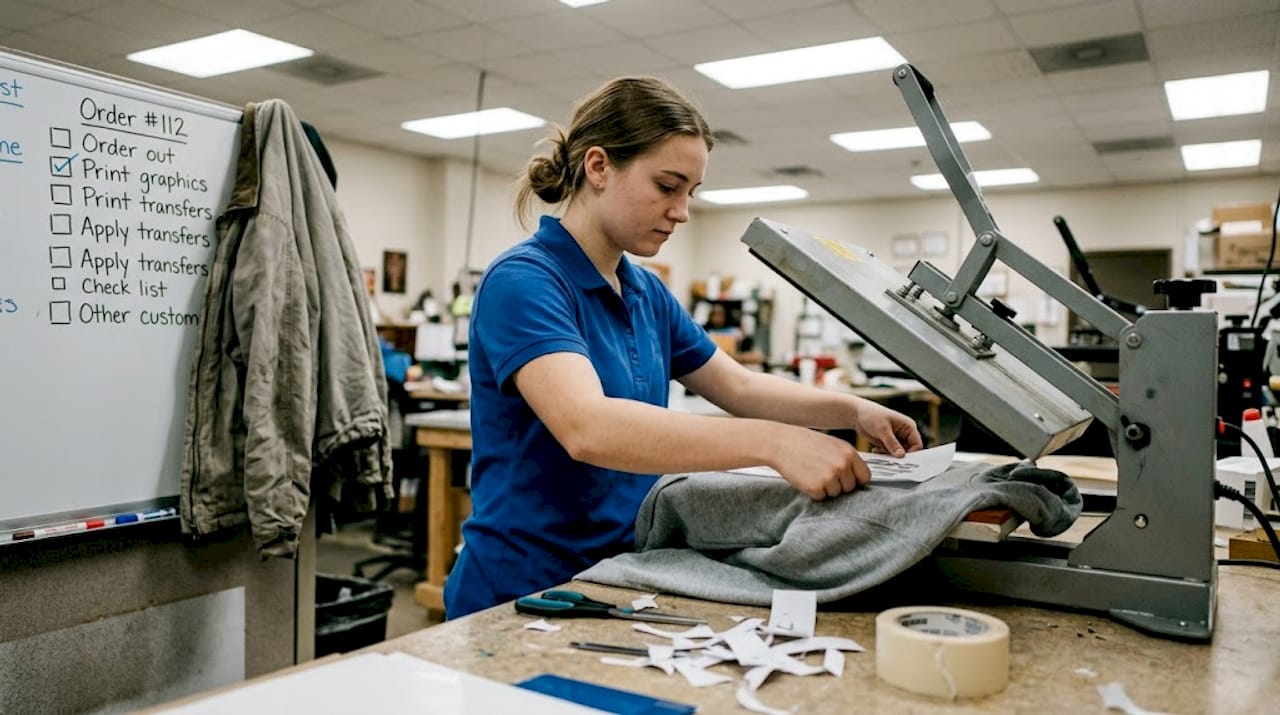
Visual cues matter enormously. Photos showing correct alignment, illustrations of proper pressure distribution, and color-coded temperature charts all reduce the cognitive load on your operators. A guide that relies entirely on text is harder to follow under production pressure. When someone is pressing 50 shirts in a row, they need to glance at a visual and confirm they are on track, not read a paragraph.
The table below shows the key differences between a generic guide and a machine-specific one:
| Feature | Generic guide | Machine-specific guide |
|---|---|---|
| Temperature settings | Broad range (300-330°F) | Exact setting for your model |
| Pressure guidance | Light/medium/firm | PSI or dial number for your press |
| Substrate notes | Cotton and polyester | All fabrics you actually use |
| Troubleshooting | General tips | Common issues with your setup |
| Visual aids | Rarely included | Photos of your actual equipment |
When choosing transfer films for different fabric types, your guide should reflect those choices with specific settings for each film and fabric combination.
Here are the must-have elements every strong guide should include:
- Materials list: Transfers, garments, release paper, and any pre-treatment supplies
- Settings chart: Temperature, pressure, and time for each substrate type
- Step order: Numbered sequence from garment prep through final inspection
- Safety notices: Heat warnings, ventilation reminders, and equipment handling notes
- Care instructions: What to tell customers about washing and drying their finished garments
Pro Tip: Always add a troubleshooting section at the end of your guide. List the five most common mistakes your team makes and the exact fix for each. This alone can cut your error rate dramatically within the first week.
How transfer application guides boost DTF print quality and business success
Now, let’s connect effective guides to concrete improvements in both quality and business outcome. The impact of a well-built guide shows up fast in your production numbers. Shops that move from informal practices to standardized guide-based workflows typically see measurable gains within the first month.
The DTF troubleshooting guide confirms that guides reduce troubleshooting time and improve yield by giving operators a clear path to diagnose and fix problems without stopping the entire production line. That kind of efficiency compounds over time.
Here is what the before-and-after typically looks like for a small shop:
| Metric | Without a guide | With a standardized guide |
|---|---|---|
| Transfer reject rate | 15-20% | 5-8% |
| Average batch time (24 shirts) | 3.5 hours | 2.2 hours |
| New staff training time | 5-7 days | 1-2 days |
| Monthly material waste cost | High | Reduced by up to 60% |
| Customer complaint rate | Moderate | Significantly lower |
Those numbers represent real dollars. Faster batch times mean more orders fulfilled per day. Lower reject rates mean less money spent on replacement garments and transfers. Faster onboarding means you can scale up for a big order without panicking about quality control.
Shops using standardized guides report up to 30% fewer rejects, which translates directly into higher margins and a stronger reputation for reliability with customers.
A solid workflow tutorial can also help you map out the full production sequence so your guide fits naturally into your existing process rather than disrupting it.
Pro Tip: If you are scaling up production across multiple shifts or locations, create workflow-specific guides for each setup. A guide built for your morning crew on a single press will not serve your evening team running two machines. Tailor each guide to its context.
Implementing and customizing transfer application guides for your shop
Finally, knowing why and how guides work, here’s how you can implement them for best results. You do not have to build a guide from scratch. Starting with a proven template and adapting it to your setup is faster, smarter, and less likely to leave out critical steps. The key is making it yours before you put it into regular use.
Personalized workflows yield higher efficiency and fewer errors, as shown in research on custom DTF workflow practices. A template gives you the structure; your team’s experience gives it accuracy.
Here is a simple process for customizing any guide to fit your shop:
- Start with a template: Use a professionally built guide as your baseline structure
- Tailor your settings: Replace generic temperature and pressure values with the exact numbers that work on your equipment
- Add team tips: Ask your most experienced operator to contribute notes on common pitfalls and shortcuts
- Test it live: Run a small production batch using only the guide, no verbal instructions, and note where operators hesitate or ask questions
- Update regularly: Revise the guide whenever you change equipment, films, or fabric suppliers
Involving your team in the guide-building process also increases buy-in. When operators help write the troubleshooting section, they are more likely to actually use it. That collaborative approach turns a document into a shared standard.
For digital guides, keep them accessible on a shared drive or tablet mounted near the press. For physical guides, laminate them and post them at each workstation. A setup guide can help you structure the initial configuration steps so your custom guide starts from a solid technical foundation.
The overlooked power of transfer guides: Lessons from the field
Stepping back, there is a bigger lesson most guides do not highlight enough. The biggest mistake we see shops make is treating a transfer application guide as a one-time document. They print it out, put it on the wall, and never touch it again. That approach misses the entire point.
The real power of a guide is not in following it once. It is in refining it over time. Every production run teaches you something. A small tweak to your peeling technique, a half-degree adjustment on your press, a note about a specific fabric brand that behaves differently. When you capture those lessons in your guide, you build a living document that gets smarter with every batch.
We have seen shops cut their error rates dramatically not by buying new equipment, but by updating their guides after every major production run. The guide becomes a training tool, a quality standard, and a communication bridge between shifts. When your morning and evening teams are working from the same updated document, quality stops depending on who showed up that day.
Tracking cost savings with transfer quality over time also gives you hard data to justify further investment in better films, equipment upgrades, or additional staff. Your guide is not just an operational tool. It is a business asset.
Upgrade your apparel business with expert DTF transfer support
If you’re ready to boost your own results, here’s where to go for guidance and materials. At Transfer Kingz, we do not just supply premium DTF transfers. We back every order with the expertise to help you apply them right.
Whether you need tailored application checklists, troubleshooting help, or a full workflow review, our team is ready to support your production goals. Businesses across the country, including those using our DTF Transfers Dallas and DTF Transfers Texas services, trust us for both quality materials and practical guidance. Visit our Print Point resource hub to explore setup guides, application tips, and tools designed to help your shop produce cleaner prints, faster, with fewer headaches.
Frequently asked questions
What is a transfer application guide?
A transfer application guide is a structured set of instructions designed to help users accurately apply DTF transfers for custom apparel. Well-designed guides help apparel businesses achieve more reliable, consistent results across every production run.
How do transfer application guides improve print quality?
Guides provide exact steps and settings, leading to better adhesion, fewer mistakes, and consistently higher quality prints. Standardized guides directly enhance output quality by removing guesswork from every stage of the process.
Can I customize a transfer application guide for my equipment?
Yes, and you should. Tailoring your guide to match your specific machines, materials, and team experience produces better results than any generic template. Custom-tailored guides are consistently more effective for diverse production workflows.
Where can I find professional help with DTF transfer applications?
Specialized providers like Transfer Kingz offer both premium DTF transfers and application guidance tailored to your specific workflow, equipment, and production goals.
Recommended
- How to choose transfer films for custom apparel in 2026 – Transfer Kingz
- Master the DTF Application Process for Custom Apparel – Transfer Kingz
- Custom apparel designs: 5 DTF transfer inspirations – Transfer Kingz
- Advantages of custom transfers for apparel businesses – Transfer Kingz
- Koraki za personalizacijo majice za promocijo in podjetja
0 comments