

TL;DR:
- Heat transfer films are polymer-based substrates that bond printed designs to fabrics using heat and pressure from a heat press. Choosing the correct film type for your substrate and design requirements prevents adhesion failures and garment waste. Key categories include DTF PET release film, HTV, sublimation transfer paper, reflective, glitter, metallic, and specialty films like UV DTF and crystal labels.
Heat transfer films are polymer-based substrates that bond printed designs to fabric and other materials using heat and pressure from a heat press. The market includes at least six distinct film categories, each suited to different substrates, workflows, and finish requirements. Understanding the types of heat transfer films before you buy saves you from costly adhesion failures and wasted garments. The most widely used categories include DTF PET release film, heat transfer vinyl (HTV), sublimation transfer paper, reflective films, and glitter or metallic films, with specialty options like crystal label and UV DTF rounding out the field.
1. types of heat transfer films and their core applications
The six main film categories each require specific equipment and processing parameters. Choosing the wrong film for your substrate is the single most common cause of print failure.
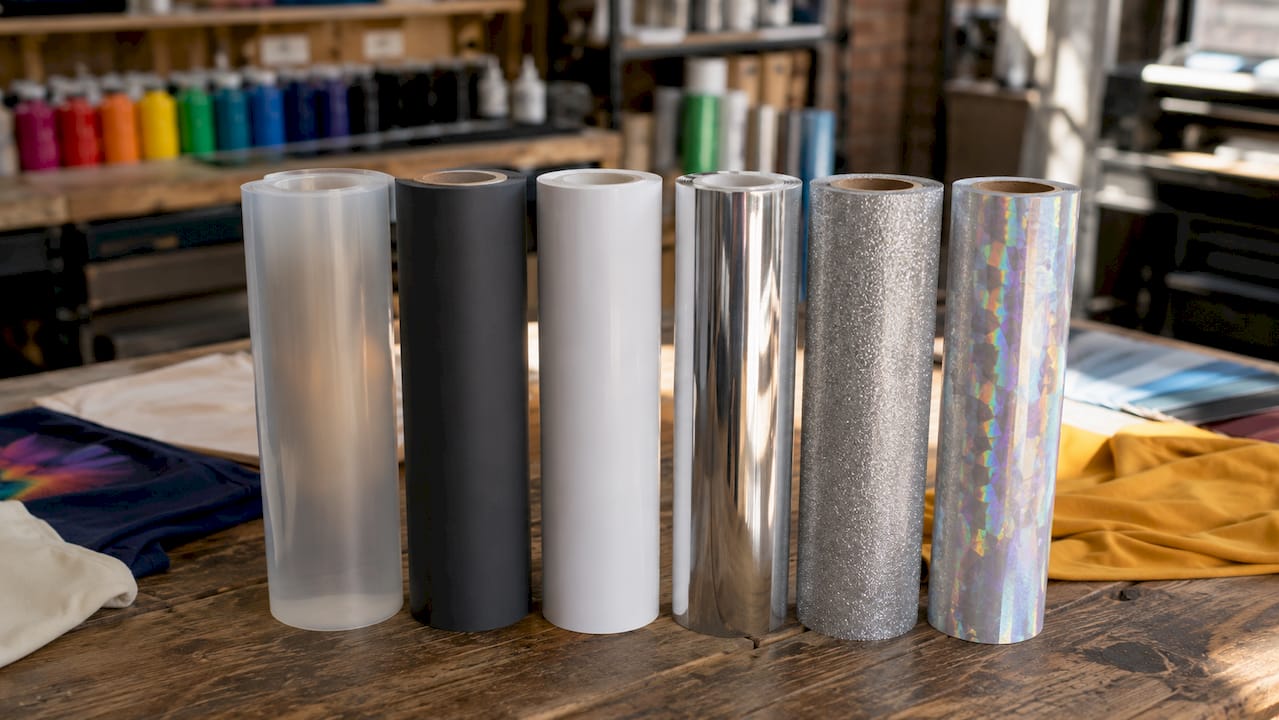
DTF PET Release Film is the dominant choice for direct-to-film printing on cotton, polyester, and blended fabrics. The film receives CMYK plus white ink layers, which are then cured with hot-melt powder and heat pressed onto the garment. It works on virtually any textile, which makes it the most versatile option in the lineup.
Heat Transfer Vinyl (HTV) is a vinyl-based film cut into shapes using a plotter cutter, then pressed onto fabric with an adhesive backing. It comes in dozens of finishes including glitter, metallic, matte, and stretchable options. HTV is the go-to choice for simple text, logos, and single-color graphics on apparel.
Sublimation Transfer Paper uses dye-sublimation technology to bond ink permanently with polyester fibers at the molecular level. The result is a print that will not crack, peel, or fade through repeated washing. The trade-off is that sublimation only works on polyester or polyester-coated substrates, limiting its use on natural fibers like cotton.
Reflective Heat Transfer Films feature specialized coatings that return light to its source, making them standard in safety apparel for construction workers, cyclists, and emergency responders. Fashion designers have also adopted reflective films for streetwear and activewear collections.
Glitter and Metallic Films add decorative finishes to designs and are popular in sportswear, dance costumes, and promotional merchandise. These films are typically applied over a base HTV layer or used as standalone accent elements.
Specialty Films such as crystal label film and UV DTF serve niche applications. Crystal label film creates a raised, glossy effect on hard surfaces like phone cases and mugs. UV DTF transfers work on non-textile surfaces including glass, wood, and acrylic, expanding heat transfer film applications well beyond apparel.
2. how film materials affect print quality and durability
The three primary heat transfer film materials are PET, PU, and PVC, and each performs differently under production conditions.
| Material | Key Strength | Main Weakness | Best Use Case |
|---|---|---|---|
| PET | Dimensional stability, print clarity | Less flexible than PU | DTF printing on flat or stable fabrics |
| PU | High flexibility and stretch | Higher cost than PVC | Activewear, stretch fabrics, sportswear |
| PVC | Low cost, durable | Less eco-friendly, regulatory pressure | Budget production, non-stretch items |
| Eco-friendly/Bio-based | Reduced environmental impact | Price premium, limited availability | Sustainability-focused brands |
PET-based transfer films dominate the market because of their dimensional stability and print clarity. Environmental regulations are pushing PVC usage toward greener alternatives, though those alternatives carry a price premium. PU sits in the middle, offering the flexibility that activewear and stretch fabrics demand without the environmental concerns tied to PVC.
Film thickness is another variable that directly affects production. 75 micron films are thinner and flexible, suited for desktop printers and smaller operations. 100 micron films deliver industrial durability and better heat stability for high-volume production environments. Selecting the wrong thickness causes feed errors and inconsistent curing.
One technical detail that trips up many buyers: the matte side on double-sided PET films is for feed stability in printers, not for double-sided printing. It prevents slippage and static during print runs. Misunderstanding this leads to wasted film and printer jams.
Pro Tip: Prioritize coating quality over price when sourcing DTF PET film. The coating’s ability to handle maximum ink loads without bleeding is the factor that separates clean, vibrant prints from muddy, failed runs.
3. hot peel, cold peel, and warm peel: which one do you need?
Peel behavior is one of the most misunderstood variables in heat transfer film selection. Getting it wrong ruins garments and slows production.
Hot peel films require you to remove the carrier film immediately after pressing while the transfer is still hot. This method is fast and suits high-volume production lines. The trade-off is that hot peeling on delicate fabrics or intricate designs can cause tearing or distortion if the operator moves too quickly.
Cold peel films require you to let the transfer cool completely before removing the carrier. This produces sharper edges and better detail retention, making it the right choice for photographic prints or designs with fine lines. The downside is slower throughput, since each garment needs cooling time before the next step.
Warm peel is a hybrid approach. You wait 10–20 seconds after pressing, then peel. It balances speed and safety, and works well for operators who handle a wide variety of fabric types throughout the day.
Here is a practical decision framework for choosing peel type:
- High-volume production on stable fabrics: Use hot peel to maximize throughput.
- Detailed or photographic designs: Use cold peel to preserve edge sharpness.
- Mixed fabric types or general-purpose shops: Use warm peel for consistent results across substrates.
- Delicate or sheer fabrics: Always default to cold peel to avoid heat damage.
- Testing a new film or substrate combination: Start with cold peel, then test warm peel once you confirm adhesion.
Experienced operators who encounter peel problems repress and peel from different edges to avoid tearing or leaving adhesive residue. This simple technique saves garments that would otherwise be scrapped.
Pro Tip: Always run a peel test on scrap fabric before committing to a full production run. A five-minute test prevents hours of rework.
4. how to choose the best heat transfer film for your project
Selecting the right film comes down to five variables: substrate type, design complexity, production volume, budget, and finish requirements.
Match film to fabric first. Cotton and cotton blends work best with DTF PET film or HTV. Polyester and polyester-coated substrates are the natural home for sublimation. Stretch fabrics like spandex and athletic knits need PU-based films that flex without cracking. Adhesion failure post-wash is the most frequent consequence of mismatching film to substrate.
Design complexity drives film choice. Full-color photographic prints with gradients belong on DTF PET film. Simple text and block graphics are faster and cheaper to produce with HTV. Specialty finishes like glitter or reflective effects require their dedicated film types regardless of design complexity.
Volume and speed shape your thickness decision. High-volume shops running hundreds of garments per day need 100 micron film for feed stability and heat consistency. Smaller operations and hobbyists can work efficiently with 75 micron film on desktop printers.
Budget realities matter. PVC-based films cost less upfront but face growing regulatory restrictions. PU and eco-friendly films cost more per roll but deliver better stretch performance and align with consumer demand for sustainable products. Film material choices are increasingly shaped by both regulation and buyer preference for sustainability.
Always validate before production. Testing film-substrate adhesion and wash durability on scrap fabric before large runs is the single most reliable way to avoid costly failures. Run the test garment through at least three wash cycles before approving the film for production.
You can explore the full breakdown of DTF transfer material types to see how each substrate category performs across different printing scenarios.
5. specialty and emerging film types worth knowing
Beyond the core categories, several specialty heat transfer film types are gaining traction in 2026 and deserve attention from anyone building out a product line.
UV DTF films transfer designs onto hard, non-porous surfaces including glass, ceramic, metal, and acrylic without a heat press. A UV lamp cures the ink instead of heat. This opens up product categories like custom drinkware, awards, and signage that traditional heat press films cannot reach.
Crystal label films create a thick, raised, glossy effect that mimics a resin dome. They are popular for phone cases, laptop skins, and branded merchandise. The tactile quality of the finish commands a higher retail price, making them attractive for premium product lines.
Glow-in-the-dark and color-change films are niche but growing in children’s apparel and novelty merchandise. These films use photoluminescent or thermochromic coatings that react to light or temperature. Production volumes are low, but the novelty factor supports strong margins.
Eco-friendly and bio-based films represent the direction the industry is heading. Biodegradable coating alternatives are available now but carry a price premium. As production scales up and regulations tighten around PVC, expect these options to become more cost-competitive within the next few years. Brands that adopt them early build a credible sustainability story before it becomes a requirement.
For a deeper look at where film technology is heading, the DTF technology trends for 2026 breakdown covers emerging materials and printing methods shaping the next wave of custom apparel production.
Key takeaways
The best heat transfer film for any project is determined by substrate type, design complexity, production volume, and peel behavior requirements.
| Point | Details |
|---|---|
| Match film to substrate | DTF PET suits most textiles; sublimation requires polyester; PU films handle stretch fabrics best. |
| Coating quality drives results | Anti-static properties and max ink load tolerance determine print clarity and wash durability. |
| Peel type affects workflow | Hot peel maximizes speed; cold peel protects detail; warm peel balances both for mixed production. |
| Test before full runs | Validate adhesion and washability on scrap fabric to prevent costly production failures. |
| Specialty films expand revenue | UV DTF and crystal label films open non-textile product categories with strong margin potential. |
What i’ve learned after years of watching film choices make or break print runs
The conversation around heat transfer films almost always starts with price. That is the wrong place to start. The coating quality on a DTF PET film, specifically its anti-static properties and its ability to carry a heavy ink load without bleeding, is what separates a clean, sellable print from a garment you throw in the scrap bin. I have seen shops save a few cents per roll on film and lose far more on ruined blanks and reprints.
The other mistake I see constantly is skipping the peel test. Operators assume that because a film worked on one fabric, it will work on everything. It will not. A cold peel film pressed onto a performance polyester blend at the wrong temperature will lift the design in the first wash. Five minutes of testing on scrap fabric before a 200-piece run is not optional. It is the cheapest insurance in the building.
On the eco-friendly side, I understand the hesitation. Bio-based films cost more and the supply chain is still maturing. But the brands I see winning in 2026 are the ones that adopted sustainable materials before their customers demanded it. The price gap is narrowing. Getting comfortable with these films now puts you ahead of the curve rather than scrambling to catch up when regulations force the issue.
My practical recommendation: run DTF PET film as your default for mixed-fabric production, use PU-based films for anything with stretch, and keep a roll of cold peel on hand for detailed or photographic work. That three-film setup covers 90% of what most custom print shops encounter. Build from there once you know your volume and substrate mix.
— Anthony
Print smarter with Transferkingz
Transferkingz produces custom DTF transfers using premium PET films and professional-grade inks, with no minimum order requirements. Whether you are a solo creator testing a new design or a production shop running hundreds of pieces per week, Transferkingz delivers fast turnaround and consistent print quality across cotton, polyester, and blended fabrics. The gang sheet builder lets you maximize film usage and cut your cost per print. Upload your artwork, select your film specs, and get production-ready transfers shipped quickly. Explore the full range of DTF printing services and see why thousands of businesses trust Transferkingz for their custom apparel production.
FAQ
What is the most versatile heat transfer film type?
DTF PET release film is the most versatile option because it adheres to cotton, polyester, and blended fabrics without requiring a polyester-coated substrate. It supports full-color photographic prints and works with standard heat press equipment.
How do i know if i need hot peel or cold peel film?
Use hot peel for fast production on stable fabrics and cold peel for detailed designs or delicate materials. Warm peel is a reliable middle ground when you work with multiple fabric types in the same session.
Can heat transfer films be used on non-fabric surfaces?
UV DTF films and crystal label films transfer designs onto hard surfaces like glass, ceramic, metal, and acrylic. Standard DTF PET and HTV films are designed for textiles and do not adhere reliably to non-porous surfaces.
Why does my heat transfer print peel off after washing?
Wash failure is almost always caused by a mismatch between the film type and the fabric substrate, or by incorrect press temperature and time. Testing adhesion on scrap fabric before production runs is the most reliable way to catch this problem before it costs you finished garments.
What film thickness should i use for a desktop DTF printer?
75 micron film is the standard choice for desktop DTF printers because its flexibility suits smaller feed mechanisms. 100 micron film is better suited to industrial printers where heat stability and feed consistency are priorities.
0 comments