

TL;DR:
- Industrial printing equipment varies by technology, substrate compatibility, and output needs. Choosing the right system, such as CIJ, TTO, flexographic, digital, or laser, ensures efficiency and quality for specific production requirements. Proper selection considers long-term costs, reliability, and future scalability rather than just speed or initial price.
Types of industrial printing equipment are specialized machines designed to meet production demands across speed, substrate compatibility, and output quality. The five core categories are Continuous Inkjet (CIJ), Thermal Transfer Overprint (TTO), Flexographic, Digital flatbed and roll-to-roll, and Laser printing systems. Each technology solves a different production problem. CIJ reaches speeds up to 600 meters per minute, while TTO delivers 300–600 dpi resolution on flexible films. Choosing the wrong machine for your substrate or run length costs money in waste, downtime, and reprints. This guide breaks down each type so you can match the right equipment to your production line.
1. What is Continuous Inkjet (CIJ) printing?
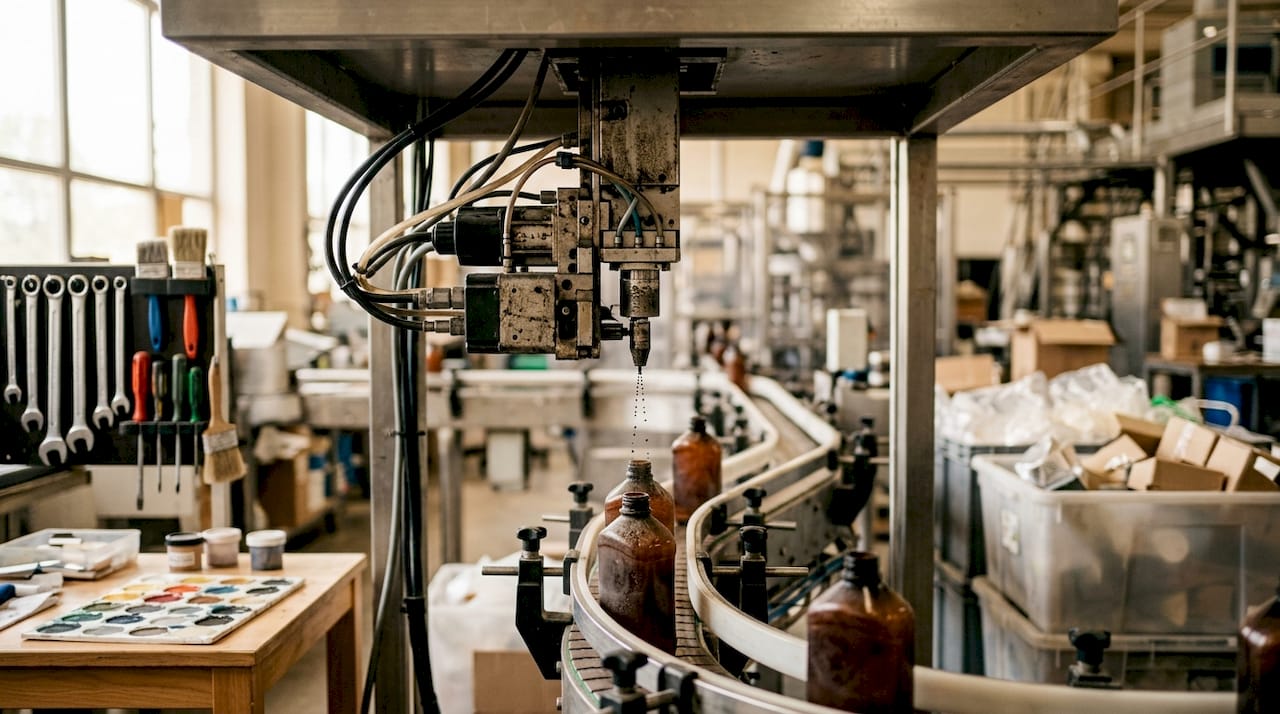
Continuous Inkjet printing is a non-contact technology that fires a continuous stream of charged ink droplets onto a substrate. The press deflects droplets electrostatically to form characters, codes, and graphics without touching the surface. That non-contact design is what makes CIJ indispensable on lines running curved, uneven, or delicate materials.
CIJ handles a wide range of substrates with no mechanical pressure involved:
- Glass bottles and beverage cans
- Flexible films and foil pouches
- Eggs and food-grade surfaces
- Plastic pipes and metal components
CIJ reaches speeds up to 600 m/min, making it the fastest marking option in most industrial environments. That throughput advantage means a single CIJ unit can keep pace with the fastest filling and packaging lines without becoming a bottleneck.
The tradeoff is print resolution. CIJ typically produces lower-resolution output than TTO or laser systems, so it works best for date codes, batch numbers, and barcodes rather than fine-detail graphics. Ink consumption and solvent management also add to operating costs, particularly in regulated environments.
Pro Tip: Run a substrate audit before specifying a CIJ unit. If your line handles more than three different surface types, CIJ’s substrate versatility often justifies the ink management overhead.
2. How does Thermal Transfer Overprint (TTO) stand out for flexible packaging?
Thermal Transfer Overprint is a contact printing method that uses a heated printhead to transfer ink from a ribbon onto a flat film substrate. The ribbon melts precisely where heat is applied, depositing clean, sharp marks directly onto the packaging material. TTO is the preferred coding method for flexible packaging lines.
TTO delivers 300–600 dpi resolution on materials like:
- Stand-up pouches and sachets
- Flow-wrap films and lidding stock
- Laminated foil packaging
- Pillow bags and stick packs
That resolution range produces legible barcodes, QR codes, and small-font regulatory text that CIJ cannot match on film substrates. The output quality also stays consistent across long production runs because ribbon consumption is predictable and controllable.
TTO wins on ink cost too. TTO provides the cleanest marks at low ink cost on flexible materials, which reduces waste and lowers per-unit coding expense compared to solvent-based inkjet systems. Understanding transfer film technology helps explain why ribbon-based systems deliver such consistent results on film substrates.
Pro Tip: Match ribbon grade to your film type. A mismatch between ribbon chemistry and substrate coating is the leading cause of smearing and adhesion failures on TTO lines.
3. What are flexographic printing presses and their industrial strengths?
Flexographic printing is a rotary press technology that uses flexible photopolymer plates mounted on cylinders to transfer ink onto a substrate at high speed. Modern flexo presses are a long way from the basic aniline printing of the mid-20th century. Triple-servo drive systems now give press operators precise, repeatable control over every print unit.
Triple-servo sleeve presses achieve ±0.15 mm registration precision at throughput speeds up to 200 m/min. That level of accuracy matters on multi-color label and packaging jobs where color misregistration is visible to the naked eye. Flexo’s combination of speed and color accuracy makes it the dominant technology for long-run label production.
Flexographic presses handle a broad substrate range:
- Paper and board labels
- Flexible film packaging
- Corrugated liners
- Specialty coatings and metallized films
Modular flexo press designs support inline finishing options including foiling, embossing, lamination, and die-cutting. That modularity protects your capital investment. As production needs change, you add units rather than replace the entire press.
Pro Tip: Evaluate sleeve-based plate mounting over conventional plate mounting when specifying a new flexo press. Sleeve systems cut job changeover time significantly on high-mix production schedules.
Flexographic press performance at a glance
| Feature | Specification |
|---|---|
| Registration precision | ±0.15 mm |
| Maximum speed | Up to 200 m/min |
| Typical substrates | Film, paper, board, metallized |
| Inline finishing options | Foiling, embossing, lamination, die-cutting |
4. How are digital flatbed and roll-to-roll printers transforming industrial printing?
Digital flatbed and roll-to-roll printers apply ink directly from a digital file without plates or screens. Flatbed units print on rigid substrates up to several inches thick. Roll-to-roll systems handle continuous flexible materials including textiles, vinyl, and technical films. Both formats eliminate plate-making costs and make short runs economically viable.
Digital flatbed printers deliver productivity over 2,700 ft²/hour using vision-based distortion compensation technology. That compensation system reads substrate deformation in real time and adjusts the print path to maintain accuracy on materials that stretch or warp. The result is consistent output on technical textiles, membrane switches, and flexible electronics.
Digital printing also supports sustainability goals. Transitioning to digital methods like DTF eliminates pre-treatment steps and reduces material waste compared to screen-based processes. Pigment inks used in many industrial digital systems are water-based, which lowers VOC emissions and simplifies waste disposal. For a deeper look at eco-friendly digital printing practices, the case for digital over analog grows stronger as environmental regulations tighten.
The shift from analog to digital printing prioritizes setup speed, personalization, and waste reduction for high-mix production. That shift is most visible in apparel decoration, promotional products, and industrial component marking where run lengths are short and design variation is high.
Pro Tip: For fabric and flexible substrate applications, always specify a printer with active distortion compensation. Without it, print accuracy degrades as the material relaxes after feeding.
5. What advantages do laser printing technologies offer for permanent marking?
Laser printing systems use focused light energy to mark or engrave a substrate without ink. CO₂ lasers work on organic materials like paper, wood, and some plastics. Fiber lasers mark metals and hard plastics with high contrast. UV lasers handle sensitive materials including glass, ceramics, and certain pharmaceutical packaging where heat must be minimized.
Laser systems produce permanent, tamper-evident, biocompatible marks suited for regulated industries. Common applications include:
- Pharmaceutical UDI codes on blister packs and vials
- Automotive part serial numbers and VIN marks
- Medical device traceability codes
- Electronic component identification on PCBs
No ink means no consumable cost beyond the laser source itself. Maintenance requirements are low compared to inkjet systems, and there are no solvents, ribbons, or printheads to replace on a regular schedule. At scale, that operating cost advantage compounds significantly over the equipment lifecycle.
Laser systems also comply with ISO/IEC 15415 standards for DataMatrix code quality, which is a mandatory requirement in pharmaceutical and aerospace supply chains. The cold marking process used by UV lasers preserves heat-sensitive substrates without distortion or discoloration. For operations that need permanent, regulation-grade marks, laser is the only technology that meets all three requirements simultaneously: permanence, biocompatibility, and tamper evidence.
Key Takeaways
Selecting the right industrial printing machine depends on matching substrate type, production speed, and output quality requirements to the correct technology category.
| Point | Details |
|---|---|
| CIJ for high-speed diverse lines | CIJ handles curved and uneven surfaces at speeds up to 600 m/min. |
| TTO for flexible film coding | TTO delivers 300–600 dpi resolution with low ink cost on pouches and sachets. |
| Flexo for long-run multi-color jobs | Triple-servo flexo presses achieve ±0.15 mm registration at up to 200 m/min. |
| Digital for short runs and sustainability | Digital flatbed systems exceed 2,700 ft²/hour and reduce pre-treatment waste. |
| Laser for permanent regulated marks | CO₂, fiber, and UV lasers produce ISO/IEC 15415-compliant codes with no ink cost. |
Why equipment selection is more complex than most buyers expect
The conventional wisdom says buy the fastest machine your budget allows. I disagree with that framing entirely. Speed is the last variable you should optimize for. Substrate compatibility and total cost of ownership are the variables that determine whether a machine earns its place on your floor.
Total cost of ownership includes hidden costs like compressed air requirements, frequent servicing intervals, and ink consumption that can outweigh the purchase price within three years. A CIJ unit that looks affordable at acquisition can become expensive when you factor in solvent replenishment, printhead cleaning cycles, and the downtime cost of a blocked nozzle on a 600 m/min line.
Reliability and remote diagnostic tools separate industrial-grade equipment from commercial-grade equipment in harsh environments. If your facility runs 24/7 and your printer cannot self-diagnose a developing fault before it causes a line stoppage, you are paying for a machine that is not truly industrial. Ask vendors for mean time between failures data, not just maximum speed specs.
Modularity is the third factor most buyers underweight. A press that accepts additional print units, drying systems, or finishing modules protects your investment as production needs evolve. Buying a fixed-configuration machine to solve today’s problem often means buying a second machine in four years to solve tomorrow’s problem. The garment printing trends shaping 2026 show the same pattern: the operations that scale well are the ones that built flexibility into their equipment choices from the start.
— Anthony
Transferkingz: custom DTF printing for production shops
Print shops and manufacturers that need high-quality custom transfers without the overhead of running their own industrial digital press have a direct solution in Transferkingz.
Transferkingz specializes in Direct-to-Film (DTF) transfer printing, producing vibrant, durable designs on textiles and hard goods with no minimum order requirement. You upload artwork, configure your gang sheet, and receive production-ready transfers with fast turnaround. For operations in the region, DTF printing in Dallas gives local print shops access to premium DTF output without capital investment in equipment. Transferkingz also covers the broader Texas DTF market for shops outside the Dallas metro. The best practices for digital printing resource on the Transferkingz blog covers how to get the most from DTF transfers in a production environment.
FAQ
What is the fastest type of industrial printing equipment?
Continuous Inkjet (CIJ) is the fastest industrial printing technology, reaching speeds up to 600 meters per minute. It is the standard choice for high-speed beverage, food, and pharmaceutical coding lines.
Which industrial printer works best on flexible packaging?
Thermal Transfer Overprint (TTO) is the preferred method for flexible packaging. It delivers 300–600 dpi resolution on pouches, sachets, and flow-wrap films at low ink cost.
What does ISO/IEC 15415 compliance mean for industrial printers?
ISO/IEC 15415 is the international standard for 2D barcode print quality verification. Laser printing systems that meet this standard produce DataMatrix codes accepted in pharmaceutical, aerospace, and medical device supply chains.
When does digital printing outperform flexographic printing?
Digital printing outperforms flexo on short runs, high-mix jobs, and applications requiring personalization. Flexo remains more cost-effective for long, single-design runs where plate amortization cost per unit is low.
What is total cost of ownership for industrial printers?
Total cost of ownership covers purchase price plus ongoing expenses including ink, ribbons, maintenance, compressed air, and downtime costs. These hidden operational costs often exceed the initial equipment price over a three-year period.
0 comments