

TL;DR:
- Understanding film types requires analyzing both narrative genre and production format to clarify a film’s story conventions and technical style. Recognizing genre as a psychological contract shapes audience expectations, while format describes how a film is made, and style connects the two through cinematic choices. Combining these axes enhances film analysis, helps avoid confusion, and fosters deeper appreciation of hybrid and evolving film languages.
Film types are defined by two distinct classification axes: narrative genre, which organizes films by story conventions and emotional tone, and production format, which categorizes them by technical method and presentation style. Understanding film types through this dual framework, rather than treating genre as the only organizing system, is what separates casual viewers from sharp analysts and confident filmmakers. A thriller and a documentary can share the same subject matter, yet they belong to entirely different categories. Recognizing that distinction is the foundation of serious film literacy.
What understanding film types really means
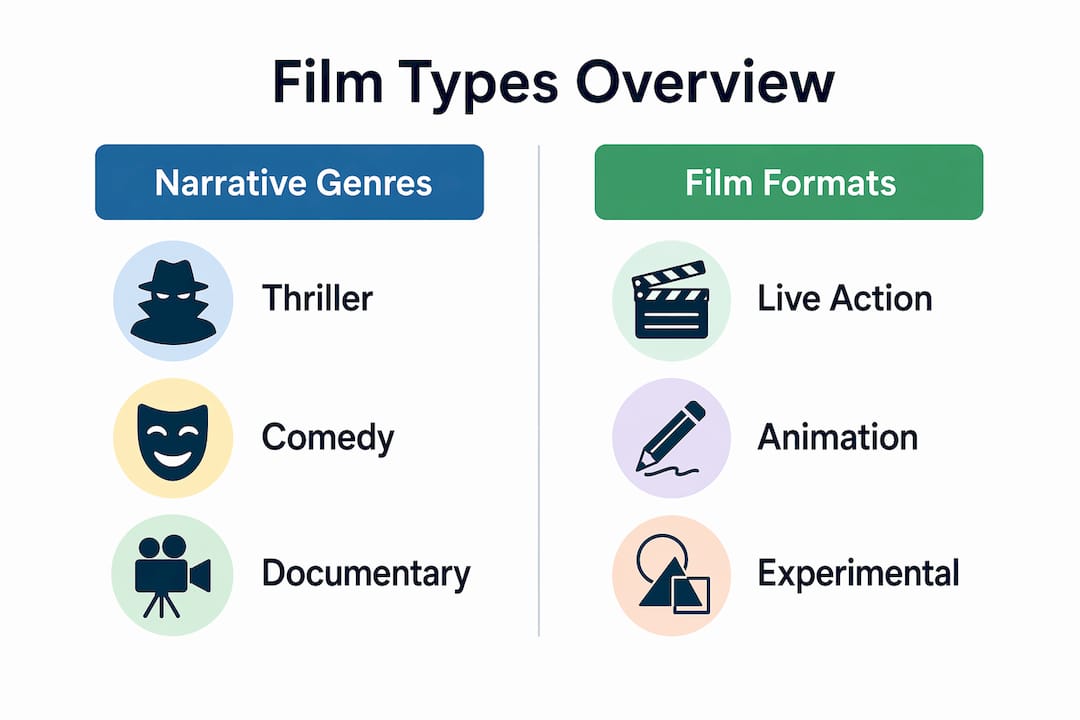
Films are classified along two primary axes: format and production type (documentaries, animated films, experimental works) and narrative genre (westerns, comedies, musicals). Most people conflate these two systems, which creates confusion when trying to analyze or discuss cinema with any precision. A documentary is not a genre in the same sense that horror is a genre. One describes how a film was made and presented; the other describes the story conventions it uses.

Think of it this way: Se7en (1995) is a thriller by genre and a live-action feature film by format. Waltz with Bashir (2008) is a war film by genre and an animated documentary by format. Both axes carry meaning, and both are necessary for a complete picture. Classifying films by both axes reduces confusion and improves clarity for enthusiasts and creators alike. This two-axis model is the core insight that makes everything else in film studies click into place.
What are the main narrative genres and how do they shape audience expectations?
Genre is less a fixed label and more a repeatable psychological contract that generates specific audience expectations before a single frame plays. When you sit down to watch a horror film, you arrive with a set of anticipations: dread, suspense, threat, and likely some form of confrontation with death or the unknown. The filmmaker’s job is to manage those expectations, fulfill them, subvert them, or both.
Common film genres include action, mystery, thriller, comedy, drama, horror, musical, animation, and documentary. Each genre signals expected story patterns and moods, creating that psychological contract with the audience. Here is how the major genres define themselves through narrative conventions:
- Action: Physical conflict, high stakes, and momentum-driven plotting. Think chase sequences, fight choreography, and a protagonist who solves problems through force or skill.
- Comedy: Incongruity, social inversion, and resolution through laughter. Comedies often expose the gap between how people present themselves and how they actually behave.
- Drama: Character-driven conflict, emotional realism, and moral complexity. Drama is the broadest genre and frequently bleeds into others.
- Thriller: Suspense, escalating danger, and a protagonist under pressure. The thriller relies on information asymmetry: the audience often knows more than the character, which generates tension.
- Horror: Fear as the primary emotional target. Horror uses threat, dread, and the violation of safety to provoke visceral responses.
- Science fiction: Speculative technology or science as the engine of the story world. Sci-fi uses imagined futures or alternate realities to interrogate present anxieties.
- Documentary: Real-world subjects presented through non-fiction filmmaking. This is where genre and format begin to overlap, which is why the two-axis model matters.
- Musical: Story told partly through song and choreography, where emotional peaks are externalized through performance.
Genre iconography acts as visual shorthand to communicate genre instantly. Revolvers and desert landscapes signal a Western. Trench coats and rain-slicked streets signal noir. Spaceships and alien vistas signal sci-fi. These visual codes are so deeply embedded in film culture that a single image can set audience expectations before any story information is delivered.
Pro Tip: When analyzing a film’s genre, ask which genre conventions the film prioritizes rather than forcing it into a single category. Most films blend elements from two or three genres, and identifying the dominant conventions tells you more than a single label ever could.
How do film formats and production types differentiate films beyond genres?
Format refers to the technical and presentational method used to create and deliver a film. Two films can share the same genre while existing in completely different format categories, and understanding this distinction sharpens both analysis and production decisions.
| Format category | Definition | Example |
|---|---|---|
| Live action | Filmed with real actors and physical environments using a camera | The Dark Knight (2008) |
| Animation | Images created frame by frame through drawing, CGI, or stop motion | Spirited Away (2001) |
| Documentary | Non-fiction footage presenting real events, people, or subjects | Searching for Sugar Man (2012) |
| Experimental / avant-garde | Non-narrative work prioritizing visual or conceptual exploration over story | Un Chien Andalou (1929) |
| Silent film | Films produced without synchronized dialogue, relying on title cards and visual performance | Metropolis (1927) |
| Short film | Typically under 40 minutes; a format defined by length rather than story type | La Jetée (1962) |
| Feature film | Standard theatrical length, generally 70 minutes or longer | Parasite (2019) |
Technical factors also define format in ways that matter to filmmakers. Film stock versus digital capture produces measurably different visual textures. Analog film grain carries a warmth and imperfection that digital sensors replicate only with deliberate effort. Sound synchronization, aspect ratio, and frame rate all contribute to the format identity of a film. A film shot on 16mm black-and-white stock communicates something different from the same story shot on 4K digital, even if the script is identical.
Length-based categories add another layer. Short films, feature films, and serials each impose different structural demands on storytelling. A 12-minute short cannot afford a three-act structure in the traditional sense. A serial, like the original Flash Gordon chapters from the 1930s, builds suspense across installments in ways a standalone feature cannot. Format shapes what stories are even possible to tell.
How do film styles interact with genre and format?
Film style refers to technique patterns across mise-en-scène, cinematography, editing, and sound. Style is distinct from genre, which is story-based, and from format, which is production-based. A film’s style is the sum of its recurring technical choices, and those choices shape mood and viewer perception at every moment.
Film form is the narrative system organizing the whole movie, while film style is the moment-to-moment pattern of cinematic techniques. Effective film analysis links style patterns to form functions like setup, payoff, or delay. When David Fincher uses desaturated color grading, shallow focus, and precise symmetrical framing in Se7en, those choices are not decorative. They build a world that feels procedural, cold, and inescapable, which is exactly what the thriller’s narrative requires.
Several major film styles recur across cinema history:
- Film noir: Low-key lighting, deep shadows, morally ambiguous protagonists, and fatalistic tone. Noir is a style that frequently appears in crime thrillers but is not limited to them.
- German Expressionism: Distorted sets, extreme angles, and exaggerated performances to externalize psychological states. The Cabinet of Dr. Caligari (1920) is the defining example.
- Italian Neorealism: Non-professional actors, location shooting, and naturalistic storytelling. Directors like Vittorio De Sica used this style to document postwar poverty with documentary-like honesty.
- Cinéma vérité: Handheld cameras, natural lighting, and minimal scripting to create an observational, fly-on-the-wall feel.
- Maximalism: Dense visual compositions, rapid editing, and layered sound design. Directors like Baz Luhrmann use this style to create sensory overload as an emotional strategy.
Films in the same genre can use widely different styles, and styles can cross multiple genres. Both Get Out (2017) and The Shining (1980) are horror films, but their styles are completely different. Get Out uses clean, precise framing to create unease through normalcy. The Shining uses Steadicam glides and geometric symmetry to make familiar spaces feel wrong. Genre sets the expectation; style delivers the experience.
Pro Tip: When developing a film project, choose your style before you choose your visual references. Knowing whether you want a neorealist or expressionist approach will guide every decision from casting to color grading, and it will keep your creative team aligned from day one.
How can combining genre, format, and style improve film appreciation and production?
Using all three axes together produces the clearest picture of what a film is and how it works. Here is a practical framework for applying this to both analysis and production:
- Identify the primary genre. Ask which narrative conventions dominate. Is the story organized around suspense, laughter, emotional catharsis, or spectacle? Name the dominant genre and note any secondary genre elements.
- Identify the format. Is this live action or animated? Feature length or short? Documentary or fiction? These answers tell you how the film was made and what structural constraints shaped it.
- Identify the style. Look at the cinematography, editing rhythm, color palette, and sound design. Do these choices feel naturalistic or heightened? Sparse or dense? Match the style to known movements or describe it in technical terms.
- Map the interactions. Ask how the style serves the genre. Does the format create any limitations or opportunities that the style compensates for? A low-budget horror film might use handheld camera not just for style but because it is cheaper, and the resulting aesthetic actually amplifies the genre’s tension.
- Recognize hybrids. Hybrid and genre-bending films challenge fixed genre definitions by blending conventions and styles, requiring flexible classification. Parasite is simultaneously a dark comedy, a thriller, and a social drama. Forcing it into one category loses critical information about how it works.
A common pitfall is confusing format with genre. Calling animation a genre is one of the most frequent misclassifications in casual film discussion. Animation is a production format. An animated film can be a comedy (Toy Story), a horror film (Coraline), a war drama (Grave of the Fireflies), or a documentary (Waltz with Bashir). The format tells you nothing about the story conventions. Keeping these axes separate prevents that confusion and makes film genre classifications far more useful as analytical tools.
Key takeaways
Mastering film types requires two classification axes: narrative genre for story conventions and production format for technical method, with style as the layer that connects both to viewer experience.
| Point | Details |
|---|---|
| Genre is a psychological contract | Genres signal expected story patterns and moods, creating audience anticipation before the film begins. |
| Format is production-based | Live action, animation, documentary, and short film describe how a film was made, not what story it tells. |
| Style operates across both axes | Technique choices in cinematography, editing, and sound shape mood and can appear in any genre or format. |
| Hybrids require flexible thinking | Most films blend genre conventions; asking which conventions dominate is more precise than forcing a single label. |
| Two-axis classification prevents confusion | Separating format from genre enables clearer film analysis and more deliberate production decisions. |
Why rigid genre labels are the enemy of real film literacy
Genre labels are useful until they become cages. I have spent years watching students and enthusiasts argue about whether a film “counts” as horror or thriller, as if the answer changes what the film actually does to an audience. It does not. The more productive question is always: what conventions is this film using, and what is it doing with them?
Genre functions as a living cultural mirror, reflecting societal anxieties and values that evolve over time. The horror films of the 1950s were processing nuclear anxiety. The horror films of the 2010s, from Get Out to Hereditary, are processing racial trauma, grief, and institutional failure. The genre label stayed the same. The cultural content shifted completely. That is what makes genre study genuinely interesting rather than just taxonomic.
Format innovations are expanding what film types even exist. Virtual reality cinema, interactive documentaries like Bandersnatch, and AI-assisted animation are creating categories that did not exist a decade ago. The two-axis model holds up because it is built on principles rather than a fixed list of categories. When a new format emerges, you add it to the format axis. When a new genre convention solidifies, you add it to the genre axis. The framework scales.
My advice to filmmakers: do not start with genre. Start with the emotional experience you want to create, then find the genre conventions that serve it and the style that delivers it. The label comes last, and honestly, it matters least.
— Anthony
Bring your creative vision to life with Transferkingz
Understanding how different film types work is the foundation of any creative project, and the same principle applies to custom printing. Just as choosing the right film format shapes the final cinematic result, selecting the right transfer film determines the quality, durability, and vibrancy of your printed designs. Transferkingz specializes in premium DTF transfers that deliver sharp, full-color results on virtually any textile. Whether you are a small business producing branded apparel or a hobbyist bringing original artwork to life, Transferkingz offers fast turnaround, no minimums, and film materials built for detail. The right film type makes all the difference.
FAQ
What is the difference between film genre and film format?
Genre classifies films by narrative conventions and emotional tone, such as horror, comedy, or thriller. Format classifies films by production method and presentation style, such as animation, documentary, or live action.
How do you identify a film’s genre?
Identify which narrative conventions dominate the story: the source of conflict, the emotional target, and the visual iconography. Most films blend elements from multiple genres, so naming the primary and secondary conventions is more precise than a single label.
Is animation a genre or a format?
Animation is a production format, not a genre. An animated film can belong to any narrative genre, including horror, drama, comedy, or documentary, depending on its story conventions.
What is film style and why does it matter?
Film style is the pattern of recurring technique choices across cinematography, editing, sound, and mise-en-scène. Style shapes the moment-to-moment emotional experience of a film and can appear across multiple genres and formats.
Why do some films resist easy genre classification?
Hybrid films blend genre conventions from multiple categories, making single-label classification imprecise. Analyzing which conventions a film prioritizes, rather than forcing one label, produces more accurate and useful results.
Recommended
- What Is Film in DTF? The Key to Vibrant Custom Prints – Transfer Kingz
- Where to Buy Top-Quality DTF Supplies USA: Your Guide to the Best Dire – Transfer Kingz
- Where to Buy Top-Quality DTF Supplies USA: Your Guide to the Best Dire – Transfer Kingz
- 7 Essential DTF Transfer Material Types Explained – Transfer Kingz
0 comments