

How heat transfer mechanisms shape window thermal performance
Windows account for roughly one-third of winter heat loss in a typical American home, and in larger homes that figure can reach 19% of total heating load. That single fact explains why understanding heat transfer through windows is not an academic exercise. It directly determines your energy bills, your HVAC sizing, and whether the room next to a glass wall stays comfortable in January.
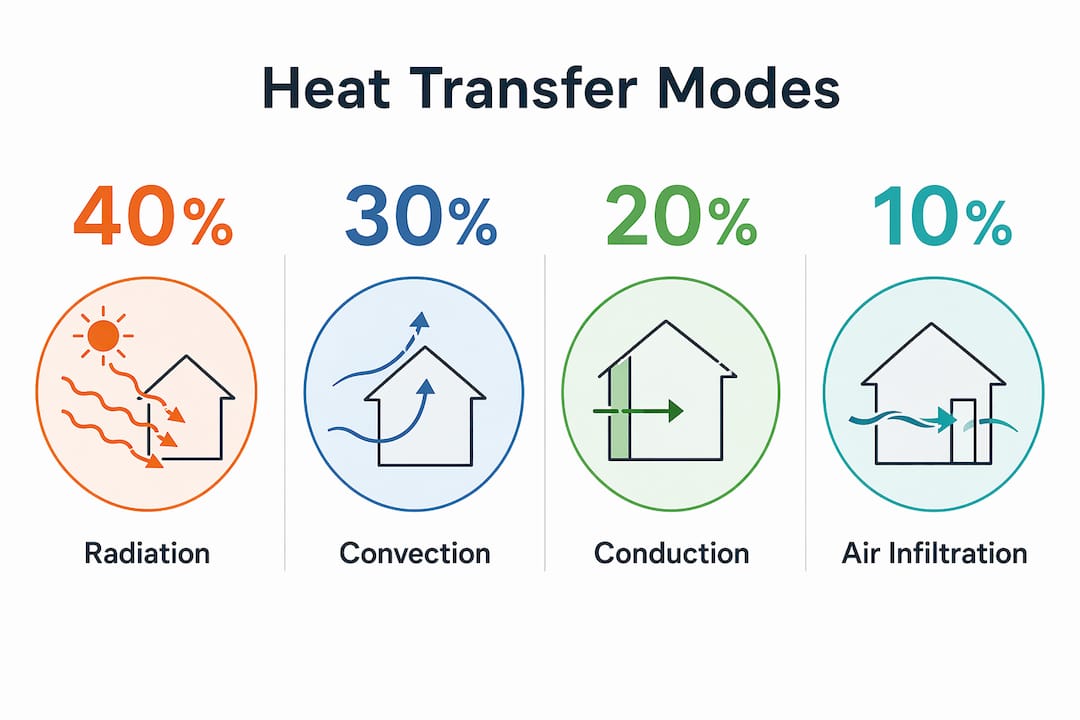
Four distinct mechanisms drive heat flow through any window assembly:
- Conduction: Heat moves through solid material from the warm side to the cool side. In a window, this means heat traveling through the glass pane itself, and critically, through the frame. Glass conducts heat relatively well; aluminum frames conduct it even better, which is why thermally broken frames matter so much.
- Convection: Moving air carries heat. This happens on both surfaces of the glass (indoor and outdoor air currents) and inside the gap of a double-pane or triple-pane unit, where air or gas between the panes circulates and transfers heat across the cavity.
- Radiation: Every surface emits infrared radiation proportional to the fourth power of its absolute temperature, following the Stefan-Boltzmann Law. Glass surfaces exchange long-wave infrared radiation with surrounding surfaces, and solar short-wave radiation passes through the glazing as direct solar heat gain.
- Air leakage: Gaps at the perimeter, around the frame, or through the sash allow conditioned air to escape and outdoor air to infiltrate. This is not modeled by the U-factor alone, yet it often dominates real-world heat loss in poorly installed or aged windows.
Two metrics capture most of what you need to know about thermal performance of windows: the U-factor, which measures heat transfer per unit area per degree of temperature difference (Btu/h·ft²·°F), and the Solar Heat Gain Coefficient (SHGC), which is the fraction of incident solar radiation that enters the building as heat. Lower U-factor means better insulation. SHGC is climate-dependent: you want it higher in cold climates to capture free solar heating, and lower in hot climates to block unwanted gain.
How thermal modeling captures heat flow through window assemblies
Modeling heat transfer in a window is not as simple as treating the assembly as a single slab of material. Engineers divide the window into three distinct regions, each with its own thermal behavior: the center-of-glass, the edge-of-glass, and the frame. The whole-window U-factor is then an area-weighted average of those three values, a calculation that consistently produces a higher (worse) number than the center-of-glass U-factor alone.
The standard analytical framework is the thermal resistance network model. Each mode of heat transfer gets represented as a resistance in the circuit. Conduction through the glass sits between the two glass surface temperatures. On each surface, convective and radiative resistances run in parallel, connecting the glass surface to the surrounding air. Solving the network gives you the total heat flux per unit area, and from that, the U-factor. The resistance network approach handles conduction, convection, and radiation simultaneously, which is what makes it the foundation of every major window simulation tool.
“For most practical purposes, the U-VALUE and the SOLAR HEAT GAIN COEFFICIENT help to characterize a window’s energy efficiency, and the comfort it might add to a room.” — Lawrence Berkeley National Laboratory, Windows 101
One complication: radiative heat transfer is nonlinear. It scales with the fourth power of absolute temperature, not linearly with temperature difference. Simulation tools handle this by using linearized radiation heat transfer coefficients for single-iteration calculations, then iterating until the solution converges. The TARCOG module used in WINDOW 6 software, for example, sets up a system of 4n nonlinear equations for an n-layer glazing system and solves them iteratively, checking convergence at each glazing layer surface temperature.
Energy-active window models add another layer. These include electrochromic glazing, phase-change materials, and building-integrated photovoltaic glazing, all of which have thermal properties that change with operating state. Modeling them requires coupling the optical and thermal calculations, because the SHGC and even the U-factor shift depending on tint state or temperature. Validation against empirical measurements is non-negotiable for these models; the ASHRAE Handbook fenestration chapter and ISO 15099 both provide standardized boundary conditions that allow measured data to be compared against simulation outputs on a consistent basis.
Edge-of-glass and frame regions deserve separate treatment because thermal bridging through spacers and frame materials creates temperature gradients that differ sharply from center-of-glass conditions. A standard aluminum spacer, for instance, creates a cold strip along the inner glass edge in winter, which can cause condensation and localized discomfort even when the center-of-glass performance looks acceptable on paper.
What THERM software does for window heat transfer analysis
THERM uses finite-element methods to model 2D conduction and radiation heat transfer in cross-sections of window components. Where the resistance network model treats each region as a lumped parameter, THERM resolves the full spatial temperature distribution across a frame cross-section, a spacer, or a sill detail. That spatial resolution is what makes it the industry standard for calculating edge-of-glass and frame U-factors.
Key capabilities of THERM include:
- 2D finite-element conduction analysis across any cross-sectional geometry, including complex frame profiles with thermal breaks, cavities, and multiple materials
- Radiation modeling within frame cavities using view-factor calculations between surfaces
- Automatic mesh generation that refines around high-gradient regions like metal-to-polymer interfaces
- Integration with WINDOW software so that frame and edge U-factors calculated in THERM feed directly into whole-window U-factor calculations
- NFRC compliance outputs formatted for submission to the National Fenestration Rating Council certification process
- Moisture and transient modeling available in THERM 8, which extends the tool to condensation risk and time-varying boundary conditions
Pro Tip: THERM results are only as good as the material property inputs. Always verify the thermal conductivity values for frame polymers and thermal break materials against manufacturer data sheets rather than using generic defaults, since conductivity can vary by 20% or more across product families.
The THERM software suite is developed and maintained by Lawrence Berkeley National Laboratory and is available for free download. It runs on Windows operating systems and is used by window manufacturers, building scientists, and code compliance consultants across the United States. The companion WINDOW software handles the full glazing system calculation, including gas-filled cavities and coated surfaces, while OPTICS handles the spectral optical properties of glass coatings.
How conduction, convection, radiation, and air infiltration each drive building energy loads
Each mechanism contributes differently to the total heat load, and the relative importance of each shifts with climate, window design, and installation quality.
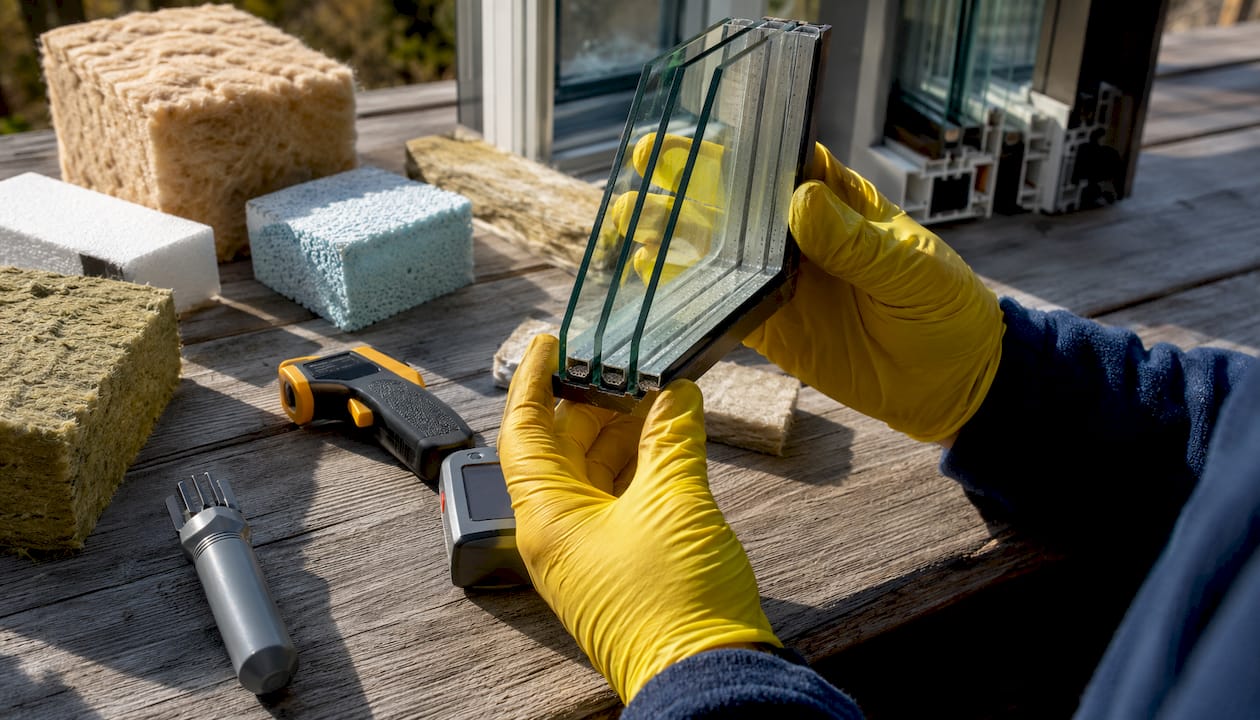
Conduction through the glass itself is actually a minor contributor in a well-designed double-pane unit. Glass is thin, and the thermal resistance of the gas gap dominates. Where conduction becomes a problem is at the frame and spacer, where metal components create direct thermal bridges from the warm interior to the cold exterior. Thermally broken aluminum frames interrupt this path with a polymer insert, but the break is never perfect.
Convection inside the gas cavity is the primary driver of center-of-glass U-factor in double and triple-pane windows. Air gaps work well up to about 13 mm; beyond that, convection currents develop inside the cavity and start carrying heat across it, offsetting the benefit of the wider gap. Argon and krypton fill gases suppress convection more effectively than air because of their lower thermal conductivity and higher viscosity, which is why gas-filled units consistently outperform air-filled ones at the same gap width.
The effect of outdoor wind speed on the exterior convection coefficient is direct and measurable. The TARCOG model calculates the outdoor convection coefficient as a function of wind speed near the glass surface, meaning a window’s effective U-factor in a windy location is higher than its rated value under standard test conditions.
Radiation accounts for a large share of heat transfer through clear single-pane glass. Low-emissivity (low-e) coatings address this directly. Applying a low-e coating to an interior glass surface cuts radiant heat transfer by roughly half, which explains why even a basic low-e double-pane window outperforms an uncoated double-pane unit by a wide margin.
Air leakage is the mechanism most often underestimated. The U-factor rating covers conduction, convection, and radiation, but it does not capture air infiltration through the window perimeter. In practice, air leakage through window perimeters can dominate real-world heat loss, particularly in older windows or units that were poorly installed. ENERGY STAR measures air leakage separately using ASTM E283, reported in cfm/ft².
The combined effect on occupant comfort goes beyond energy numbers. Cold glass surfaces in winter create radiant asymmetry, where a person sitting near a window loses body heat to the cold surface even when the air temperature is comfortable. This is why upgrading windows often improves perceived comfort more than the energy savings alone would suggest.
ENERGY STAR requirements and the metrics that define window thermal performance
The U-factor and SHGC are defined precisely in the ENERGY STAR framework. U-factor measures heat transfer per unit time per unit area per degree of temperature difference, in Btu/h·ft²·°F. Multiply it by the window area and the indoor-outdoor temperature difference and you get the total conductive-convective-radiative heat loss through the window. SHGC is dimensionless, ranging from 0 to 1, representing the fraction of incident solar radiation that enters the building.
ENERGY STAR Version 7.0 sets climate-zone-specific requirements for residential windows:
| Climate Zone | U-Factor (max) | SHGC |
|---|---|---|
| Northern | ≤0.22 | ≥0.17 |
| North-Central | ≤0.22 | ≤0.40 |
| South-Central | ≤0.28 | ≤0.23 |
| Southern | ≤0.32 | ≤0.23 |
The Northern zone demands the lowest U-factor because heating loads dominate, and it sets a minimum SHGC of 0.17 to preserve passive solar gain. The Southern and South-Central zones flip the priority: a higher U-factor is acceptable because the climate is milder in winter, but SHGC must stay at or below 0.23 to limit cooling loads. North-Central allows a wider SHGC range of up to 0.40, reflecting the mixed heating and cooling demands of that zone.
A few design considerations worth keeping in mind:
- Frame material matters as much as glazing. Fiberglass and wood frames have far better thermal resistance than aluminum, even with a thermal break. A high-performance glazing unit in a poor frame can underperform a modest glazing unit in a well-designed fiberglass frame.
- Spacer selection affects edge-of-glass performance. Warm-edge spacers made from polymer or stainless steel reduce the thermal bridge at the glass edge compared to standard aluminum spacers, improving both U-factor and condensation resistance.
- Low-e coating position matters. For heating-dominated climates, a low-e coating on surface 3 (the inner surface of the outer pane in a double-pane unit) reflects interior heat back inside. For cooling-dominated climates, a coating on surface 2 blocks solar near-infrared before it enters the cavity.
- Triple-pane glazing achieves U-factors below 0.20 by adding a third pane and two gas-filled cavities, but the added weight and cost make it most appropriate for the Northern climate zone.
The DOE Efficient New Homes program demonstrates how high-performance windows create design flexibility across the whole envelope. Installing windows that meet or exceed ENERGY STAR Version 7 specifications can allow reductions in ceiling insulation requirements, from R-49 down to R-22 in some climate zones, because the improved window performance reduces the overall thermal load the insulation must offset.
Practical steps for improving window thermal performance in your building
Selecting the right window product is only part of the job. How it gets installed, where it sits in the wall assembly, and how much glazing area you specify all determine whether the rated performance translates to real-world results.
Start with these fundamentals:
- Match the product to the climate zone. Use the ENERGY STAR climate zone map before specifying any window. A Northern-zone window in a Southern climate wastes money on insulation you do not need and may overheat the space.
- Minimize window-to-wall ratio where possible. Windows carry R-values of roughly 3–5 for a standard double-pane unit, while well-insulated walls reach R-13 to R-40. Every square foot of glass you add replaces insulation with a thermal penalty, so sizing glazing to daylighting and view needs rather than aesthetics alone pays off in energy performance.
- Seal the rough opening thoroughly. Spray foam or backer rod with sealant at the window-to-framing interface stops air infiltration that no product U-factor can compensate for.
- Use warm-edge spacers. They reduce condensation risk and improve the edge-of-glass contribution to the whole-window U-factor.
- Consider low-e coatings as the baseline, not an upgrade. In virtually every U.S. climate zone, a low-e coating is the single highest-value glazing feature per dollar spent.
Pro Tip: The gap between a window’s rated U-factor and its installed performance can be large. Proper flashing, continuous air barrier connection at the rough opening, and thermally broken installation clips all affect real-world performance in ways that product ratings do not capture.
Recent advances worth knowing about:
Dynamic glazing (electrochromic glass) changes tint state in response to an electrical signal, allowing SHGC to shift from roughly 0.09 to 0.36 depending on conditions. Electrochromic windows achieve a median energy savings of 7.2% in commercial buildings with window-to-wall ratios above 10%, compared to 4.3%–7.2% for static window retrofits. The ability to manage solar gain dynamically is particularly valuable in buildings with high glazing ratios, where a fixed low-SHGC coating would block useful winter solar gain.
Vacuum insulated glass (VIG) places a near-vacuum between two panes separated by tiny pillars, eliminating both conduction through a gas fill and convection entirely. The result is a unit roughly 6 mm thick with a center-of-glass U-factor approaching 0.10, comparable to a well-insulated wall. Commercial availability in the U.S. is still limited, but several manufacturers are scaling production.
Aerogel glazing fills the cavity with silica aerogel, a translucent material with extremely low thermal conductivity. It trades some visible light transmission for excellent insulation, making it useful for skylights and north-facing windows where solar gain is not the priority.
Case studies showing heat transfer principles across window types and climates
Real-world examples ground the theory and show where the performance gaps actually appear.
Cold climate: triple-pane windows in a Minnesota passive house
A passive house project in Minneapolis specified triple-pane fiberglass-framed windows with krypton fill and a U-factor of 0.18. The center-of-glass U-factor was 0.12, but the whole-window value rose to 0.18 after accounting for the frame and edge contributions, a pattern consistent with ASHRAE Handbook guidance that frame and edge regions consistently degrade whole-window performance relative to center-of-glass values. Interior surface temperatures on the glass stayed above the dew point even at outdoor temperatures of -20°F, eliminating condensation that had plagued the previous aluminum-framed double-pane units. Heating load calculations showed the window assembly contributing less than 15% of total envelope heat loss, a sharp improvement over the roughly one-third typical of standard double-pane windows in many homes.
Hot-humid climate: low-SHGC glazing in a Houston office building
A commercial retrofit in Houston replaced clear double-pane windows with a low-e unit carrying an SHGC of 0.22 and a U-factor of 0.28. The primary driver was cooling load reduction, not insulation. Post-retrofit energy monitoring showed peak cooling demand dropping noticeably during afternoon hours when west-facing glazing had previously driven the HVAC system to its limits. The building’s window-to-wall ratio was above 40%, which meant solar gain through the glass dominated the cooling load far more than conductive losses. This is a textbook case where SHGC selection matters more than U-factor in a hot climate.
Mixed climate: dynamic glazing in a California commercial building
A California office building with floor-to-ceiling south-facing glazing installed electrochromic windows to manage the competing demands of winter solar heating and summer cooling. In winter mornings, the glass stayed clear to admit solar gain and reduce heating demand. By midday in summer, the tint state shifted to its darkest setting, cutting solar heat gain by roughly 75% compared to the clear state. The ability to manage solar gain dynamically addressed a problem that no fixed coating could solve: the same window orientation that benefits from solar gain in December actively overheats the space in July.
Residential retrofit: air leakage as the dominant loss mechanism
A 1970s ranch house in Ohio had double-pane replacement windows with a rated U-factor of 0.30, yet occupants still reported drafts and high heating bills. An infrared camera survey during a blower door test revealed air infiltration at the window-to-wall interface on three windows where the installer had not sealed the rough opening. The air leakage was adding a heat loss equivalent to leaving a small window open continuously. Resealing the perimeters with low-expansion foam and interior trim caulk resolved the drafts and reduced heating energy use measurably, without replacing the windows. This case illustrates why installation quality is as consequential as product selection.
THERM analysis: aluminum vs. thermally broken frame
A building scientist used THERM to compare two curtain wall frame cross-sections: a standard aluminum frame and a thermally broken aluminum frame with a polyamide insert. The THERM model resolved the full 2D temperature distribution across both cross-sections under standard NFRC boundary conditions. The standard aluminum frame showed a frame U-factor of approximately 1.0 Btu/h·ft²·°F, with a cold strip extending several inches onto the interior glass surface. The thermally broken frame dropped the frame U-factor to roughly 0.40, and the interior surface temperature at the frame edge rose by several degrees, eliminating the condensation risk zone. The whole-window U-factor improvement was smaller than the frame-only numbers suggest, because the glazing area dominates the area weighting, but the comfort and moisture benefits were clear in the temperature distribution maps.

Key Takeaways
Windows are the weakest thermal link in the building envelope, and closing that gap requires matching the right glazing, frame, and installation practice to your specific climate zone.
| Point | Details |
|---|---|
| Four mechanisms drive heat loss | Conduction, convection, radiation, and air leakage each require separate design responses. |
| U-factor and SHGC are the core metrics | ENERGY STAR Version 7.0 sets U-factor limits from ≤0.22 to ≤0.32 and SHGC from 0.17 to 0.40 by climate zone. |
| THERM resolves frame and edge performance | Finite-element modeling in THERM captures thermal bridging that resistance network models cannot resolve. |
| Low-e coatings cut radiant transfer by half | Applying a low-e coating to an interior glass surface reduces radiant heat transfer by roughly half. |
| Installation quality determines real-world results | Air leakage at the rough opening can dominate heat loss regardless of the window’s rated U-factor. |
0 comments