

Expect to pay about $0.50 to $3.00 per print in raw consumables for a UV DTF decal, depending on size and ink coverage, according to Castle Ink’s cost breakdown. That range covers UV ink, AB transfer film, and laminate. It does not cover equipment, labor, or maintenance.
If you’re producing a few dozen decals a month, outsourcing almost always beats buying a printer. Once you’re consistently pushing several hundred or more decals monthly, the math starts favoring in-house production. Transfer Kingz is one option small businesses use to get predictable per-piece pricing without buying equipment at all.
- Consumables alone: $0.50 to $3.00 per decal
- Low volume (samples, small runs): outsource
- High, steady volume: in-house may pay off
- Either way: know your real per-print number before you set retail prices
Key Takeaways
Per-print UV DTF costs typically range from $0.50 to $3.00 in consumables, and the outsource-versus-buy decision comes down to whether your monthly volume justifies a $3,000 to $25,000 equipment investment.
| Point | Details |
|---|---|
| Know your per-print range | Budget $0.50 to $3.00 in consumables per decal, depending on size and coverage. |
| Track total cost monthly | Include ink, film, laminate, labor, and prorated maintenance, not just materials. |
| Match equipment tier to volume | Entry printers start near $3,000; industrial systems run $15,000 to $25,000 or more. |
| Batch to save on film | Gang-sheeting multiple designs cuts per-piece film cost significantly. |
| Outsource for low or unpredictable volume | Transfer Kingz offers no-minimum UV DTF orders with fixed per-piece pricing for samples and low-run production. |
Table of Contents
- Breaking Down UV DTF Decal Cost Per Print
- Equipment and Startup Costs for UV DTF Printing
- How to Calculate Your Cost Per Decal
- Should You Outsource UV DTF or Buy Equipment?
- Common Miscalculations in UV DTF Budgeting
- Getting Predictable UV DTF Pricing Without the Equipment Risk
- Sources
Breaking Down UV DTF Decal Cost Per Print
Your per-print price isn’t one number. It’s five or six smaller numbers stacked together, and most shop owners only track one or two of them.
UV ink runs $100 to $200 per liter, which sounds steep until you realize a liter typically covers 10 to 15 square meters. The catch is coverage density. A dense, full-color design with heavy white underbase eats ink far faster than a simple line-art logo, so two decals the same size can cost noticeably different amounts to produce.
AB transfer film and laminate get priced by area, so sticker size drives cost directly. A 2 inch logo sticker uses a fraction of the film a 6 inch tumbler wrap needs. Laminate adds a thin but real per-piece cost on top, since it’s what gives UV DTF decals their scratch resistance and gloss.
Then there’s the substrate itself if you’re outsourcing finished products rather than just transfers, plus packaging or finishing work.
Pro Tip: Prorate your labor. If it takes you 20 minutes to weed, apply, and package a batch of 30 decals, that’s 40 seconds of labor per piece. Multiply by your hourly rate and add it to your unit cost. Most small shops skip this and wonder why margins feel thin.
Don’t forget maintenance. Printheads and UV lamps wear down and need periodic replacement, and that expense should get spread across every print you make, not treated as a surprise repair bill.
- UV ink: $100–$200/liter, covering 10–15 sqm
- AB film and laminate: priced per square inch or meter, scales with decal size
- Labor: prorate minutes per piece, not per job
- Maintenance: amortize printhead and lamp costs into your per-unit price
Equipment and Startup Costs for UV DTF Printing
If you’re weighing whether to buy a UV DTF printer at all, the price bands vary more than most buying guides admit.
Entry-level desktop UV DTF printers fall within a lower price range. Mid-range machines are more expensive, suited for daily commercial use. Industrial systems designed for high-volume production cost significantly more, often substantially exceeding mid-range prices, according to Fujia Printer’s cost breakdown. The gap between tiers usually comes down to print speed, head durability, and how much unattended runtime the machine can handle.
Buying the printer is just the entry fee. You’ll also need a starter consumables bundle covering CMYK ink, white ink, and varnish, plus RIP software to drive the machine, a cleaning kit, and spare parts. Together, these typically add $300 to $1,200 to your initial outlay depending on scale, per Fujia Printer’s estimates.
A few line items get overlooked until the invoice arrives:
- Installation and setup, especially for industrial units that need electrical or ventilation work
- Operator training, which some manufacturers bundle and others charge separately
- Freight and shipping, which can run several hundred dollars for larger machines
To turn that capital outlay into a per-print number, divide your total equipment cost by the number of decals you realistically expect to produce over the machine’s useful life, then add that fraction to your consumables cost. A detailed guide to UV DTF decal production walks through how that math plays out for hard goods specifically.
How to Calculate Your Cost Per Decal
The formula is simple even if the inputs take some digging:
(Ink + film + laminate + substrate + prorated maintenance + labor + overhead) ÷ quantity produced
Here’s how that plays out across three common product types:
- Small logo sticker (2 inch, low coverage): Minimal ink and film usage keep this near the bottom of the range, often landing around $0.50 to $0.80 in raw production cost.
- Tumbler wrap (medium coverage, larger format): Higher film usage and denser color coverage push production cost to roughly $1.50, based on industry cost estimates.
- Phone case or full wrap (high coverage, precise fit): Despite the smaller surface than a tumbler, tight registration and heavier ink laydown put this around $1.20 in production cost.
Acrylic signs, which use more substrate and often more laminate for durability, run closer to $2.50 in production cost, per the same estimates.
Gang-sheeting multiple designs onto a single film run cuts your per-piece film cost meaningfully, since you’re spreading the setup and edge waste across more units. It’s the same logic bulk buyers use everywhere: batch it, and the math per unit improves.
Pro Tip: Run your actual numbers through this formula once a month, not once a year. Ink prices shift, film suppliers change pricing, and your “known” cost per decal can drift 20 to 30 cents without you noticing until margins feel off.
Should You Outsource UV DTF or Buy Equipment?
Run through this checklist before you commit either way:
- Check your monthly volume. Producing a few dozen decals a month rarely justifies the equipment spend. Several hundred or more per month starts tilting toward ownership.
- Check your space and operations. UV DTF printers need ventilation, a dedicated workspace, and someone trained to run and maintain them.
- Run a payback calculation. Amortizing equipment against expected monthly output is the practical way to estimate payback, and Fujia Printer’s analysis suggests 3 to 6 months is realistic when producing 30 or more items daily.
- Stress-test the numbers. Ink prices and demand both fluctuate. Model a slower month before you sign off on a $6,000 purchase.
- Operational readiness: ventilation, floor space, waste disposal
- Financial readiness: payback period, sensitivity to ink cost swings
- For single runs, sample batches, or unpredictable demand, ordering from a provider like Transfer Kingz avoids the capital risk entirely
For low and inconsistent volume, most makers find that ordering finished UV DTF decals from a print service is simpler and more cost-effective than managing a home setup.
Common Miscalculations in UV DTF Budgeting
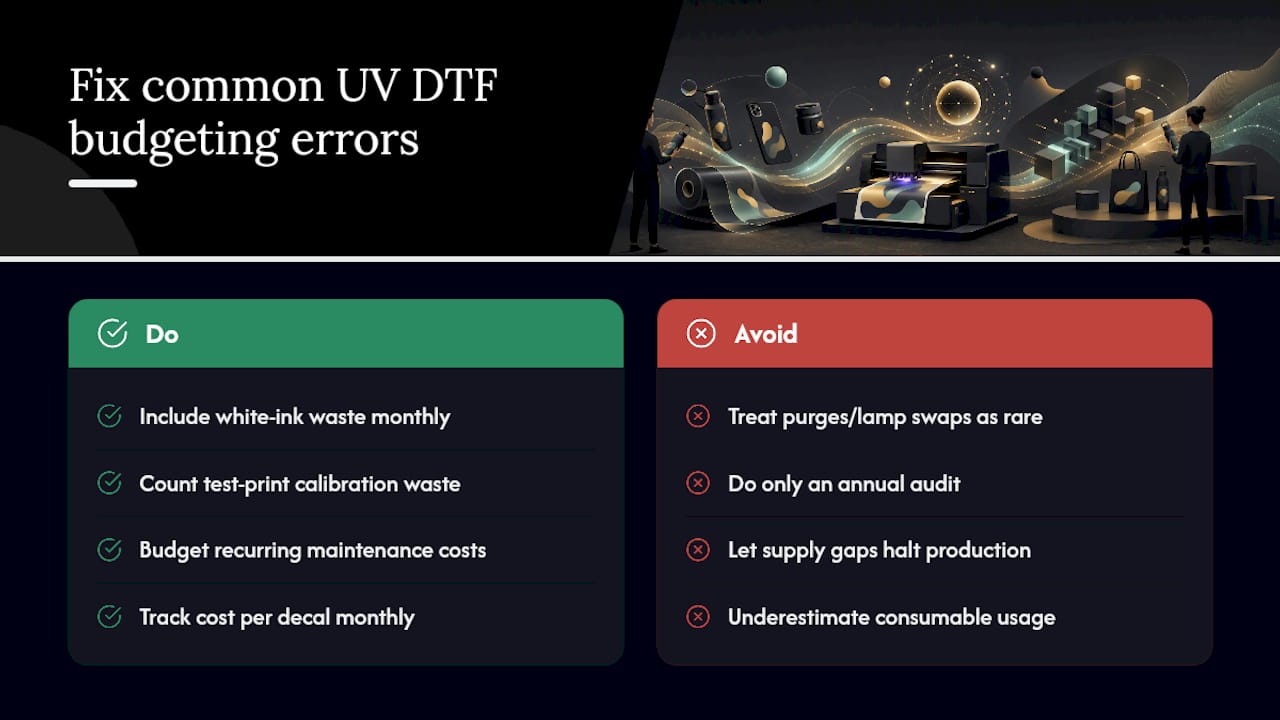
Small shops consistently underestimate three things: white-ink waste, test prints burned during calibration, and maintenance intervals that sneak up faster than expected. Printhead purges and lamp swaps aren’t rare events. They’re recurring costs that belong in your monthly total cost of ownership, not a surprise line item.
My honest advice: track your real cost per decal monthly, not annually, and keep a reorder buffer for film and ink so a supply gap doesn’t stall production. The shops that protect their margins are the ones that treat this as a spreadsheet habit, not a once-a-year audit.
— Anthony
Getting Predictable UV DTF Pricing Without the Equipment Risk
Transfer Kingz gives you a fixed, known cost per decal without the $3,000 to $25,000 equipment gamble this article just walked through. You upload your design, build your sheet, and pay for exactly what you order. No minimums, no idle machine between jobs, no maintenance fund to budget for.
That structure fits particularly well if you’re testing a new product line, filling a one-off customer order, or running seasonal batches where owning a printer would sit unused most of the year. Transfer Kingz produces UV DTF PermaStickers and transfers for cotton, polyester, glass, and acrylic, with a gang sheet builder that lets you combine multiple designs to cut waste the same way in-house batching does. Orders ship fast, with same-day local pickup available.
If you’re deciding between a capital purchase and a per-order cost you can actually predict, check the order and production details and get a quote on your next run before you commit to buying equipment.
Sources
- UV & UVDTF Printing Costs: Ink, Film & Equipment Breakdown – Castle Ink
- UV DTF Printer Price: 2025 Cost Breakdown
0 comments