

Cured UV DTF transfers are water-resistant enough for daily use on tumblers, bottles, and hard goods, once applied correctly. The two catches: substrate matters (glass and coated metal hold up better than porous or flexible surfaces), and repeated dishwasher cycles or heavy abrasion will wear down even a well-applied sticker faster than handwashing. Get the application right, and you’re covering the rest of what that means below.
TL;DR:
- UV DTF transfers are water-resistant on non-porous surfaces such as glass and coated metal, but repeated dishwasher cycles and heavy abrasion will reduce longevity.
- Proper application, including surface prep with alcohol and selecting the correct peel method, is crucial for achieving and maintaining water resistance.
- Testing methods like water submersion, soak, wash, and abrasion simulate real-world conditions to verify durability before mass production.
- Use protective clearcoats or laminates on products expected to face frequent washing or outdoor exposure to extend lifespan.
- Qualitative data shows actual UV DTF water resistance lasts between a few weeks to several months, depending on environmental stress and handling.
Table of Contents
- What Makes UV DTF Waterproof in the First Place
- How Waterproof Is UV DTF, Really?
- What Actually Determines Whether Your Sticker Stays Waterproof
- How Vendors Actually Test Waterproof Claims
- How to Apply UV DTF So It Actually Stays Waterproof
- Where UV DTF Fits and Where It Doesn’t
- Transfer Kingz’s Testing and Application Support
- The Real Bottom Line on UV DTF Waterproofing
- Order UV DTF Samples and Get Application Specs
- Sources
What Makes UV DTF Waterproof in the First Place
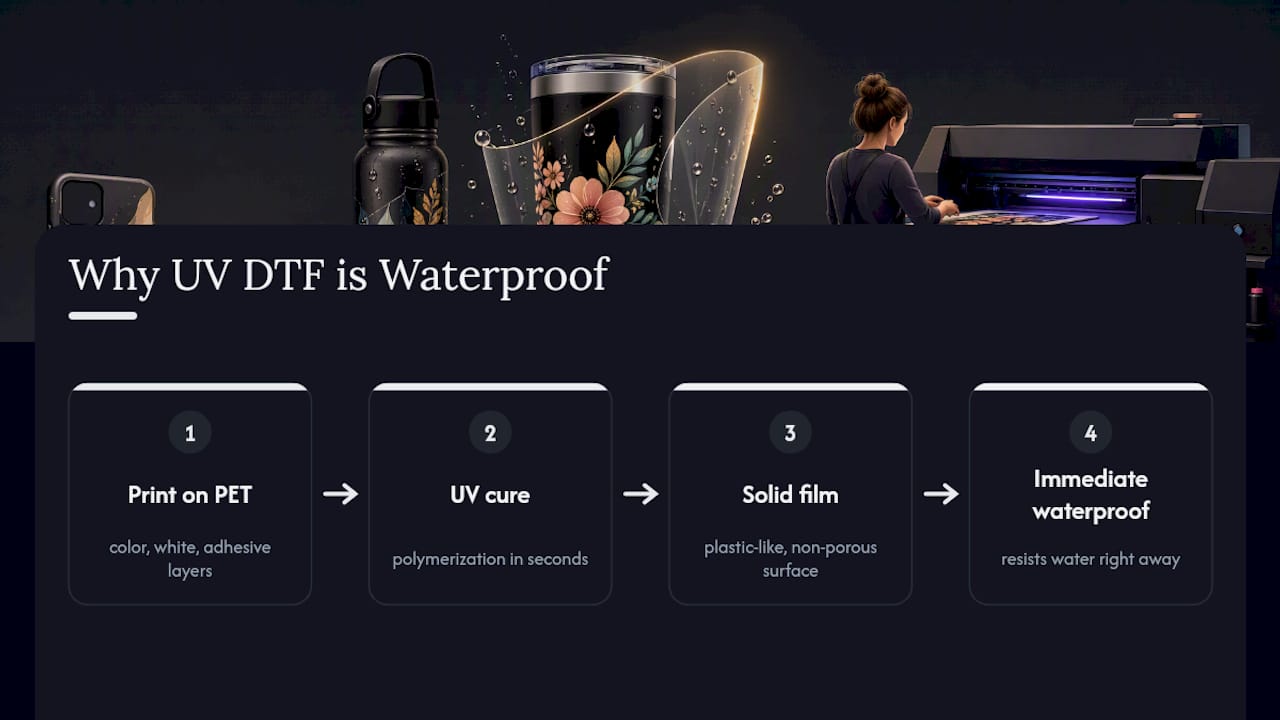
UV DTF starts as a print on PET film: a color layer, a white backing layer, then an adhesive coating instead of the powder adhesive used in standard DTF printing. What sets it apart is the ink itself. Standard DTF inks air-dry or heat-cure over time. UV inks cure instantly under ultraviolet light, triggering a chemical reaction called polymerization that hardens the ink into a solid plastic-like film within seconds.
That instant hardening is why UV DTF resists water almost immediately after printing, unlike solvent-based inks that stay slightly porous even after drying. UV ink forms a water-resistant surface the moment it cures, which is also why UV DTF handles glass, acrylic, and metal better than fabric-focused transfer methods do.
How Waterproof Is UV DTF, Really?
Vendor documentation and industry testing both point the same direction: cured UV DTF is genuinely water-resistant, not just marketing language. Print shop support pages describe UV DTF transfers as waterproof and weather-ready once fully applied, and they typically hold up fine on drinkware, laptops, and outdoor gear.
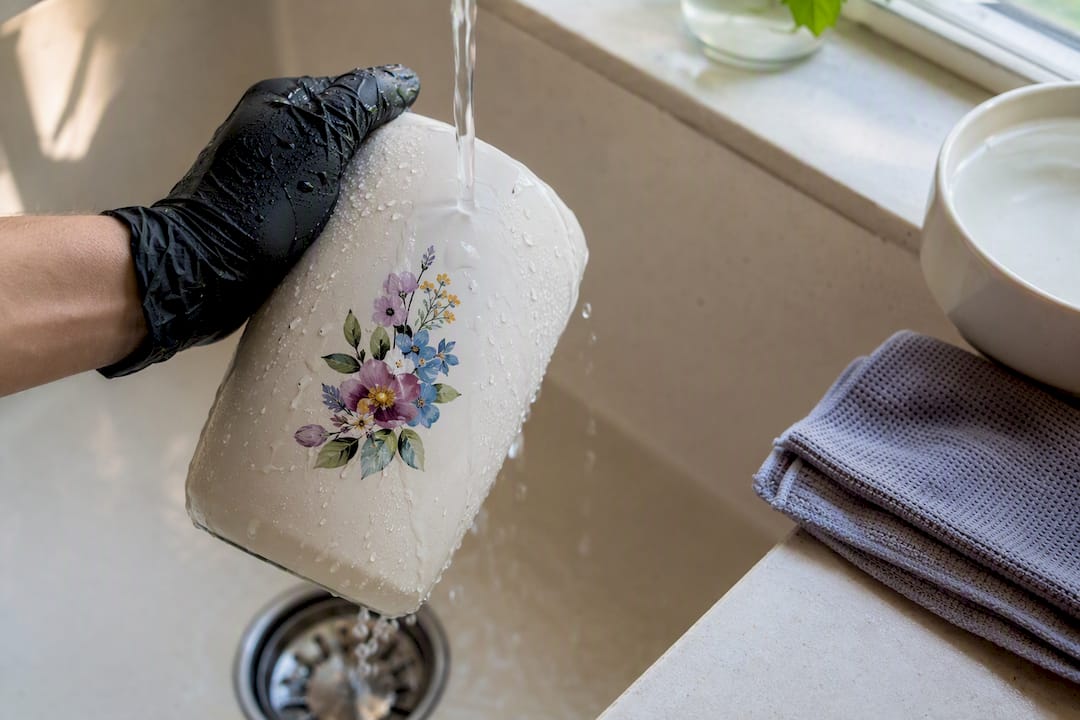
What “waterproof” actually covers: Cured UV ink resists splashes, rain, hand washing, and casual submersion (rinsing a tumbler under the tap, for instance). It does not mean indestructible.
The limits show up under sustained stress. Long-term outdoor exposure and physical abrasion remain the real threats to UV-printed surfaces, not water contact itself. A tumbler that sits in a dishwasher with harsh detergent, high heat, and a scrubbing action every day will degrade faster than one that gets hand-washed. Cheap dish sponges and gritty cleaners are harder on a UV DTF sticker than water ever will be.
For most small business owners selling tumblers, water bottles, or laptop decals, the realistic expectation is this: excellent water resistance for normal handling and hand washing, with some caution warranted if the end customer runs everything through a dishwasher on a daily basis. If dishwasher survival matters to your product line, that’s a conversation to have before you print at volume, not after a batch of customer complaints.
What Actually Determines Whether Your Sticker Stays Waterproof
Curing chemistry gets a UV DTF transfer most of the way to waterproof. What happens after that determines whether it stays that way for six months or six weeks.
- Surface type and finish. Smooth, non-porous surfaces (glass, powder-coated metal, acrylic) hold adhesive far better than matte plastics or anything with texture or micro-scratches.
- Surface prep. Wipe the application area with isopropyl alcohol before applying. Skipping this step is the single most common reason a sticker lifts at the edges within weeks.
- Adhesive and film quality. Not all UV DTF film is manufactured the same way. Adhesive-layer formulas have improved as DTF systems have matured industry-wide, but quality still varies between suppliers.
- Cure energy and timing. Under-cured ink stays tacky and vulnerable; properly cured ink is fully hardened before it ever reaches the customer.
- Protective clearcoats. A laminate or clearcoat adds a buffer against scratching and chemical exposure, particularly useful for products headed for rougher daily use.
- Environmental stress. Direct sun, temperature swings, and repeated flexing (on anything other than a rigid surface) all shorten a transfer’s working life.
Pro Tip: If a customer asks whether their tumbler can go in the dishwasher, the honest answer is “hand wash for best results.” Say it upfront. It prevents refund requests three weeks later.
How Vendors Actually Test Waterproof Claims
Most waterproof claims in this industry aren’t backed by lab certifications. They come from a handful of simple, repeatable tests that any small shop can run before committing to a design run.
- Running water test. Hold the applied sticker under a tap for 30 to 60 seconds and check for color bleed or edge separation.
- Soak test. Submerge the piece for several hours (some testers go 24 hours) and inspect for lifting, cloudiness, or ink transfer onto a paper towel.
- Repeated hand-wash simulation. Wash the item by hand with dish soap over several days and track whether adhesion or color holds steady.
- Dishwasher cycle test. Run it through a normal cycle two or three times to see how quickly, if at all, edges start to curl.
- Abrasion test. Rub the surface with a cloth or light scrubber to check how the surface film handles friction.
A pass means no bleeding, no lifting at the edges, and adhesion that feels the same as day one. A fail usually starts small, a slightly curled corner, before it spreads. Vendors touting durability across dozens of wash cycles are almost always describing hand-wash conditions, not daily dishwasher abuse.
How to Apply UV DTF So It Actually Stays Waterproof
Application technique determines more about long-term waterproofing than the ink itself. Most failures trace back to skipped prep, not bad film.
- Clean the surface with isopropyl alcohol and let it dry fully before applying anything. Skip this and you’re gambling on adhesion.
- Follow the film manufacturer’s press specs. DTF and UV DTF pressing generally falls in the a temperature range around the high 150s to low 170s °C (around 320 °F) for a short duration of several seconds (https://en.wikipedia.org/wiki/Direct-to-film_printing), though exact numbers vary by film.
- Check whether your film calls for a hot peel or cold peel. Peeling at the wrong stage is one of the fastest ways to wreck an otherwise solid application.
- Add a clearcoat or edge seal on products headed for heavy handling, outdoor use, or repeated washing.
- Store unused sheets flat, away from direct heat and humidity, so the adhesive layer doesn’t degrade before it’s ever applied.
Pro Tip: Press a test piece on scrap material from the same substrate batch before running a full order. Adhesive behaves differently on glossy versus matte finishes, and you want to know that before 200 units are printed, not after.
For a closer walkthrough of press settings and peel timing, Transferkingz’s application guide breaks down the process step by step.
Where UV DTF Fits and Where It Doesn’t
UV DTF earns its keep on rigid, smooth substrates: tumblers, water bottles, acrylic plaques, coated metal signage, laptop shells. These surfaces let the adhesive form a strong, even bond, which is exactly what waterproofing depends on.
It’s a worse fit for flexible apparel, heavily textured surfaces, or anything that flexes constantly (phone cases that get dropped and bent daily, for example). Fabric printing is still better served by standard DTF transfers built for stretch and wash cycles. For hard goods bound for daily dishwasher use, a clearcoat isn’t optional. It’s the difference between a sticker lasting a season and lasting a year.
Transfer Kingz’s Testing and Application Support
Transferkingz’s UV DTF sticker line is built specifically for waterproof, durable applications on hard goods, and the durability review walks through what that durability actually looks like under repeated use. A separate breakdown on why DTF holds up across roughly 50 washes at lower setup costs gives a concrete sense of expected lifespan before you commit to a full print run. If you’re unsure how a specific substrate will perform, requesting a sample sheet first beats guessing.
The Real Bottom Line on UV DTF Waterproofing
Cured UV DTF holds up to genuine water exposure. Order a sample sheet, run the soak and wash tests yourself, and get the vendor’s exact press specs before you commit to a production batch.
— Anthony
Order UV DTF Samples and Get Application Specs
Some suppliers offer UV DTF stickers intended for waterproof use cases such as tumblers, bottles, signage, and other hard goods requiring durable transfers for daily handling, not just lab tests. These suppliers may provide film specs and application notes for their products.
If you’re planning a production run, start with the Print Point resource page to see current product options and request a quote, or check the intricate print detail page if your design has fine linework that needs to survive the same wash-and-wear conditions. Ordering a small sample batch before a full run is the cheapest insurance you’ll find against a bad print job.
0 comments