

TL;DR:
- B2C printing involves selling personalized printed products directly to consumers through online platforms, emphasizing quick turnarounds and emotional appeal. Advanced technologies like DTF and sublimation enable small brands to produce durable, full-color merchandise without bulk orders, transforming independent creators’ businesses. Utilizing optimized workflows, design tools, and targeted marketing helps build sustainable, scalable merchandise operations in a competitive market.
If you’ve been wondering what is B2C printing and how it actually applies to selling custom merchandise, you’re not alone. The term sounds like business jargon, but the reality is straightforward. B2C printing means selling printed products directly to individual consumers, often through an online storefront, with no bulk order requirements. For independent designers, artists, and small business owners, this model has opened doors that screen printing and traditional production shops once kept firmly shut. This guide breaks down how it works, what technologies power it, and how to use it to your advantage.
Table of Contents
- Key takeaways
- What is B2C printing, exactly?
- Common B2C printing technologies
- B2C printing vs B2B printing
- Best practices for using B2C print services
- My honest take on B2C printing for creators
- Take your B2C printing further with Transferkingz
- FAQ
Key takeaways
| Point | Details |
|---|---|
| B2C printing definition | B2C printing means selling custom printed goods directly to individual consumers, not businesses or resellers. |
| DTF is the top tech for creators | Direct-to-Film printing removes setup costs and handles full-color, small-batch orders with durable results. |
| B2C differs from B2B in key ways | B2C focuses on personalization and speed, while B2B prioritizes volume, cost per unit, and brand consistency. |
| Resolution is a silent quality killer | Many print platforms default to low resolution on uploads, so always select “Full Resolution” manually. |
| Automation drives profitability | Linking your storefront to fulfillment workflows cuts errors and lets you scale without extra hands. |
What is B2C printing, exactly?
At its core, the B2C printing definition is simple. B2C transactions involve selling goods or services from a business directly to an individual consumer, bypassing any intermediary retailer or wholesale chain. Applied to printing, this means a customer visits a website, uploads their design or chooses a template, places an order, and receives a finished printed product. The entire process can take minutes to complete online.
What makes B2C printing distinct is who it serves and at what scale. The typical B2C print customer is not a corporation ordering 5,000 branded brochures. They are a wedding planner ordering 50 custom napkins, a musician selling 30 tour shirts, or a small boutique owner adding their logo to tote bags. Orders tend to be smaller in quantity and faster in expectation, with customers wanting prints in days rather than weeks.
The products in this space are wide-ranging:
- Custom apparel: t-shirts, hoodies, hats
- Photo products: prints, canvases, photo books
- Promotional items: mugs, stickers, tote bags
- Posters and wall art for home or events
- Personalized gifts for holidays, weddings, and milestones
There is also a psychological dimension worth understanding. B2C customers prioritize emotional appeal and convenience above all else. They buy because a product connects to something personal, a memory, an identity, or a creative vision. This is fundamentally different from B2B print buyers, who evaluate cost per unit, brand compliance, and production efficiency. If you are designing or selling for individual consumers, that emotional hook matters more than the price sheet.
Common B2C printing technologies
Understanding what does B2C printing mean in practice requires knowing what technologies actually produce these products. Not all printing methods suit small-batch, customized, direct-to-consumer orders. The right technology determines your cost, quality, and turnaround.
Digital inkjet printing
Digital printing is the backbone of most B2C print services. It prints directly from a digital file onto paper, fabric, or other substrates without plates or screens. The setup cost is near zero per job, which makes it perfect for single-unit or small-batch orders. Quality is excellent for photo products, posters, and flat-surface items.
Direct-to-Film (DTF) printing
DTF is the biggest development for apparel-focused B2C creators in recent years. DTF printing eliminates screen setups, allowing full-color, photo-realistic prints on fabric with no minimum order. The resulting transfer bonds to the garment fibers and holds up through repeated washes, making it a serious option for merchandise brands.

For small brands and independent artists, DTF offers superior durability on dark fabrics compared to older methods like screen printing or heat transfer vinyl, and without the setup costs that made short runs economically painful. You can learn more about this at Transferkingz’s detailed breakdown of how DTF printing works for custom apparel.
Sublimation printing
Sublimation is the go-to for polyester-based products: mugs, mousepads, sports jerseys, and similar items. The dye bonds at a molecular level, producing extremely vivid, wash-resistant results. The limitation is that it only works on light-colored, poly-coated substrates.
Here is a summary of which method fits which use case:
- DTF: Best for cotton and blended fabric apparel, dark or light colors, small to medium batches
- Digital inkjet: Best for paper, canvas, photo prints, and flat merchandise
- Sublimation: Best for polyester items like mugs, drinkware, and sportswear
- Screen printing: Best for very large runs of a single design with limited colors
Pro Tip: When ordering DTF transfers for a new design, start with a small test batch before scaling. A single gang sheet through a service like Transferkingz lets you proof the colors and placement on actual fabric before committing to a full production run.
B2C printing vs B2B printing
The comparison between B2C and B2B printing reveals more than just order volume. It reflects completely different buyer goals, sales structures, and expectations.
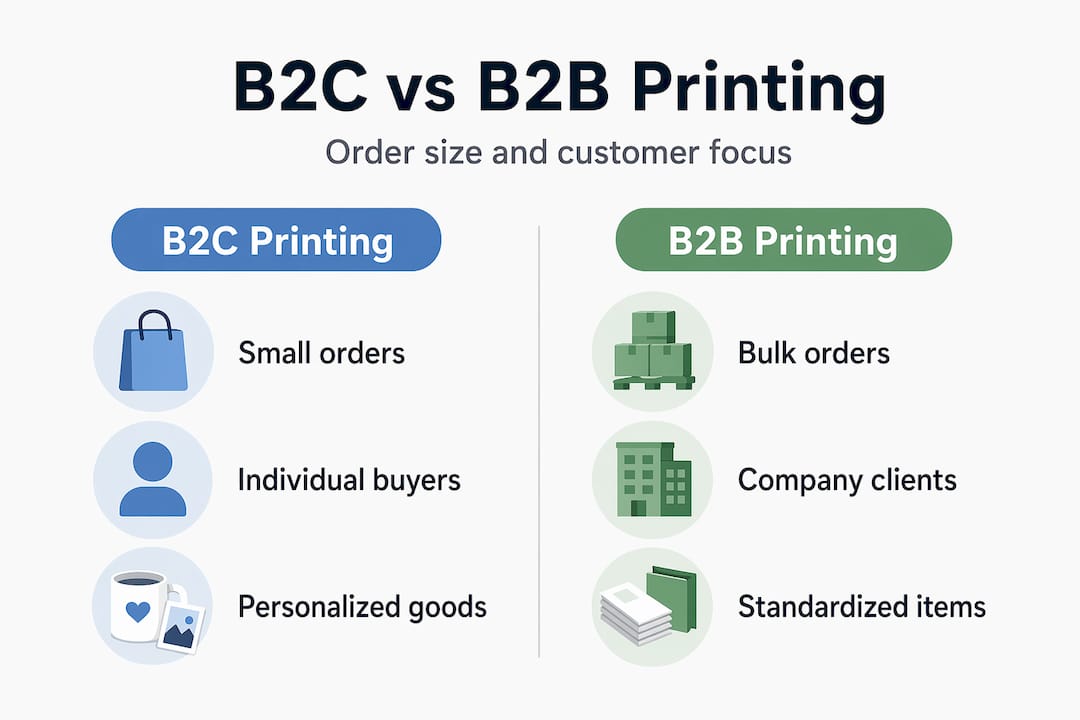
B2C print storefronts focus on individual buyers who want personalized products without bulk commitments. A B2B printing client, by contrast, is typically a company procurement team or marketing department looking for consistent, large-volume output at negotiated pricing. The interaction model, the website experience, and the fulfillment workflow are built around completely different needs.
| Characteristic | B2C printing | B2B printing |
|---|---|---|
| Typical order size | 1 to 100 units | 500 to 10,000+ units |
| Buyer motivation | Personalization, emotion, gifts | Brand consistency, efficiency, cost |
| Pricing model | Retail price, coupons, flash deals | Volume discounts, contract pricing |
| Turnaround expectation | 1 to 5 days | 1 to 4 weeks |
| Customization level | Per-order, individual designs | Standardized brand assets |
| Sales channel | Online storefront, self-service | Sales reps, RFQ, account management |
| Marketing approach | Social media, email, impulse | Account relationships, procurement cycles |
One detail that many creators miss is the pricing dynamic on the B2C side. Coupon-driven pricing is standard in consumer print services, with promo codes sometimes expiring within 48 to 72 hours and occasionally being exclusive to one sales channel. This matters if you are building a resale operation or managing client print budgets because your cost basis can swing significantly depending on when and where you buy.
Speed is another major differentiator. Leading B2C printing providers offer same-day processing for simple prints, with professional labs completing custom orders within one day for runs up to 100 images. B2B jobs at comparable complexity routinely take 10 to 20 business days through traditional trade printers.
Best practices for using B2C print services
Knowing B2C printing services exist is one thing. Using them well is another. These practices separate creators who get frustrated and quit from those who build sustainable merchandise operations.
Use a storefront with a built-in design tool
Online design studios integrated directly into print storefronts are a conversion catalyst. When customers can preview their custom product in real time, they are far more likely to complete the purchase. If you are building your own print-on-demand store, prioritize platforms that offer live product previews and easy-to-use design interfaces. It reduces abandonment and increases average order value.
Fix your file resolution before you upload
This is the single most overlooked quality issue in B2C printing. Many platforms default to a lower-resolution “Standard” setting on uploads. Unless you manually switch to “Full Resolution,” your poster or detailed apparel graphic may print softer than you expect. Always upload at 300 DPI for print-ready files and verify the resolution setting in your account before submitting.
Pro Tip: When preparing files for large-format prints like posters or banners, work at 150 DPI at final print size rather than trying to upscale a 72 DPI web graphic. Upscaling never recovers true detail, and the difference shows clearly on anything bigger than a sheet of paper.
Automate your order-to-fulfillment workflow
Integrating your storefront with a Print MIS backend eliminates manual handoffs and cuts fulfillment errors. Every time a customer places an order, the job data should flow automatically into your production queue or to your DTF transfer supplier. Manual re-entry of orders at any step creates bottlenecks and mistakes that cost you both time and reputation.
Leverage AI-powered marketing tools
AI-driven CRM platforms are no longer just for enterprise retailers. B2C print businesses use them to track which designs customers view, what they purchase repeatedly, and when they are likely to buy again. That data powers personalized email recommendations and retargeting ads that feel relevant rather than generic. If you are selling merchandise at any consistent volume, this kind of automation pays for itself quickly.
Price with intention, not just intuition
Understand the real cost structure of your print method before setting retail prices. DTF transfers, for example, carry a per-unit cost that drops significantly when you use gang sheets to combine multiple designs on one film. Exploring cost-effective merch production with DTF can help you find the pricing sweet spot between margin and competitiveness.
My honest take on B2C printing for creators
I’ve watched hundreds of independent designers go through the same frustrating cycle: they discover B2C printing, get excited, order a batch of shirts, hate the quality, and assume the technology is the problem. It almost never is. The problem is usually a misaligned expectation about what a specific technology does well.
What I’ve learned is that the emotional dimension of B2C printing is genuinely its biggest asset, and most people treat it as an afterthought. Your customer isn’t buying a t-shirt. They are buying the feeling of wearing something unique, something that belongs to them or reflects a brand they care about. When you start designing with that in mind instead of just trying to produce the cheapest possible merch, everything from your art choices to your packaging starts to shift.
The pitfall I see most often with small brands is underinvesting in file quality while overinvesting in paid ads. Stunning ads sending traffic to blurry, disappointing prints is a fast way to burn budget and damage a brand that took months to build. Get the product right before you amplify it.
DTF printing specifically has transformed what small creators can realistically offer. A few years ago, a 20-piece custom hoodie run was either prohibitively expensive or meant sacrificing design quality. That’s no longer the case. The technology has matured, the turnaround times are fast, and services like Transferkingz make it accessible without a commercial print background. What I’ve found is that the creators who embrace this technology early and learn it well are the ones building lasting merchandise businesses rather than one-off campaigns.
— Anthony
Take your B2C printing further with Transferkingz
If this article made you want to actually start printing and selling custom merchandise, Transferkingz is built for exactly this kind of work.
Transferkingz specializes in high-quality DTF transfers for custom apparel, with no minimum order requirements, fast turnaround times, and a gang sheet builder that lets you maximize value on every order. Whether you are a solo artist testing a new design or a small business owner fulfilling ongoing merchandise orders, the platform is set up so you can upload, order, and apply your transfers without needing a commercial print background. Visit the Transferkingz Print Point to explore current products and see how the process works from upload to finished garment.
FAQ
What does B2C printing mean in simple terms?
B2C printing means a business sells finished printed products directly to an individual consumer, usually through an online store, with no wholesale or bulk requirements.
How is B2C printing different from B2B printing?
B2C printing serves individual buyers with small, personalized orders and fast turnaround, while B2B printing serves companies needing large, standardized print runs at volume pricing.
What printing method works best for small-batch custom apparel?
DTF printing is widely regarded as the best option for small-batch custom apparel because it requires no screen setup, works on light and dark fabrics, and produces durable, full-color results.
Why do my prints look blurry when I use an online print service?
Most B2C print platforms default to a lower “Standard” resolution setting on uploads. Switching manually to “Full Resolution” and uploading files at 300 DPI prevents this issue.
Can I run a merchandise business using only B2C print services?
Yes. With the right combination of a print-on-demand supplier, an integrated design storefront, and automated order workflows, a solo creator can run a fully functional merchandise business without owning any print equipment.
Recommended
- B2B apparel printing: solutions and strategies explained – Transfer Kingz
- Print-on-demand guide for entrepreneurs and small brands – Transfer Kingz
- What is vibrant color printing? A guide for artists – Transfer Kingz
- DTF Printing for Business Branding: How Custom DTF Transfers Boost Sma – Transfer Kingz
0 comments