

TL;DR:
- Custom merchandise is created from scratch to match a specific vision, unlike personalized items which modify existing products. It involves higher investment, longer production times, and offers unique branding opportunities for brands and events. Print-on-demand enables testing designs without upfront inventory costs, making it an accessible entry into high-quality, emotionally resonant branding.
Most people assume custom merchandise is just slapping a name on a mug or a monogram on a tote bag. That’s a common mix-up, and it costs beginners real money when they build the wrong strategy. What is custom merchandise, exactly? It’s the creation of unique products designed from scratch to match a specific vision, brand, or purpose. The difference between that and simply personalizing something already made matters enormously for pricing, production time, and business potential. This guide breaks down everything you need to know before you spend a dollar.
Table of Contents
- Key takeaways
- What is custom merchandise, and how it differs from personalized merch
- Popular types and examples of custom merchandise
- How custom merchandise gets made
- Benefits and real challenges of custom merchandise
- How to get started with custom merchandise
- My take on where custom merch is really heading
- How Transferkingz helps you bring custom merch to life
- FAQ
Key takeaways
| Point | Details |
|---|---|
| Custom vs. personalized | Custom merchandise is built from scratch; personalized merchandise modifies existing mass-produced items. |
| Production methods vary | DTF, DTG, screen printing, and sublimation each suit different products, budgets, and order sizes. |
| Low-risk entry possible | Print-on-demand lets you test designs without buying inventory upfront. |
| Emotional value drives demand | Personalized merchandise helps brands build stronger customer connections. prefer gifts that feel personal, making custom merch a powerful brand tool. |
| Start small, scale smart | Test one product category, verify quality, then expand your lineup based on real feedback. |
What is custom merchandise, and how it differs from personalized merch
The custom merchandise definition comes down to origin. Custom merchandise means creating a unique product from scratch to meet specific requirements. You decide the design, the materials, the size, the color, and the finish. Nothing about it existed before you ordered it.
Personalized merchandise works differently. A manufacturer produces a standard item, such as a white ceramic mug or a pre-cut baseball cap, and then adds your name, date, or photo to it. The product itself was never designed for you. Only the added detail was.
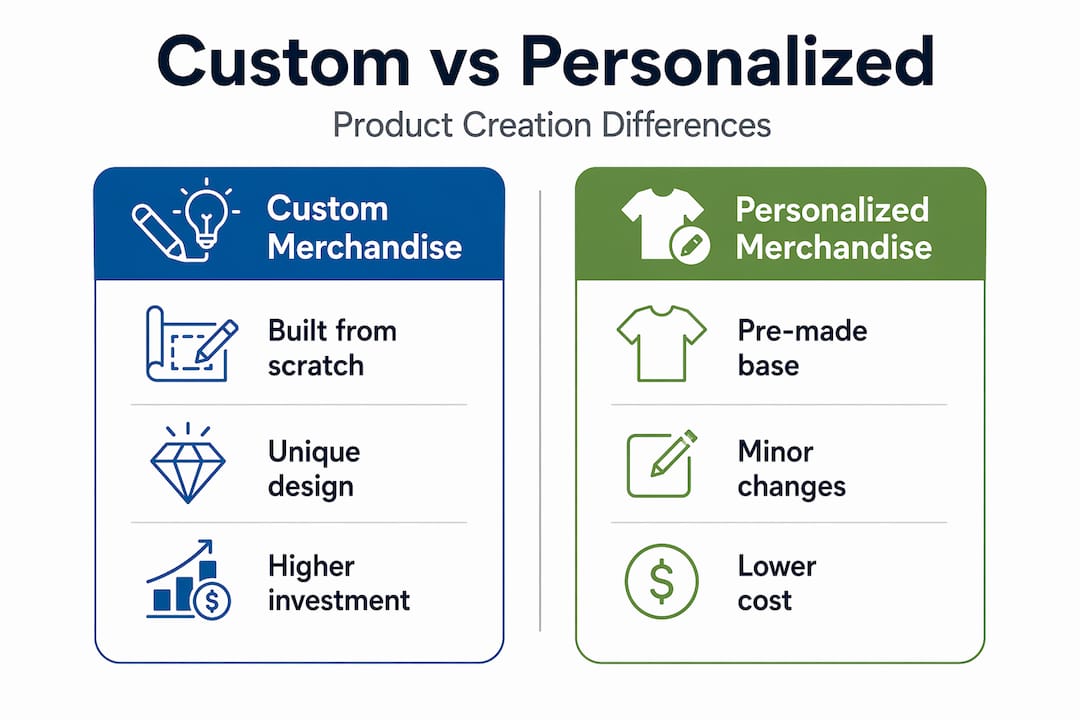
Here is a side-by-side comparison to make this concrete:
| Factor | Custom merchandise | Personalized merchandise |
|---|---|---|
| Design origin | Built from scratch | Modified from existing product |
| Cost | Higher investment | More budget-friendly |
| Production time | Longer | Faster |
| Uniqueness | Fully unique | Partially unique |
| Best use | Branding, events, collections | Gifts, simple promotions |
Custom gifts require more investment in time, craftsmanship, and resources compared to personalized items. That investment is worth it when you need to represent a brand consistently or create something with real market differentiation. For a birthday gift or a quick giveaway, personalized is often the smarter call.
Understanding this distinction saves you from over-spending on a simple task or under-investing in something that represents your brand publicly.
Popular types and examples of custom merchandise
The product categories available for custom merchandise are broader than most beginners expect. Apparel dominates the space, but it is far from the only option.
Here are the categories small businesses and individuals rely on most:
- Apparel: T-shirts, hoodies, hats, and jackets remain the highest-demand category. A single well-designed shirt can function as both a product and walking advertising.
- Accessories: Custom tote bags, phone cases, patches, and keychains work especially well for event giveaways and low-cost branded items.
- Drinkware: Tumblers, mugs, and water bottles carry strong perceived value and get used repeatedly, which means ongoing brand exposure.
- Promotional items: Stickers, lanyards, notebooks, and pens fill trade show bags and serve as low-cost touchpoints for your audience.
- Home goods: Custom pillows, blankets, and wall art appeal strongly to creators and gift markets.
What is personalized merchandise in this context? Think of a tumbler with a customer’s name laser-engraved. That’s personalized. A tumbler your brand designed with a custom color, logo placement, and exclusive artwork? That’s custom merchandise.
Pro Tip: Match your product type to how your audience actually lives. A fitness brand gets far more mileage from a custom water bottle than a notebook. A local bookshop does better with a tote bag than a phone case.
The strongest custom merchandise ideas start with one honest question: what does my audience use every single day?
How custom merchandise gets made
The production method you choose shapes your cost, minimum order size, turnaround time, and final quality. Each technology has a specific sweet spot.
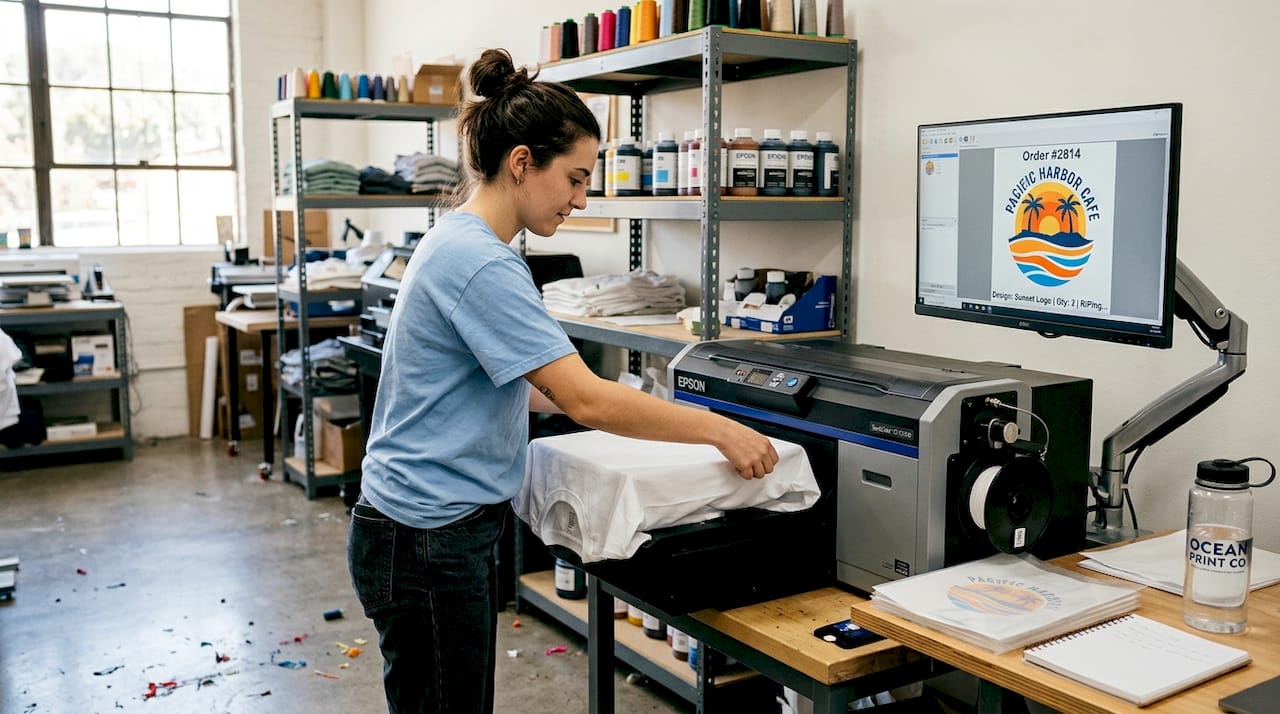
Direct-to-Film (DTF) printing transfers full-color designs onto a film sheet that is then heat-pressed onto fabric. It handles complex artwork with no color limits and works on virtually any textile. Learning how DTF printing works is genuinely useful for anyone ordering custom apparel, because it explains why vibrant, detailed designs are possible even on dark fabrics.
Direct-to-Garment (DTG) printing prints ink directly onto the fabric using an inkjet-style process. It excels at photo-quality designs on cotton but requires pre-treatment and works best on lighter fabrics.
Screen printing uses stenciled layers of ink, one color at a time. It produces vivid, durable results at scale but gets expensive for small runs or designs with many colors.
Sublimation printing infuses dye directly into polyester fabric or coated hard goods. Colors appear inside the material rather than on top, making them extremely durable. It only works on light-colored, polyester-compatible surfaces.
UV printing applies ink cured by ultraviolet light directly onto hard surfaces like phone cases, wood, or glass. Hard goods and specialty merchandise require more technical setup for consistent production than flat apparel.
Here is a quick-reference comparison:
| Method | Best for | Min. order | Color flexibility |
|---|---|---|---|
| DTF | Apparel, any color fabric | 1 piece | Unlimited |
| DTG | Cotton apparel | 1 piece | Unlimited |
| Screen printing | High-volume apparel | 12–50+ pieces | Limited per run |
| Sublimation | Polyester, hard goods | 1 piece | Unlimited |
| UV printing | Hard goods, specialty | 1 piece | Unlimited |
Pro Tip: If you are starting out, DTF is often the most forgiving option. No minimums, no pre-treatment complexity, and it works on fabric types that DTG cannot touch. Exploring textile printing methods before you commit to a supplier will save you from quality surprises.
Print-on-demand fulfillment lets merchandise get made only after an order is placed, eliminating the upfront inventory cost entirely. For anyone testing a new design or launching a first collection, this model removes the biggest financial barrier.
Benefits and real challenges of custom merchandise
The benefits of custom merchandise go beyond having a logo on a shirt. Done well, custom merch builds emotional connection, creates new revenue streams, and makes a brand feel real and tangible.
Here is what the upside looks like in practice:
- Brand identity: Every product you put into someone’s hands communicates your brand’s personality. Color, quality, and design all send a signal.
- Emotional resonance: Personalization creates deeper emotional connection by acknowledging individuality, which makes branded merchandise genuinely meaningful rather than throwaway.
- Revenue diversification: Creators, coaches, and local businesses increasingly treat merchandise as a direct income channel rather than just a marketing expense.
- Scalability: You can start with one design and one product, then add categories as demand grows without rebuilding your entire setup.
The challenges are real too, and skipping past them leads to wasted money:
- Cost of quality: Better materials, better inks, and experienced printers cost more. Cheap merch does more damage to your brand than no merch at all.
- Production time: Custom items built from scratch take longer than pulling something off a shelf. Plan for lead times, especially for events.
- Design complexity: What looks good on screen does not always translate perfectly onto a product. Test prints before you commit to bulk orders.
Why use custom merchandise despite these challenges? Because the custom apparel printing benefits for small brands compound over time. Each product creates exposure, builds loyalty, and reinforces your presence in ways that digital ads simply cannot.
How to get started with custom merchandise
Starting is simpler than most people expect once you break it into clear steps.
- Define your purpose. Are you creating custom merchandise for events, for selling online, or for personal branding? Your goal determines your product choices, quantity, and budget.
- Choose your product category. Start with one product. Trying to launch ten items at once spreads your attention and budget too thin. Pick the item your audience will actually use.
- Create or finalize your design. Your artwork file needs to be high-resolution, typically 300 DPI or higher. Vector files work best for most printing methods.
- Select a production method. Match the printing technology to your product and order size. DTF works for almost any apparel starting at a single piece. Screen printing makes sense only when volume justifies the setup cost.
- Order a sample. Never skip this. A physical sample reveals color accuracy, print placement, and fabric quality that no digital mockup can replicate.
- Review and iterate. If the sample is off, adjust the file or switch suppliers before placing a full order. This step saves money and protects your reputation.
- Place your production order. Once quality is confirmed, order with confidence. Keep records of your artwork files and supplier specs for future reorders.
Print-on-demand systems empower small businesses and creators to launch new merchandise lines without upfront inventory risk. If you are unsure which designs will sell, this model is your safest first move.
My take on where custom merch is really heading
I have watched the custom merchandise space long enough to say this clearly: most newcomers underestimate how technical it has gotten.
A few years ago, putting a logo on a shirt was enough. Now, print technologies are shifting the standard beyond simple logo placement to collections, bundles, and specialty hard goods. Audiences expect variety and quality. That means your production setup matters just as much as your design.
What I have seen trip up small business owners most often is treating merchandise as an afterthought. They design something quickly, order from the cheapest supplier, and then wonder why customers are not excited. The products that build real loyalty are the ones where the owner clearly thought about the person holding them.
The other thing most newcomers miss: brands that innovate with print technology and rapid production workflows can capitalize on trending moments far better than those locked into slow, high-minimum suppliers. Speed matters. Flexibility matters. And choosing the right production partner from the start is not a detail. It is the decision that determines whether your custom merchandise strategy actually works.
— Anthony
How Transferkingz helps you bring custom merch to life
If you are ready to move from concept to finished product, Transferkingz makes the process straightforward. Specializing in high-quality DTF transfer printing, Transferkingz serves individual creators and small businesses with no minimum order requirements, fast turnaround times, and premium inks that produce vibrant, durable results on virtually any textile. You can upload your artwork, use the gang sheet builder to maximize every print, and get custom DTF transfers for branding that hold up wash after wash. Whether you are printing one shirt or stocking up for an event, Transferkingz delivers the quality and flexibility your brand deserves.
FAQ
What is the custom merchandise definition?
Custom merchandise refers to products created from scratch based on specific design requirements, rather than modifying existing mass-produced items. The result is something fully unique to your brand or vision.
How is custom merchandise different from personalized merchandise?
Custom gifts require more investment in time and craftsmanship because they are original creations, while personalized merchandise simply adds a name, date, or image to an already-manufactured product.
What are the best examples of custom merchandise for small businesses?
Custom apparel, branded tote bags, drinkware, stickers, and promotional accessories are among the most effective options. They balance cost, visibility, and practical use for most audiences.
Why use custom merchandise over generic promotional items?
Custom merchandise builds stronger brand recognition and emotional connection. Personalized merchandise helps brands build stronger customer connections. Prefer gifts that feel personal, which translates directly into better brand recall and customer loyalty.
What is the easiest way to create custom merchandise with no inventory risk?
Print-on-demand is the lowest-risk entry point. Products are made only after orders are placed, so you test designs and expand your lineup without committing to bulk inventory upfront.
Recommended
- Custom apparel printing benefits for small brands – Transfer Kingz
- Print-on-demand guide for entrepreneurs and small brands – Transfer Kingz
- Why digital printing wins for custom apparel and merch – Transfer Kingz
- DTF Printing for Business Branding: How Custom DTF Transfers Boost Sma – Transfer Kingz
0 comments