

TL;DR:
- Small batch production involves creating limited product quantities, usually between 10 and 1,000 units, to match uncertain demand or customization needs. Digital methods like DTF printing and CNC enable low-cost setups, fast iterations, and reduced inventory risk, making small batches a strategic business advantage. It allows brands to learn customer preferences, improve quality, and scale confidently once demand is proven.
Small batch production means manufacturing a limited quantity of a product in a single run, typically between 10 and 1,000 units, rather than committing to the high volumes that mass production requires. It sits between one-off custom work and full-scale manufacturing, and it is the right call when demand is uncertain, customization matters, or capital is tight.
Three quick indicators that small-batch fits your situation:
- You are testing a new product and cannot afford to guess wrong on volume
- Your customers want personalized or limited-edition items that mass production cannot accommodate
- You need to iterate on design or specs before locking in tooling
Pro Tip: Start with digital-first methods like Direct-to-Film (DTF) printing or CNC with soft fixturing. They carry near-zero tooling cost, so your setup expense stays low even on a 10-unit run.
Table of Contents
- What is small batch production, and how does it differ from other approaches?
- How does a small batch production workflow actually run?
- What are the real business benefits of small batch production?
- What are the downsides you need to plan for?
- Small batch vs. high-volume production: how do you choose?
- What do costs and lead times actually look like?
- Which industries and product types benefit most?
- How DTF printing and gang sheets make apparel small runs work
- Key Takeaways
- Why small-batch thinking is actually a competitive strategy
- Transferkingz removes the MOQ barrier for apparel small runs
- Useful sources
What is small batch production, and how does it differ from other approaches?
Small batch manufacturing refers to producing goods in limited quantities, positioned between prototype-level custom work and full mass production. Think of it as the middle lane: more structured than making one item by hand, but far more flexible than a factory floor running 50,000 units a shift.
Batch sizes vary considerably by industry. A furniture maker might call 25 chairs a small batch. A printed circuit board shop might consider 500 units small. An apparel decorator running 50 custom hoodies is firmly in small-batch territory.
| Industry | Typical Small-Batch Range | Common Method |
|---|---|---|
| Apparel / Merch | typically between 10 and 1,000 units per run | DTF, DTG, screen print |
| Specialty Parts | typically between 10 and 1,000 units per run | CNC, soft tooling |
| Stickers / Labels | typically between 10 and 1,000 units per run | Digital print, gang sheet |
| Consumer Goods | typically between 10 and 1,000 units per run | Short-run injection molding |
| Food / Beverage | typically between 10 and 1,000 units per run | Manual or semi-automated line |
One nuance worth noting: “small batch” can describe a single order or an annual production volume. A supplier quoting a minimum order quantity (MOQ) of 500 units is talking about a single run. A brand that ships 800 units per year across multiple SKUs is operating in small-batch territory by volume. Both definitions are valid, and your supplier relationships will depend on which one applies to you.
How does a small batch production workflow actually run?
The mechanics of a small run differ from mass production in one fundamental way: setup cost is the dominant variable, not per-unit labor. Once your file, fixture, or G-code is ready, the cost per piece flattens quickly. That is why digital and additive methods like DTF printing, CNC with soft fixturing, and 3D printing have become the backbone of small-batch work. They eliminate hard tooling entirely.
A typical small-batch workflow runs like this:
- Design finalization. Lock your artwork, specs, or CAD file. Any change after this point costs time and sometimes money, so treat this step as a gate.
- File or fixture setup. For digital printing, this means preparing print-ready files and nesting them on a gang sheet. For CNC or molding, it means programming G-code and setting up soft fixturing.
- Run planning. Schedule the batch, confirm material availability, and set quality checkpoints. Short runs benefit from a first-article inspection before the full batch runs.
- Production run. Execute the batch. Quick changeovers between designs are a core advantage here; small-batch manufacturing emphasizes rapid changeover so you can shift between SKUs without long downtime.
- Quality assurance. Inspect finished units. With small runs, defects are easier to isolate and cheaper to correct than in a mass run.
- Finishing and fulfillment. Apply transfers, pack, label, and ship. For apparel, this often means heat-pressing DTF transfers onto blanks before dispatch.
A note for anyone producing children’s products: the CPSC defines “Small Batch Manufacturer” as a specific legal category that can affect third-party testing obligations. Registering does not remove safety requirements or the need for a Children’s Product Certificate, but it may reduce testing costs.
What are the real business benefits of small batch production?
The honest case for small-batch is not just “lower risk.” It is about business velocity: the ability to respond to a market signal, test a design, and correct course before you are sitting on a warehouse of unsold inventory.
Flexibility and faster iteration. When a design is not landing with customers, a small-batch producer can pivot after 50 units. A mass producer is stuck with 5,000. That speed-to-insight advantage compounds over time, especially for brands releasing seasonal or trend-driven products.
Lower inventory risk. Small batches reduce the risk of dead stock and obsolescence because capital is only committed to quantities that have been tested or pre-sold. The hidden cost that kills many product businesses is not the unit cost; it is the total landed cost of inventory that never moves.
Easier quality control. Defects in a 100-unit run are far less damaging than defects in a 10,000-unit run. Small runs let you catch problems at the source, fix them, and move on without a costly recall or markdown event.
Personalization and premium pricing. Apparel decorators and independent designers can offer bespoke SKUs profitably at low volumes when they use digital methods. Limited-edition drops and customer-specific colorways command higher margins precisely because they are not mass-produced.
Lower capital commitment. You are not financing a factory run. You are financing a batch. That distinction matters for cash flow, especially for early-stage brands or designers testing a new category.
What are the downsides you need to plan for?
Higher per-unit cost is the most cited drawback, and it is real. Setup costs, whether that is file prep, fixture design, or material waste on short runs, get amortized across fewer units. A $200 setup fee spread across 1,000 units adds $0.20 per piece. Spread across 20 units, it adds $10.
Supplier access is another friction point. Many contract manufacturers set MOQs that exclude genuinely small runs. You may need to work with specialist short-run suppliers, local print shops, or digital-first platforms that explicitly support low-volume orders.
Operational complexity also rises with frequency. More changeovers mean more scheduling, more QA touchpoints, and more coordination with suppliers. For a solo operator, that overhead adds up fast.
Three practical mitigations:
- Gang-sheet nesting. Combine multiple designs on a single print sheet to amortize setup and material costs across designs rather than runs.
- Pre-sales and deposits. Sell before you produce. Pre-orders validate demand and fund the batch, eliminating inventory risk almost entirely.
- Sample-first QA. Always run a single sample or first-article inspection before committing the full batch. The cost of one bad unit is trivial; the cost of 100 bad units is not.
Pro Tip: Build a backup supplier list before you need it. Short-run specialists often have capacity constraints, and a single supplier relationship is a single point of failure for your production schedule.
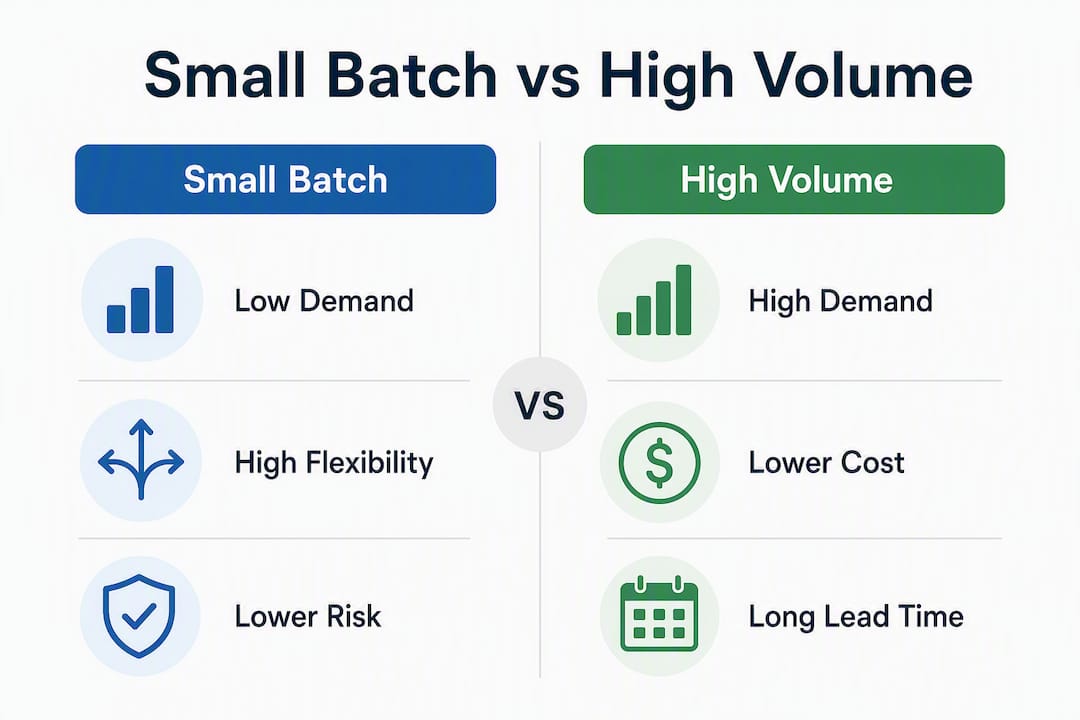
Small batch vs. high-volume production: how do you choose?
The decision is not about which approach is better in the abstract. It is about which one fits your product’s current lifecycle stage and your business’s risk tolerance.

| Decision Factor | Small Batch | High-Volume |
|---|---|---|
| Demand certainty | Low or untested | High and proven |
| Unit-cost priority | Secondary | Primary |
| Customization need | High | Low |
| Capital available | Limited | Substantial |
| Time-to-market | Fast | Slower (tooling lead time) |
| Design stability | Still evolving | Locked |
The break-even question is straightforward: mass production tooling (injection molds, screen-print screens, hard dies) typically costs thousands to tens of thousands of dollars upfront. That cost only makes sense when it is spread across enough units to bring per-unit cost below what small-batch digital methods charge. For most apparel and merch products, that crossover point sits somewhere above several hundred units per design, per run. Below that threshold, digital small-batch is almost always the better financial decision.
A quick checklist before you commit to either approach:
- Is your design finalized, or will it change in the next 90 days?
- Do you have confirmed orders or strong pre-sale data?
- Can you absorb unsold inventory if demand is softer than expected?
- Does your product require customization per customer or per SKU?
If you answered “no” to the first two and “yes” to the last two, small-batch is the right starting point.
What do costs and lead times actually look like?
Cost drivers in small-batch production break into four buckets: setup, materials, finishing, and fulfillment. Setup is the one that surprises most first-timers because it does not scale with volume.
Typical lead times:
- Digital-first methods (DTF, DTG, digital sticker print): 1–5 business days for most runs
- CNC with soft fixturing: 3–10 business days depending on complexity
- Short-run injection molding with soft tooling: 2–6 weeks
- 3D printing (FDM/SLA): 1–7 business days per batch
The table below uses illustrative numbers for a 50-unit custom apparel run using DTF transfers:
| Cost Component | Estimated Cost (50 units) | Per-Unit Impact |
|---|---|---|
| Heat press labor / finishing | $25–$50 | — |
At 200 units, the setup cost per unit drops to near zero, and total per-unit cost falls accordingly. At 20 units, setup dominates. That is the core economic logic of gang-sheet nesting: by combining four or five designs on one sheet, you effectively run a 200-unit setup cost across what would otherwise be four separate 50-unit jobs.
Which industries and product types benefit most?
Small-batch production is not a niche workaround. It is the primary production model for entire categories of business.
Apparel and merch. Independent designers, streetwear brands, and event organizers routinely run 25–150 units of a design to test demand before scaling. Limited-edition drops are built entirely on this model. A clothing designer testing a seasonal print run can place a 30-unit DTF order, sell through it in two weeks, and reorder with a color adjustment before a mass-production competitor has even finished tooling.
Prototyping and validation parts. An electronics startup ordering 100 custom aluminum brackets for a product validation run does not need injection-molded tooling. CNC with soft fixturing gets them production-representative parts in days, not months.
Specialty industrial parts. Aerospace, medical devices, and defense applications often require small quantities of highly specific components. These are not candidates for mass production regardless of cost.
Stickers, labels, and merch. Gang-sheet strategies are standard practice in sticker and label businesses. A single gang sheet can carry 20 different designs, each in quantities of 10–50, at the cost of one print run.
Limited-edition collaborations. Brand collabs and artist drops are structurally small-batch. The scarcity is the product.
Small-batch also pairs naturally with direct-to-consumer and pre-order models. When you sell before you produce, inventory risk drops to zero and cash flow turns positive before the first unit ships.
How DTF printing and gang sheets make apparel small runs work
Direct-to-Film (DTF) printing is the clearest example of a digital-first method that removes the traditional barriers to small-batch apparel production. There is no screen to burn, no plate to make, and no minimum run required to justify setup. You upload a file, it prints onto a film, and the transfer is heat-pressed onto any compatible fabric.
The economics become even more favorable with gang-sheet nesting. Instead of printing one design per sheet, you tile multiple designs onto a single sheet, sharing the film, ink, and setup cost across all of them. A designer with five colorways of one graphic and three completely different designs can run all eight on one gang sheet, paying one setup cost for the whole job.
Key advantages for apparel small-batch runs using DTF:
- No minimum order quantity on platforms built for small runs
- Full-color, photo-realistic prints with no color-separation cost
- Compatible with cotton, polyester, blends, and most fabric types
- Transfers store well, so you can press on demand rather than printing to stock
- Design changes between runs cost nothing beyond a new file
Transferkingz’s gang-sheet builder lets designers and small brands nest multiple designs on a single sheet without a minimum order, which directly solves the MOQ problem that stops most small-batch apparel projects before they start. For designers who want to test a print before committing to a full run, ordering a single transfer sheet is a practical first step.
Pro Tip: When building a gang sheet, group designs by similar color profiles. Ink coverage affects cost and drying time, so clustering high-coverage designs together can improve consistency across the sheet.
For more on substrate compatibility and application technique, the custom apparel decoration guide covers heat-press settings, peel types, and fabric prep in detail.
Key Takeaways
Small batch production is the right production model when demand is unproven, customization matters, or capital is limited, and digital-first methods like DTF printing make it viable at almost any scale.
| Point | Details |
|---|---|
| Typical batch size | Small-batch runs generally fall between 10 and 1,000 units, varying by industry and method. |
| Core financial trade-off | Higher per-unit cost than mass production, but lower total risk from inventory, obsolescence, and unsold stock. |
| Best strategic fit | Use small-batch for product launches, limited editions, and any situation where demand is uncertain or designs are still evolving. |
| Gang-sheet nesting | Nesting multiple designs on one sheet amortizes setup cost across designs, making small runs significantly more affordable. |
| Transferkingz for apparel | Transferkingz offers no-minimum DTF transfers and a gang-sheet builder, removing the MOQ barrier for apparel small-batch runs. |
Why small-batch thinking is actually a competitive strategy
Most articles frame small-batch production as a compromise, something you do when you cannot afford mass production. That framing is wrong, and it leads brands to scale too fast.
The real advantage of small-batch is not lower cost. It is lower cost of being wrong. A brand that runs 100 units, learns what customers actually want, and adjusts before the next run is operating with information that a brand locked into a 5,000-unit mass-production commitment simply does not have. That information advantage compounds. After three or four small-batch cycles, you know your customer, your best-selling colorways, your optimal price point, and your real demand curve. At that point, scaling up is a confident decision backed by data, not a bet.
The brands that treat small-batch as a permanent strategy rather than a stepping stone often find something counterintuitive: their margins stay healthy because they never carry dead inventory, their customers stay engaged because the product line keeps moving, and their supplier relationships stay flexible because they are not locked into volume commitments.
Quality control is another underrated advantage. With a 100-unit run, a single defective unit is a minor correction. With a 10,000-unit run, the same defect rate is a crisis. Small batches let you build quality into the process iteratively rather than trying to engineer it out of a mass-production line after the fact.
The practical setup that makes this work: version-controlled design files, a modular fixture or gang-sheet template you can reuse, a first-article inspection habit before every run, and at least one backup supplier relationship. None of that is complicated. All of it is the difference between a small-batch operation that scales intelligently and one that stays stuck.
Transferkingz removes the MOQ barrier for apparel small runs
For designers and small brands running apparel, the biggest friction in small-batch production is usually the minimum order requirement. Most print shops want 50 or 100 units of a single design before they will touch a job. Transferkingz is built around the opposite model.
With no minimum order quantity on DTF transfers, a gang-sheet builder that lets you mix designs on a single sheet, and nationwide shipping with same-day local pickup available, Transferkingz gives apparel decorators and independent brands the infrastructure to run genuinely small batches without paying small-batch penalties. You upload your artwork, build your sheet, and get production-ready transfers back fast, whether that is 1 design or 20 designs on the same order. The Print Point service page walks through the full ordering workflow, and the team can help you plan a run if you are not sure where to start. Place your first order and see what a 10-unit test run actually costs before you commit to anything larger.
Useful sources
- Small Batch Manufacturers and Third-Party Testing (CPSC) — Primary regulatory guidance on how the CPSC defines Small Batch Manufacturer status and what it means for testing obligations on children’s products.
- Small-Batch Production: Definition, Methods and Management (tacto.ai) — Procurement-focused overview covering definitions, methods, and risk management for buyers and operators.
- Small Batch Manufacturing: Processes, Cost Drivers, and When to Use It (Premium Parts) — Detailed breakdown of setup vs. per-unit cost dynamics, gang-sheet strategies, and method selection.
- What Is Small Batch Production? Understanding the Benefits and Applications (Polyspectra) — Covers digital and additive manufacturing methods that enable small-batch production without hard tooling.
- Custom DTF Ordering Guide (Transferkingz) — Practical ordering guide for designers placing their first small DTF run, including gang-sheet setup instructions.
0 comments