

TL;DR:
- Sublimation is ideal for light-colored, high-polyester garments offering a durable and soft finish.
- For dark fabrics and cotton, heat transfer vinyl provides better opacity and tactile quality, while DTF works on all fabric types for full-color designs.
For most apparel jobs, the decision between sublimation and iron-on (HTV) comes down to one question: what fabric is the garment? Sublimation is the right call for light-colored, high-polyester items where you want a permanent, zero-hand finish and photo-quality color. HTV wins on dark garments and cotton, where sublimation simply cannot produce a visible result. For shops handling mixed fabric types or full-color designs on dark shirts, DTF is the practical third option.
Quick decision drivers:
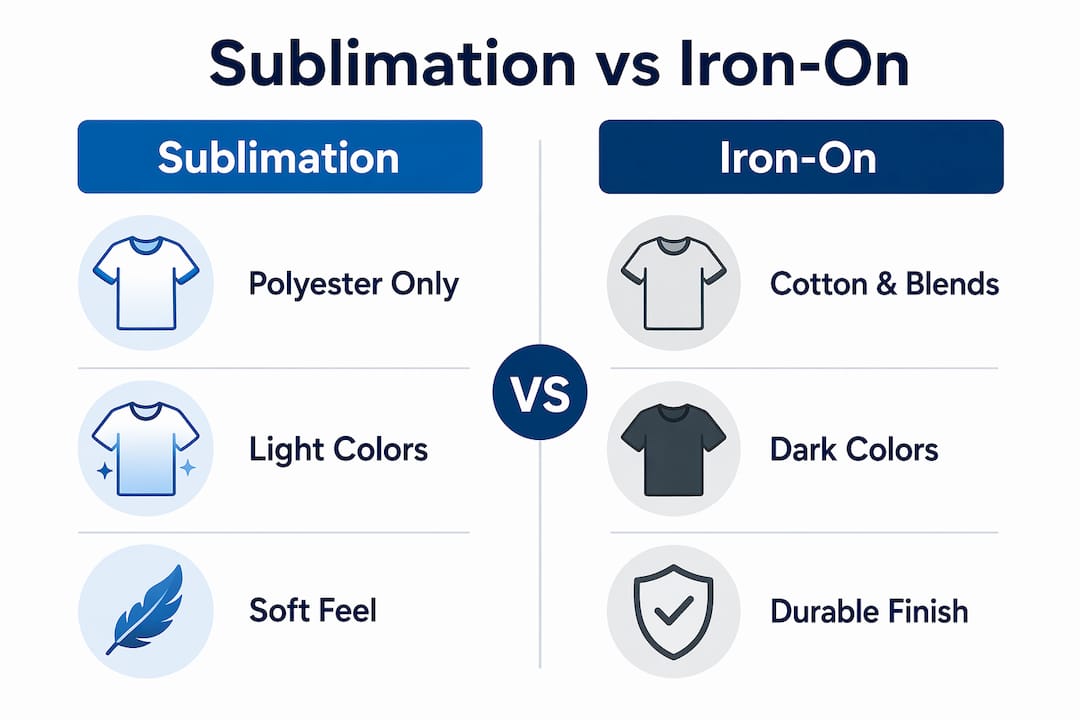
- Substrate first: Sublimation requires polyester and light-colored grounds. HTV works on cotton, dark garments, and most blends.
- Hand feel: Sublimation leaves zero texture. HTV adds a raised vinyl layer you can feel through the shirt.
- Durability: Sublimation dye bonds into fibers and can hold up for 50+ washes; HTV can start cracking or peeling after 20–30 washes if application quality or vinyl grade is off.
- Color/photo work: Sublimation handles photographic detail and unlimited gradients; HTV is best for solid-color logos and text.
Small-shop shortcut: Run 100% polyester light-color jobs on sublimation, cotton and dark garments on HTV, and anything that crosses both categories on DTF.
Table of Contents
- How do sublimation, iron-on (HTV), and DTF compare side by side?
- How each method actually works: the mechanics decorators need to know
- How to choose the right method for a given job
- Press settings, wash care, and small-shop tactics to extend print life
- Myths, common mistakes, and quick troubleshooting
- Key Takeaways
- A decorator’s honest take on mixing methods
- Why Transferkingz DTF fills the gaps sublimation and HTV leave open
- Useful sources and further reading
How do sublimation, iron-on (HTV), and DTF compare side by side?
| Dimension | Sublimation | Iron-On (HTV) | DTF |
|---|---|---|---|
| Best for | Light polyester, hard blanks (mugs, tumblers) | Dark/cotton garments, simple logos | Mixed fabrics, dark shirts, full-color designs |
| Hand feel | Zero hand, part of the fiber | Raised vinyl layer, tactile | Thin, soft film; slight texture |
| Color/photo | Photographic quality, unlimited gradients | Solid colors; limited gradients | Full color, photo-capable |
| Durability | Holds up for 50+ washes; no cracking or peeling | Can start cracking or peeling after 20–30 washes depending on quality | Lasts well with proper care |
| Dark garments | Not viable (ink is transparent) | Yes, opaque vinyl works | Yes, white underbase included |
| Setup cost | Sublimation printer + heat press | Cutting machine + heat press | Order ready-to-press transfers (no printer needed) |
| Per-unit cost | Very low at volume | Low; rises with design complexity | Competitive; no minimums with Transferkingz |
| Production speed | Fast once set up; no weeding | Requires cutting and weeding | Press-ready; fastest throughput for mixed runs |
Three trade-offs shops feel immediately:
- Sublimation has the lowest per-piece cost on polyester runs, but the substrate restriction cuts your client base significantly.
- HTV setup is accessible, but weeding time adds up fast on complex designs or large runs.
- Transferkingz DTF transfers arrive press-ready, which removes the printer, ink, and film management entirely and lets a small shop handle cotton, polyester, and dark garments from one workflow.
How each method actually works: the mechanics decorators need to know
Sublimation
- Print your design using sublimation ink onto transfer paper.
- Position the paper on a light-colored, high-polyester garment or polymer-coated blank.
- Apply heat at 375°F–400°F with firm, even pressure for the specified dwell time.
- The ink converts to gas, penetrates the polyester fibers, and bonds at the molecular level.
- Remove the paper. The design is now inside the fabric with no surface layer.
The polyester requirement is non-negotiable. On cotton, the ink has nothing to bond with and washes out almost immediately. On dark garments, the transparent ink is invisible.
HTV (iron-on vinyl)
- Cut your design from vinyl sheet using a cutting machine (Cricut, Silhouette, or similar).
- Weed away the negative vinyl, leaving only the design on its carrier sheet.
- Position on the garment and press at the vinyl manufacturer’s recommended temperature (typically 305°F–320°F) with medium pressure.
- Peel the carrier sheet (hot or cold peel depending on the vinyl type).
HTV sits on top of the fabric via a heat-activated adhesive. Because it is opaque, it works on dark garments and cotton. The trade-off is that raised layer, which some customers notice and some premium buyers dislike.
DTF (Direct to Film)
- A full-color design (including a white ink underbase) is printed onto a PET film.
- Hot-melt adhesive powder is applied to the wet ink and cured in an oven.
- The cured film is heat-pressed onto the garment at roughly 300°F–320°F.
- The carrier film is peeled away, leaving a flexible, full-color print.
DTF works on cotton, polyester, blends, and dark garments. When you order from Transferkingz, the film arrives already printed and cured, so your press operator skips steps 1–2 entirely.
How to choose the right method for a given job
Start every intake call with three questions: What is the fabric composition? What color is the garment? Does the customer want a soft hand or is a slightly raised print acceptable?
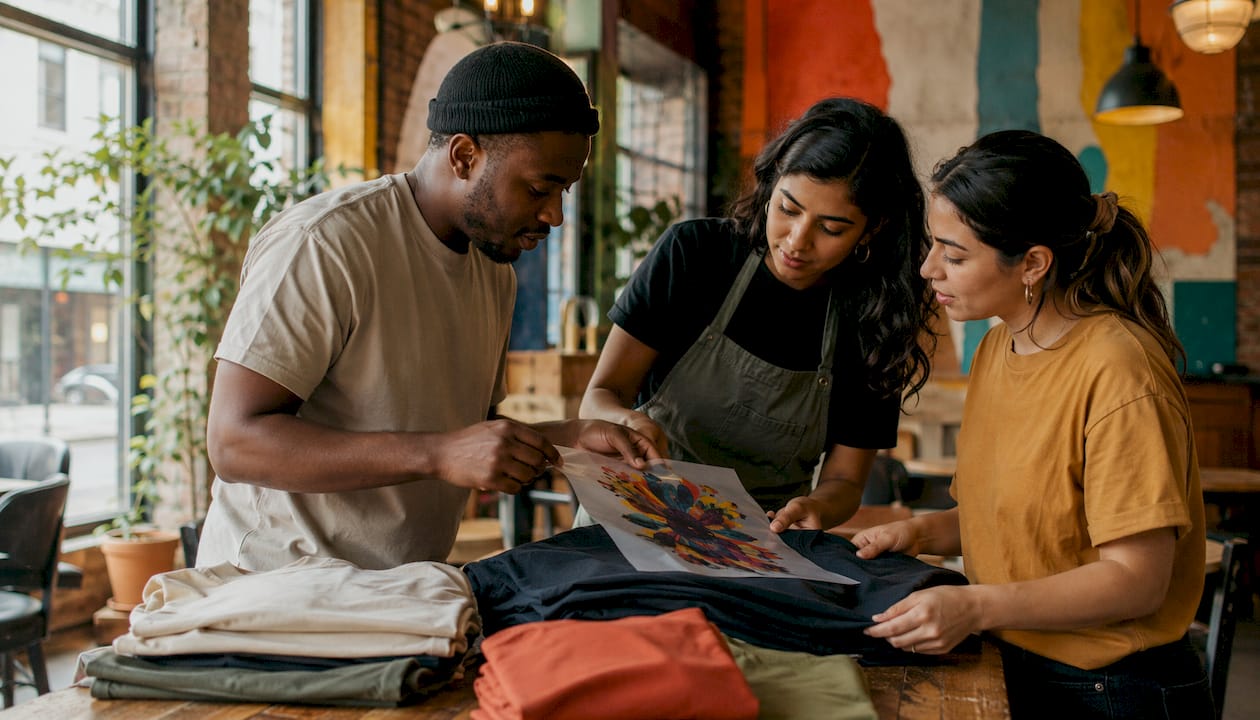
If the garment is 100% polyester and light-colored, sublimation is almost always the most cost-effective and durable route. The print will outlast the shirt, and there is no surface layer to crack. Large runs on light polyester are where sublimation’s low per-piece cost really shows.
If the garment is cotton or dark, sublimation is not an option at all. HTV covers simple text, names, and solid-color logos efficiently. For full-color or photo designs on dark shirts, HTV requires layering multiple colors, which adds time and cost. That is the situation where DTF is the cleaner call.
Red flags to catch before you press:
- Client wants a photo print on a 100% cotton tee: sublimation will not work. Redirect to DTF.
- Client wants a soft, no-feel finish on a dark garment: neither sublimation nor standard HTV delivers that. DTF comes closest.
- Mixed-fabric order with both polyester and cotton SKUs: switching between sublimation and HTV mid-run costs time. DTF handles both from one workflow.
Over 60% of first-time crafters choose the wrong transfer method for their project. Running a sample press on any new substrate before committing to a full run is the single cheapest insurance a shop can buy.
Press settings, wash care, and small-shop tactics to extend print life
| Method | Temperature | Pressure | Time | Peel |
|---|---|---|---|---|
| Sublimation | 375°F–400°F | Medium-firm, even | — | Hot peel |
| HTV | 305°F–320°F | Medium | — | Hot or cold (per vinyl spec) |
| DTF | 300°F–320°F | Medium-firm | — | Cold peel |
Wash care to pass along with every order:
- Wash inside out on a gentle cycle with cold water.
- Avoid bleach and fabric softeners; both degrade adhesive bonds and dye integrity.
- Tumble dry on low or hang dry. High heat accelerates HTV edge lift.
- For sublimation items, avoid prolonged direct sunlight storage.
Pro Tip: After pressing any transfer, let the garment cool completely, then run a piece of tape firmly across the print edge and pull. If any edge lifts, your pressure was uneven or the peel was too early. Catching this on piece one saves an entire run.
Common failure modes:
- Ghosting (sublimation): Paper shifted during press. Tape the transfer down before pressing.
- Edge lift (HTV/DTF): Insufficient pressure at the edges or premature peel. Re-press with a Teflon sheet.
- Color fade (sublimation): Temperature too low or dwell time too short. Verify your platen thermometer calibration.
- Cracking (HTV): Adhesive underactivated or vinyl quality is low. Check press temperature with a laser thermometer.
Myths, common mistakes, and quick troubleshooting
Myth vs. fact:
- “Sublimation works on any fabric.” False. It requires polyester or a polymer coating. On cotton, the dye will not bond and washes out within a few cycles.
- “All heat transfers are permanent.” Incorrect. Sublimation is effectively permanent on appropriate substrates because the dye bonds into the fiber. HTV longevity depends on vinyl grade and application quality; poor technique can cause failure well before 20 washes.
- “HTV lasts the same regardless of brand.” Not true. Vinyl composition and adhesive formulation vary significantly. Budget vinyl on a high-wash item is a return waiting to happen.
- “You can sublimate on a 50/50 blend and get full color.” You get a faded, vintage look because the dye only bonds to the polyester portion of the fiber.
Quick troubleshooting:
- Fading after first wash: Check substrate poly content and press temperature. Low poly or low heat are the usual culprits.
- Color mismatch: Sublimation color shifts between screen and press are common. Use an ICC profile and test on the actual blank before a production run.
- Uneven print: Pressure distribution. Foam padding under the platen helps on seams and zippers.
Safety note: Sublimation inks release fumes during pressing. Work in a ventilated space or use a ventilation hood over the press. DTF adhesive powder should be handled with a dust mask during application to avoid inhalation.
Key Takeaways
Sublimation is the most durable, softest-finish option for light polyester garments; HTV covers dark and cotton jobs; DTF bridges both when you need full color across fabric types.
| Point | Details |
|---|---|
| Substrate decides the method | Sublimation needs light polyester; HTV works on cotton and dark garments; DTF handles both. |
| Hand feel is a selling point | Sublimation delivers a zero-hand finish; HTV always adds a raised tactile layer customers can feel. |
| Durability gap is real | Sublimation holds 50+ washes; HTV can start cracking or peeling after 20–30 washes if application quality or vinyl grade is off. |
| Always run a sample first | One test press on the actual substrate catches pressure, temperature, and color issues before a full run. |
| Transferkingz DTF for mixed needs | Press-ready DTF transfers from Transferkingz work on cotton, polyester, and dark garments with no printer investment. |
A decorator’s honest take on mixing methods
Running a single method for every job sounds tidy, but it costs money. Sublimation is my go-to for white and light polyester runs because the per-piece economics are hard to beat and the print quality is genuinely superior. But I batch those jobs together. Switching a press from sublimation to HTV mid-day means temperature changes, different pressure settings, and more room for error.
The smarter move is scheduling: sublimation runs in the morning when the press is dialed in for high heat, HTV and DTF jobs in the afternoon. For full-color work on dark or mixed-fabric orders, I push clients toward DTF. The margin is comparable, rework is rare, and customers are happier with the hand feel than they expect. When clients ask about care instructions, I always include a printed card. Returns from wash damage are almost always a care issue, not a print issue.
Transferkingz has solid application guides and FAQs worth bookmarking if you are dialing in a new substrate or troubleshooting a press setting.
Why Transferkingz DTF fills the gaps sublimation and HTV leave open
Sublimation and HTV each have a ceiling. Sublimation stops at the fabric color and composition. HTV stops at design complexity and wash life. Transferkingz DTF transfers clear both limits: full color on cotton, polyester, blends, and dark garments, with no printer, no film curing setup, and no minimum order.
You upload your design, configure your gang sheet, and receive press-ready transfers shipped fast or available for same-day local pickup. The custom DTF transfers are printed with premium inks on quality film, so the hand feel is soft and the colors hold wash after wash. Whether you are running a single sample or a production batch, the order process is the same. Visit Transferkingz to place your first order or request a sample run today.
Useful sources and further reading
- Sublimation Paper vs Heat Transfer Paper: Key Differences — Printable Press — best for press temperature ranges, wash life data, and defect causes.
- Sublimation printing vs heat transfer — Design’N’Buy — covers substrate limits and mixed-method shop workflows.
- Sublimation Vs Heat Transfer Vinyl — Let’s Sublimate — strong on color fidelity comparisons and permanence myths.
- Sublimation vs HTV — SubliGeniusPrint — practical dark-garment workflow notes.
- Sublimation vs. Heat Transfer — Spark Blank Textiles — hand feel and premium soft-touch context.
- DTF vs Sublimation — Transferkingz — in-depth comparison for shops evaluating DTF as a primary or supplemental method.
- Print Durability Guide — Transferkingz — practical care and QA guidance for extending print life across all methods.
0 comments