
TL;DR:
- Digital transfers enable small businesses to produce full-color apparel without high setup costs.
- They offer fast turnaround, low minimum orders, and high design flexibility for growth.
- DTF technology supports intricate designs and quick testing, encouraging creative experimentation.
Most small business owners assume custom apparel is a game reserved for brands with deep pockets and warehouses full of pre-printed stock. That assumption has kept a lot of talented designers on the sidelines. The truth is, digital transfers, particularly Direct-to-Film (DTF) technology, have completely changed what’s possible on a tight budget. You can now print one shirt, fifty shirts, or five hundred shirts without paying for setup fees or committing to bulk minimums. This guide breaks down exactly how digital transfers work, why they outperform traditional methods for most small-run needs, and how to use them as a genuine growth tool for your brand.
Table of Contents
- What are digital transfers and how do they work?
- Top advantages of digital transfers for small businesses
- Comparing digital transfers to traditional methods
- How digital transfers drive growth and efficiency
- The unconventional truth about digital transfers in custom apparel
- Get started with digital transfers today
- Frequently asked questions
Key Takeaways
| Point | Details |
|---|---|
| Low minimums | Digital transfers enable profitable small-batch runs without hefty setup fees. |
| Superior customization | These transfers excel at intricate, full-color designs for unique branding. |
| Faster turnaround | You get finished custom products in days instead of weeks. |
| No inventory risk | Produce only what you need and avoid unsold stock. |
| Easy to scale | Digital transfers grow with your business, supporting rapid launches and experimentation. |
What are digital transfers and how do they work?
A digital transfer is a print produced on a specialized film or carrier sheet that is later applied to fabric using heat and pressure. Unlike traditional printing, where ink is pushed directly onto garment fibers, digital transfers are created separately and then bonded to the material. This separation is what makes the whole system so flexible.
DTF, or direct-to-film printing explained, is the dominant form of digital transfer today. The process works like this:
- Your design is printed in full color onto a clear PET film using specialized water-based inks.
- A hot-melt adhesive powder is applied evenly over the wet ink.
- The film goes through a curing oven, which melts the powder and bonds it to the ink layer.
- The finished transfer is pressed onto your garment using a heat press, then peeled away, leaving a vibrant, flexible print behind.
The result is a print that stretches with the fabric, holds color through repeated washes, and reproduces details like fine lines and gradients that would be difficult or expensive with older techniques.
Comparison: Digital transfers vs. screen printing
| Feature | Digital (DTF) transfer | Screen printing |
|---|---|---|
| Minimum order | 1 piece | Typically 12 to 24+ pieces |
| Setup cost | None | $15 to $50 per color |
| Cost per piece (small run) | Low | High |
| Detail and color range | Full color, gradients | Limited by screen count |
| Turnaround time | 1 to 3 days | 5 to 10 days |
| Design change flexibility | Instant | Requires new screens |
For small businesses, that “minimum order” row alone is a game-changer. DTF transfers enable efficient small-run production without sacrificing print quality, which is something screen printing simply cannot match at the same price point.
Pro Tip: If you’re running seasonal promotions or testing new designs, digital transfers let you swap artwork between orders without any extra cost. You’re never stuck reprinting a design that didn’t sell.
Top advantages of digital transfers for small businesses
Now that you understand the basics, let’s pinpoint the reasons digital transfers are gaining traction among small apparel brands and independent designers.
The advantages aren’t just about cost. They’re about freedom. Here’s what that looks like in practice:
- No bulk inventory risk. You print what you sell. No boxes of unsold medium-size shirts collecting dust.
- Fast production cycles. Most DTF orders ship within one to three business days, which means you can take a customer’s order on Monday and ship their product by Wednesday.
- On-demand and variable designs. Each piece in a single order can have a different design. This is huge for personalized products and custom gifting.
- Low startup cost. You don’t need your own printing equipment. Outsourcing DTF transfers means your upfront investment is close to zero.
- Scalability without a warehouse. As orders grow, you simply increase your transfer order. There’s no need to hold stock until demand is proven.
The broader industry backs this up. DTF enables efficient entry into custom apparel with low barriers, high customization, and scalability without inventory risk, making it the preferred model for emerging brands.
Small business operators using DTF for small businesses are also benefiting from wider industry trends for DTF printing, including falling transfer costs and faster turnaround capabilities as the technology matures.
“The brands winning in custom apparel today aren’t the ones with the biggest print runs. They’re the ones that can react fastest to what their customers actually want.”
Pro Tip: Before committing to a large product launch, print a small test batch of three to five designs using DTF transfers. Sell them at pop-up events or through social media. Let real sales data, not gut instinct, tell you which design deserves the bigger push.
Comparing digital transfers to traditional methods
While the advantages are substantial, it’s valuable to consider how digital transfers stack up directly against established alternatives.
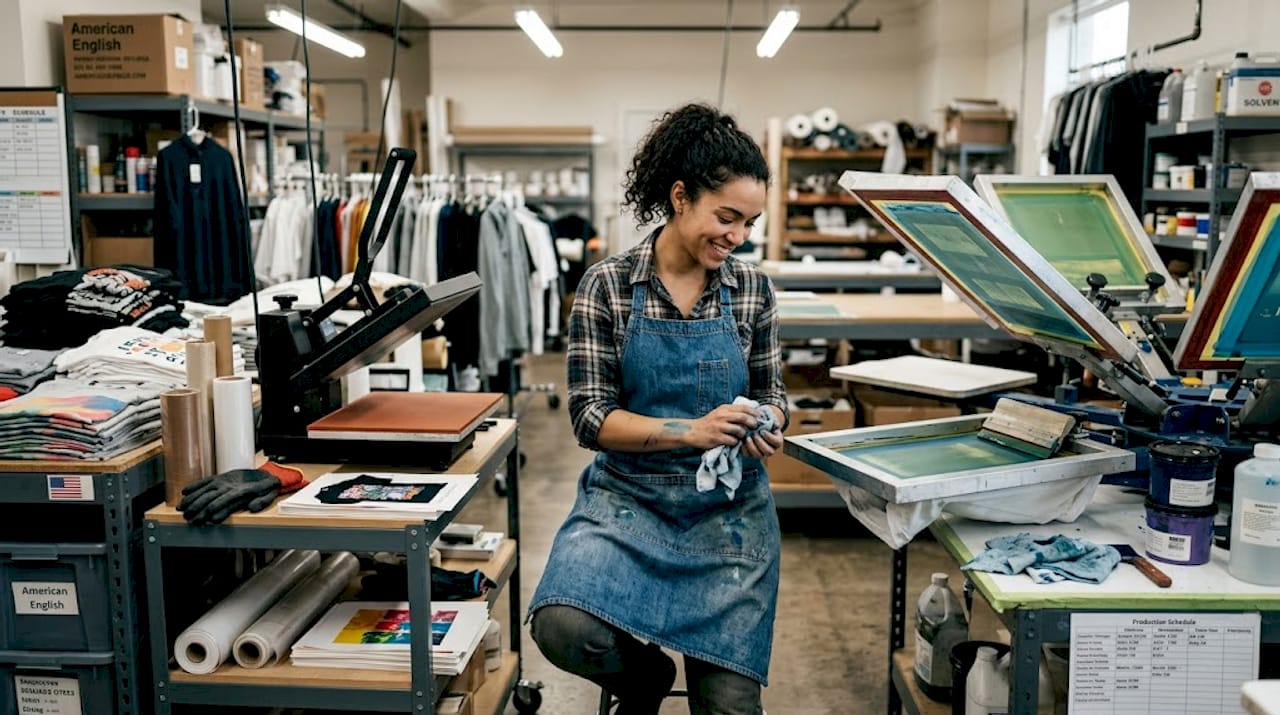
Screen printing and vinyl cutting both have their place. But for most small business use cases, especially orders under 100 units, they carry serious drawbacks.
DTF vs. screen printing vs. vinyl: side-by-side
| Category | DTF transfers | Screen printing | Vinyl (HTV) |
|---|---|---|---|
| Upfront setup cost | None | $15 to $50 per color | None |
| Color flexibility | Unlimited | Limited by screen count | Limited; multi-layer needed |
| Fine detail capability | Excellent | Moderate | Poor |
| Minimum order | 1 piece | 12 to 24+ pieces | 1 piece |
| Best for | Small runs, full color | Large runs, simple designs | Basic text and shapes |
| Application time | Under 20 seconds | Pre-applied in shop | 30 to 60+ seconds |
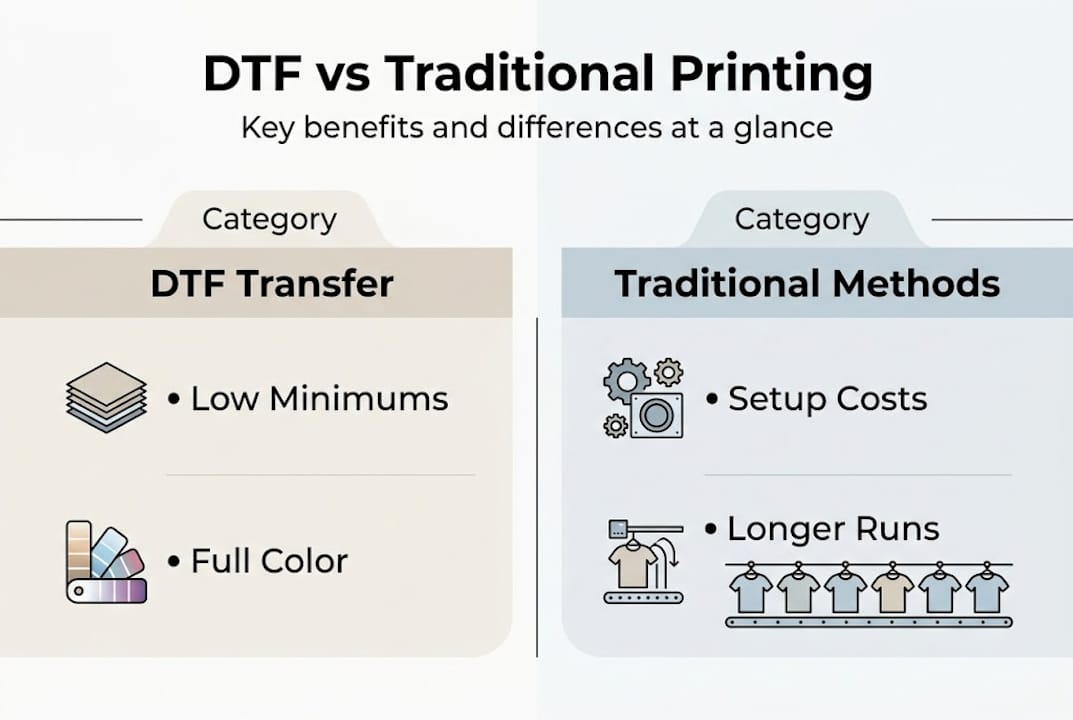
The cost breakdown makes it obvious. For orders under 100 units, DTF is prioritized over traditional screen printing because the per-unit economics are simply better. Screen printing only becomes cost-competitive when you’re printing hundreds of identical pieces in a few colors.
Vinyl heat transfer is accessible, but it struggles with photo-realistic artwork, gradients, or anything with more than three or four colors. It works well for sports jerseys with names and numbers. It doesn’t work well for your brand logo with 12 shades of blue in it.
- Choose DTF when you want full-color artwork, small runs, or fast design changes.
- Choose screen printing when you’re ordering 200+ identical pieces in limited colors.
- Choose vinyl when you need simple, text-based graphics on a very tight budget.
For a deeper look at what makes premium DTF heat transfers perform so consistently, or to explore what professional DTF services look like in practice, those resources break it down from a production standpoint.
How digital transfers drive growth and efficiency
Beyond basic advantages, let’s break down how digital transfers become a growth catalyst and reduce everyday headaches.
The most underrated benefit of DTF for growing brands is speed to market. When a trend breaks on social media, you can have a relevant product ready to ship within 48 hours. That kind of agility used to belong only to major retailers with massive production teams.
DTF production benchmarks for small businesses
| Metric | Typical range |
|---|---|
| Turnaround time (small batch) | 1 to 3 business days |
| Minimum order quantity | 1 piece |
| Average profit margin per unit | 40% to 65% (depending on retail price) |
| Design change cost | $0 |
| Heat press application time per piece | 15 to 20 seconds |
Those numbers tell a clear story. With near-zero changeover time between designs and margins that hold even at low volumes, DTF is built for the way small businesses actually operate.
Here’s a simple action plan to integrate DTF into your production workflow:
- Finalize your design files in 300 DPI PNG format with a transparent background.
- Order a test batch of five to ten transfers from a trusted supplier to check color accuracy and feel.
- Press and photograph your samples for marketing assets before your official launch.
- List your product and set fulfillment expectations based on your supplier’s turnaround time.
- Scale your transfer orders based on actual sales velocity, not projections.
DTF lowers the barriers for brand expansion and inventory management, which means you can grow a product line without the financial exposure that used to come with custom apparel. Pair that with resources on merch production efficiency and cost-saving tips with DTF printing and you have a full operational playbook.
The unconventional truth about digital transfers in custom apparel
Stepping back, it’s worth considering how the mindset around digital transfers may be the real differentiator. Most conversations about DTF focus on speed and cost. Those matter. But the brands that actually build lasting audiences are using digital transfers for something more important: creative experimentation.
When producing a single design costs almost nothing extra, you stop treating each product launch as a high-stakes bet. You start testing bolder ideas. You run limited drops that create urgency. You print a design just for your 50 most loyal customers and watch what happens. This cycle of fast testing and iteration is how the most interesting apparel brands get built.
The brands clinging to traditional production habits are waiting weeks for proofs and locking budgets into inventory before a single customer has seen the design. That model rewards caution. DTF rewards creativity. Unlock DTF services not just as a production tool but as a creative engine, and the growth follows naturally.
Get started with digital transfers today
If you’re convinced digital transfers are the missing piece in your merch or apparel strategy, here’s how to get started fast.
Transfer Kingz specializes in high-quality DTF transfers with no minimum order requirements, fast turnaround times, and premium inks that deliver consistent color across every run. Whether you’re based in the South or shipping nationally, services like DTF transfers in Dallas and DTF transfers in Texas make professional-grade production accessible for businesses at any stage.
Ready to see how DTF transfers revolutionize apparel production for brands like yours? Explore the full range of services at Transfer Kingz and place your first order with zero minimums and complete design flexibility.
Frequently asked questions
What is the main benefit of choosing digital transfers for custom apparel?
Digital transfers deliver high-quality, full-color prints with no minimum order requirements and fast turnaround times. They allow small brands to produce efficient, high-quality production for even a single piece without inflated per-unit costs.
Are digital transfers cost-effective for small orders?
Yes, digital transfers are far more affordable than traditional screen printing for short runs. For orders under 100 units, DTF consistently outperforms screen printing on cost per piece.
Can digital transfers handle complex and multi-color designs?
Absolutely. DTF excels at reproducing intricate artwork with gradients, fine lines, and unlimited colors. It supports high customization and detail without charging extra for color count or complexity.
How quickly can I get custom products using digital transfers?
Most small-batch digital transfer orders are ready within one to three business days from design approval, making same-week turnarounds realistic for most shops.
Do digital transfers require special equipment to apply?
No. A standard heat press is all you need. Most transfers apply in under 20 seconds, which makes the process completely manageable for any small business or solo operator.
Recommended
- Why Choose High-Quality Transfers for Apparel Printing? – Transfer Kingz
- Why Choose Custom DTF for Apparel Printing Success – Transfer Kingz
- Why Choose Custom Transfers for Apparel Brands – Transfer Kingz
- Advantages of custom transfers for apparel businesses – Transfer Kingz
- Custom Embroidery Gift Wrap: Luxury With Impact – Nicholas & Rose Limited
0 comments