

TL;DR:
- Online ordering increases revenue, reduces labor costs, and captures after-hours sales. It also improves order accuracy and customer experience, making it a vital necessity for competitiveness in 2026.
Online ordering is a direct revenue channel that increases ticket sizes, reduces labor costs, and captures sales your phone line misses entirely. Business owners who treat it as a convenience add-on leave measurable money on the table. The industry data is clear: businesses that shift order volume to digital platforms see higher average order values, fewer errors, and recovered staff hours within months. This guide breaks down the measurable benefits of online ordering, the customer experience advantages, the competitive stakes, and the best practices that separate profitable implementations from mediocre ones.
Why choose online ordering for your business?
Online ordering is defined as a digital system that lets customers place and pay for orders through a website, app, or platform without staff involvement. The business case goes well beyond convenience.
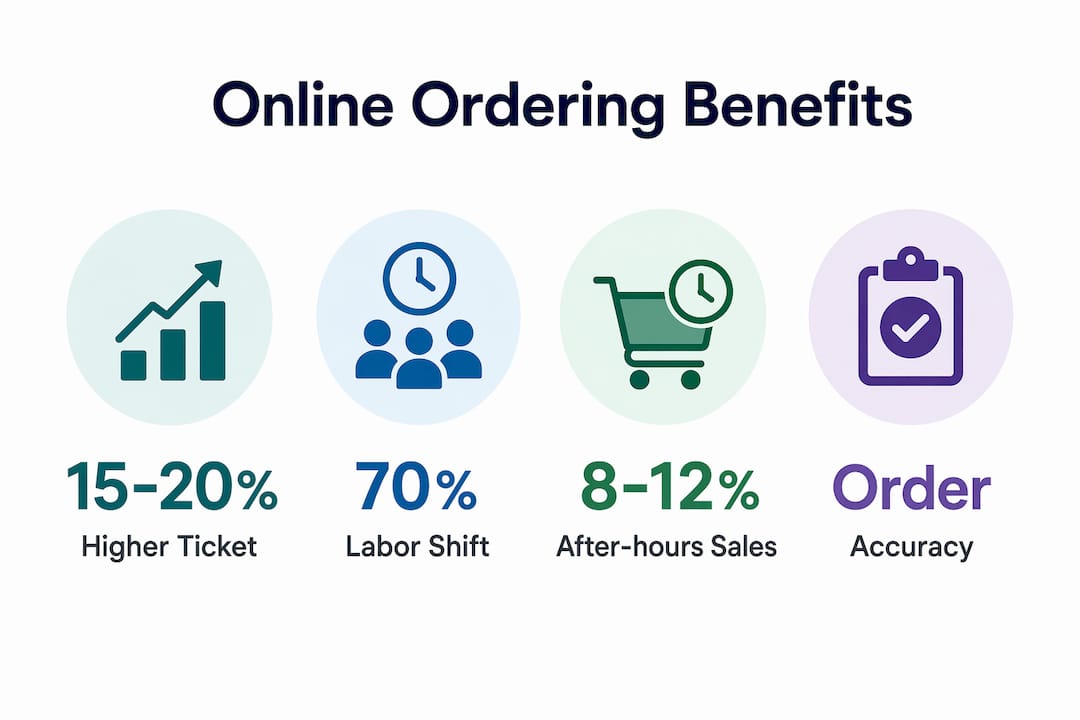
Online orders average 15–20% higher ticket sizes than phone orders. For a business doing $800,000 in annual order volume, that gap translates to $120,000–$160,000 in additional revenue per year. That number alone reframes the decision from “should we offer this?” to “how fast can we launch it?”
The reason ticket sizes rise is behavioral. Digital ordering removes time pressure from the customer. Without a staff member waiting on the line, customers browse, read descriptions, and add items they would have skipped during a rushed phone call. The result is a larger, more deliberate order every time.
Pro Tip: If you sell customizable products, online ordering is especially powerful. Customers who configure their own orders spend more and complain less because they own every choice they made.
What measurable business benefits does online ordering provide?
The advantages of online ordering show up in four concrete areas: revenue, accuracy, labor, and after-hours sales.
Revenue and ticket size
The 15–20% ticket size increase is the headline number, but the compounding effect matters more. Every order placed online carries a higher baseline value. Multiply that across thousands of transactions per year and the revenue gap between a phone-first and digital-first business becomes structural, not incidental.
Order accuracy
Phone orders fail because of what researchers call “telephone-game distortion.” Details get misheard, modifiers get dropped, and staff write down approximations. Online ordering eliminates this because customers enter their own specifications directly. Accurate digital records also reduce food waste and refunds by ensuring precise fulfillment of every instruction. Fewer errors mean fewer refunds, fewer reprints, and fewer unhappy customers.
Labor savings
70% of order volume typically shifts from phone to digital within six months of launching an online ordering system. That shift recovers roughly 175 minutes of staff labor per day. That is nearly three hours your team can redirect to production, customer service, or fulfillment instead of answering calls and transcribing orders.
Order automation lets staff focus on higher-value tasks rather than manual entry or managing phone lines. For small businesses with lean teams, this is not a minor efficiency gain. It is the difference between a staff member doing two jobs or one.
After-hours revenue
Online ordering captures 8–12% of orders placed outside standard business hours. Those orders come in with zero additional overhead. No staff member is clocked in. No phone is being answered. The system processes the order and you fulfill it the next morning. For custom printing businesses, this means a client in a different time zone can place a bulk order at 11:00 PM and have it queued for production by the time your shop opens.
How does online ordering improve the customer experience?
Customers choose digital ordering because it gives them control. Online ordering systems provide 24/7 access, order tracking, multiple payment options, and transparent product displays with photos and modifiers. Each of those features addresses a specific friction point that causes customers to abandon orders or call with complaints.
Convenience and flexibility
A customer who can order at 2:00 AM, pay with Apple Pay, and receive an order confirmation immediately has no reason to call your business during peak hours. That convenience builds loyalty faster than any discount program. Repeat customers cost less to serve and spend more per transaction over time.
Transparency and upsells
A well-built online ordering interface shows customers exactly what they are buying. Photos, size options, material choices, and add-ons appear clearly before checkout. That transparency encourages upsells naturally because customers see options they did not know existed. A customer ordering a single custom transfer may add a gang sheet builder option once they see it displayed. That is a sale that never happens over the phone.
Pro Tip: Use high-quality product photos in your online ordering interface. Customers who can see what they are buying convert at higher rates and request fewer changes after the fact.
Trust through confirmation
Order confirmation emails and tracking updates reduce customer anxiety and inbound “where is my order?” calls. Both outcomes save your team time and signal professionalism to the customer. Businesses that offer reliable ordering experiences build the kind of habit loops that bring customers back without a marketing push.
Is online ordering a competitive necessity in 2026?
Customer expectation for digital-first experiences in 2026 makes online ordering a critical hedge against competition. Businesses that rely solely on phone orders face a structural disadvantage. Customers who cannot order digitally from you will find a competitor who lets them.
“Online ordering is no longer a feature that differentiates you. It is a baseline expectation. Businesses without it are not competing on equal terms. They are competing with one hand tied behind their back.”
The competitive risk is not just losing individual orders. It is losing the habit. When a customer builds a routine around a competitor’s ordering platform, switching costs rise. They have saved preferences, payment methods, and order history stored there. Getting them back requires more than a lower price.
The businesses most at risk are those with high repeat-order volume and a phone-first model. Custom apparel shops, print businesses, and specialty retailers fit this profile exactly. Every phone order that could have been digital is a missed opportunity to capture data, automate fulfillment, and build a customer relationship that scales.
For print businesses specifically, exploring garment printing trends in 2026 shows how digital ordering is reshaping customer expectations across the entire apparel decoration industry.
What are best practices for implementing online ordering?
A poorly implemented online ordering system creates more problems than it solves. These five practices separate high-performing implementations from ones that frustrate customers and staff alike.
-
Integrate with your POS and inventory in real-time. Real-time inventory syncing prevents overselling and maintains customer trust. A customer who orders a product that is out of stock and receives a cancellation email will not order again. Sync your systems before you go live.
-
Offer multiple payment options. Offering a variety of digital payment methods removes friction that stops customers from completing their purchase. Accept credit cards, digital wallets like Apple Pay and Google Pay, and buy-now-pay-later options where your customer base expects them.
-
Use high-quality visuals and modifier prompts. Every product needs a photo and a clear description. Modifier prompts (size, color, quantity, material) guide customers toward complete orders and reduce back-and-forth after submission.
-
Optimize for mobile. The majority of online orders are placed on mobile devices. A checkout flow that works on desktop but breaks on a phone loses orders silently. Test every step of your ordering process on iOS and Android before launch.
-
Use order data to improve your catalog. Your online ordering system generates data on what customers buy, what they skip, and where they abandon their carts. Review that data monthly. Remove low-performing options. Promote high-margin items. For print businesses, a workflow optimization checklist can help you align your digital ordering setup with your production capacity.
| Implementation area | Why it matters |
|---|---|
| POS and inventory integration | Prevents overselling and fulfillment errors |
| Multiple payment options | Reduces cart abandonment at checkout |
| Mobile optimization | Captures the majority of digital orders |
| Product visuals and modifiers | Increases average order size and reduces errors |
| Order data analysis | Drives catalog and pricing decisions over time |
For businesses setting up ecommerce solutions for the first time, working with a platform that handles payment processing, inventory sync, and order management in one place cuts implementation time significantly.
Key Takeaways
Online ordering is a revenue-generating system that increases ticket sizes by 15–20%, recovers labor hours, and captures after-hours sales that phone-based ordering cannot reach.
| Point | Details |
|---|---|
| Higher ticket sizes | Online orders average 15–20% more than phone orders, adding significant annual revenue. |
| Labor recovery | Shifting 70% of orders to digital saves roughly 175 minutes of staff labor per day. |
| After-hours revenue | 8–12% of online orders come in outside business hours with zero additional overhead. |
| Order accuracy | Direct customer entry eliminates phone-order distortion and reduces refunds and waste. |
| Competitive positioning | Digital ordering is a baseline customer expectation in 2026, not a differentiator. |
The misconception that costs business owners the most
Most business owners I have observed treat online ordering as a convenience upgrade. They add it to their website, point a few customers toward it, and consider the job done. That approach misses the entire point.
Online ordering is not a feature. It is a revenue channel with its own economics. The 15–20% ticket size increase does not happen because customers suddenly like you more. It happens because the ordering environment changes their behavior. They browse. They add. They spend more because no one is rushing them. That behavioral shift is predictable and repeatable every single time.
The labor savings argument is equally undervalued. Business owners who have never tracked how many staff hours go into answering phones, transcribing orders, and correcting mistakes are often shocked when they run the numbers. Three hours of recovered labor per day is not a rounding error. It is a part-time employee’s worth of productive time redirected to actual work.
My honest take: the businesses that will struggle most in the next three years are the ones still treating digital ordering as optional. Customers have already decided. They want to order on their terms, at their pace, from their phone. The only question is whether your business is the one they order from.
Transferkingz and custom apparel online ordering
Transferkingz built its entire operation around the advantages of online ordering for custom printing. Business owners and production shops can upload artwork, configure gang sheets, and place orders without minimums, all through a direct digital interface that removes the friction of phone-based quoting.
For businesses in Texas looking for fast turnaround on custom transfers, DTF printing in Dallas gives you a direct online ordering path from artwork upload to production-ready transfer. No phone calls. No back-and-forth. Just a clean digital workflow that gets your order into production faster. Transferkingz also covers the full state through its Texas DTF services, so location is never a barrier to placing an order.
FAQ
What is online ordering and how does it work?
Online ordering is a digital system where customers place and pay for orders through a website or app without staff involvement. The order goes directly into your fulfillment queue, often synced with your POS and inventory in real-time.
Why is online ordering better than phone ordering?
Online orders average 15–20% higher ticket sizes and eliminate the order errors caused by verbal miscommunication. Customers enter their own specifications, which reduces mistakes and refunds.
How quickly do businesses see results from online ordering?
70% of order volume typically shifts from phone to digital within six months of implementation, recovering roughly 175 minutes of staff labor per day.
Does online ordering capture sales outside business hours?
Online ordering captures 8–12% of orders placed outside standard business hours, adding revenue with no additional staffing cost.
Is online ordering worth it for small businesses?
Online ordering benefits small businesses directly through reduced labor, higher order accuracy, and increased average order values. The gains compound as order volume grows, making early adoption the most cost-effective approach.
0 comments