

TL;DR:
- Fast turnaround combines quick production and reliable delivery, which builds customer trust and competitive advantage. Reliable, accurate delivery promises are more valuable to customers than just speed and prevent silent churn. Aligning production with carrier pickups and fostering a culture of responsibility are essential for sustained fast turnaround.
Fast turnaround is defined as the combined speed of production completion and reliable delivery to the customer. For small and mid-sized apparel and merchandise businesses, why fast turnaround matters goes far beyond shipping speed. It shapes customer trust, drives repeat purchases, and determines whether your brand wins or loses against larger competitors. Roland Berger identifies speed as a strategic leadership priority in dynamic markets with faster product cycles. Miss a delivery window once, and you may never see that customer again.
Why fast turnaround matters for customer satisfaction
Speed is not just a convenience. For apparel customers, a missed deadline is a broken promise. A school uniform order that arrives after the first day of class, or a custom team jersey that shows up after the tournament, destroys trust that took months to build.
Bringg’s 2026 survey finds that late delivery is the single biggest driver of customer churn after purchase. That finding matters because the damage is often silent. Customers do not always complain. They simply stop ordering.
The numbers from The Harris Poll UK reinforce this pattern. 28% of customers who experience delivery issues are unlikely to reorder. That figure climbs to 41% when items are missing and 36% when customer support is poor. For an apparel SMB with tight margins, losing nearly one in three customers after a single bad delivery is not a recoverable situation.
Event-driven purchases make this even more acute. Apparel and merchandise orders are frequently tied to specific dates: graduations, sports seasons, corporate events, and holidays. A customer who orders custom DTF transfers for a holiday pop-up shop has zero flexibility on timing. Fast turnaround is not a perk for these customers. It is the baseline requirement.
- Late delivery causes silent churn, meaning customers leave without explaining why
- Event-driven apparel orders have hard deadlines that make delays unacceptable
- Poor customer service after a delivery failure compounds the damage significantly
- Repeat purchase rates drop sharply after even a single delivery failure
Pro Tip: Set your published delivery window slightly longer than your actual average. Consistently delivering ahead of the stated date builds a reputation for reliability faster than any marketing campaign.
What are the operational elements behind fast turnaround?
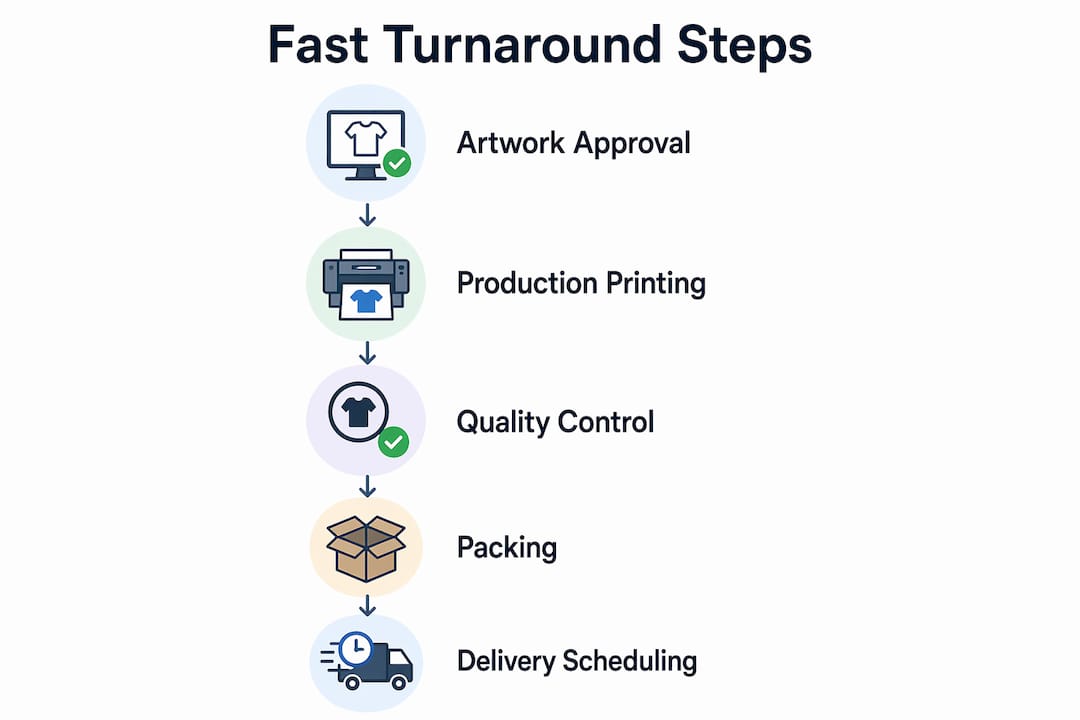
Fast turnaround does not happen by accident. It results from tight alignment between two distinct phases: production turnaround and delivery turnaround. Most apparel businesses treat these as separate problems. The ones that win treat them as a single system.

Production turnaround covers artwork approval, printing, curing, quality inspection, and packing. Delivery turnaround covers carrier pickup, transit, and final delivery. Bringg advises collapsing the gap between these two phases through aligned scheduling and logistics planning. A print job that finishes at 6 p.m. but misses the carrier cutoff at 5 p.m. adds a full day to the customer’s wait.
Lean manufacturing principles apply directly here. Reducing bottlenecks in the approval stage, standardizing file formats, and batching similar print jobs all cut production time without cutting corners on quality. Transferkingz applies this thinking to its DTF printing workflow by synchronizing gang sheet builds with production scheduling to minimize idle press time.
Quality control is a turnaround factor that most businesses underestimate. A rework cycle caused by a missed color check or a misaligned transfer adds hours or days to the timeline. Building inspection into the workflow rather than treating it as a final gate prevents rework delays before they start.
| Workflow stage | Common bottleneck | Fix |
|---|---|---|
| Artwork approval | Back-and-forth revisions | Standardize file specs upfront |
| Printing | Job sequencing inefficiency | Batch similar jobs together |
| Quality inspection | End-of-line rework | Inspect at each stage, not just the end |
| Packing and labeling | Manual errors | Use pre-printed packing slips |
| Carrier handoff | Missing cutoff windows | Schedule production around carrier pickup times |
Pro Tip: Map your carrier pickup times first, then build your production schedule backward from those cutoffs. This single change eliminates the most common cause of same-day production delays.
Why reliability matters as much as speed
Speed without reliability is a liability. A business that promises two-day delivery and hits it 70% of the time creates more frustration than one that promises four days and hits it 98% of the time. Customers do not benchmark you against your fastest delivery. They benchmark you against your promise.
Shippit’s 2026 delivery insights show that 68% of consumers say an accurate delivery date is essential. More telling: 52% value a reliable date over a fast one. That data reframes the entire conversation about quick turnaround. Customers are not asking for speed above all else. They are asking for accuracy.
The concept Shippit calls the “promise gap” describes the difference between the delivery date shown at checkout and the actual delivery date. A wide promise gap, even when delivery is technically fast, erodes trust. Shippit also notes that under-promising and reliably over-delivering grows both acquisition and retention without adding costs.
Real-time updates close the promise gap from the customer’s side. When a customer knows their order shipped, where it is, and when it will arrive, they tolerate minor delays far better. The absence of communication is what turns a one-day delay into a customer service crisis.
Speed-focused approach vs. reliability-focused approach:
| Factor | Speed-focused | Reliability-focused |
|---|---|---|
| Primary goal | Fastest possible delivery | Accurate delivery promise |
| Customer expectation | High, often unrealistic | Calibrated and met consistently |
| Churn risk | High when speed fails | Low due to consistent accuracy |
| Communication | Minimal | Proactive updates at every stage |
| Long-term brand trust | Fragile | Strong and compounding |
How does fast turnaround create a competitive advantage?
For apparel and merchandise SMBs, speed is one of the few areas where you can genuinely outperform larger competitors. Big brands carry large inventory buffers and long supply chains. A nimble SMB with a tight production workflow can take a custom order on Monday and ship it by Wednesday. That capability is a real market differentiator.
Roland Berger’s research confirms that shortening development and market launch timelines reduces costs, enables earlier customer access, and supports first-mover advantage. Applied to apparel SMBs, this means the business that can fulfill a trending design order first captures the sale and the customer relationship.
Faster turnaround also reduces inventory carrying costs. When you can produce and ship quickly, you do not need to hold large stocks of finished goods. That frees up cash and reduces the risk of unsold inventory. For custom merchandise, where designs change frequently, this financial benefit compounds over time.
The competitive edge compounds further through word of mouth. A customer who receives a custom order two days ahead of schedule tells people. That referral carries more weight than any paid ad. Apparel businesses that build a reputation for fast, reliable turnaround acquire customers at a lower cost than those competing purely on price.
- Faster production cycles let SMBs respond to trending designs before competitors
- Reduced inventory needs free up working capital for growth
- Reliable turnaround generates referrals that lower customer acquisition costs
- First-mover advantage in seasonal or event-driven apparel is often decisive
Pro Tip: Track your average turnaround time by order type each month. Knowing where custom orders slow down versus standard orders tells you exactly where to focus your workflow improvements.
What practical steps can apparel SMBs take to improve turnaround?
Improving turnaround starts with measuring it. Most apparel SMBs know their average shipping time but cannot tell you where production hours actually go. That gap in visibility is where delays hide.
The Harris Poll UK recommends implementing post-delivery feedback loops to pinpoint bottlenecks like approval delays or packing errors. A simple survey sent 48 hours after delivery, combined with internal time-stamping at each production stage, gives you the data to fix chronic problems rather than just react to them.
- Audit your current turnaround by time-stamping each production stage for two weeks to find where hours disappear
- Align production schedules with carrier cutoffs so finished orders ship the same day they are completed
- Communicate realistic delivery dates at checkout based on actual averages, not best-case scenarios
- Send proactive shipping updates at order confirmation, dispatch, and out-for-delivery stages
- Review delivery feedback monthly and trace complaints back to specific production or logistics stages
Transferkingz publishes a workflow optimization checklist that walks through each of these steps in the context of DTF printing production. For businesses handling bulk print orders, the sequencing advice alone can cut production time significantly.
Pro Tip: Use a shared production calendar visible to both your print team and your shipping team. When both sides see the same schedule, carrier cutoff misses drop immediately.
Key takeaways
Fast turnaround builds customer loyalty and competitive advantage only when production speed and delivery reliability work together as a single system.
| Point | Details |
|---|---|
| Speed and reliability must align | Promising fast delivery and missing it causes more damage than a slower, accurate promise. |
| Late delivery drives silent churn | 28% of customers who face delivery issues will not reorder, per The Harris Poll UK. |
| Accurate dates beat fast dates | 52% of consumers value a reliable delivery date over a fast one, according to Shippit. |
| Operational alignment is the key | Synchronizing production cutoffs with carrier pickups eliminates the most common delay. |
| Feedback loops prevent repeat failures | Post-delivery surveys tied to internal time-stamps identify bottlenecks before they become chronic. |
Speed is a culture, not just a clock
I have watched apparel businesses invest in faster printers, faster carriers, and faster software, then still miss delivery windows consistently. The equipment was never the problem. The workflow culture was.
The businesses I have seen sustain fast turnaround over years share one trait: everyone from the designer to the person packing boxes understands the delivery promise and owns their part of it. Roland Berger’s research backs this up directly, noting that speed must be anchored with clear responsibilities and quick decision-making to create sustained advantage rather than one-off efficiency gains.
Speed without that culture becomes a liability. You hit your targets when things go smoothly, then fall apart when a file comes in late or a carrier misses a pickup. Reliability is what separates businesses that grow through referrals from those that constantly replace churned customers.
My honest advice: stop measuring turnaround as a shipping metric and start treating it as a brand promise. Every stage of production is either keeping that promise or breaking it. When your team sees it that way, the operational improvements follow naturally.
— Anthony
Transferkingz delivers fast, reliable custom DTF printing
Custom apparel and merchandise businesses need a printing partner that treats turnaround as seriously as they do.
Transferkingz specializes in high-quality DTF transfers in Dallas with production workflows built around fast, reliable fulfillment. No minimum order requirements mean you can respond to small urgent orders without committing to large runs. Premium inks, gang sheet builders, and clear communication at every production stage keep your delivery promises intact. Whether you run a small custom shop or a mid-sized decoration operation, Transferkingz gives you the production speed to compete on turnaround without sacrificing print quality.
FAQ
Why does fast turnaround matter for apparel businesses?
Fast turnaround directly affects customer retention. Bringg’s 2026 research shows late delivery is the top driver of post-purchase churn, making speed a core business requirement in apparel.
Is speed or delivery accuracy more important to customers?
Accuracy wins. Shippit’s 2026 data shows 52% of consumers value a reliable delivery date over a fast one, meaning consistent promises matter more than raw speed.
How does fast turnaround create a competitive advantage?
Faster production cycles let SMBs fulfill trending or event-driven orders before competitors, reduce inventory costs, and generate referrals that lower customer acquisition costs.
What is the biggest operational mistake that slows turnaround?
Missing carrier cutoff windows after production is complete. Aligning your production schedule with carrier pickup times eliminates this avoidable delay.
How can I measure my current turnaround performance?
Time-stamp each production stage for two weeks and send post-delivery surveys to customers. The Harris Poll UK recommends this feedback loop to identify and fix chronic bottlenecks.
0 comments