

Choosing the right printing method can make or break custom apparel businesses aiming for quality and cost savings. Small business owners across North America, Europe, and beyond are revisiting their production strategies as Direct-to-Film and Heat Transfer Vinyl promise different results for diverse design needs and fabric types. This article highlights key differences in versatility and cost efficiency, helping you compare DTF’s broad fabric compatibility with HTV’s accessible setup and decide which suits your business ambitions best.
Table of Contents
- Defining DTF And Heat Transfer Vinyl Methods
- Types Of DTF Transfers And Vinyl Variations
- Application Processes And Fabric Compatibility
- Design Complexity, Durability, And Feel Comparison
- Cost Structure, Speed, And Production Efficiency
- Which Method Suits Your Business Needs
Key Takeaways
| Point | Details |
|---|---|
| Method Differences | DTF offers high detail and versatility across various fabrics, while HTV is simpler and best for bold designs. |
| Cost and Production Efficiency | DTF has higher setup costs but is more efficient for bulk production, whereas HTV is cheaper initially and suits small runs. |
| Design Complexity | DTF accommodates intricate designs and photorealistic images, while HTV is better for solid color graphics. |
| Business Suitability | HTV is ideal for startups and small operations, while DTF is suited for established businesses with diverse design needs. |
Defining DTF and Heat Transfer Vinyl Methods
Custom apparel printing techniques have evolved dramatically, with Direct-to-Film (DTF) and Heat Transfer Vinyl (HTV) emerging as two popular methods for creating personalized garments. While both techniques transform blank textiles into vibrant, custom pieces, they employ distinctly different approaches to design application.
In the DTF printing process, designers print intricate designs onto specialized PET film using digital printers. This unique method involves several critical steps:
- Printing the design onto transfer film
- Applying hot-melt adhesive powder to wet ink
- Curing the adhesive powder
- Heat pressing the design onto various fabric types
The most significant advantage of DTF is its remarkable versatility. Unlike traditional methods, DTF works seamlessly across multiple fabric compositions - including cotton, polyester, blends, and even leather. This flexibility makes it a game-changer for small businesses and custom apparel designers seeking broad application capabilities.
Heat Transfer Vinyl (HTV), by contrast, represents a more traditional customization technique. HTV requires manual design preparation through a multi-step process:
- Selecting colored vinyl sheets
- Cutting precise design shapes
- Removing excess material (weeding)
- Positioning vinyl on the fabric
- Heat pressing to permanently adhere the design
HTV traditionally suits simpler designs, particularly those involving fewer color layers. Its straightforward setup and minimal material requirements make it accessible for hobbyists and small-scale producers who prefer a more hands-on approach to garment customization.
Pro tip: When choosing between DTF and HTV, consider your design complexity, fabric type, and production volume to select the most efficient method for your specific project needs.
Types of DTF Transfers and Vinyl Variations
The world of custom apparel printing offers a fascinating array of transfer and vinyl options, each designed to meet specific design and fabric requirements. Heat Transfer Vinyl (HTV) presents multiple specialized variations that cater to diverse creative and functional needs.
HTV technologies provide several distinctive vinyl types:
- Polyurethane (PU) Vinyl: Known for exceptional flexibility and soft texture
- Polyvinyl Chloride (PVC) Vinyl: Offers superior durability and thicker material composition
- Glitter Vinyl: Creates eye-catching sparkle effects for statement designs
- Flock Vinyl: Produces a luxurious, velvety surface texture
- Metallic Vinyl: Delivers reflective and shimmering design possibilities
- Holographic Vinyl: Generates dynamic, multi-dimensional visual effects
- Stretch Vinyl: Specifically engineered for athletic and performance apparel
Each vinyl variation brings unique characteristics that transform ordinary garments into personalized fashion statements. Designers and small business owners can strategically select vinyl types based on specific project requirements, fabric composition, and desired aesthetic outcomes.
In the Direct-to-Film (DTF) transfer realm, variations are equally nuanced. DTF transfers offer multiple film qualities and adhesive options that enable precise design reproduction across different textile surfaces. The technology supports intricate color gradients, photorealistic images, and complex multi-color designs that traditional vinyl methods cannot easily replicate.

Pro tip: Always test vinyl or DTF transfer samples on similar fabric types before committing to a full production run to ensure optimal results and compatibility.
Application Processes and Fabric Compatibility
Successful custom apparel decoration hinges on understanding the intricate relationship between transfer methods and fabric characteristics. Direct-to-Film (DTF) and Heat Transfer Vinyl (HTV) each require specific application techniques that dramatically impact design durability and overall garment quality.
DTF application involves a precise, multi-step process:
- Printing high-resolution designs onto specialized transfer film
- Applying adhesive powder evenly across wet ink
- Curing the powdered design using controlled heat
- Positioning the transfer precisely on the fabric surface
- Pressing with consistent temperature and pressure
- Peeling the transfer film to reveal the final design
Fabric compatibility represents a critical consideration for both DTF and HTV methods. Different textile compositions respond uniquely to heat and pressure, demanding strategic approach:
- Cotton fabrics: Excellent for both DTF and HTV transfers
- Polyester blends: Require lower temperature settings
- Synthetic materials: Need specialized transfer techniques
- Stretch fabrics: Demand flexible transfer methods
- Delicate textiles: Require minimal heat and pressure
Fabric Performance Factors include material stretch, heat sensitivity, fiber density, and surface texture. These variables significantly influence transfer adhesion, design longevity, and overall print quality. Professionals must carefully evaluate each fabric’s unique characteristics to select the most appropriate transfer method.
Pro tip: Always conduct small test transfers on fabric scraps to determine optimal temperature, pressure, and transfer technique before completing your full production run.
Design Complexity, Durability, and Feel Comparison
Custom apparel printing technologies offer nuanced approaches to design reproduction, with each method presenting unique strengths and limitations. DTF and Heat Transfer Vinyl demonstrate remarkable differences in design complexity and fabric interaction.
Design complexity comparisons reveal distinctive characteristics:
-
DTF Printing:
- Supports photographic-quality images
- Enables intricate multi-color designs
- Allows fine detail reproduction
- Produces smooth, integrated print appearance
-
Heat Transfer Vinyl:
- Optimal for bold, solid color graphics
- Ideal for simple geometric shapes
- Requires manual layering for complex designs
- Creates more pronounced texture on fabric
Durability represents another critical distinguishing factor between these transfer methods. DTF transfers demonstrate superior longevity, with remarkable resistance to cracking and peeling when properly cured. The integrated printing technique allows for a more flexible, fabric-friendly finish that maintains design integrity through repeated washing and wear.
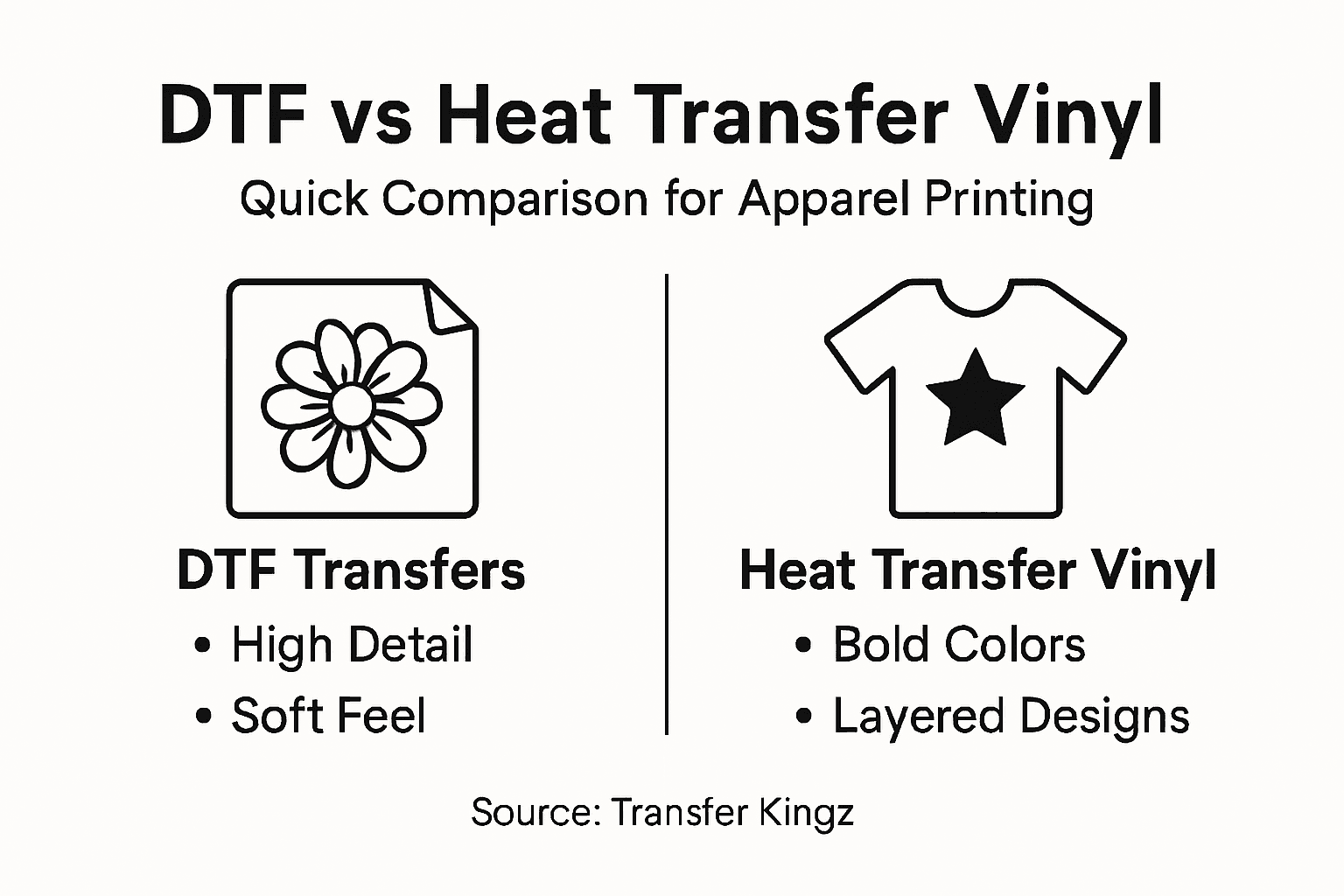
The tactile experience of the final garment differs significantly between DTF and vinyl transfers. DTF prints create a remarkably soft, almost integrated feel that mimics direct fabric printing. Vinyl transfers, while durable, tend to have a more pronounced texture and can feel slightly stiffer, especially on stretchable fabrics.
This overview highlights the main differences between DTF and HTV processes:
| Aspect | DTF | Heat Transfer Vinyl |
|---|---|---|
| Design Detail | Photo-quality, gradients | Bold shapes, limited detail |
| Fabric Range | All major types, including blends | Best on cotton, poly, blends |
| Production Time | Faster with multi-color designs | Slower with layering |
| Finished Feel | Soft, integrated with fabric | Slightly raised, textured |
Pro tip: For designs requiring photographic detail or soft feel, prioritize DTF; for bold, simple graphics with high contrast, heat transfer vinyl might be your best choice.
Cost Structure, Speed, and Production Efficiency
Custom apparel businesses must carefully evaluate the economic landscape of different printing technologies. DTF and Heat Transfer Vinyl present distinct cost structures that dramatically impact production strategies.
Initial investment requirements vary significantly between these methods:
-
DTF Setup Costs:
- Higher initial equipment investment
- Requires specialized printers
- Needs dedicated film and ink systems
- Includes powder application and curing equipment
-
Vinyl Setup Costs:
- Lower initial equipment expenses
- Basic vinyl cutters and heat presses
- Minimal technological infrastructure
- Less complex training requirements
Production efficiency becomes particularly nuanced when considering design complexity. Multi-color designs reveal stark differences in per-unit costs and time investments. DTF printing allows full-color designs to be produced in a single pass, dramatically reducing production time and material waste. Vinyl transfers, by contrast, require intricate manual layering for complex graphics, increasing labor costs and production duration.
Scalability represents another critical economic consideration. DTF technologies excel in bulk production scenarios, offering consistent per-unit costs regardless of design intricacy. Smaller production runs might favor vinyl methods due to lower initial setup expenses, but larger volumes quickly demonstrate DTF’s economic advantages.
Pro tip: Calculate your expected production volume and design complexity before investing in equipment, as the break-even point differs substantially between DTF and vinyl transfer technologies.
Which Method Suits Your Business Needs
Selecting the optimal printing method requires a strategic evaluation of your specific business requirements and operational constraints. HTV and DTF technologies offer distinct advantages for different business models.
Business characteristics that influence method selection include:
-
Startups and Small Operations:
- Lower initial investment budget
- Limited design complexity needs
- Smaller production volumes
- Focus on basic, single-color designs
-
Established Custom Apparel Businesses:
- Diverse design requirements
- Large-scale production capabilities
- Need for intricate, multi-color artwork
- Scalability and efficiency priorities
Heat Transfer Vinyl emerges as an ideal solution for entrepreneurs entering the custom apparel market. Its lower equipment costs, straightforward workflow, and minimal training requirements make it an attractive option for businesses testing market potential or operating with constrained resources.
Direct-to-Film (DTF) technology represents a more advanced approach, perfect for businesses seeking comprehensive design flexibility. DTF supports complex, photorealistic designs across multiple fabric types, enabling companies to offer premium, high-quality custom apparel solutions that differentiate them in competitive markets.
Here’s a quick comparison of which method suits different business types best:
| Business Size & Needs | Best Fit Method | Key Reason |
|---|---|---|
| Hobbyist or New Startup | HTV | Low cost, simple setup |
| Established Print Business | DTF | High volume, complex designs |
| Seasonal/Small Run Operator | HTV | Flexible, minimal investment |
| On-Demand/Bulk Producer | DTF | Scalable, efficient multicolor |
Pro tip: Consider your business’s growth trajectory and design complexity when choosing between HTV and DTF, as your initial investment should align with both current needs and future expansion plans.
Discover Your Perfect Printing Solution with Transfer Kingz
Choosing between DTF and Heat Transfer Vinyl can feel overwhelming with the variety of design complexities, fabric types, and production demands discussed in the article. If you are seeking vibrant, durable, and soft-feel prints that capture intricate details without compromising quality or speed, Transfer Kingz offers a proven solution tailored exactly for those needs. Our specialization in premium DTF transfers, custom apparel printing, heat transfers, t-shirt printing, high-quality prints empowers businesses and hobbyists to overcome challenges like costly setups, limited fabric compatibility, and intricate multi-color designs.
Take control of your custom apparel projects today by leveraging our advanced digital printing services. Upload your artwork, explore our convenient gang sheet builders, and enjoy quick turnaround times with no minimum orders. Visit our Home page to get started and explore our full Collection of options designed to scale with your business demands. The future of hassle-free, high-quality custom printing is just a click away at https://www.transferkingz.com/. Don’t wait—transform your apparel printing experience now.
Frequently Asked Questions
What is the difference between DTF and Heat Transfer Vinyl (HTV)?
DTF uses printed designs on a special film that can be applied to various fabrics, while HTV involves cutting colored vinyl sheets and heat pressing them onto the fabric, making HTV suitable for simpler designs.
Which method is more versatile for different fabric types, DTF or HTV?
DTF is more versatile as it works well on multiple fabrics, including cotton, polyester, and leather, making it suitable for various applications compared to HTV, which generally performs best on cotton and polyester blends.
How do DTF and HTV methods differ in terms of design complexity?
DTF supports intricate and photorealistic designs with smooth color gradients, while HTV is better suited for bold, solid colors and simpler geometric shapes, which may require manual layering for more complex designs.
Which printing method is more cost-effective for small businesses?
HTV typically has lower initial setup costs, making it more suitable for small businesses or hobbyists with limited budgets. However, for larger production runs, DTF can offer better cost efficiency due to its faster production capabilities.
Recommended
- DTF Supplies Thermal Tape: The Ultimate Guide – Transfer Kingz
- Role of Heat Presses in DTF: Achieving Vibrant Results – Transfer Kingz
- DTF Transfer Sheets Explained: Transforming Apparel Printing – Transfer Kingz
- What Is Film in DTF? The Key to Vibrant Custom Prints – Transfer Kingz
- DIY: Homemade Fabric Softener - Home Remedies
- Top 10 Best Plastics for Laser Cutting (2025) | A Guide for Pros & DIYers
0 comments